Hubbry Logo
Ray RobsonRay RobsonMain
Open search
Ray Robson
Community hub
Ray Robson
logo
8 pages, 0 posts
0 subscribers
Be the first to start a discussion here.
Ray Robson
Ray Robson
from Wikipedia

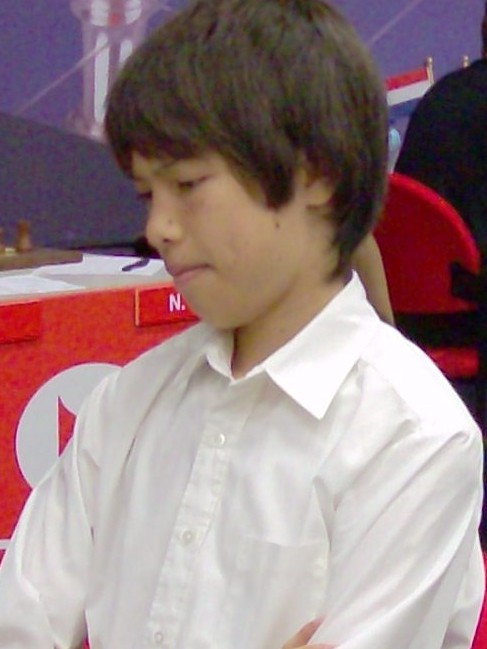
Ray Robson (born October 25, 1994) is an American chess grandmaster. He achieved the grandmaster title in 2010, at the time the youngest American player to be awarded the title by FIDE.[1]

Key Information

Early life

[edit]

Robson was born in Guam to American father Gary Robson, a professor at the college of education (applied linguistics) at St. Petersburg College, and Chinese mother Yee-chen, a kindergarten teacher at Country Day School.[2] They later moved to Largo, Florida and then Clearwater, Florida. As an only child, he learned chess from his father at age three.[3] He attended public school for kindergarten, then a public school for the gifted in first grade, then from grades 2-5 he was at a private Montessori school. He started homeschooling in grade 6.

Robson said as a child that he wanted to become a professional chess player, and his parents hoped for him to gain a chess scholarship to college.[3][4] In April 2005, at the Super Nationals (the world's largest scholastic chess tournament) in Nashville, Tennessee, he won every match he played and emerged as the national champion in the elementary age (K-6) division. By winning this title, he earned a four-year scholarship covering full tuition and fees, along with a housing stipend, to the University of Texas at Dallas. The scholarship has a cash value of about $48,000 to non-Texas residents. The only stipulation is that the winner must meet the university's entrance requirements at matriculation.[5] In 2009 Robson was the recipient of the Samford Fellowship.[6] In early 2012, Robson decided to attend Webster University instead of UT Dallas.[7]

In August 2012, Robson started his full-time study at Webster University in St. Louis under the SPICE Program,[8][9] founded by former Women's World Champion Susan Polgar.

Chess career

[edit]

Robson has won seven national scholastic titles, including regulation events and blitz events. In addition, he has represented the United States in international scholastic events since 2004. Robson finished in the top ten at each of the World Youth Chess Championships from 2004 to 2007, and he tied for first place in the U12 section of the Pan American Youth Chess Festival in 2005 and 2006, taking the silver medal on tiebreak on both occasions.[10][11]

Robson also plays in many of the major open tournaments in the United States. He finished in the top ten both at the 2006 National Chess Congress in Philadelphia and at the 2006 North American Open in Las Vegas.[12] Robson's performance at the former event qualified him for the 2007 U.S. Chess Championship, making him the youngest player in the history of the event.[citation needed]

In 2004, at the age of nine, Robson defeated his first National Master in tournament play.[citation needed] In 2005, he defeated his first international master (IM), and in 2006 he defeated his first grandmaster (GM).[citation needed] He studied with GM Gregory Kaidanov for almost two years[13] (2005–07), mainly via the phone and Internet. He has also studied with GM Alexander Onischuk.[14]

Robson was awarded the title of FIDE Master (FM) in June 2005 after tying for first place at the Pan American Youth Festival in Brazil. He earned the USCF title of National Master (NM) in January 2006 by raising his Elo rating above 2200. Robson earned the three norms required for the IM title in only six weeks: the first at the 6th North American FIDE Invitational on November 3, 2007, in Chicago, Illinois; the second on November 27 at the World Youth Championships in Antalya, Turkey, and the third and final norm on December 10 at the University of Texas at Dallas (UTD) GM Invitational in Dallas, Texas, making him the youngest IM-elect in the United States, beating the previous record-holder Hikaru Nakamura by one month.[13]

Robson tied for first place in the 2008 Florida championship.[15] On July 16, 2009, he won the U.S. Junior Chess Championship.[16] In August 2009, Robson tied for first at the Arctic Chess Challenge in Tromsø, Norway, garnering his first GM norm in the process.[17] Later that same month, Robson then went on to earn his second GM norm by winning the 23rd North American FIDE Invitational in Skokie, Illinois.[18] He earned his third and final GM norm in October 2009 by winning the Pan American Junior Chess Championship in Montevideo, Uruguay.[19] He was formally awarded the title by FIDE in January 2010.[20]

Robson played in his first FIDE World Cup in November 2009 in Russia. He competed again in this event two years later and was eliminated in the first round by Étienne Bacrot.[21] Robson won the 2012 Webster University - SPICE Cup Open in St. Louis with an undefeated score of 7-2 .[22] In 2014, he finished second in Millionaire Chess in Las Vegas, losing to Wesley So in the final round. In April 2015, Robson finished second in the 2015 U.S. Championship, held for the seventh consecutive year at the Chess Club and Scholastic Center of Saint Louis. He won five games, drew five, and lost one, scoring 7½/11 points.

Robson is a five-time Chess.com Puzzle Battle World Champion, holding the title from 2020 to 2024.[23] He won the 2023 tournament while only losing a single individual battle.[24] He crossed FIDE classical rating of 2700 in November 2022.[25]

References

[edit]
[edit]
Revisions and contributorsEdit on WikipediaRead on Wikipedia
from Grokipedia
Ray Robson (born October 25, 1994) is an American chess grandmaster who achieved the title at age 15 in 2010, becoming the youngest player from the to do so at the time—a record later surpassed. Born in and raised in , Robson learned the game at age three from his father, Gary, and quickly rose through the ranks, earning the Master title in 2005 after tying for first in the U.S. National K-6 Championship. By 2008, he had become an International Master at age 13, the youngest American to hold that distinction, and in 2009, he won both the U.S. Junior Closed Championship and the Pan-American Junior Championship, securing his final grandmaster norm. Robson has been a prominent figure in American chess, representing the in major international competitions, including the —where he was the youngest American participant—and the , contributing to the team's in the 2010 World Team Championship and in the 2016 . His over-the-board successes include second-place finishes in the 2014 Millionaire Chess Open and the 2015 U.S. Championship, where he notably defeated then-top-rated American , as well as victories in the 2019 Saint Louis Fall Classic and the 2023 International Chess Festival . Renowned for his sharp tactical style, Robson reached a peak FIDE rating of 2704 in April 2023 and maintains a FIDE rating of 2657 as of November 2025, placing him among the top 10 grandmasters in the U.S. and top 100 worldwide. Additionally, he has dominated online puzzle-solving events, winning the Puzzle Battle five consecutive times from 2020 to 2024. While studying at , Robson helped the team secure multiple national collegiate championships starting in 2012.

Early life and education

Childhood and family background

Ray Robson was born on October 25, 1994, in , to parents Gary Robson, a of at , and Yee-chen Robson, a kindergarten teacher. As an in this academic household, Robson grew up in an environment that emphasized education and intellectual pursuits from an early age. The family relocated from to when Robson was young, first settling in Largo and later moving to Clearwater, where they continued to foster a supportive setting for his development. This transition placed the family in a community that aligned with their professional and educational values, with both parents actively involved in teaching roles. Beginning in , Robson was homeschooled, a decision by his family to provide flexibility for his training and schedule within their nurturing academic framework. This approach reflected the Robsons' commitment to tailored education, allowing him to balance personal growth with familial expectations.

Introduction to chess and early development

Ray Robson was introduced to chess by his father, Gary, at the age of three, when Gary purchased an inexpensive checkers-chess set from a in , seeking an activity to bond with his young son. The two played hundreds of games over Ray's first year with the game, building his foundational understanding through repeated practice against his father, who was himself a casual player. Raised in , Robson quickly developed self-study habits, analyzing positions independently for hours each day and directing much of his own learning as his skills advanced. His family's support, including attendance at public school for and first grade (in a program for gifted students) followed by a private Montessori school from grades 2 through 5, allowed him to dedicate substantial time to chess amid his early education. This environment in fostered disciplined routines, such as reviewing games and puzzles solo, which became central to his growth. Robson entered his first local at age six during , facing initial losses that spurred greater determination. By ages eight and nine, he competed in more significant youth events, including scholastic across like the Clermont Tornado, where his play began to show marked improvement. His USCF rating progressed rapidly from around 1,600 at age eight to the level above 2,000 by age ten, reflecting his burgeoning talent through consistent local participation.

Academic pursuits

To accommodate his burgeoning chess career, Ray Robson transitioned to homeschooling starting in the sixth grade and continued through high school, providing the flexibility needed to balance rigorous training with academic responsibilities. His homeschooling curriculum included studying Mandarin Chinese with his mother and engaging in discussions on literature with his father, a college professor. At age 10, Robson won the 2005 U.S. Super Nationals K-6 Elementary Championship, securing a four-year full-tuition scholarship to the valued at approximately $48,000 for non-residents, along with housing support; however, he ultimately declined the offer to pursue other opportunities. In 2012, Robson enrolled full-time at in under the Institute for Chess Excellence () program, which integrated academic study with competitive chess participation. There, he majored in international studies while actively competing, including winning the 2012 SPICE Cup Open shortly after arriving and helping the university's chess team secure multiple national titles. By 2016, as a junior, he continued balancing coursework with high-level tournaments and even joined the university's team. Robson graduated from with a degree in international studies.

Chess career

Junior achievements and rise to prominence

Ray Robson emerged as one of the most promising young chess talents in the United States during his early teens, marked by a series of impressive victories and consistent high placements in international youth events. At age nine in 2004, he achieved a significant milestone by defeating his first National Master in tournament play, showcasing his rapid development from local competitions. The following year, in 2005, Robson defeated his first International Master, further solidifying his reputation as a prodigy. By 2006, at age 12, he scored a notable upset win against a Grandmaster during an invitational tournament in . Domestically, Robson dominated scholastic chess, securing seven national titles between 2005 and 2009, including the U.S. National K-6 Championship in 2005 and victories in the SuperNationals K-12 events. These successes highlighted his tactical acumen and competitive edge in age-restricted formats, often competing against significantly more experienced opponents. On the international stage, Robson consistently performed at an elite level in the World Youth Chess Championships. In 2004, he finished 10th in the under-10 boys' category in , , marking the best U.S. result in that section. He placed 5th in the under-12 boys' division in 2005 in , , with 8/11 points. In 2006, competing in the same category in , Georgia, he scored 7.5/11 to tie for 8th place. His strong showing continued in 2007, where he earned 8 points in the under-14 boys' event in , , placing within the top 10 and contributing to the U.S. team's overall medal contention. These results, spanning under-10 to under-14 categories, established Robson as a standout American junior on the global stage by age 13.

Path to grandmaster title

At the age of 13, Ray Robson achieved three International Master norms in late 2007, earning the title in 2008. His first norm came on November 3 at the 6th North American Invitational in , where he performed strongly against a field of titled players. Twenty-four days later, he secured his second norm at the World Youth Under-14 Championship in , . The third norm followed shortly thereafter, completing the requirements in just six weeks and marking him as one of the youngest players to attain International Master status. Building on his junior successes, Robson pursued Grandmaster norms in 2009 at age 14. His first came in August at the Arctic Chess Challenge in Tromsø, Norway, where he tied for first with 7.5/9, exceeding the required performance level against an international field. Later that month, he claimed his second norm by winning the 23rd North American Masters in Chicago with an undefeated 7/9 score. These rapid achievements, combined with his rising FIDE rating above 2500, positioned him for the final step. Robson secured his third and final Grandmaster norm in October 2009 at the Pan-American Junior Championship in , , winning with 7.5/8, including a perfect score in his first seven games. officially awarded him the Grandmaster title in January 2010, when he was 15 years and 2 months old, making him the youngest American to achieve it at the time—fulfilling the requirements at 14 years, 11 months, and 16 days—until the record was surpassed in 2014.

Key tournament wins and national successes

In 2009, at the age of 14, Ray Robson achieved a pivotal transition from junior to senior chess by winning the U.S. Junior Championship in , , scoring 6/7 and becoming the youngest winner in the event's history. Later that year, he dominated the Pan American Junior Championship in , , with 7.5/8, including wins in his first seven games, securing the title and his final grandmaster norm in the process. These victories marked Robson's emergence as a prodigy ready for elite competition, propelling him into international opens. Robson's breakthrough in senior open tournaments came in 2012 when, as a 17-year-old freshman at , he won the Webster SPICE Cup in Saint Louis, Missouri, with an undefeated 7.5/9 score against a strong field including grandmasters. Two years later, he earned second place in the inaugural Millionaire Chess Open in Las Vegas, Nevada, finishing with 6/7 in the Swiss phase and reaching the finals, where he lost to but claimed $50,000 in prize money for his runner-up performance. Throughout the and into the , Robson consistently secured top finishes in major open and invitational events, demonstrating sustained excellence. Notable results include third places at the World Open in 2011 (6.5/9), 2012 (6.5/9), and 2019 (7/9), where he competed against large fields of international players. He also won the 2018 Chinggis City Invitational in with 7/9 and the 2019 Saint Louis Fall Classic (Group A) outright by two points (7/9). In 2023, Robson captured first place at the International Chess Festival Masters, tying for the lead at 5.5/9 before winning a playoff against Bogdan-Daniel Deac. These achievements highlight his competitive edge in diverse formats up to age 28.

Performances in the U.S. Chess Championship

Ray Robson debuted in the U.S. Chess Championship in 2011 at age 16, competing in Group A of the event's double round-robin format before . He scored 4/7, securing third place in his group with wins over Alexander Ivanov and Alexander Stripunsky, as well as draws against top seed , but did not advance to the semifinals, resulting in a mid-pack overall finish among the 24 participants. In subsequent years, Robson established himself as a consistent top-10 contender. He placed seventh in 2012 with 5.5/11, eighth in 2013 with 5/11 (including a three-game winning streak), and sixth in 2014 with 5.5/11. His breakthrough came in 2015, where he finished a clear second with 7.5/11, half a point behind winner ; notable performances included a victory over in round 9 and draws against Caruana and Kamsky, though no tiebreaks were needed for his position. Robson maintained strong showings thereafter, tying for fourth in with 7/11 after starting with two wins, and continued multiple appearances through the decade, often qualifying via high placements or ties for first in events like the U.S. Open or National Conference. Robson's recent performances reflect sustained competitiveness against elite American players. In 2024, he tied for second through seventh with 6.5/11, featuring key games such as a draw against . The 2025 edition saw him finish ninth with 4.5/11, including draws against , , and Sam Shankland, but losses to and ; no tiebreakers were required for his final standing. Throughout his championship career, Robson has frequently challenged top seeds, amassing wins and draws against figures like Nakamura, So, and that underscore his tactical sharpness in critical encounters.

International team representations

Ray Robson made his international team debut for the at the 2010 in , , where he competed as the youngest member of the squad at age 15, shortly after earning his international master title. Robson has been a key contributor to multiple U.S. teams, playing primarily on boards 3 and 4. In the 42nd held in , in 2016, he helped secure the U.S. team's first since 1976, with the squad tying on points but prevailing on tiebreakers after 11 rounds. The team lineup featured top grandmasters including , , and , with Robson's solid play on the lower boards supporting the overall victory. At the in , Georgia in 2018, Robson returned on board 5 as part of the same core lineup, contributing to a finish behind . The U.S. team scored 19 match points, demonstrating depth and resilience in a highly competitive field. Due to the , the was held online in 2020, where Robson participated on board 3 for the U.S. team, which earned bronze after reaching the semifinals and losing to . Robson continued his Olympiad appearances at the 45th edition in Budapest, Hungary in 2024, serving as a reserve but playing in several rounds on board 4, aiding the U.S. team's silver medal performance behind India. His consistent contributions across these events highlight his reliability in high-stakes team formats, often achieving win rates above 50% on his assigned boards while facing strong opposition.

Online and puzzle-solving accomplishments

Ray Robson has established himself as a dominant force in puzzle competitions, particularly through his unparalleled success in the Chess.com Puzzle Battle World Championship. He secured the title five consecutive times from to 2024, earning the nickname "G.O.A.T. of Puzzle Battle" for his tactical acuity and consistency in high-pressure formats. In the 2025 edition, he reached the final but was defeated by 14-year-old . In the event, Robson clinched victory in a thrilling final, defeating an unexpected opponent after navigating intense knockout battles. He repeated the feat in , capturing the $8,000 first prize with superior puzzle-solving speed and accuracy. The 2022 championship saw him dominate once more, maintaining his streak against a field of top tacticians. His 2023 triumph was particularly notable, as Robson won the tournament while suffering only a single loss in the fifth round of the Grand Final against Dimitrios Ladopoulos, ultimately prevailing in the Winners Final 5-0 and securing the overall title with exceptional precision, including a 137-puzzle streak. In 2024, he extended his reign to five titles, defeating strong challengers like in the final stages and reinforcing his status as the event's most decorated champion. These victories highlight Robson's exceptional and rapid decision-making in puzzle formats, which demand solving complex tactical positions under time constraints. Beyond puzzles, Robson has actively competed in major online rapid and blitz events, including the Champions Chess Tour organized by , where he participated in multiple divisions and qualified through the 2025 play-ins. His online performances have contributed to significant rating milestones; he first crossed the 2700 classical rating threshold in November 2022 following strong results, peaking at 2704 in April 2023. As of November 2025, his rating stands at 2657, placing him at world number 58.

Playing style and legacy

Strategic approach and notable games

Ray Robson exhibits an aggressive, tactical playing style, characterized by a preference for sharp, dynamic positions that lead to complex middlegame battles where his calculation prowess shines. This approach suits his strengths in navigating complications, often emerging victorious in unbalanced structures that reward precise tactics over positional maneuvering. As White, Robson typically opens with 1.e4, favoring the , including lines such as the Berlin Defense faced from Black, to steer games into open, fighting positions. Against 1.e4 as Black, he employs the Sicilian Defense, particularly the Najdorf Variation, to challenge White aggressively and provoke tactical skirmishes early. One of Robson's early breakthroughs came in at age 11, when he secured his first victory over a grandmaster, demonstrating his precocious tactical acumen in a sharp encounter. A standout junior game occurred in 2011 during the Saint Louis match, where Robson outmaneuvered IM Benjamin Finegold in a middlegame rife with tactical motifs, converting a slight advantage into a decisive win through accurate piece play. In the 2014 Millionaire Chess knockout, Robson notched a key victory over GM , navigating a Najdorf Sicilian to refute White's aggressive setup and secure the full point in a tactical melee. Post-2020, Robson's style has evolved with deeper integration of computer-assisted preparation, enhancing his opening depth while maintaining his tactical edge, as evidenced by his dominance in puzzle-solving formats. This shift is reflected in his improved handling of engine-like precision in complex positions, contributing to consistent results across formats. In classical chess, Robson achieves a total score of approximately 56%, with wins in 35% of games amid high draw rates typical of elite play. His win rate rises in rapid events, where his aggressive tendencies yield more decisive outcomes, such as his 2023 Saint Louis Rapid victory with 11/18 points, underscoring a stylistic affinity for faster time controls.

Contributions to American chess

Ray Robson has established himself as one of the top 10 grandmasters in the , consistently competing at the highest levels and contributing to the nation's competitive depth in chess. His role on the U.S. team at the 2016 , where he shared board four duties and assisted coach Alex Lenderman in preparing teammates, was instrumental in securing the gold medal—the first for the since 1976. This victory highlighted the strength of American chess and development, with Robson's team-oriented efforts exemplifying the collaborative spirit that propelled the squad past traditional powerhouses like . Beyond international representation, Robson's achievements as the youngest American grandmaster at age 14 have served as a benchmark for aspiring players, fostering a new era of high-caliber U.S. talent. His path from prodigy to elite competitor, including multiple podium finishes in the U.S. Championship since 2015, has inspired the emergence of subsequent young grandmasters by demonstrating the potential for early success within the American system. As a resident grandmaster at the Saint Louis Chess Club since relocating there for collegiate play, Robson actively participates in the organization's training initiatives, which include scholastic programs and advanced workshops aimed at nurturing talent across all levels. This involvement post-2015 has bolstered the club's role as a premier center for American chess education, providing direct access to elite instruction and competitive opportunities that enhance youth development nationwide.

Personal life

Residence and professional affiliations

Ray Robson resides in the , area, having moved there as part of the influx of top American chess players attracted by the city's growing chess infrastructure. As a professional grandmaster, Robson is closely affiliated with the , where he regularly competes in major tournaments hosted by the organization, including multiple editions of the U.S. Chess Championship. He has also represented U.S. teams in FIDE-sanctioned international events, such as the Chess Olympiads and World Team Championships, under the auspices of the (USCF). Robson maintains strong ties to , having won the platform's Puzzle Battle World Championship five consecutive times from 2020 to 2024, establishing him as a prominent figure in their online chess ecosystem. His professional engagements are further supported by his past association with in , where he studied and competed on the chess team.

Interests outside chess

Ray Robson maintains a high degree of privacy regarding his personal interests and life outside of chess, with few public details available about his hobbies or non-competitive activities. As the only child of academic parents—his father, Gary Robson, a professor of at , and his mother, Yee-chen Robson, a Chinese —he grew up in an intellectually focused household that emphasized education alongside his early chess development. To balance his burgeoning chess career, Robson was homeschooled from through high school in , allowing flexibility for travel and training while ensuring academic progress. In 2012, he enrolled at in , , as part of the Institute for Chess Excellence () program, where he pursued higher education as a full-time student, majoring in international studies and reaching senior status by 2018. Robson has not publicly elaborated on whether he completed his degree or on specific plans following his time at , or on family updates in recent years.

References

Add your contribution
Related Hubs
User Avatar
No comments yet.