Hubbry Logo
Kenneth RogoffKenneth RogoffMain
Open search
Kenneth Rogoff
Community hub
Kenneth Rogoff
logo
8 pages, 0 posts
0 subscribers
Be the first to start a discussion here.
Kenneth Rogoff
Kenneth Rogoff
from Wikipedia

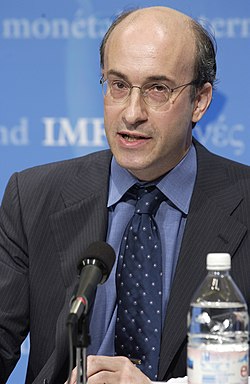
Kenneth Saul Rogoff (born March 22, 1953) is an American economist and chess Grandmaster.

Key Information

He is the Maurits C. Boas Chair of International Economics at Harvard University.[4] During the Great Recession, Rogoff was an influential proponent of austerity.[5][6]

Early life and education

[edit]

Rogoff grew up in a Jewish family in Rochester, New York. His father was a professor of radiology at the University of Rochester.

Rogoff received a B.A. and M.A. from Yale University summa cum laude in 1975,[7] and a PhD in Economics from the Massachusetts Institute of Technology in 1980.[7] His doctoral dissertation was titled Essays on expectations and exchange-rate volatility (1980).[8]

Chess

[edit]

At sixteen Rogoff dropped out of high school to concentrate on chess. At that time he met Bobby Fischer, who was impressed by Rogoff's "self-assured style and his knowing exactly what he wanted over the chessboard".[9] He won the United States Junior Championship in 1969 and spent the next several years living primarily in Europe and playing in tournaments there. However, at eighteen he made the decision to go to college and pursue a career in economics rather than to become a professional player, although he continued to play and improve for several years afterward. Rogoff was awarded the IM title in 1974, and the GM title in 1978. He was 3rd in the World Junior Championship of 1971 and finished 2nd in the US Championship of 1975, which doubled as a Zonal competition, a half point behind Walter Browne; this result qualified him for the 1976 Interzonal at Biel where he finished 13–15th. In other tournaments, he tied for first at Norristown in 1973 and at Orense in 1976.[10] He has also drawn individual games against former world champions Mikhail Tal[11] and Tigran V. Petrosian.[12] In 2012 he drew a blitz game with the world's highest rated player Magnus Carlsen.[13]

Career

[edit]

Early in his career, Rogoff served as an economist at the International Monetary Fund (IMF), and at the Board of Governors of the Federal Reserve System.

Rogoff was the Charles and Marie Robertson Professor of International Affairs at Princeton University.[14] In 1998 he joined the faculty at Harvard University,[15] and later was appointed as the Thomas D. Cabot Professor of Public Policy and Professor of Economics at Harvard.[16] He also served as Chief Economist of the International Monetary Fund from 2001–2003.[17][18][19] He currently is the Maurits C. Boas Chair of International Economics at Harvard.[4]

In 2002, Rogoff was in the spotlight because of a dispute with Joseph Stiglitz, former chief economist of the World Bank and 2001 Nobel Prize winner. After Stiglitz criticized the IMF in his book, Globalization and Its Discontents, Rogoff replied in an open letter.[20] He is also a regular contributor to the non-profit media organization Project Syndicate since 2002.

2008 financial crisis

[edit]

Fellow economist Alan Blinder credits both Rogoff and Carmen Reinhart with describing highly relevant aspects of the 2008 financial crisis and Great Recession.[21]

In a normal recession such as 1991 or 2000, the Keynesian tools of tax cuts and infrastructure spending (fiscal stimulus), as well as lowered interest rates (monetary stimulus), will usually right the economic ship in a matter of months and lead to recovery and economic expansion. Even the serious recession of 1982, which Blinder states "was called the Great Recession in its day," fits comfortably within this category of a normal recession which will respond to the standard tools.[21]

By contrast, the 2008 near-meltdown destroyed parts of the financial system and left other parts reeling and in serious need of de-leveraging. Large amounts of governmental debt, household debt, corporate debt, and financial institution debt were left in its wake. This debt made the normal tools of tax cuts and increased infrastructure spending somewhat less available and/or politically difficult to achieve. Fiscal policy at times even ended up becoming pro-cyclical, as it did in some European countries under austerity policies. In the United States, economist Paul Krugman argued that even the combination of the October 2008 bailout and the February 2009 bailout was not big enough, although Blinder states that they were large compared to previous bailouts. Since interest rates were already near zero, the standard monetary tool of lowering rates was not going to provide much help.[21]

Recovery from what Blinder terms a Reinhart-Rogoff recession may require debt forgiveness, either directly, or implicitly through encouraging somewhat higher than normal rates of inflation, as Blinder described not being "your father's recovery policies".[21]

During the 2010 United Kingdom general election, Rogoff contributed to an open letter to The Sunday Times endorsing the Conservative Party and Shadow Chancellor of the Exchequer George Osborne's demands for greater austerity during the European debt crisis.[5]

Criticism and controversy

[edit]

In April 2013, Rogoff was at the center of worldwide attention with Carmen Reinhart (coauthor of the book This Time is Different) when their widely cited study "Growth in a Time of Debt" was shown to contain computation errors which critics claim undermine its central thesis that too much debt causes low growth.[6][22] An analysis by Thomas Herndon, Michael Ash and Robert Pollin argued that "coding errors, selective exclusion of available data, and unconventional weighting of summary statistics led to serious errors that inaccurately represent the relationship between public debt and GDP growth among 20 advanced economies in the post-war period."[23][24] Their calculations demonstrated that some high-debt countries grew at 2.2 percent rather than the −0.1 percent figure initially cited by Reinhart and Rogoff.[23] Rogoff and Reinhart claimed that their fundamental conclusions were accurate after correcting the coding errors detected by their critics.[25][26] They disavowed their claim that a 90% government debt-to-GDP ratio is a specific tipping point for growth outcomes.[27] The subject remains controversial, because of the political ramifications of the research, though in Rogoff and Reinhart's words "[t]he politically charged discussion ... has falsely equated our finding of a negative association between debt and growth with an unambiguous call for austerity."[27]

Memberships

[edit]

Publications

[edit]

His book This Time Is Different: Eight Centuries of Financial Folly, which he co-authored with Carmen Reinhart, was released in October 2009.[29]

In The Curse of Cash, published in 2016, he urged that the United States phase out the 100-dollar bill, then the 50-dollar bill, then the 20-dollar bill, leaving only smaller denominations in circulation.[30]

His 2025 book Our Dollar, Your Problem explores the global rise of the U.S. dollar and shows why its future stability is far from assured.[31]

Personal life

[edit]

Rogoff has been married to the TV and film producer Natasha Lance since 1995.[1][32] They have two children.[33]

See also

[edit]

References

[edit]
[edit]
Revisions and contributorsEdit on WikipediaRead on Wikipedia
from Grokipedia
Kenneth Saul Rogoff (born March 22, 1953) is an American economist specializing in international macroeconomics, sovereign debt, and financial crises, serving as the Maurits C. Boas Professor of Economics at and former Chief Economist of the from 2001 to 2003. An International Grandmaster of chess since 1978, Rogoff achieved early prominence by winning the U.S. Under-21 Championship at age 16 and representing the in world team championships. Rogoff's research, including foundational work on determination and optimal currency areas, has earned him election to the and American Academy of Arts and Sciences, with rankings among the most cited economists globally. He co-authored the widely referenced 2009 book This Time Is Different: Eight Centuries of Financial Folly with , which compiles historical data on debt defaults, banking panics, and inflation episodes to demonstrate recurring patterns in financial distress despite claims of uniqueness in modern crises. In a notable controversy, a 2010 paper by Rogoff and Reinhart on high public debt thresholds impeding growth faced scrutiny in 2013 after graduate student Thomas Herndon identified computational errors—including a formula mistake, selective data exclusion, and improper weighting—that exaggerated the negative growth effects beyond 90 percent debt-to-GDP ratios; while Rogoff and Reinhart acknowledged the technical issues and defended the qualitative insights on debt overhangs, the episode highlighted challenges in empirical fiscal research and influenced debates on policies. Rogoff has continued contributing to policy discussions through books like The Curse of Cash (2016) on currency's role in illicit finance and Our Dollar, Your Problem (2025) examining the U.S. dollar's global dominance.

Early Life and Education

Family Background and Upbringing

Kenneth Rogoff was born on March 22, 1953. He grew up in , near Buffalo and , in a household shaped by his parents' professional commitments to academia and public service. His father, Stanley M. Rogoff, was a professor of radiology at the , chairman of the radiology department at , and president of the Association of University Radiologists. His mother began her career as a librarian in the Monroe County Library System before advancing to head the Rochester public library system. Rogoff had an older brother, Hal, who inherited their mother's broad intellectual curiosity, while Rogoff pursued active childhood interests in team sports, regularly playing , , and football with neighborhood friends. The family's liberal values influenced their decision to enroll Rogoff in East High School, an inner-city public school in Rochester, prioritizing what they viewed as an authentic American urban educational environment over suburban alternatives. This upbringing occurred in a stable, intellectually oriented home that valued professional achievement and community engagement, though Rogoff later diverged from traditional paths by prioritizing chess pursuits in his mid-teens.

Academic Training and Influences

Rogoff received his B.A. and M.A. in from in May 1975, graduating summa cum laude with honors in the major. His undergraduate training emphasized economic theory and quantitative methods, laying the groundwork for his subsequent focus on international . He completed his Ph.D. in at the Massachusetts Institute of Technology (MIT) in February 1980, with a dissertation titled Essays on Expectations and Volatility. The work examined the role of expectations in driving fluctuations, drawing on models prevalent in during the late 1970s. Rogoff's doctoral committee at MIT was chaired by , a leading figure in open-economy known for his overshooting model of exchange rates, with additional members , an expert in and stabilization, and Jerry Hausman, specializing in and . , a prominent , also exerted significant influence on Rogoff during his MIT years, encouraging rigorous analysis of international . These mentors, all associated with MIT's strong tradition in dynamic general equilibrium modeling, oriented Rogoff toward empirical and theoretical inquiries into global financial dynamics rather than purely domestic or .

Chess Accomplishments

Competitive Achievements and Grandmaster Status

Rogoff achieved early competitive success in chess, earning the U.S. Master title at age 14 and the Senior Master title (the highest national title at the time) shortly thereafter. He won the U.S. Under-21 Championship at age 16 in 1969, marking him as one of the country's top young talents. Rogoff participated in three U.S. Championships, finishing 5th, 2nd (in 1975, half a point behind the winner in a field of grandmasters), and 7th, respectively, which contributed to his international recognition. On the international stage, Rogoff represented the as the youngest player at the World Student Team Championship in in 1969, tying for 13th-15th individually. At age 17, he played first board for the U.S. team that won the Chess World Student Olympiad in , , in 1970. He competed in the World Under-27 Championship in Mayaguez, , where he faced future world champion , and tied for 13th-15th at the 1976 World Championship Interzonal Tournament. These results, along with consistent performances in approximately 300 tournament games between 1967 and 1978, positioned him among the top 40 players worldwide. The International Chess Federation (FIDE) awarded Rogoff the International Master title in 1974 based on his tournament norms and results. He attained the Grandmaster title, the highest in chess (held by roughly 100 players globally at the time), in 1978 after fulfilling FIDE's requirements of three grandmaster norms and a sufficient rating. Following this peak, Rogoff largely ceased competitive play to pursue economics, though he has occasionally participated in events since, including a 2012 game against .

Strategic Insights and Parallels to Economic Analysis

Rogoff has frequently highlighted how his experience as an international chess grandmaster informed his approach to economic analysis, emphasizing skills in probabilistic evaluation, opponent anticipation, and multi-step foresight that mirror challenges in macroeconomic outcomes and formulation. In chess, players must assess positions under , weighing potential risks and rewards across branching scenarios, a process Rogoff parallels to economic modeling where agents operate with incomplete information and interdependent decisions. This strategic discipline, honed through competitive play against top opponents like those in the 1970s World Junior Championship, equipped him to navigate complex systems like , where miscalculating tail risks can amplify crises. A core insight Rogoff derives from chess is , where recurring board configurations guide intuitive yet rigorous decision-making, analogous to identifying economic cycles or disequilibria from historical data. For instance, just as grandmasters exploit familiar motifs to counter threats, economists apply empirical patterns—such as debt overhangs preceding defaults—to predict vulnerabilities, a method Rogoff employed in his research on sovereign debt dynamics. He has noted that chess instilled an early appreciation for technological disruption, observing computer programs' rise in the 1970s and 1990s (e.g., Deep Blue's 1997 victory over ), which paralleled his foresight on artificial intelligence's role in driving global growth beyond traditional factors like emerging markets. Long-term strategic planning represents another parallel, as chess demands evaluating moves' implications over dozens of turns, akin to central banks' on rates or fiscal policies with lagged effects spanning years. Rogoff credits chess with teaching deliberate pausing before action to re-evaluate positions, a he applies to avoid hasty policy prescriptions amid economic volatility, such as during his tenure as IMF from 2001 to 2003. Additionally, modeling opponents' perspectives in chess fosters game-theoretic thinking, which Rogoff extends to , where nations' strategies interlock like adversarial play, requiring anticipation of countermeasures in trade or currency negotiations. Rogoff also draws lessons in and error recognition from chess's unforgiving nature, where even grandmasters overlook tactics, underscoring the fallibility inherent in economic forecasts that often fail to account for human misjudgment. This awareness tempers overconfidence in models, promoting robust analysis over deterministic predictions, as seen in his advocacy for in frameworks. Overall, these chess-derived principles underscore Rogoff's emphasis on causal mechanisms and empirical validation in , viewing both domains as arenas for disciplined, forward-looking reasoning amid inherent uncertainties.

Professional Trajectory

Academic Positions and Research Focus

Rogoff commenced his academic career as an associate professor of economics at the University of Wisconsin-Madison, serving from 1985 to 1988. He advanced to full professor at the , holding the position from 1989 to 1991. Subsequently, he joined as professor of economics and international affairs in 1992, becoming the Charles and Marie Robertson Professor of in 1995, a role he maintained until 1999. In 1999, Rogoff was appointed professor of at , where he remains affiliated. He holds the Maurits C. Boas Chair in and has served as Thomas D. Cabot Professor of Public Policy since January 2004. Rogoff's research centers on international , with emphases on financial crises, exchange rates, sovereign , independence, and . He co-authored Foundations of International Macroeconomics (1996) with Maurice Obstfeld, establishing a foundational graduate-level treatment of open-economy models incorporating and forward-looking behavior. His collaborative work with , including This Time Is Different: Eight Centuries of Financial Folly (2009), analyzes historical patterns in defaults and banking crises across 66 countries over 800 years, highlighting recurring quantitative regularities in dynamics. Additional foci include global imbalances, currency evolution (encompassing cashless societies and cryptocurrencies), and the dimensions of .

Policy and Advisory Roles

Rogoff served as Economic Counsellor and Director of the Research Department at the (IMF) from August 2001 to September 2003, where he advised on global , including responses to financial crises and monetary frameworks. In this capacity, he influenced IMF research agendas and policy recommendations during a period marked by post-dot-com recovery and vulnerabilities, emphasizing data-driven analysis of . Following his IMF tenure, Rogoff has advised central banks on and issues. He served as an adviser to the Bank of New York and the Central Bank of Sweden (), providing expertise on exchange rates, , and . As of 2025, he continues to participate on the Economic Advisory Panel of the New York Federal Reserve, contributing to deliberations on U.S. dollar dynamics and macroeconomic risks. Rogoff is also a member of the , engaging in discussions on international economic policy and geopolitical influences on trade and finance. His advisory work underscores a consistent focus on sovereign debt sustainability and independence, often advocating for conservative fiscal stances amid global uncertainties.

Key Contributions to Economics

Foundations in International Finance and Exchange Rates

Rogoff's foundational work in international finance includes co-authoring the influential textbook Foundations of International Macroeconomics with Maurice Obstfeld, published in 1996 by MIT Press, which provides an integrative treatment of open-economy macroeconomics and finance, emphasizing microfoundations for exchange rate determination and capital flows. The book synthesizes models of intertemporal trade, asset markets, and monetary policy under flexible and fixed exchange rates, highlighting how nominal rigidities and risk premia drive exchange rate volatility beyond traditional Mundell-Fleming frameworks. In theoretical contributions, Rogoff and Obstfeld developed the "exchange rate dynamics redux" model in 1995, extending Dornbusch's overshooting hypothesis by incorporating optimizing agents and sticky prices in a framework, demonstrating how anticipated future affects immediate jumps. Their 1998 NBER paper "Risk and Exchange Rates" further argued that persistent risk premia, driven by level differences in consumption growth across countries, explain long-run deviations from (PPP), potentially accounting for observed biases in forward rates. These models underscore causal links between domestic monetary shocks, global , and currency movements, challenging earlier views that dismissed risk premia as negligible. Empirically, Rogoff identified key puzzles in behavior, notably in his contribution to NBER Macroeconomics Annual 2000, where he outlined six major anomalies in international macroeconomics, including the "exchange rate disconnect" wherein rates exhibit excessive short-term volatility relative to fundamentals while showing slow mean reversion to PPP. He quantified PPP deviations as having a of three to five years, far longer than implied by efficient markets, attributing this to persistent real shocks and barriers to rather than mere noise trading. Rogoff also analyzed G-3 (dollar, euro, yen) fickleness, linking high volatility to incomplete asset market integration and policy uncertainty, as detailed in his 2002 IMF Finance & Development article. On regimes, Rogoff collaborated with to classify historical arrangements in their 2004 framework, introducing categories like "freely falling" currencies for hyper-depreciations exceeding 40% annually, revealing that pegs often mask dual rates or controls, with implications for predictability. This work, updated in later studies, supports Rogoff's advocacy for flexible rates paired with to mitigate sudden stops, drawing from that rigid regimes amplify shocks in open economies. His research consistently prioritizes empirical patterns over ideological fixes, cautioning against over-reliance on fixed pegs amid global capital mobility.

Analysis of Sovereign Debt and Financial Crises

Rogoff's analysis of sovereign debt emphasizes historical patterns of default and the recurring of believing contemporary conditions exempt economies from past lessons. In collaboration with , he compiled an extensive dataset spanning eight centuries and over 66 countries, revealing that sovereign defaults cluster in waves, often triggered by excessive borrowing during booms followed by inability to service debts amid downturns. This work challenges optimistic narratives by demonstrating that domestic public debt crises, frequently overlooked, have been as prevalent as external ones, with post-default resolutions involving inflation, restructuring, or averaging 40-50% haircuts to creditors. A core insight links financial sector crashes to sovereign debt vulnerabilities, positing that banking crises precipitate public debt surges as governments absorb private losses through bailouts and guarantees. Empirical evidence from 1800 onward shows post-crisis public debt-to-GDP ratios rising by an average of 86 percentage points within three years, with advanced economies experiencing even sharper increases due to larger financial sectors relative to GDP. Rogoff argues this dynamic creates a "doom loop" where risk feeds back into banking instability, as seen in cases like and during the 2008-2012 period, where private conversion to public liabilities overwhelmed fiscal capacity. He quantifies that such episodes double the likelihood of compared to non-crisis periods, underscoring the causal chain from private overleveraging to public . On debt sustainability, Rogoff introduces the concept of "debt intolerance," where emerging markets face default thresholds far below those of advanced economies—often at 50-60% of GDP versus 100% or more—due to institutional weaknesses and histories of mismanagement. His research identifies nonlinear effects, with levels exceeding 90% of GDP correlating with median growth reductions of 1 annually across advanced economies since 1800, driven by crowding out and heightened rollover risks. For resolution, he advocates orderly restructurings over indefinite bailouts, citing historical success rates where explicit haircuts (averaging 40% in external defaults) restore viability faster than suppression via or repression, which erodes long-term creditor confidence and growth. These findings, grounded in granular default episode , prioritize empirical regularities over theoretical models assuming perfect .

Theories on Central Bank Independence and Monetary Policy

Rogoff's foundational contributions to monetary policy theory emphasize the role of central bank independence in mitigating time-inconsistency problems, where discretionary policymaking leads to inflationary biases due to short-term incentives to stimulate output at the expense of price stability. In his 1985 paper, "The Optimal Degree of Commitment to an Intermediate Monetary Target," he demonstrated analytically that delegating authority to a "conservative" central banker—one with a stronger aversion to inflation than society at large—can achieve welfare-improving outcomes intermediate between full discretion (which yields higher inflation) and rigid commitment (which may be infeasible). This model, building on Kydland and Prescott's time-inconsistency framework, posits that partial precommitment via institutional design reduces average inflation without fully sacrificing output stabilization, influencing subsequent advocacy for legal independence in central banks like the Federal Reserve and European Central Bank. Extending these ideas to international settings, Rogoff argued that central bank independence enhances credibility in open economies by anchoring inflation expectations, thereby stabilizing s and reducing volatility from policy surprises. His collaborative work, including with Maurice Obstfeld in Foundations of International (1996), integrates monetary delegation into models of optimal currency areas and regimes, suggesting that independent central banks facilitate credible commitments to low-inflation targets, which in turn support fixed or managed systems under certain conditions. Empirical cross-country evidence from the era, such as lower inflation in countries with higher independence scores, aligned with these predictions, though Rogoff cautioned that formal rules alone insufficiently bind policymakers without reputational mechanisms. In more recent analyses, Rogoff has theorized risks to independence arising from post-2008 expansions into quasi-fiscal roles, such as and , which blur monetary and fiscal boundaries and invite political encroachment. He contends that prolonged low-interest-rate environments foster fiscal dominance, where governments exploit central banks to monetize debt, eroding autonomy as seen in cases like or emerging markets with populist pressures. To preserve effectiveness, Rogoff advocates proactive strategies like transparent communication of limits, gradual normalization of balance sheets, and occasional tolerance for mild to rebuild room for maneuver, warning that unchecked expansion risks a return to ary biases amid uncertainty. His 2023 NBER paper, "Monetary Policy without Commitment," further models how diminished credibility prolongs dynamics, implying that independence must be dynamically maintained through verifiable restraint rather than assumed . Rogoff's framework underscores causal realism in policy design: independence succeeds when aligned with long-run incentives but falters under fiscal-monetary imbalances, as evidenced by historical episodes like the 1970s or recent surges where central banks prioritized growth over . While early models idealized delegation, later refinements incorporate constraints, rejecting naive views of independence as a and emphasizing empirical to avoid over-reliance on untested unconventional tools.

Engagement with the 2008 Financial Crisis

Pre-Crisis Predictions and Framework

Prior to the , Kenneth Rogoff, in collaboration with , advanced a predictive framework rooted in empirical analysis of over eight centuries of financial crises across dozens of countries, emphasizing recurring patterns rather than . This approach highlighted common precursors such as rapid expansion, asset price bubbles, and external imbalances, which historically culminated in banking panics, sovereign debt distress, and protracted economic slumps. Rogoff and Reinhart contended that policymakers and markets often succumb to the of "this time is different," underestimating the severity of and the drag on growth following debt-fueled booms. Applying this framework to the emerging U.S. subprime turmoil in , Rogoff and Reinhart published "Is the 2007 US Sub-Prime Financial Crisis So Different? An International Historical Comparison," which drew parallels to prior systemic banking crises, including those in (1987–1991), (1990–1995), and (1977–1985). They predicted that the crisis would not be contained but would propagate through interconnected financial systems, leading to sharp contractions in output, elevated persisting for years, and a median GDP decline of approximately 3.3% in affected advanced economies, based on historical medians from 18 post-World War II banking crises. Unlike standard recessions, they forecasted recoveries averaging three to four years longer due to debt overhang and retrenchment. Rogoff's earlier work at the IMF and subsequent research also underscored the role of global imbalances—particularly the U.S. current account deficit exceeding 6% of GDP by —as a catalyst amplifying domestic vulnerabilities. These imbalances, driven by surplus countries' capital inflows, suppressed U.S. rates and incentivized excessive leverage in and financial markets, mirroring dynamics in pre-crisis episodes like the 1997 Asian crisis. While not pinpointing the exact timing of the housing correction, Rogoff warned that such asymmetries heightened systemic risks, advocating for coordinated adjustments to mitigate bubble formation. This perspective informed his view that the crisis's origins lay in intertwined domestic profligacy and international capital flows, rather than isolated failures.

Post-Crisis Advocacy for Fiscal Discipline

Following the 2008 global financial crisis, Rogoff emphasized the historical pattern of sharp public debt increases in its aftermath, as documented in the September 2009 book This Time Is Different: Eight Centuries of Financial Folly, co-authored with , which analyzed over 800 years of crisis data showing average debt-to-GDP ratios in advanced economies rising by 86 percentage points post-crisis, often resulting in extended growth slowdowns without corrective action. The analysis underscored that such debt surges, unprecedented in peacetime for advanced nations, typically necessitate fiscal adjustments to restore sustainability, including spending restraint and revenue measures, rather than relying on growth alone. Rogoff advocated for timely fiscal consolidation after initial stimulus efforts, warning that prolonged deficits erode fiscal space and heighten vulnerability to shocks. In a June 2012 Project Syndicate commentary, he argued that economies nearing 90% debt-to-GDP thresholds— a level associated with markedly lower median growth rates of 1.6% versus 3.3% below it, per empirical findings from their research—faced on further borrowing and required "debt realism" to avoid historical pitfalls like or default. He contended that fiscal multipliers during recoveries are often lower than assumed, making consolidation less contractionary than feared, and urged policymakers to prioritize structural reforms alongside budget balancing to enhance long-term output. This stance extended to specific contexts, such as Europe's sovereign debt challenges, where Rogoff recommended front-loaded in high-debt nations to rebuild credibility with markets, citing evidence from post-WWII episodes where rapid primary surplus generation halved debt ratios within five years. He critiqued indefinite stimulus as illusory, positing that disciplined fiscal paths, combined with moderate inflation targets, offer more reliable paths to debt renormalization than optimistic assumptions of exceptionalism.

Major Controversies

Reinhart-Rogoff Empirical Disputes

In 2010, economists and Kenneth Rogoff published "Growth in a Time of Debt" in the , analyzing central government -to-GDP ratios across 20 advanced economies from 1946 to 2009. Their empirical findings indicated a nonlinear relationship: annual real GDP growth averaged 3–4% when was below 90% of GDP, but dropped sharply to -0.1% when exceeding that threshold, based on data weighted by country and suggesting potential risks from sustained high levels. The paper's results faced significant scrutiny in April 2013 when researchers Thomas Herndon, Michael Ash, and Robert Pollin published a replicating the . They identified three key methodological issues: a coding in that inadvertently omitted five years of data from high-debt periods in , , and ; an unconventional averaging method that weighted countries equally rather than observations equally, amplifying outliers like post-World War II ; and selective exclusions of available data, such as 44 pre-1946 British observations and certain post-1945 years. Correcting these yielded an average GDP growth rate of 2.2% for debt above 90% of GDP—statistically similar to lower debt bins—and no evidence of a discrete 90% tipping point, refuting the claim of consistent growth stifling at that level. Reinhart and Rogoff acknowledged the Excel error as an "unintentional " in an , 2013, statement, confirming it affected results but insisting it did not invalidate their core observation of a negative -growth association across their full . In a subsequent paper, "Responding to Our Critics," they argued the critiques misunderstood their illustrative use of the 90% threshold, which was never presented as a universal causal rule, and emphasized that individual country histories and broader evidence (including their raw data tables) still showed slower growth during high- episodes, often persisting beyond recessions that initially elevated . They maintained reverse —low growth driving debt—was accounted for by focusing on debt overhangs, though critics countered that and endogeneity persisted without instrumental variables or time-series controls. The disputes highlighted tensions in empirical : while the errors overstated the severity of high-debt growth impacts, subsequent analyses of Reinhart and Rogoff's confirmed a statistically significant but gradual negative , with medians around 0% for over 90%, challenging claims of no relationship yet underscoring debates over weighting, sample selection, and direction. Herndon et al.'s equal-weighting approach yielded less dramatic nonlinearity, but Reinhart and Rogoff defended country weighting as appropriate for relevance across heterogeneous economies. Independent reviews, such as those noting rare extreme spikes outside crises, supported neither a rigid threshold nor dismissal of risks, aligning with first-principles caution on fiscal amid historical defaults averaging over 80% GDP rises post-crisis.

Austerity Policy Debates and Political Repercussions

Rogoff's research, particularly the 2010 paper co-authored with titled "Growth in a Time of Debt," posited a between public exceeding 90% of GDP and significantly reduced , with high-debt episodes showing median GDP growth of -0.1% compared to 3-4% in lower-debt periods across 200 years of data from 44 countries. This finding was invoked by proponents of fiscal consolidation in the wake of the to argue for measures, suggesting that high debt levels posed risks of stagnation or crisis independent of immediate recessionary pressures. Critics, including economists aligned with expansionary fiscal policies, contended that the analysis conflated with causation, as slow growth often precedes debt accumulation rather than vice versa, and accused the work of providing intellectual cover for premature spending cuts that exacerbated downturns in and elsewhere. The debate intensified in April when researchers Thomas Herndon, Michael Ash, and Robert Pollin replicated the study and identified methodological errors, including selective exclusion of data for certain countries (e.g., , , and post-1946), improper weighting of years by country, and a spreadsheet formula mistake that omitted five countries' data entirely from key regressions. Correcting these yielded no statistically significant 90% threshold; instead, high-debt growth averaged 2.2%, still below low-debt levels but without a sharp discontinuity, undermining claims of a "tipping point." Rogoff and Reinhart acknowledged the errors but maintained that they did not alter the overarching historical pattern of debt overhangs impeding growth, citing over 20 subsequent studies confirming negative associations between high and growth rates, often through channels like higher burdens and reduced private . They argued in a New York Times op-ed that the controversy exemplified politicized misinterpretation, where austerity opponents exaggerated the flaws to dismiss evidence of fiscal limits amid low rates. Politically, the Reinhart-Rogoff findings were referenced by European policymakers during the sovereign debt crisis, including in justifications for the Greek bailout terms and UK Chancellor George Osborne's 2010 program, which aimed to reduce deficits to avert backlash akin to peripheral states. In the , Republican lawmakers cited the 90% threshold in opposition to stimulus extensions, framing it as a caution against unchecked borrowing. Detractors, such as Nobel laureate , attributed prolonged recessions in austerity-adopting nations—like the UK's "lost decade" of stagnant —to overreliance on such , claiming it shifted focus from stimulus to supply-side fears despite evidence from IMF analyses showing multiplier effects exceeding unity in depressed economies. Rogoff countered that austerity's perceived failures stemmed from incomplete implementation and external shocks, defending the UK's approach in 2013 as prudent "insurance" against potential vigilante attacks on gilts, which never materialized due to interventions but highlighted real risks in less credible sovereigns. The controversy amplified broader tensions between fiscal hawks emphasizing long-term sustainability and doves prioritizing short-term recovery, with Rogoff's positions drawing ire from left-leaning academic and media circles that often downplayed debt risks during periods of accommodative monetary policy. It fueled anti-austerity movements, contributing to electoral gains for parties like Syriza in Greece (2015) and Podemos in Spain, which campaigned against imposed fiscal rigor. By the mid-2020s, Rogoff revisited the theme, arguing that the post-pandemic inflation surge validated austerity's rationale by exposing the perils of prolonged deficits financed by ultra-low rates, which masked underlying vulnerabilities and eroded central bank credibility when shocks reversed. Empirical updates, including his own analyses, reinforced that while no rigid threshold exists, sustained high debt correlates with volatility and lower potential output, underscoring the need for credible consolidation paths to preserve policy space.

Defenses Grounded in Broader Empirical Evidence

Reinhart and Rogoff argued in response to the critique by Herndon, , and Pollin that their errors, while unfortunate, did not invalidate the qualitative finding of an inverse association between public debt exceeding 90% of GDP and subsequent , as corrected data still indicated median growth rates of -0.1% for high-debt periods compared to 3.0% for low-debt ones across 20 advanced economies from 1946 to 2009. They emphasized that this result aligned with a broader empirical predating their work, including studies by Kumar and Woo (2010) documenting a negative debt-growth relationship in a panel of 38 countries over 1800–2007, and Caner, Grennes, and Koehler-Geib (2010) estimating a growth threshold at approximately 77% debt-to-GDP. Independent research has since reinforced the existence of debt thresholds, with Cecchetti, Mohanty, and Zampolli (2011) finding adverse growth effects from public and private debt combined above 85% of GDP in OECD countries from 1980–2010, and Checherita-Westphal and Rother (2012) identifying a 90–95% threshold for euro area nations where each additional percentage point of debt reduces growth by 0.02%. Égert (2013) similarly detected nonlinear effects in OECD data, with growth penalties emerging beyond 20–60% debt levels depending on the econometric specification. These findings, drawn from diverse methodologies and datasets, support Rogoff's assertion of a robust "debt overhang" mechanism, where high indebtedness crowds out productive investment and heightens rollover risks, rather than relying solely on the contested 2010 paper. Rogoff further defended the policy implications for fiscal restraint by citing post-crisis , such as the International Monetary Fund's 2013 analysis acknowledging that advanced economies with above 75% face amplified growth costs from fiscal consolidation, though less severe than in high- episodes historically. A 2020 review by the synthesized over a of studies, concluding mixed but persistent for thresholds near 90%, with causality tests indicating burdens Granger-cause slower growth in many specifications, countering claims that low growth primarily drives accumulation. Critics' focus on selective datasets or endogeneity overlooks this cumulative , which Rogoff maintained underscores the risks of sustained high in distorting and eroding investor confidence.

Recent Developments and Ongoing Influence

Publications on Global Finance and US Debt Dynamics

Rogoff's seminal collaboration with Carmen Reinhart produced This Time Is Different: Eight Centuries of Financial Folly in 2009, a comprehensive dataset-driven of over 800 years of defaults, banking crises, surges, and debasements across 66 countries, emphasizing recurring patterns in global finance that challenge narratives of in modern crises. The work highlights how external and domestic dynamics often culminate in defaults or restructurings, with showing that high levels correlate with heightened probabilities, informing debates on fiscal in interconnected global markets. Building on this, their 2010 paper "Growth in a Time of Debt" examined postwar data from advanced economies, finding that real GDP growth weakens nonlinearly above public debt-to-GDP ratios of 90%, with median growth dropping to 1.6% versus 3-4% at lower levels, a threshold effect attributed to crowding out, higher interest burdens, and reduced policy flexibility amid global capital flows. This analysis extended to US debt dynamics by contextualizing America's postwar fiscal expansions within historical precedents, warning of vulnerabilities if ratios exceed sustainable bounds without offsetting growth or inflation. In A Decade of Debt (2011), Rogoff and Reinhart documented a surge in advanced-economy public debts to levels unseen since , averaging over 80% of GDP by 2010, driven by post-2008 stimuli and banking rescues; the study projected persistent overhangs without renormalization via , growth, or , with implications for fiscal policy amid rising entitlements and deficits. Complementary research, such as "Public Debt Overhangs: Advanced-Economy Episodes since 1800" (2012), reinforced these findings through historical episodes, associating debt exceedances of 90% with subpar growth and fiscal adjustments, often entailing spending cuts or revenue hikes rather than default in reserve-currency nations like the . Rogoff's recent contributions intensify focus on US-specific risks within global contexts. In "Daunting Debt Dynamics" (2020), he questioned the sustainability of post-pandemic US borrowing, projecting potential market repricing, inflation spikes, or growth stagnation if foreign financing wanes, given debt-to-GDP approaching 130% and interest costs rivaling defense outlays. His 2024 Project Syndicate column "The End of Magical Debt Thinking" critiqued overreliance on low rates for endless deficits, arguing empirical reassessments show borrowing costs now exceed benefits at current levels, urging US policymakers toward entitlement reforms and tax base broadening to avert dynamics akin to historical overhangs. The forthcoming Our Dollar, Your Problem: An Insider's View of Seven Turbulent Decades of Global Finance, and the Road Ahead (2025) traces the 's dominance in facilitating global imbalances and accumulation, positing that America's "exorbitant privilege" as issuer of the masks underlying fiscal fragilities, potentially eroding if spirals trigger confidence loss or dedollarization pressures. Echoing these themes, Rogoff's September/October 2025 Foreign Affairs article "America's Coming Crash" warns that unchecked addiction—projected to hit 140% of GDP by 2030 amid entitlements and interest exceeding 5% of GDP—could ignite a via , , or sudden stops, drawing parallels to prewar British sterling declines and advocating preemptive fiscal consolidation. These publications underscore Rogoff's consistent empirical emphasis on thresholds, global spillovers, and the limits of monetary offsets in preserving financial .

Commentary on Contemporary Economic Challenges

Rogoff has repeatedly cautioned that the ' public debt, exceeding 120% of GDP as of 2025, risks triggering a sovereign debt crisis with global repercussions, drawing parallels to historical debt supercycles where fiscal denial preceded sharp adjustments. In his September/October 2025 Foreign Affairs analysis, he attributes this trajectory to bipartisan "debt addiction," warning that unchecked deficits could erode investor confidence, spike borrowing costs, and destabilize the dollar's reserve status without immediate entitlement reforms and tax base broadening. Persistent inflation remains a core concern in Rogoff's assessments, with higher real interest rates—projected to average 2-3% long-term rather than near-zero—amplifying debt servicing burdens and constraining flexibility. He argues that fiscal expansion, including proposals for large-scale tax cuts without offsets, could fuel renewed inflationary spirals by overheating demand and undermining credibility, as evidenced by post-2020 experiences where loose policy prolonged price pressures beyond supply shocks. Rogoff critiques the failure of anti-austerity approaches, asserting that the pre-2022 era of artificially suppressed rates via masked fiscal imbalances, leaving economies vulnerable to shocks like geopolitical disruptions or demographic pressures. He advocates renewed fiscal discipline, including spending caps and revenue measures, to restore , noting that empirical patterns from over 200 historical episodes show high-debt economies rarely grow out of overload without contractionary policies. Emerging technologies such as offer limited relief for these fiscal strains, per Rogoff, as productivity gains may not translate into commensurate tax revenue surges due to capital-intensive growth and evasion challenges. In an October 2025 Project Syndicate piece, he explains that AI-driven output increases in wealthy nations will likely widen inequality without addressing structural deficits, necessitating proactive policy over reliance on unproven windfalls. Broader challenges include threats to dollar hegemony from U.S. policy complacency, where debt monetization risks could accelerate de-dollarization trends observed in initiatives. Rogoff stresses preserving independence and market discipline to avert self-inflicted vulnerabilities, positioning fiscal realism as essential for navigating multipolar economic tensions.

Affiliations, Honors, and Personal Aspects

Professional Memberships and Recognitions

Rogoff is an elected member of the since 2010. He has been a fellow of the American Academy of Arts and Sciences since 2001. Additionally, he was elected a fellow of the Econometric Society in 1991. He serves as a member of the since 2004 and the since 2008. Rogoff has been a research associate of the since 1985. He is also a member of the since 2003 and a since 2003. Among his recognitions, Rogoff received the Deutsche Bank Prize in Financial Economics in 2011 for contributions to . He was awarded the TIAA-CREF Paul A. Samuelson Award in 2010 for research fostering financial security. Other honors include the Award and the Arthur Ross Book Award, both in 2011. Rogoff held a John Simon Guggenheim Fellowship in 1998. He served as vice president of the in 2007.

Personal Life and Extracurricular Pursuits

Kenneth Rogoff was born on March 22, 1953, in , where he grew up near Buffalo and . His father, Stanley M. Rogoff, served as a of at the . Rogoff married Susan Lance on June 25, 1995; Lance, at the time an executive producer for Sesame Street adaptations in , later became known as Lance Rogoff. The couple has two children, Gabriel and Juliana. In April 2020, Rogoff resided in , with his wife and then-21-year-old daughter during the early stages of the . Rogoff's primary extracurricular pursuit has been chess, in which he achieved elite status early in life. He earned the International Master title in 1974 and the Grandmaster title in 1978, the highest accolade in the game, after competing against top players including , , and later drawing with . Despite reaching a world ranking as high as 40th and participating in events like the World Junior Championship, Rogoff largely set aside competitive chess to focus on , describing the game as addictive but requiring sacrifice for professional advancement. He maintains an ongoing interest, occasionally commenting on modern chess developments and praising figures like .

References

Add your contribution
Related Hubs
User Avatar
No comments yet.