
Recent from talks
Space
Knowledge base stats:
Talk channels stats:
Members stats:
Space
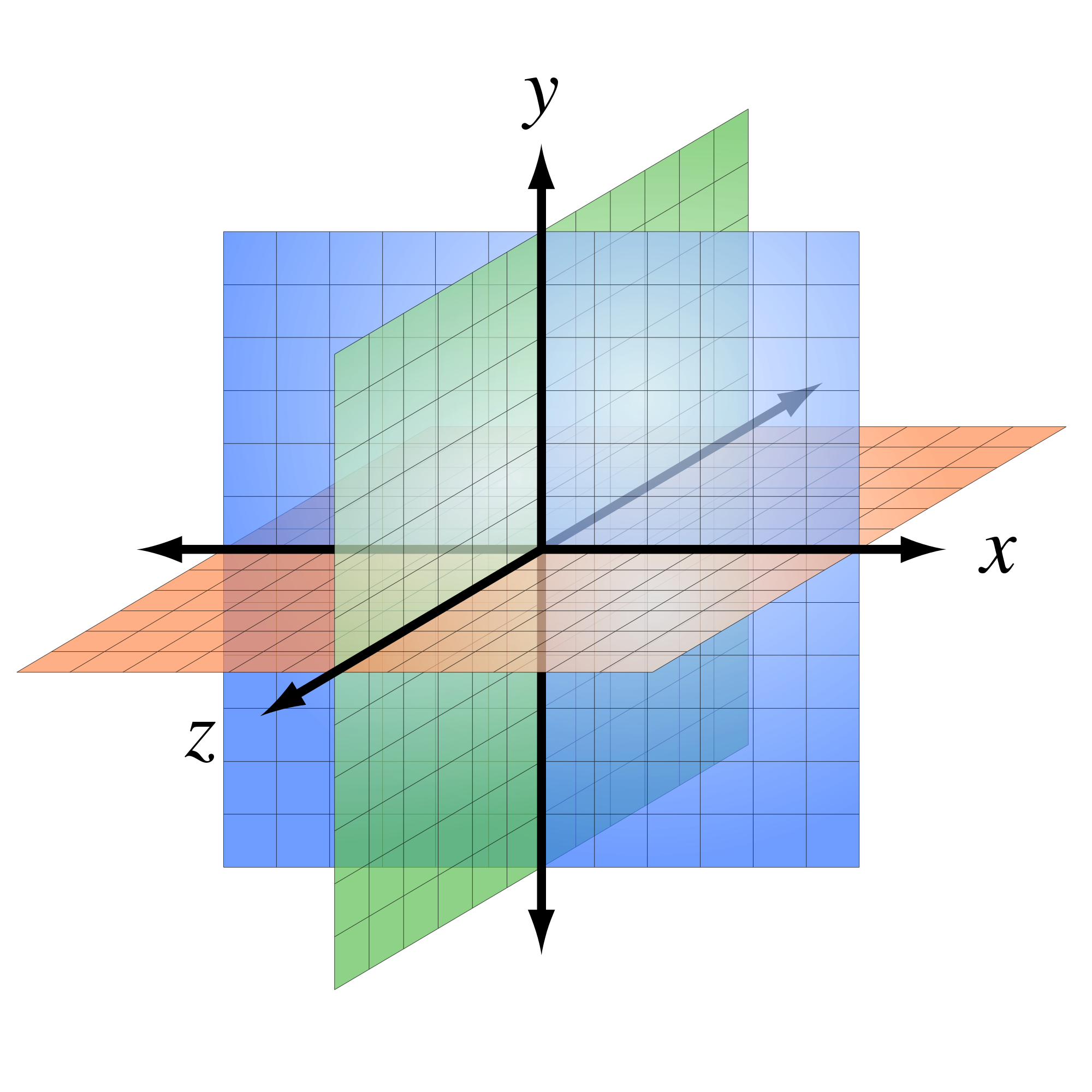
Space is a three-dimensional continuum containing positions and directions. In classical physics, physical space is often conceived in three linear dimensions. Modern physicists usually consider it, with time, to be part of a boundless four-dimensional continuum known as spacetime. The concept of space is considered to be of fundamental importance to an understanding of the physical universe. However, disagreement continues between philosophers over whether it is itself an entity, a relationship between entities, or part of a conceptual framework.
In the 19th and 20th centuries mathematicians began to examine geometries that are non-Euclidean, in which space is conceived as curved, rather than flat, as in the Euclidean space. According to Albert Einstein's theory of general relativity, space around gravitational fields deviates from Euclidean space. Experimental tests of general relativity have confirmed that non-Euclidean geometries provide a better model for the shape of space.[citation needed]
Debates concerning the nature, essence and the mode of existence of space date back to antiquity; namely, to treatises like the Timaeus of Plato, or Socrates in his reflections on what the Greeks called khôra (i.e. "space"), or in the Physics of Aristotle (Book IV, Delta) in the definition of topos (i.e. place), or in the later "geometrical conception of place" as "space qua extension" in the Discourse on Place (Qawl fi al-Makan) of the 11th-century Arab polymath Alhazen. Many of these classical philosophical questions were discussed in the Renaissance and then reformulated in the 17th century, particularly during the early development of classical mechanics.
Isaac Newton viewed space as absolute, existing permanently and independently of whether there was any matter in it. In contrast, other natural philosophers, notably Gottfried Leibniz, thought that space was in fact a collection of relations between objects, given by their distance and direction from one another. In the 18th century, the philosopher and theologian George Berkeley attempted to refute the "visibility of spatial depth" in his Essay Towards a New Theory of Vision. Later, the metaphysician Immanuel Kant said that the concepts of space and time are not empirical ones derived from experiences of the outside world—they are elements of an already given systematic framework that humans possess and use to structure all experiences. Kant referred to the experience of "space" in his Critique of Pure Reason as being a subjective "pure a priori form of intuition".
Galilean and Cartesian theories about space, matter, and motion are at the foundation of the Scientific Revolution, which is understood to have culminated with the publication of Newton's Principia Mathematica in 1687. Newton's theories about space and time helped him explain the movement of objects. While his theory of space is considered the most influential in physics, it emerged from his predecessors' ideas about the same.
As one of the pioneers of modern science, Galileo revised the established Aristotelian and Ptolemaic ideas about a geocentric cosmos. He backed the Copernican theory that the universe was heliocentric, with a stationary Sun at the center and the planets—including the Earth—revolving around the Sun. If the Earth moved, the Aristotelian belief that its natural tendency was to remain at rest was in question. Galileo wanted to prove instead that the Sun moved around its axis, that motion was as natural to an object as the state of rest. In other words, for Galileo, celestial bodies, including the Earth, were naturally inclined to move in circles. This view displaced another Aristotelian idea—that all objects gravitated towards their designated natural place-of-belonging.
Descartes set out to replace the Aristotelian worldview with a theory about space and motion as determined by natural laws. In other words, he sought a metaphysical foundation or a mechanical explanation for his theories about matter and motion. Cartesian space was Euclidean in structure—infinite, uniform and flat. It was defined as that which contained matter; conversely, matter by definition had a spatial extension so that there was no such thing as empty space.
The Cartesian notion of space is closely linked to his theories about the nature of the body, mind and matter. He is famously known for his "cogito ergo sum" (I think therefore I am), or the idea that we can only be certain of the fact that we can doubt, and therefore think and therefore exist. His theories belong to the rationalist tradition, which attributes knowledge about the world to our ability to think rather than to our experiences, as the empiricists believe. He posited a clear distinction between the body and mind, which is referred to as the Cartesian dualism.
Hub AI
Space AI simulator
(@Space_simulator)
Space
Space is a three-dimensional continuum containing positions and directions. In classical physics, physical space is often conceived in three linear dimensions. Modern physicists usually consider it, with time, to be part of a boundless four-dimensional continuum known as spacetime. The concept of space is considered to be of fundamental importance to an understanding of the physical universe. However, disagreement continues between philosophers over whether it is itself an entity, a relationship between entities, or part of a conceptual framework.
In the 19th and 20th centuries mathematicians began to examine geometries that are non-Euclidean, in which space is conceived as curved, rather than flat, as in the Euclidean space. According to Albert Einstein's theory of general relativity, space around gravitational fields deviates from Euclidean space. Experimental tests of general relativity have confirmed that non-Euclidean geometries provide a better model for the shape of space.[citation needed]
Debates concerning the nature, essence and the mode of existence of space date back to antiquity; namely, to treatises like the Timaeus of Plato, or Socrates in his reflections on what the Greeks called khôra (i.e. "space"), or in the Physics of Aristotle (Book IV, Delta) in the definition of topos (i.e. place), or in the later "geometrical conception of place" as "space qua extension" in the Discourse on Place (Qawl fi al-Makan) of the 11th-century Arab polymath Alhazen. Many of these classical philosophical questions were discussed in the Renaissance and then reformulated in the 17th century, particularly during the early development of classical mechanics.
Isaac Newton viewed space as absolute, existing permanently and independently of whether there was any matter in it. In contrast, other natural philosophers, notably Gottfried Leibniz, thought that space was in fact a collection of relations between objects, given by their distance and direction from one another. In the 18th century, the philosopher and theologian George Berkeley attempted to refute the "visibility of spatial depth" in his Essay Towards a New Theory of Vision. Later, the metaphysician Immanuel Kant said that the concepts of space and time are not empirical ones derived from experiences of the outside world—they are elements of an already given systematic framework that humans possess and use to structure all experiences. Kant referred to the experience of "space" in his Critique of Pure Reason as being a subjective "pure a priori form of intuition".
Galilean and Cartesian theories about space, matter, and motion are at the foundation of the Scientific Revolution, which is understood to have culminated with the publication of Newton's Principia Mathematica in 1687. Newton's theories about space and time helped him explain the movement of objects. While his theory of space is considered the most influential in physics, it emerged from his predecessors' ideas about the same.
As one of the pioneers of modern science, Galileo revised the established Aristotelian and Ptolemaic ideas about a geocentric cosmos. He backed the Copernican theory that the universe was heliocentric, with a stationary Sun at the center and the planets—including the Earth—revolving around the Sun. If the Earth moved, the Aristotelian belief that its natural tendency was to remain at rest was in question. Galileo wanted to prove instead that the Sun moved around its axis, that motion was as natural to an object as the state of rest. In other words, for Galileo, celestial bodies, including the Earth, were naturally inclined to move in circles. This view displaced another Aristotelian idea—that all objects gravitated towards their designated natural place-of-belonging.
Descartes set out to replace the Aristotelian worldview with a theory about space and motion as determined by natural laws. In other words, he sought a metaphysical foundation or a mechanical explanation for his theories about matter and motion. Cartesian space was Euclidean in structure—infinite, uniform and flat. It was defined as that which contained matter; conversely, matter by definition had a spatial extension so that there was no such thing as empty space.
The Cartesian notion of space is closely linked to his theories about the nature of the body, mind and matter. He is famously known for his "cogito ergo sum" (I think therefore I am), or the idea that we can only be certain of the fact that we can doubt, and therefore think and therefore exist. His theories belong to the rationalist tradition, which attributes knowledge about the world to our ability to think rather than to our experiences, as the empiricists believe. He posited a clear distinction between the body and mind, which is referred to as the Cartesian dualism.
Recent media