Recent from talks
Nothing was collected or created yet.
Reconnaissance Corps
View on Wikipedia| The Reconnaissance Corps | |
|---|---|
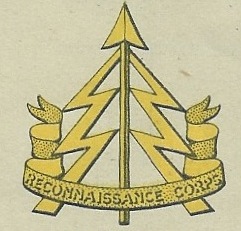
![]() Cap badge of the Reconnaissance Corps, 1941 | |
| Active | 1941–1946 |
| Country | |
| Branch | |
| Role | Military reconnaissance |
| Nicknames | The Reccies The Recce Corps |
| Motto | "Only The Enemy In Front" |
The Reconnaissance Corps, or simply Recce Corps, was a service branch of the British Army, formed during the Second World War, whose units provided reconnaissance for infantry divisions. It was formed from infantry brigade reconnaissance groups on 14 January 1941.
All the brigade reconnaissance groups of each infantry corps were formed into reconnaissance battalions, each usually bearing the number of its relevant division. For example, the 43rd Battalion, Reconnaissance Corps (based on the 5th Battalion, Gloucestershire Regiment) was the divisional reconnaissance battalion of the 43rd (Wessex) Division.[1]
Initially, coming from infantry units, reconnaissance units used the infantry designations of battalions, companies and platoons. However, from 6 June 1942, the Corps changed to the cavalry descriptions of regiments, squadrons and troops.[2]
The Corps became part of the Royal Armoured Corps (RAC) in 1944, still maintaining its own cap badge with two lightning strikes supporting an upright spear. With the end of the war, this number of reconnaissance units was not needed and the Reconnaissance Corps was disbanded in August 1946. Reconnaissance duties reverted to regular armoured units of the RAC.
Organisation and equipment
[edit]
The Reconnaissance Corps was charged with gathering vital tactical information in battle for infantry divisions, probing ahead and screening the flanks of main advances. The training centre was established at Winchester in February 1941, until the home of the Corps moved to Catterick in Yorkshire. Although the Corps was raised from various regular army units, it did not follow that all men would be retained, as potential reconnoiterers were required to take an IQ test and other tests before being accepted. Many failed and were sent to normal infantry battalions, but those who succeeded enjoyed the kudos of belonging to an elite unit and were determined to prove their own worth. Before beginning training with his unit, each man undertook a five-week course with technical units, which determined his role as a driver, wireless operator or mechanic. Most recce men became efficient in two of these roles e.g. driver and operator. During training with a reconnaissance unit, emphasis was placed on both aggressiveness and initiative, as these were the characteristics expected of the men selected for such units, and, as a result, a proud offensive spirit was created, similar to other newly founded units such as The Parachute Regiment. Reconnaissance regiments were organised into a headquarters squadron (including anti-tank, signals and mortar troops) and three reconnaissance (or "recce") squadrons. Each recce squadron comprised three scout troops and an assault troop. Scout troops were equipped with Bren Gun Carriers and light reconnaissance cars, such as the Humber Light Reconnaissance Car. The assault troops were composed of lorried infantry and were called up when enemy resistance needed to be overcome. Later in the war, more efficient and well-armed armoured cars such as the Humber Armoured Car, Daimler Armoured Car, Staghound and Greyhound augmented the light reconnaissance cars in scout troops.[3]
Units
[edit]

The following units served in the Recce Corps:[4]
- 1st Reconnaissance Regiment formed January 1941 in the 1st Infantry Division from the Hampshire Regiment.[5]
- 2nd Reconnaissance Regiment formed April 1941 in the 2nd Infantry Division, mainly from the 6th Battalion, Loyal Regiment (North Lancashire), the division's motorcycle battalion.[6][7]
- 3rd (Royal Northumberland Fusiliers) Reconnaissance Regiment formed April 1941 in the 3rd Infantry Division, from the 8th Battalion, Royal Northumberland Fusiliers, the division's motorcycle battalion.[8][9][10]
- 4th Reconnaissance Regiment formed January 1941 mainly from the anti-tank companies of the 10th, 11th and 12th Brigades of the 4th Infantry Division.[11]
- 5th Reconnaissance Regiment formed February 1941 in the 5th Infantry Division from the 3rd Battalion, Tower Hamlets Rifles.[12][13]
- 11th (East African) Reconnaissance Regiment formed May 1943 in the 11th (East Africa) Division by conversion of the Kenya Armoured Car Regiment[14]
- 15th Scottish Reconnaissance Regiment formed February 1943 in the 15th (Scottish) Infantry Division from the 15th, 45th and 54th Independent Reconnaissance Squadrons.[13][15]
- 18th Reconnaissance Battalion formed in the 18th (East Anglian) Infantry Division from the 5th Battalion, Loyal Regiment (North Lancashire); surrendered at Singapore 1942.[16]
- 38th Reconnaissance Regiment formed October 1943 in the 38th (Welsh) Infantry Division from the 47th, 38th and 55th Independent Reconnaissance Squadrons; disbanded October 1944, number taken by 80th (Holding) Reconnaissance Regiment.[17]
- 43rd Reconnaissance Regiment formed from 5th Battalion, Gloucestershire Regiment transferred to the 43rd (Wessex) Infantry Division from the 48th (South Midland) Infantry Division November 1941; lost 'A' and 'C' Sqns through the sinking of the Motor Transport Ship T72 (the Derrycunihy) off Sword Beach on 24 June 1944; one replacement squadron received from the 161st Reconnaissance Regiment.[13][18][19][20][21]
- 44th Reconnaissance Regiment formed January 1941 in the 44th (Home Counties) Infantry Division from the 7th Battalion, Queen's Own Royal West Kent Regiment; transferred to 56th (London) Infantry Division in 1943, but retained number.[22]
- 45th Reconnaissance Regiment formed January 1941 mainly from the 134th, 135th and 136th Brigade Anti-Tank Companies of the 45th Infantry Division; transferred to 70th Infantry Division in August 1942; formed 45 and 54 Columns of the Chindits;[23] converted to infantry and redesignated as the 2nd Battalion, South Staffordshire Regiment in October 1944.[24]
- 46th Reconnaissance Regiment formed July 1941 in the 46th Infantry Division from the 23rd Battalion, Royal Fusiliers and the 137th, 138th and 139th Brigade Anti-Tank Companies.[25]

- 49th Reconnaissance Regiment formed September 1942 in the 49th (West Riding) Infantry Division from the 29th and 148th Independent Reconnaissance Sqns, with the 1st Belgian Fusiliers as 'C' Sqn, later replaced by 24th (Guards) Independent Reconnaissance Squadron.[13][26]
- 50th Reconnaissance Regiment formed April 1941 in the 50th (Northumbrian) Infantry Division from the 4th Battalion, Royal Northumberland Fusiliers, previously the division's motorcycle battalion; disbanded and remnants returned to the 4th RNF after action at the Battle of Gazala June 1942.[10][13][27][28]
- 51st Reconnaissance Regiment formed February 1941 from the brigade anti-tank companies of the 51st (Highland) Infantry Division: 152 (Camerons and Seaforths) as 'A' Sqn, 153 (Gordons and Black Watch) as 'B' Sqn and 154 (Black Watch and Argylls) as 'C' Sqn; converted to infantry and redesignated as the 14th Battalion, Highland Light Infantry in January 1943.[13][29]
- 52nd Reconnaissance Regiment formed January 1941 from the three Brigade Reconnaissance Groups of the 52nd (Lowland) Infantry Division: 'A' Sqn (Royal Scots and King's Own Scottish Borderers); 'B' Sqn (Royal Scots Fusiliers and Cameronians (Scottish Rifles)); 'C' Sqn (Highland Light Infantry and Gordon Highlanders).[13][30]

- 53rd Reconnaissance Regiment formed January 1941 from the 158th, 159th and 160th Brigade Anti-Tank Companies of the 53rd (Welsh) Infantry Division.[13][31]
- 54th Reconnaissance Battalion formed July 1941 in the 54th (East Anglian) Infantry Division from the 21st Battalion, Royal Fusiliers; split into the 45th, 54th and 76th Independent Reconnaissance Squadrons in November 1941.[32]
- 56th Reconnaissance Regiment formed January 1941 from the 167th, 168th and 169th Brigade Anti-Tank Companies of the 56th (London) Infantry Division; transferred to the 78th Infantry Division, but retained its number.[13][33]

- 59th Reconnaissance Regiment formed January 1941 in the 59th (Staffordshire) Infantry Division; disbanded 31 August 1944.[34][35]
- 61st Reconnaissance Regiment formed September 1941 from the 182nd, 183rd and 184th Brigade Anti-Tank Companies of the 61st Infantry Division; transferred to the 50th (Northumbrian) Infantry Division; disbanded December 1944.[13][36]
- 63rd Reconnaissance Training Centre formed January 1942, absorbed Reconnaissance Training Centre (formed January 1941) in August 1943.[37]
- 80th (Holding and Training) Reconnaissance Regiment formed January 1943 from the 48th, 76th and 77th Independent Reconnaissance Squadrons, attached to the 80th Infantry (Reserve) Division;[38] renumbered 38th Reconnaissance Regiment October 1944.[39]
- 81st (West African) Reconnaissance Regiment formed in the 81st (West Africa) Infantry Division.[40]
- 82nd (West African) Reconnaissance Regiment formed in the 82nd (West Africa) Infantry Division.[41]
- 161st Reconnaissance Regiment converted from the 161st Regiment Royal Armoured Corps (formerly 12th Battalion, Green Howards) October 1943; attached to the 55th (West Lancashire) Infantry Division from December 1943 to July 1944,[42] then supplied replacements, including a complete squadron to the 43rd Reconnaissance Regiment in July 1944.[19][21] Attached to the new 45th Infantry Division in September 1944.[43]
- 2nd Derbyshire Yeomanry converted from an armoured car regiment of the Royal Armoured Corps and assigned to the 51st (Highland) Infantry Division.[44][45]
- 6th Armoured Airborne Reconnaissance Regiment formed in 6th Airborne Division[46][47]
- GHQ Liaison Regiment (Phantom).[48][49]
Independent reconnaissance squadrons
Those infantry divisions placed on a lower establishment in December 1941 only required an independent reconnaissance company/squadron; some independent brigades had a similar reconnaissance unit.[4][50]

- 1st Airborne Reconnaissance Squadron[46][51][52]
- 15th Independent Reconnaissance Squadron transferred in February 1943 to the 15th (Scottish) Reconnaissance Regiment.[32]
- 24th (Guards) Independent Reconnaissance Squadron transferred to the 49th (West Riding) Reconnaissance Regiment.[26]
- 29th Independent Reconnaissance Squadron transferred in September 1942 from the 78th Infantry Division to the 49th (West Riding) Reconnaissance Regiment.[26]
- 38th Independent Reconnaissance Squadron transferred to the 38th (Welsh) Reconnaissance Regiment in October 1943[17]
- 45th Independent Reconnaissance Squadron formed November 1941 from the 54th Reconnaissance Regiment; transferred in February 1943 to the 15th (Scottish) Reconnaissance Regiment.[32]
- 47th Independent Reconnaissance Squadron transferred to the 38th (Welsh) Reconnaissance Regiment in October 1943[17]
- 48th Independent Reconnaissance Squadron formed January 1942 in the 48th (South Midland) Infantry Division after the original 48th Battalion, transferred to the 43rd (Wessex) Infantry Division; transferred to the 80th (Holding and Training) Reconnaissance Regiment in January 1943[39][53]
- 54th Independent Reconnaissance Squadron formed November 1941 from the 54th Reconnaissance Regiment; transferred in February 1943 to the 15th (Scottish) Reconnaissance Regiment.[32]
- 55th Independent Reconnaissance Squadron transferred to the 38th (Welsh) Reconnaissance Regiment in October 1943[17]
- 76th Independent Reconnaissance Squadron formed November 1941 from the 54th Reconnaissance Regiment; transferred to the 80th (Holding and Training) Reconnaissance Regiment in January 1943.[32][39]
- 77th Independent Reconnaissance Squadron transferred to the 80th (Holding and Training) Reconnaissance Regiment in January 1943[39]
- 148th Independent Reconnaissance Squadron formed January 1941 in the 148th Independent Brigade Group; transferred in September 1942 to the 49th (West Riding) Reconnaissance Regiment.[26][54]
See also
[edit]- Formation reconnaissance regiment, currently provided by cavalry regiments of the British Army
Notes
[edit]- ^ Mills, T.F. Land Forces of Britain, the Empire and Commonwealth 5th Battalion, The Gloucestershire Regiment page. Retrieved 26 November 2007. Archived November 29, 2007, at the Wayback Machine
- ^ "Reconnaissance Corps (UK)". Regiments.org. 2013. Archived from the original on December 26, 2005. Retrieved 7 May 2013.
- ^ A British Soldier Remembers Archived 2007-06-07 at the Wayback Machine The Logistics of a Recce Regiment (organisation and vehicles pages).
- ^ a b Frederick, pp. 11–2.
- ^ "1st Reconnaissance Regiment". The Reconnaissance Corps website. 2009. Archived from the original on December 23, 2012. Retrieved 7 May 2013.
- ^ Joslen p. 39.
- ^ Doherty, British Reconnaissance Corps, pp. 51–4.
- ^ Joslen, p. 43.
- ^ "3rd (RNF) Reconnaissance Regiment". The Reconnaissance Corps website. 2009. Archived from the original on 21 June 2013. Retrieved 7 May 2013.
- ^ a b "4th Bn, Royal Northumberland Fusiliers: war services". 2013. Archived from the original on December 27, 2005. Retrieved 7 May 2013.
- ^ "4th Reconnaissance Regiment". The Reconnaissance Corps website. 2009. Archived from the original on 23 December 2012. Retrieved 7 May 2013.
- ^ "5th Reconnaissance Regiment". The Reconnaissance Corps website. 2009. Archived from the original on December 24, 2012. Retrieved 7 May 2013.
- ^ a b c d e f g h i j "Reconnaissance Regiments RAC 1939-1945". 2013. Archived from the original on 6 September 2006. Retrieved 7 May 2013.
- ^ Joslen, p. 121.
- ^ "15th (Scottish) Reconnaissance Regiment". The Reconnaissance Corps website. 2009. Archived from the original on 23 December 2012. Retrieved 7 May 2013.
- ^ Doherty, British Reconnaissance Corps, pp. 9, 51.
- ^ a b c d "38th (Welsh) Reconnaissance Regiment". The Reconnaissance Corps website. 2009. Archived from the original on December 23, 2012. Retrieved 7 May 2013.
- ^ "43rd (Wessex) Reconnaissance Regiment". The Reconnaissance Corps website. 2009. Archived from the original on 14 July 2014. Retrieved 7 May 2013.
- ^ a b "161st (Green Howards) Reconnaissance Regiment". The Reconnaissance Corps website. 2009. Archived from the original on 21 May 2014. Retrieved 7 May 2013.
- ^ "5th Battalion, The Gloucestershire Regiment". 2013. Archived from the original on January 17, 2006. Retrieved 7 May 2013.
- ^ a b Ellis Vol I, p. 275.
- ^ "44th Reconnaissance Regiment". The Reconnaissance Corps website. 2009. Archived from the original on 23 December 2012. Retrieved 7 May 2013.
- ^ Bellis 1994, p. 33
- ^ "45th Reconnaissance Regiment". The Reconnaissance Corps website. 2009. Archived from the original on 23 December 2012. Retrieved 7 May 2013.
- ^ "46th Reconnaissance Regiment". The Reconnaissance Corps website. 2009. Archived from the original on December 23, 2012. Retrieved 7 May 2013.
- ^ a b c d "49th (WR) Reconnaissance Regiment". The Reconnaissance Corps website. 2009. Archived from the original on 23 December 2012. Retrieved 7 May 2013.
- ^ Joslen, p. 81.
- ^ "50th Reconnaissance Regiment". The Reconnaissance Corps website. 2009. Archived from the original on December 23, 2012. Retrieved 7 May 2013.
- ^ "51st (H) Reconnaissance Regiment". The Reconnaissance Corps website. 2009. Archived from the original on December 23, 2012. Retrieved 7 May 2013.
- ^ "52nd (Lowland) Reconnaissance Regiment". The Reconnaissance Corps website. 2009. Archived from the original on 23 December 2012. Retrieved 7 May 2013.
- ^ "53rd (Welsh) Reconnaissance Regiment". The Reconnaissance Corps website. 2009. Archived from the original on 23 December 2012. Retrieved 7 May 2013.
- ^ a b c d e "54th Reconnaissance Regiment". The Reconnaissance Corps website. 2009. Archived from the original on December 23, 2012. Retrieved 7 May 2013.
- ^ "56th Reconnaissance Regiment". The Reconnaissance Corps website. 2009. Archived from the original on December 23, 2012. Retrieved 7 May 2013.
- ^ "59th Reconnaissance Regiment". The Reconnaissance Corps website. 2009. Archived from the original on December 23, 2012. Retrieved 7 May 2013.
- ^ Ellis Vol I, pp. 453 & 530.
- ^ "61st Reconnaissance Regiment". The Reconnaissance Corps website. 2009. Archived from the original on 23 December 2012. Retrieved 7 May 2013.
- ^ "The Reconnaissance Training Centre". The Reconnaissance Corps website. 2009. Archived from the original on 23 December 2012. Retrieved 7 May 2013.
- ^ Joslen, p. 103.
- ^ a b c d "80th Reconnaissance Regiment". The Reconnaissance Corps website. 2009. Archived from the original on December 23, 2012. Retrieved 7 May 2013.
- ^ "81st (WA) Reconnaissance Regiment". The Reconnaissance Corps website. 2009. Archived from the original on December 23, 2012. Retrieved 7 May 2013.
- ^ "82nd (WA) Reconnaissance Regiment". The Reconnaissance Corps website. 2009. Archived from the original on December 23, 2012. Retrieved 7 May 2013.
- ^ Joslen, p. 90.
- ^ Joslen, p. 73.
- ^ "2nd Derbyshire Yeomanry". The Reconnaissance Corps website. 2009. Archived from the original on 23 December 2012. Retrieved 7 May 2013.
- ^ "The Derbyshire Yeomanry (UK)". 2013. Archived from the original on December 19, 2007. Retrieved 7 May 2013.
- ^ a b "Reconnaissance Corps: Service of Airborne Units". 2013. Archived from the original on May 19, 2006. Retrieved 7 May 2013.
- ^ Ellis Vol I, p. 527.
- ^ "The G.H.Q. Liaison Regiment "Phantom"". The Reconnaissance Corps website. 2009. Retrieved 7 May 2013.[dead link]
- ^ Ellis Vol I, p. 523.
- ^ Joslen, pp. 41, 58, 65, 73, 77, 89, 90, 99, 100, 101, 269, 333.
- ^ Ryan pp. 16 & 124.
- ^ Ellis Vol II, pp. 35, 46.
- ^ Joslen p. 77.
- ^ Joslen, p. 333.
References
[edit]- Bellis, Malcolm A. (1994). Regiments of the British Army 1939–1945 (Armour & Infantry). London: Military Press International. ISBN 978-0-85420-999-6.
- Doherty, Richard (1994). Only The Enemy in Front (Every other beggar behind...): The Recce Corps at War 1940-1946. London: Tom Donovan. ISBN 978-1-871085-18-1.
- Doherty, Richard & Chapman, Rob (2007). The British Reconnaissance Corps in World War II. Oxford: Osprey Publishing. ISBN 978-1-84603-122-9.
- Ellis, L.F. (1962). The Battle of Normandy. History of the Second World War. Vol. Victory in the West, Vol.I. London: HM Stationery Office. ISBN 978-1-84574-058-0.
{{cite book}}: ISBN / Date incompatibility (help) - Ellis, L.F. (1968). The Defeat of Germany. History of the Second World War. Vol. Victory in the West, Vol.II. London: HM Stationery Office. ISBN 978-1-84574-059-7.
- J.B.M. Frederick, Lineage Book of British Land Forces 1660–1978, Vol I, Wakefield: Microform Academic, 1984, ISBN 1-85117-007-3.
- Howard, Roy (2004). Beaten Paths are Safest: From D-Day to the Ardennes. Memories of the 61st Reconnaissance Regiment. Studley: Brewin Books. ISBN 978-1-85858-256-6.
- Joslen, H. F. (2003) [1960]. Orders of Battle: Second World War, 1939–1945. Uckfield, East Sussex: Naval and Military Press. ISBN 978-1-84342-474-1.
- Parlour, Andy; Parlour, Sue (2004). Phantom at War. Bristol: Cerberus Publishing Ltd. ISBN 978-1-84145-118-3.
- Ryan, Cornelius (1974). A Bridge Too Far. London: Hamish Hamilton. ISBN 978-0-340-19941-1.
- Taylor, Jeremy L. (1947). This Band of Brothers: A History of the Reconnaissance Corps of the British Army. Bristol: White Swan Press. OCLC 14952752.
- Tee, Ronald Arthur (2001). A British Soldier Remembers: The World War II Reminiscences of Ronald Arthur Tee. Belleville, Ontario: Epic Press. ISBN 978-1-55306-277-6.
External links
[edit]Reconnaissance Corps
View on GrokipediaHistory
Formation and Early Development
The Reconnaissance Corps originated from the pre-war infantry brigade reconnaissance groups, which had been established within British Army divisions to provide basic scouting capabilities, but proved inadequate for the demands of modern mechanized warfare following the Dunkirk evacuation in 1940. The rapid German advances highlighted the need for more specialized, divisional-level reconnaissance units capable of gathering tactical intelligence ahead of infantry formations, leading to the decision to centralize and expand these groups into a dedicated corps. On 14 January 1941, the Reconnaissance Corps was officially formed as a separate entity under the British Army, drawing personnel and structure from the existing brigade groups to equip each infantry division with its own reconnaissance regiment.[4][3] The initial training center for the Corps was established at Winchester on 1 February 1941 to standardize skills in scouting, wireless communication, and vehicle operation, later relocating to Catterick in Yorkshire to accommodate growing numbers and integrate with other armored training facilities. Recruitment targeted volunteers from across the Army, emphasizing adaptability and technical proficiency; candidates underwent rigorous IQ tests and aptitude assessments to assign roles such as drivers, wireless operators, or mechanics, with many failing and being reassigned to standard infantry units. This selective process ensured a cadre of resourceful soldiers suited to the Corps' mobile, independent operations, though it initially strained manpower availability amid wartime expansion.[4][5][4] By mid-1942, the Corps faced organizational ambiguities in its structure and nomenclature, initially adopting infantry-style designations like battalions, companies, and platoons, which clashed with its emerging armored reconnaissance role. On 6 June 1942, the War Office formalized a shift to cavalry terminology—regiments, squadrons, and troops—to better reflect the Corps' mechanized focus and align it with the Royal Armoured Corps, addressing inconsistencies that had arisen from ad hoc unit formations. Early challenges included standardizing training across diverse recruits and ensuring seamless integration with infantry divisions, where reconnaissance regiments often operated semi-independently, requiring clear doctrinal protocols to avoid operational friction during the Corps' formative deployments.[4][5][4]World War II Service
The Reconnaissance Corps commenced operational deployments in mid-1942, assigning units to provide essential reconnaissance support for every British infantry division engaged in active campaigns worldwide.[5][6] These mobile units scouted ahead of advancing forces, screened flanks, and gathered critical tactical intelligence to inform infantry maneuvers.[5][2] In the North African theater, Reconnaissance Corps elements supported the Eighth Army's advances, contributing to operations such as the push into Tunisia between December 1942 and May 1943.[6] In the Italian campaign, their involvement included the Anzio landings in early 1944 and assaults along the Gothic Line later that year, where they located enemy positions and facilitated breakthroughs.[6] In Northwest Europe, following the Normandy invasion in June 1944, units operated continuously from the beaches through to the German heartland, screening rapid advances and enabling coordinated infantry actions amid fluid battle conditions.[5][6] In the Far East theater, Reconnaissance Corps units, such as elements of the 2nd and 45th Regiments, supported Allied operations in Burma from 1943 onward, conducting patrols and intelligence gathering in challenging jungle terrain.[2] On 1 January 1944, the Reconnaissance Corps was formally absorbed into the Royal Armoured Corps, with its regiments redesignated accordingly—such as the 4th becoming the 4th Reconnaissance Regiment, Royal Armoured Corps—while retaining their distinctive cap badge and reconnaissance role.[5][7] This integration streamlined command structures without altering their frontline duties.[5] The Corps' tactical contributions were pivotal in enabling infantry divisions to navigate hostile terrain and enemy defenses, often through aggressive patrolling that identified artillery positions and troop concentrations ahead of main assaults.[2][6] However, their exposed vanguard positions led to high attrition rates, with units frequently suffering significant losses from ambushes and direct engagements due to limited armor and forward positioning.[6] Despite these risks, their intelligence efforts proved highly effective in reducing overall division casualties by preempting threats.[2]Disbandment and Transition
Following the end of hostilities in Europe in May 1945, the Reconnaissance Corps continued in a limited capacity, with many of its regiments performing occupation duties in Germany as personnel were progressively demobilized and replaced by units from the Royal Armoured Corps (RAC). These roles involved maintaining security and conducting patrols in the British zone, though the scale of operations diminished rapidly amid the broader demobilization of the British Army. Some units, such as the 6th Airborne Armoured Reconnaissance Regiment, were redeployed to Palestine for internal security duties, marking the last active service for Reconnaissance Corps elements. The Corps was officially disbanded on 1 August 1946, with most units ceasing to exist by that date.[1] This dissolution was driven by the cessation of wartime requirements, which had necessitated a large number of specialized reconnaissance formations, coupled with severe post-war budget constraints and the need for a comprehensive reorganization of the British Army to reduce its size from almost three million personnel in 1945 to around 450,000 by 1948.[5] Reconnaissance responsibilities were transferred back to the standard regiments of the Royal Armoured Corps, which had absorbed the Corps administratively on 1 January 1944 but now assumed them exclusively as part of the peacetime structure.[5] Upon disbandment, personnel were dispersed across the British Army: many officers and other ranks were reassigned to existing RAC regiments or infantry battalions to fill shortages, while others were demobilized under the government's phased release program.[1] This transition reflected the Corps' wartime origins as a temporary expedient, ensuring its expertise was integrated into the regular army without preserving a separate entity.[5]Organization and Role
Structure and Training
The Reconnaissance Corps was structured hierarchically at the regimental level, comprising a regimental headquarters, a headquarters squadron equipped with specialized support elements including anti-tank, signals, and mortar troops, and three reconnaissance squadrons designed for frontline scouting duties.[8][4] Each reconnaissance squadron typically included four troops—three reconnaissance troops and one assault troop—with individual troops consisting of 3-4 vehicles crewed by 8-12 personnel to enable flexible, mobile operations.[8][6] This organization supported a total regimental strength of approximately 770 men, balancing combat and technical roles.[4][6] Personnel were recruited as volunteers primarily from infantry regiments, with selection emphasizing physical fitness, initiative, and technical aptitude for tasks requiring high mobility; candidates underwent IQ testing to assess suitability, and those who failed were often reassigned to standard infantry units.[4][6] The composition integrated drivers, mechanics, wireless operators, and scouts, fostering a versatile force capable of independent action while maintaining doctrinal ties to divisional reconnaissance needs. Training occurred at dedicated centers, beginning at Winchester in 1941, then moving to Lockerbie in May 1941, before relocating to Catterick by August 1943, where recruits completed a comprehensive 12-16 week program covering vehicle driving and maintenance, wireless communication, basic mechanics, fieldcraft, map reading, and reconnaissance tactics under varying operational conditions.[4] Officers received additional advanced instruction at Reconnaissance Officer Cadet Training Units, such as the 162nd OCTU, to prepare for leadership in fluid battlefield environments.[4] Post-1942 reforms standardized the regimental structure for consistent attachment to infantry divisions, incorporating lower-establishment variants for understrength formations to optimize resource allocation amid wartime demands; this evolution culminated in the Corps' absorption into the Royal Armoured Corps in January 1944, adopting cavalry-style designations while retaining its core reconnaissance focus.[4][8]Doctrinal Responsibilities
The primary role of the Reconnaissance Corps was to gather tactical intelligence on enemy positions, strength, and movements ahead of the main British Army forces, enabling informed decision-making for infantry divisions.[5] This involved scouting forward and screening flanks to provide early warning without exposing the broader force to unnecessary risk.[5] Doctrinal principles centered on speed and stealth to achieve surprise and avoid detection, prioritizing the collection of information over direct combat, as articulated in Royal Armoured Corps guidance to obtain "the maximum amount of detailed information about the enemy without his knowledge."[9] While aggression was not the core focus—reconnaissance units were instructed not to fight for information—limited offensive action could support screening tasks when necessary to maintain momentum.[9] These principles emphasized multi-role versatility, with personnel trained for adaptability in diverse environments.[5] Reconnaissance Corps units were integrated into infantry divisions at the divisional level, with regiments numbered or named to align directly with their assigned formations, ensuring seamless coordination for probing enemy lines without escalating to full-scale battle.[5] This attachment allowed divisions to leverage reconnaissance as an extension of their command structure, enhancing overall situational awareness.[2] The doctrine evolved from pre-war ad-hoc reconnaissance efforts within infantry units to a formalized corps established in January 1941, reflecting lessons from early wartime setbacks.[5] By June 1942, specialization intensified with a shift to cavalry nomenclature—battalions redesignated as regiments and companies as squadrons—aligning the Corps more closely with armored mobility and operational needs at the divisional level.[5] A key limitation was the inherent vulnerability of reconnaissance elements to enemy counter-reconnaissance measures, which often forced engagements despite doctrinal preferences for evasion.[9] This exposure prompted adaptations, including the incorporation of combined arms support from artillery or infantry to protect forward elements and sustain operational effectiveness.[2]Equipment and Tactics
Vehicles and Armaments
The Reconnaissance Corps employed a progression of vehicles suited to its scouting role, beginning with lightweight options in its formative years. From 1941 to 1942, units primarily used the Universal Carrier, commonly known as the Bren Gun Carrier, a small tracked vehicle that provided basic mobility for forward observation and liaison tasks. These carriers were typically armed with a .303-inch Bren light machine gun mounted in the front compartment, supplemented by personal weapons such as rifles and pistols for the crew of three to four. Alongside them, the Humber Light Reconnaissance Car (Mk I and II) served as a wheeled counterpart, offering greater speed on roads and light armor plating; it was fitted with a .303-inch Bren gun or a .55-inch Boys anti-tank rifle firing through a front slot, enabling hit-and-run reconnaissance in varied terrains.[2] The Daimler Dingo scout car, introduced from 1941, was another lightweight 4x4 vehicle weighing about 3 tons, with a top speed of 55 mph and armed with a .303-inch Bren gun, ideal for close reconnaissance and liaison due to its low profile and reliability across terrains.[10] As the war progressed into 1943 and 1944, the Corps transitioned to more robust armoured cars to handle increased threats, particularly in North Africa and Italy. The Humber Armoured Car (various marks) became a staple, weighing around 7 tons with improved armor and armed with co-axial 15mm and 7.92mm Besa machine guns for suppressive fire during scouting. For heavier engagements, the Daimler Armoured Car was introduced, a 7.6-ton vehicle mounting a 40mm (2-pounder) gun in a turret alongside a co-axial .303-inch Besa machine gun, allowing regiments to engage enemy armor at range while maintaining mobility up to 55 mph. These upgrades addressed early vulnerabilities but introduced logistical strains, including high fuel consumption—Humber cars required about 12 miles per gallon on roads and 6 miles per gallon off-road—and maintenance demands from sand ingress in desert environments, where units improvised air filters and reinforced suspensions for North African operations.[2][10] In the late war period from 1944 onward, American Lend-Lease vehicles enhanced the Corps' firepower and reliability, particularly in northwest Europe and the Mediterranean. The M8 Greyhound, a 6x6 armoured car weighing 9 tons, was adopted for its speed (up to 55 mph) and armed with a 37mm main gun and .50-caliber and .30-caliber machine guns, proving effective in rapid advances like those into Austria. Similarly, the T17E1 Staghound, another 6x6 design, featured a 37mm gun and twin .30-caliber machine guns, though its 14-ton weight posed challenges on narrow Italian roads and in muddy European conditions. Select units also integrated towed 57mm (6-pounder) anti-tank guns for defensive positions, while .303-inch Vickers machine guns provided additional anti-infantry support on lighter vehicles. Overall, these armaments emphasized versatility over heavy firepower, but logistical issues persisted, including parts shortages and fuel dependency that limited operational range to 200-300 miles without resupply, necessitating adaptations like extended fuel tanks for desert and mountain terrains in North Africa and Sicily.[2]| Vehicle Type | Period | Key Armament | Weight (tons) | Top Speed (mph) |
|---|---|---|---|---|
| Bren Gun Carrier | 1941-1942 | .303 Bren MG | 3.8 | 30 |
| Humber Light Recon Car | 1941-1942 | .303 Bren or .55 Boys AT rifle | 3.2 | 45 |
| Daimler Dingo | 1941-1945 | .303 Bren MG | 3 | 55 |
| Humber Armoured Car | 1943-1944 | 15mm/7.92mm Besa MGs | 7 | 45 |
| Daimler Armoured Car | 1943-1944 | 2-pdr gun, .303 Besa MG | 7.6 | 55 |
| M8 Greyhound | 1944-1945 | 37mm gun, .50/.30 MGs | 9 | 55 |
| Staghound | 1944-1945 | 37mm gun, .30 MGs | 14 | 55 |

