
Recent from talks
Northern flicker
Knowledge base stats:
Talk channels stats:
Members stats:
Northern flicker
The northern flicker or common flicker (Colaptes auratus) is a medium-sized bird of the woodpecker family. It is native to most of North America, parts of Central America, Cuba, and the Cayman Islands, and is one of the few woodpecker species that migrate. Over 100 common names for the northern flicker are known, including yellowhammer (not to be confused with the Eurasian yellowhammer (Emberiza citrinella)), clape, gaffer woodpecker, harry-wicket, heigh-ho, wake-up, walk-up, wick-up, yarrup, and gawker bird. Many of these names derive from attempts to imitate some of its calls.
The English naturalist Mark Catesby described and illustrated the northern flicker in his book The Natural History of Carolina, Florida and the Bahama Islands which was published between 1729 and 1732. Catesby used the English name "Gold-winged Wood-pecker" and the Latin Picus major alis aureis. When in 1758 the Swedish naturalist Carl Linnaeus updated his Systema Naturae for its 10th edition, he included the northern flicker, coined the binomial name Cuculus auratus for it, and cited Catesby's book.
The specific epithet auratus is a Latin word meaning "gilded" or "ornamented with gold". The type locality is South Carolina. The northern flicker is one of 14 extant New World woodpeckers now placed in the genus Colaptes that was introduced by the Irish zoologist Nicholas Aylward Vigors in 1825 with the northern flicker (Colaptes auratus) as the type species.
Ten subspecies are recognized, one of which is now extinct, though it may be invalid. The nine extant subspecies were at one time considered subspecies of two separate species called the yellow-shafted flicker (C. auratus, with four subspecies) and the red-shafted flicker (C. cafer, with six subspecies, five living and one extinct), but they commonly interbreed where their ranges overlap and are now considered one species by the American Ornithologists Union. This is an example of what is referred to in science as the species problem.
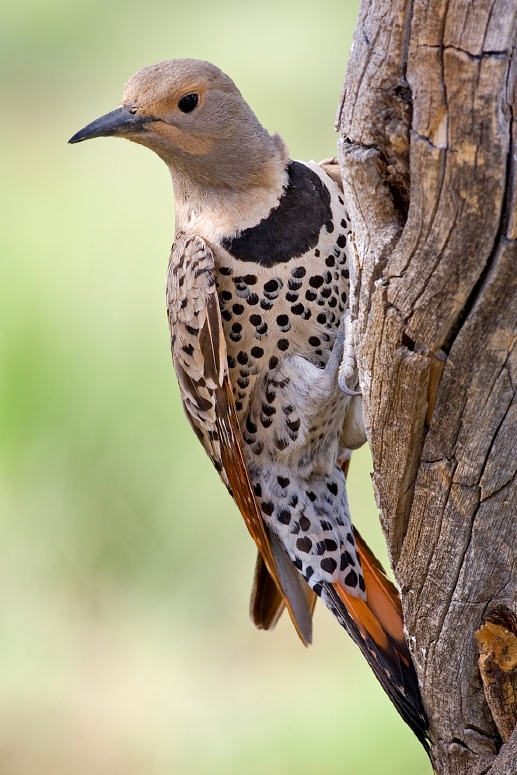
Adults are brown with black bars on the back and wings. A mid- to large-sized northern flicker measures 28–36 cm (11–14 in) in length and 42–54 cm (16+1⁄2–21+1⁄2 in) in wingspan. The body mass can vary from 86 to 167 g (3 to 5+7⁄8 oz). Among standard scientific measurements, the wing bone measures 12.2–17.1 cm (4+13⁄16–6+3⁄4 in), the tail measures 7.5–11.5 cm (3–4+1⁄2 in), the bill measures 2.2–4.3 cm (7⁄8–1+11⁄16 in) and the tarsus measures 2.2–3.1 cm (7⁄8–1+1⁄4 in). The largest-bodied specimens are from the northern stretches of the species' range at the latitude of Alaska and Labrador, while the smallest specimens come from Grand Cayman. A necklace-like black patch occupies the upper breast, while the lower breast and belly are beige with black spots. Males can be identified by a black (in the eastern part of the species' range) or red (in the western part) mustachial stripe at the base of the beak, while females lack this stripe. The tail is dark on top, transitioning to a white rump which is conspicuous in flight. Subspecific plumage is variable.
This bird's call is a sustained laugh, ki ki ki ki, quite different from that of the pileated woodpecker (Dryocopus pileatus). One may also hear a constant knocking as they often drum on trees or even metal objects to declare territory. Like most woodpeckers, northern flickers drum on objects as a form of communication and territory defense. In such cases, the purpose is to make as loud a noise as possible, so woodpeckers sometimes drum on metal objects.
Like many woodpeckers, its flight is undulating. The repeated cycle of a quick succession of flaps followed by a pause creates an effect comparable to a roller coaster.
According to the Audubon field guide, "flickers are the only woodpeckers that frequently feed on the ground", probing with their beak, also sometimes catching insects in flight. Although they eat fruits, berries, seeds, and nuts, their primary food is insects. Ants alone can make up 45% of their diet. Other invertebrates eaten include flies, butterflies, moths, beetles, and snails. Northern flickers also eat berries and seeds, especially in winter, including those of poison ivy, poison oak, dogwood, sumac, wild cherry, and grape, bayberries, hackberries, and elderberries, as well as sunflower and thistle seeds. Northern flickers often break into underground ant colonies to get at the nutritious larvae there, hammering at the soil the way other woodpeckers drill into wood. They have been observed breaking up cow dung to eat the insects living within. Their tongues can dart out 50 mm (2 in) beyond the end of the bill to catch prey. The northern flicker is a natural predator of the European corn borer (Ostrinia nubilalis), an invasive species of moth that costs the U.S. agriculture industry more than $1 billion annually in crop losses and population control. As well as eating ants, northern flickers exhibit a behavior known as anting, in which they use the formic acid from the ants to assist in preening, as it is useful in keeping them free of parasites.
Hub AI
Northern flicker AI simulator
(@Northern flicker_simulator)
Northern flicker
The northern flicker or common flicker (Colaptes auratus) is a medium-sized bird of the woodpecker family. It is native to most of North America, parts of Central America, Cuba, and the Cayman Islands, and is one of the few woodpecker species that migrate. Over 100 common names for the northern flicker are known, including yellowhammer (not to be confused with the Eurasian yellowhammer (Emberiza citrinella)), clape, gaffer woodpecker, harry-wicket, heigh-ho, wake-up, walk-up, wick-up, yarrup, and gawker bird. Many of these names derive from attempts to imitate some of its calls.
The English naturalist Mark Catesby described and illustrated the northern flicker in his book The Natural History of Carolina, Florida and the Bahama Islands which was published between 1729 and 1732. Catesby used the English name "Gold-winged Wood-pecker" and the Latin Picus major alis aureis. When in 1758 the Swedish naturalist Carl Linnaeus updated his Systema Naturae for its 10th edition, he included the northern flicker, coined the binomial name Cuculus auratus for it, and cited Catesby's book.
The specific epithet auratus is a Latin word meaning "gilded" or "ornamented with gold". The type locality is South Carolina. The northern flicker is one of 14 extant New World woodpeckers now placed in the genus Colaptes that was introduced by the Irish zoologist Nicholas Aylward Vigors in 1825 with the northern flicker (Colaptes auratus) as the type species.
Ten subspecies are recognized, one of which is now extinct, though it may be invalid. The nine extant subspecies were at one time considered subspecies of two separate species called the yellow-shafted flicker (C. auratus, with four subspecies) and the red-shafted flicker (C. cafer, with six subspecies, five living and one extinct), but they commonly interbreed where their ranges overlap and are now considered one species by the American Ornithologists Union. This is an example of what is referred to in science as the species problem.
Adults are brown with black bars on the back and wings. A mid- to large-sized northern flicker measures 28–36 cm (11–14 in) in length and 42–54 cm (16+1⁄2–21+1⁄2 in) in wingspan. The body mass can vary from 86 to 167 g (3 to 5+7⁄8 oz). Among standard scientific measurements, the wing bone measures 12.2–17.1 cm (4+13⁄16–6+3⁄4 in), the tail measures 7.5–11.5 cm (3–4+1⁄2 in), the bill measures 2.2–4.3 cm (7⁄8–1+11⁄16 in) and the tarsus measures 2.2–3.1 cm (7⁄8–1+1⁄4 in). The largest-bodied specimens are from the northern stretches of the species' range at the latitude of Alaska and Labrador, while the smallest specimens come from Grand Cayman. A necklace-like black patch occupies the upper breast, while the lower breast and belly are beige with black spots. Males can be identified by a black (in the eastern part of the species' range) or red (in the western part) mustachial stripe at the base of the beak, while females lack this stripe. The tail is dark on top, transitioning to a white rump which is conspicuous in flight. Subspecific plumage is variable.
This bird's call is a sustained laugh, ki ki ki ki, quite different from that of the pileated woodpecker (Dryocopus pileatus). One may also hear a constant knocking as they often drum on trees or even metal objects to declare territory. Like most woodpeckers, northern flickers drum on objects as a form of communication and territory defense. In such cases, the purpose is to make as loud a noise as possible, so woodpeckers sometimes drum on metal objects.
Like many woodpeckers, its flight is undulating. The repeated cycle of a quick succession of flaps followed by a pause creates an effect comparable to a roller coaster.
According to the Audubon field guide, "flickers are the only woodpeckers that frequently feed on the ground", probing with their beak, also sometimes catching insects in flight. Although they eat fruits, berries, seeds, and nuts, their primary food is insects. Ants alone can make up 45% of their diet. Other invertebrates eaten include flies, butterflies, moths, beetles, and snails. Northern flickers also eat berries and seeds, especially in winter, including those of poison ivy, poison oak, dogwood, sumac, wild cherry, and grape, bayberries, hackberries, and elderberries, as well as sunflower and thistle seeds. Northern flickers often break into underground ant colonies to get at the nutritious larvae there, hammering at the soil the way other woodpeckers drill into wood. They have been observed breaking up cow dung to eat the insects living within. Their tongues can dart out 50 mm (2 in) beyond the end of the bill to catch prey. The northern flicker is a natural predator of the European corn borer (Ostrinia nubilalis), an invasive species of moth that costs the U.S. agriculture industry more than $1 billion annually in crop losses and population control. As well as eating ants, northern flickers exhibit a behavior known as anting, in which they use the formic acid from the ants to assist in preening, as it is useful in keeping them free of parasites.
Recent media