
Hubbry Logo
Reflection principleReflection principleMain
Open search
Reflection principle
Community hub
Reflection principle
logo
7 pages, 0 posts
0 subscribers
Be the first to start a discussion here.
Reflection principle
from Wikipedia

In set theory, a branch of mathematics, a reflection principle says that it is possible to find sets that, with respect to any given property, resemble the class of all sets. There are several different forms of the reflection principle depending on exactly what is meant by "resemble". Weak forms of the reflection principle are theorems of Zermelo–Fraenkel set theory (ZF) due to Montague (1961), while stronger forms can be new and very powerful axioms for set theory.

The name "reflection principle" comes from the fact that properties of the universe of all sets are "reflected" down to a smaller set.

Motivation

[edit]

A naive version of the reflection principle states that "for any property of the universe of all sets we can find a set with the same property". This leads to an immediate contradiction: the universe of all sets contains all sets, but there is no set with the property that it contains all sets. To get useful (and non-contradictory) reflection principles we need to be more careful about what we mean by "property" and what properties we allow.

Reflection principles are associated with attempts to formulate the idea that no one notion, idea, or statement can capture our whole view of the universe of sets.[1] Kurt Gödel described it as follows:[2]

The universe of all sets is structurally indefinable. One possible way to make this statement precise is the following: The universe of sets cannot be uniquely characterized (i.e., distinguished from all its initial segments) by any internal structural property of the membership relation in it which is expressible in any logic of finite or transfinite type, including infinitary logics of any cardinal number. This principle may be considered a generalization of the closure principle.

— 8.7.3, p. 280

All the principles for setting up the axioms of set theory should be reducible to Ackermann's principle: The Absolute is unknowable. The strength of this principle increases as we get stronger and stronger systems of set theory. The other principles are only heuristic principles. Hence, the central principle is the reflection principle, which presumably will be understood better as our experience increases. Meanwhile, it helps to separate out more specific principles which either give some additional information or are not yet seen clearly to be derivable from the reflection principle as we understand it now.

— 8.7.9, p. 283

Generally I believe that, in the last analysis, every axiom of infinity should be derivable from the (extremely plausible) principle that V is indefinable, where definability is to be taken in [a] more and more generalized and idealized sense.

— 8.7.16, p. 285

Georg Cantor expressed similar views on absolute infinity: All cardinality properties are satisfied in this number, in which held by a smaller cardinal.

To find non-contradictory reflection principles we might argue informally as follows. Suppose that we have some collection A of methods for forming sets (for example, taking powersets, subsets, the axiom of replacement, and so on). We can imagine taking all sets obtained by repeatedly applying all these methods, and form these sets into a class X, which can be thought of as a model of some set theory. But in light of this view, V is not exhaustible by a handful of operations, otherwise it would be easily describable from below, this principle is known as inexhaustibility (of V).[3] As a result, V is larger than X. Applying the methods in A to the set X itself would also result in a collection smaller than V, as V is not exhaustible from the image of X under the operations in A. Then we can introduce the following new principle for forming sets: "the collection of all sets obtained from some set by repeatedly applying all methods in the collection A is also a set". After adding this principle to A, V is still not exhaustible by the operations in this new A. This process may be repeated further and further, adding more and more operations to the set A and obtaining larger and larger models X. Each X resembles V in the sense that it shares the property with V of being closed under the operations in A.

We can use this informal argument in two ways. We can try to formalize it in (say) ZF; by doing this we obtain some theorems of ZF, called reflection theorems. Alternatively we can use this argument to motivate introducing new axioms for set theory, such as some axioms asserting existence of large cardinals.[3]

In ZFC

[edit]

In trying to formalize the argument for the reflection principle of the previous section in ZF, it turns out to be necessary to add some conditions about the collection of properties A (for example, A might be finite). Doing this produces several closely related "reflection theorems" all of which state that we can find a set that is almost a model of ZFC. In contrast to stronger reflection principles, these are provable in ZFC.

One of the most common reflection principles for ZFC is a theorem schema that can be described as follows: for any formula with parameters, if is true (in the set-theoretic universe ), then there is a level of the cumulative hierarchy such that . This is known as the Lévy-Montague reflection principle,[4] or the Lévy reflection principle,[5] principally investigated in Lévy (1960) and Montague (1961).[6] Another version of this reflection principle says that for any finite number of formulas of ZFC we can find a set in the cumulative hierarchy such that all the formulas in the set are absolute for (which means very roughly that they hold in if and only if they hold in the universe of all sets). So this says that the set resembles the universe of all sets, at least as far as the given finite number of formulas is concerned.
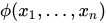
Another reflection principle for ZFC is a theorem schema that can be described as follows:[7][8] Let be a formula with at most free variables . Then ZFC proves that

where denotes the relativization of to (that is, replacing all quantifiers appearing in of the form and by and , respectively).

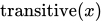
Another form of the reflection principle in ZFC says that for any finite set of axioms of ZFC we can find a countable transitive model satisfying these axioms. (In particular this proves that, unless inconsistent, ZFC is not finitely axiomatizable because if it were it would prove the existence of a model of itself, and hence prove its own consistency, contradicting Gödel's second incompleteness theorem.) This version of the reflection theorem is closely related to the Löwenheim–Skolem theorem.

If is a strong inaccessible cardinal, then there is a closed unbounded subset of , such that for every , is an elementary substructure of .[9]

As new axioms

[edit]

Large cardinals

[edit]

Reflection principles are connected to and can be used to motivate large cardinal axioms. Reinhardt gives the following examples, using Cantor's informal notion of absolute infinity in place of the universe of sets:[10]

It may be helpful to give some informal arguments illustrating the use of reflection principles.
The simplest is perhaps: the universe of sets is inaccessible (i.e., satisfies the replacement axiom), therefore there is an inaccessible cardinal. This can be elaborated somewhat, as follows. Let enumerate the inaccessible cardinals. By the same sort of reasoning, is not bounded; the Cantor absolute (all ordinals) is an inaccessible above any proposed bound , therefore there is an inaccessible cardinal above . Clearly, then, there are inaccessibles above below ; therefore there is an inaccessible such that there are inaccessibles below it (i.e., ).

Bernays class theory

[edit]

Paul Bernays used a reflection principle as an axiom for one version of set theory (not Von Neumann–Bernays–Gödel set theory, which is a weaker theory). His reflection principle stated roughly that if is a class with some property, then one can find a transitive set such that has the same property when considered as a subset of the "universe" . This is quite a powerful axiom and implies the existence of several of the smaller large cardinals, such as inaccessible cardinals. (Roughly speaking, the class of all ordinals in ZFC is an inaccessible cardinal apart from the fact that it is not a set, and the reflection principle can then be used to show that there is a set that has the same property, in other words that is an inaccessible cardinal.) Unfortunately, this cannot be axiomatized directly in ZFC, and a class theory like Morse–Kelley set theory normally has to be used. The consistency of Bernays's reflection principle is implied by the existence of an ω-Erdős cardinal.

More precisely, the axioms of Bernays' class theory are:[11]

  1. extensionality
  2. class specification: for any formula without free,
  3. subsets:
  4. reflection: for any formula ,
  5. foundation
  6. choice

where denotes the powerset.

According to Akihiro Kanamori,[12]: 62  in a 1961 paper, Bernays considered the reflection schema

for any formula without free, where asserts that is transitive. Starting with the observation that set parameters can appear in and can be required to contain them by introducing clauses into , Bernays just with this schema established pairing, union, infinity, and replacement, in effect achieving a remarkably economical presentation of ZF.

Others

[edit]

Some formulations of Ackermann set theory use a reflection principle. Ackermann's axiom states that, for any formula not mentioning ,[2]

Peter Koellner showed that a general class of reflection principles deemed "intrinsically justified" are either inconsistent or weak, in that they are consistent relative to the Erdös cardinal.[13] However, there are more powerful reflection principles, which are closely related to the various large cardinal axioms. For almost every known large cardinal axiom there is a known reflection principle that implies it, and conversely all but the most powerful known reflection principles are implied by known large cardinal axioms.[11] An example of this is the wholeness axiom,[14] which implies the existence of super-n-huge cardinals for all finite n and its consistency is implied by an I3 rank-into-rank cardinal.

Add an axiom saying that Ord is a Mahlo cardinal — for every closed unbounded class of ordinals C (definable by a formula with parameters), there is a regular ordinal in C. This allows one to derive the existence of strong inaccessible cardinals and much more over any ordinal.

For arithmetic

[edit]

Reflection principles may be considered for theories of arithmetic, which are generally much weaker than ZFC.

Soundness

[edit]

Let denote Peano arithmetic, and denote the set of true sentences in the language of PA that are in the arithmetical hierarchy. Mostowski's reflection theorem is that for each natural number , proves the consistency of . As each set is -definable, this must be expressed as a theorem schema.[15]p. 4 These soundness principles are sometimes referred to as syntactic reflection principles, in contrast to the satisfaction-based varieties mentioned above, which are called semantic reflection principles.[16]p. 1

The local reflection principle for a theory is the schema that for each sentence of the language of , . When denotes the restricted version of the principle only considering those in a class of formulas , we have that and are equivalent over .[17]p. 205

The uniform reflection principle for a theory is the schema that for each natural number , , where is the union of the sets of Gödel-numbers of and formulas, and is with its free variables replaced with numerals , etc. in the language of Peano arithmetic, and is the partial truth predicate for formulas.[17]p. 205

Model reflection

[edit]

For , a -model is a model that has the correct truth values of statements, where is at the th level of the analytical hierarchy. A countable -model of a subsystem of second-order arithmetic consists of a countable set of sets of natural numbers, which may itself be encoded as a subset of . The theory proves the existence of a -model, also known as a -model.[18]Theorem VII.2.16

The -model reflection principle for formulas states that for any formula with as its only free set variable, for all , if holds, then there is a countable coded -model where such that . An extension of by a schema of dependent choice is axiomatized. For any , the system is equivalent to -reflection for formulas.[18]Theorem VII.7.6

-model reflection has connections to set-theoretic reflection, for example over the weak set theory KP, adding the schema of reflection of -formulas to transitive sets ( for all formulas ) yields the same -consequeneces as plus a schema of -model reflection for formulas.[19]


References

[edit]
[edit]
Revisions and contributorsEdit on WikipediaRead on Wikipedia
from Grokipedia
In set theory, the reflection principle asserts that the set-theoretic universe ''V'' is reflected in its initial segments ''V''α for certain ordinals α. Formally, the Lévy–Montague reflection principle is a of with the (ZFC) stating that for any finite set of formulas {φ1, …, φn} in the language of set theory, there exists a club class ''C'' of ordinals such that for every α in ''C'', ''V'' ⊨ φi(a1,…,am) ''V''α ⊨ φi(a1,…,am) for all ''i'', where the ''a''j are sets in ''V''α. This principle, formulated by Azriel Lévy and around 1960, encapsulates the essence of ZFC: together with , separation, and foundation, it is equivalent to the full axioms of ZF (without ). Reflection principles motivate stronger axioms in , such as those implying the existence of large cardinals, and have applications in and arithmetic.

Historical Development and Motivation

Origins in Paradoxes and Early Set Theory

, the founder of , encountered foundational paradoxes in his work on transfinite cardinals during the 1890s, which profoundly influenced the development of reflection principles. His diagonal argument, advanced in 1891, not only proved the uncountability of the real numbers but also revealed structural limitations in assuming a complete of sets, fostering early intuitions about the hierarchical and self-similar nature of the set-theoretic universe. These insights culminated in what is known as , articulated in his 1899 correspondence with , where he demonstrated that no set can contain all cardinalities, as the power set of any purported "set of all sets" would exceed it in size. This contradiction implied that the universal collection V of all sets cannot be a proper set, marking V as an "improper" totality and highlighting the need for principles to reflect properties across its stages without global inconsistencies. Ernst Zermelo's efforts to axiomatize addressed these paradoxes, particularly of 1901, by providing a controlled framework. In his 1908 paper, Zermelo introduced a system of axioms that restricted comprehension to avoid self-referential issues, emphasizing a well-ordered hierarchy of sets built from emptyset through separation and replacement-like operations. This axiomatization served as a precursor to reflection ideas by ensuring that sets are generated cumulatively, preventing the kind of universal pathologies had uncovered, and laying groundwork for viewing the universe as an infinite progression rather than a single totality. Zermelo revisited these themes in , proposing a more dynamic model of the set-theoretic through his of boundary numbers (Grenzzahlen) and domains (Mengenbereiche). In this framework, he described the cumulative as a of models indexed by ordinals, where each stage approximates the full while reflecting its essential . Zermelo argued that to circumvent global definability problems and paradoxes, requires informal reflection mechanisms, ensuring that no single stage fully captures the whole but that properties "reflect" downward to avoid attributing improper uniformity to V. Kurt Gödel extended these historical concerns in his work on the foundations of , emphasizing the indefinability of the true universe within any . He posited that 's inexhaustible nature—stemming from Cantor's paradoxes and Zermelo's hierarchies—renders it impossible to fully characterize. This perspective underscored the philosophical shift toward viewing not as a closed domain but as an open-ended edifice.

Philosophical and Intuitive Foundations

The reflection principle in draws a profound analogy to , which demonstrate that no consistent capable of expressing basic arithmetic can fully capture all truths about the natural numbers within itself. Just as arithmetic cannot be completely axiomatized without leaving some truths unprovable, the universe of all sets, denoted , resists full axiomatization in any finitary theory, prompting reflection principles as a mechanism to approximate global truths through local validations in smaller substructures. This approach mitigates incompleteness by ensuring that statements—asserting the truth of provable sentences—can be incorporated as new axioms, thereby extending the theory without contradiction. At its core, the intuitive underlying reflection posits that for any definable in the language of , its truth in the entire V is mirrored in sufficiently many elementary substructures, such as the initial segments V_α of the cumulative . This ensures a kind of structural continuity, where V resembles its approximations in a way that prevents any formula from uniquely characterizing the whole without also applying to these segments. Such resemblance underscores the iterative conception of sets, where the hierarchy builds ordinally without a definitive endpoint, making reflection a natural safeguard against over-idealized global assertions. Philosophically, reflection principles emerge as a "natural" axiom bridging finitary reasoning—rooted in concrete, constructive proofs—and the transfinite hierarchies of , aligning with Georg Kreisel's 1960s advocacy for informal rigour as a method to rigorously analyze intuitive concepts like set membership and validity. Kreisel viewed reflection as essential for deriving precise axioms from informal notions, such as reflecting truths of the cumulative hierarchy to yield the axioms of Zermelo-Fraenkel , thereby resolving debates on foundational realism versus in mid-20th-century . This perspective positions reflection not as an addition but as an embodiment of the ineffable richness of V, ensuring that no single formula can distinguish the universe from its set-sized approximations without invoking higher-order limitations.

Reflection in ZFC Set Theory

Formal Statement of the Lévy-Montague Principle

The Lévy–Montague reflection principle, provable as a theorem in Zermelo–Fraenkel set theory with the axiom of choice (ZFC), asserts that the universe of sets VV is approximated by its initial segments in the cumulative hierarchy. Specifically, for any finite collection of formulas ϕ1(x),,ϕn(x)\phi_1(\mathbf{x}), \dots, \phi_n(\mathbf{x}) in the language of set theory (where x=x1,,xm\mathbf{x} = x_1, \dots, x_m) and any sets a1,,amVa_1, \dots, a_m \in V, there exists a limit ordinal α\alpha such that Vαϕi[a1,,am]    Vϕi[a1,,am]V_\alpha \models \phi_i[a_1, \dots, a_m] \iff V \models \phi_i[a_1, \dots, a_m] for each i=1,,ni = 1, \dots, n, with all ajVαa_j \in V_\alpha. This biconditional ensures that truth for these formulas is preserved between the level VαV_\alpha and the entire universe VV. A weaker, global version of the principle states that for any formula ϕ(x)\phi(\mathbf{x}) and any a1,,amVa_1, \dots, a_m \in V, if Vϕ[a1,,am]V \models \phi[a_1, \dots, a_m], then there exists an ordinal α\alpha such that Vαϕ[a1,,am]V_\alpha \models \phi[a_1, \dots, a_m]. This one-directional reflection captures the idea that every true statement in VV is realized at some stage of the . The principle applies within the cumulative hierarchy V=αOrdVαV = \bigcup_{\alpha \in \mathrm{Ord}} V_\alpha, where V0=V_0 = \emptyset, Vβ+1=P(Vβ)V_{\beta+1} = \mathcal{P}(V_\beta), and Vλ=β<λVβV_\lambda = \bigcup_{\beta < \lambda} V_\beta for limit ordinals λ\lambda; its proof relies on ZFC's axioms of (ensuring the existence of infinite ordinals) and replacement (facilitating the construction of higher levels). The principle provides reflecting models VαV_\alpha for limit ordinals α\alpha, including uncountable ones, via ZFC alone. Countable elementary submodels are also guaranteed by the applied to transitive collapses of Skolem hulls.

Proof and Key Properties

The proof of the Lévy-Montague reflection principle in ZFC proceeds by transfinite induction on the syntactic complexity of the set-theoretic formulas, establishing that for any formula ϕ(x)\phi(\mathbf{x}), the class of limit ordinals α\alpha such that VαV_\alpha reflects ϕ\phi (meaning Vϕ(a)V \models \phi(a) if and only if Vαϕ(a)V_\alpha \models \phi(a) for all aVα\mathbf{a} \in V_\alpha) forms a closed unbounded (club) class in the ordinals. For atomic formulas, the reflecting class is all ordinals, as relativization preserves equality and membership. For Boolean combinations, the reflecting class is the intersection (or the same class) of those for the components, which remains club. For existential quantifiers ϕ(x)=yψ(x,y)\phi(\mathbf{x}) = \exists y \, \psi(\mathbf{x}, y), one uses the axiom of replacement to define, for each x\mathbf{x}, the least rank where a witness yy appears in the cumulative hierarchy, and then the supremum function F(β)=sup{G(x)xVβ}F(\beta) = \sup \{ G(\mathbf{x}) \mid \mathbf{x} \in V_\beta \} over initial segments; the reflecting class is then the intersection of the class for ψ\psi with the limit ordinals closed under FF, ensuring witnesses remain internal to VαV_\alpha while preserving absoluteness of satisfaction under replacement. This inductive construction relies on the absoluteness of the truth definition for bounded quantifiers and the replacement schema to bound ranks of witnesses, yielding a club class by the closure properties of limit ordinals and unboundedness from the axiom of infinity. For a finite collection of formulas {ϕ1,,ϕk}\{\phi_1, \dots, \phi_k\} comprising a finite fragment of ZFC, the set of ordinals α\alpha where VαV_\alpha reflects all ϕi\phi_i simultaneously is the finite of the individual club classes, which is itself club; thus, there are stationarily many such α\alpha, and in particular, arbitrarily large ones. Mostowski collapse is not directly invoked in this core argument but supports the transitive nature of the VαV_\alpha models, as the cumulative hierarchy is well-founded by the axiom of foundation. enters indirectly via the finite axiomatizability of fragments, ensuring the reflection holds for any consistent finite subsystem without assuming global consistency. A key property of the principle is that it implies the existence of arbitrarily large ordinals α\alpha such that VαV_\alpha satisfies any given finite fragment of ZFC, demonstrating that no single formula or finite set fully characterizes the universe VV. As a corollary, ZFC proves the existence of transitive models of any finite subsystem of itself, namely the VαV_\alpha for sufficiently large α\alpha in the corresponding club; this links to Skolem hulls, where the countable Skolem hull of VV (or initial segments) yields countable elementary submodels reflecting finite fragments, facilitating downward Löwenheim-Skolem arguments within ZFC. For a fixed formula ϕ\phi, the reflection map associating to each ordinal α\alpha the initial segment {β<αVβ reflects ϕ}\{\beta < \alpha \mid V_\beta \text{ reflects } \phi\} yields a club set, as the full class of reflecting ordinals is club and closed under limits below α\alpha.

Stronger Reflection Principles as Axioms

Implications for Large Cardinals

Stronger reflection principles, extending beyond the version provable in ZFC, function as axioms that assert the existence of large cardinals and form a hierarchy ordered by consistency strength, starting from principles equivalent to inaccessible cardinals and ascending to those comparable to supercompact cardinals. The global reflection principle states that for every formula φ in the language of and parameters from V, there exists an κ such that V_κ reflects φ. This principle is equivalent to the existence of inaccessible cardinals. Azriel Lévy in the and Paul Bernays in developed enhanced reflection principles. Lévy's , involving reflection of certain definable to initial segments, is equivalent to the existence of inaccessible cardinals. Bernays' stronger principle, incorporating class reflection for stationary sets of ordinals, implies the existence of Mahlo cardinals, characterized by the stationarity of the set of regular cardinals below them, thereby reflecting the regularity property across stationary subsets. The reflection scheme asserting that for every formula there is a reflecting ordinal provides models for ZFC up to certain strengths. Stronger variants, such as structural reflection principles applied to elementary embeddings, yield n-huge cardinals, where for n ≥ 1, a cardinal κ is n-huge if there is an elementary embedding j: V → M with critical point κ such that the n-th iterate satisfies j^n(κ) ⊆ M, reflecting properties across iterated extensions. These principles escalate in strength, with certain forms equivalent to huge cardinals and beyond, up to supercompact equivalents in the large cardinal hierarchy.

Role in Bernays Class Theory

In Bernays' axiomatization of set theory from 1937 to 1940, proper classes are treated as primitive alongside sets, with axioms including global choice and impredicative comprehension schemas that allow quantification over all classes to define new classes. This framework, later formalized as von Neumann–Bernays–Gödel (NBG) set theory, incorporates reflection principles to ensure that properties expressible with class parameters hold in set-sized models, leveraging the global nature of class comprehension to extend ZFC's reflective capabilities beyond pure sets. In NBG, the reflection principle for class formulas—stating that for any formula ϕ with class quantifiers and parameters, there exists a transitive set u such that the power set of u reflects the truth of ϕ restricted to u—implies the existence of inaccessible cardinals within the universe of sets V. Specifically, Π_m-Bernays reflection for finite m yields a of cardinals stronger than inaccessibles, as each level corresponds to Π_m^1-indescribable cardinals, ensuring fixed points of the inaccessible function and thus a proper class of such cardinals under iterated reflection. In Morse–Kelley (MK) class theory, which extends NBG by allowing impredicative class comprehension with full second-order quantification, strong reflection axioms for first- and second-order formulas are provable as theorems, establishing the consistency of ZFC and the of models satisfying it. However, augmenting MK with a global class reflection principle—that every class-definable property of V holds in some V_α for α a limit ordinal—proves the of many inaccessible cardinals, as the reflection iterates to produce a chain of elementary submodels unbounded in the ordinals. A key implication of such class reflection in Bernays-style theories is that it equates to the universe V being indescribable, meaning V reflects all Π_1^m sentences with class parameters down to set-sized initial segments, akin to the global analog of indescribable cardinals. This connection highlights limitations, as Kunen's 1971 inconsistency theorem demonstrates that stronger forms of reflection, such as those implying nontrivial elementary embeddings j: V → V, lead to contradictions in ZFC extended with global choice.

Other Extensions and Variants

In Ackermann set theory, the core functions as a reflection principle, often referred to as Ackermann's reflection, which asserts that for any definable class of sets, there exists a set that reflects its properties in a manner akin to the wholeness . This ensures that no can fully define the of sets VV or the class of all ordinals, thereby embodying Cantor's notion of the unknowability of the Absolute. Unlike ZFC, it avoids the full of replacement by restricting comprehension to definable subclasses, yet it proves equivalent to ZF . Ackermann's reflection aligns with structural properties but does not imply large cardinals beyond those of ZF. Lévy extended reflection principles to handle axiom schemas by formulating them as infinite conjunctions, ensuring that the entire schema reflects into transitive sets. Specifically, for any axiom schema Σ\Sigma of ZFC, the principle states that there exists a transitive set MM such that MM satisfies the infinite conjunction of all instances of Σ\Sigma, capturing the full logical strength of the schema in a single model. This variant, part of Lévy's schemata of strong infinity, has consistency strength strictly above ZFC but relative to ZFC plus the existence of a strongly inaccessible cardinal, as the reflection requires models closed under the schema's operations up to inaccessible heights. Post-2000 developments have explored indescribability hierarchies as generalized forms of reflection, where Πnm\Pi_n^m-indescribable cardinals κ\kappa satisfy that for any Πnm\Pi_n^m sentence ϕ\phi true in VκV_\kappa, there exists α<κ\alpha < \kappa such that ϕ\phi holds in VαV_\alpha. These hierarchies extend the basic Lévy-Montague reflection by restricting to specific syntactic classes of formulas, yielding a fine-grained ladder of large cardinals between weakly compacts and subtler strengths like totally indescribable cardinals. Recent work equates certain structural reflection principles to these hierarchies, showing their equivalence to embeddings preserving infinitary formulas up to level nn and quantifier complexity mm. Marginally, Koepke's investigations around 2010 into reflection principles within set theories incorporating urelements highlight adaptations for non-well-founded or urelement-extended universes, though these remain peripheral to mainstream extensions due to their limited impact on core set-theoretic hierarchies.

Applications to Arithmetic and Logic

Reflection Principles for Peano Arithmetic

In Peano Arithmetic (PA), reflection principles adapt the intuitive notion from —where properties of the entire universe are mirrored in smaller substructures—to ensure that provable statements hold in finite models derived from finite fragments of the theory. Unlike set-theoretic reflection, which relies on the cumulative hierarchy of sets, arithmetic reflection leverages the recursive axiomatizability of PA and the completeness of to link provability to realizability in concrete, finite structures. A foundational result in this area is that every sentence provable in PA holds true in some finite model. Specifically, since any proof in PA employs only finitely many instances of the induction schema and other axioms, there exists a finite S of PA's axioms such that PA ⊢ φ if and only if S ⊢ φ; the consistent finite theory S admits a finite model M, as it is satisfied by a sufficiently large finite initial segment of the natural numbers, and thus M ⊧ φ. This result underscores that PA's theorems are not merely abstract consequences but are verifiable in bounded, computational settings, providing a form of finitary justification for arithmetic reasoning. The strong reflection principle extends this idea to finite collections of axioms directly: for any finite set S of PA axioms, there exists a finite model N such that N realizes the truths provable from S, meaning N satisfies all sentences derivable from S. This follows from the same finitary consistency argument, where PA itself proves the consistency of such S (i.e., PA ⊢ Con(S)), ensuring the existence of N via a satisfaction relation definable in arithmetic. Formally, the core statement of reflection in PA can be expressed as: if PA ⊢ φ, then there exists a finite model M with M ⊧ φ; this ties directly to the properties of finite axiomatic fragments, as the proof length bounds the size of the required model. These reflection principles for PA are provable within weaker systems such as (PRA), which suffices to establish the existence of finite models for finite fragments through primitive recursive searches for satisfying assignments. However, adopting stronger uniform reflection schemes—such as the full schema Pr_{PA}("φ") → φ over all formulas—leads to significant consistency implications, including the consistency of PA itself, by Gödel's second incompleteness theorem.

Model Reflection and Soundness

In , model reflection manifests as the property that every consistent theory admits models in which arithmetic sentences are evaluated with respect to the standard natural numbers N\mathbb{N}, thereby reflecting their true semantic value. Full second-order semantics ensures that the domain of individuals is always the standard ω\omega, so any model (N,P)( \mathbb{N}, \mathcal{P} ) of a consistent theory TT extending the axioms of interprets arithmetic sentences standardly, independent of the collection P\mathcal{P} of second-order objects. Consequently, if TϕT \vdash \phi for an arithmetic sentence ϕ\phi, then ϕ\phi holds in N\mathbb{N}, as the model's satisfaction relation for arithmetic aligns precisely with standard truth. This model-theoretic setup implies the soundness of Peano arithmetic (PA) relative to the consistency of stronger theories. Specifically, reflection principles in , which formalize the adequacy of proofs via satisfaction predicates, entail that PA proves no false theorems about N\mathbb{N}. Georg Kreisel's foundational work on partial truth predicates, introduced to unwind non-finitist proofs into finitist terms, provides the key mechanism: these predicates define truth for bounded classes of formulas (e.g., Σn\Sigma_n) within arithmetic, allowing reflection schemas to capture partial . By PA into and leveraging model reflection, Kreisel demonstrated that the existence of such models implies PA's global , as any purported false theorem would contradict the standard interpretation in the model. A central formalization of this is the reflection scheme for PA: for each arithmetic formula ϕ(x1,,xk)\phi(x_1, \dots, x_k), PA reflects ϕ\phi if PA x(ϕ(x)TrueN(ϕ,x))\vdash \forall \vec{x} \, (\phi(\vec{x}) \to \mathrm{True}_{\mathbb{N}}(\ulcorner \phi \urcorner, \vec{x}))
Add your contribution
Related Hubs
User Avatar
No comments yet.




