
Recent from talks
Reporter gene
Knowledge base stats:
Talk channels stats:
Members stats:
Reporter gene
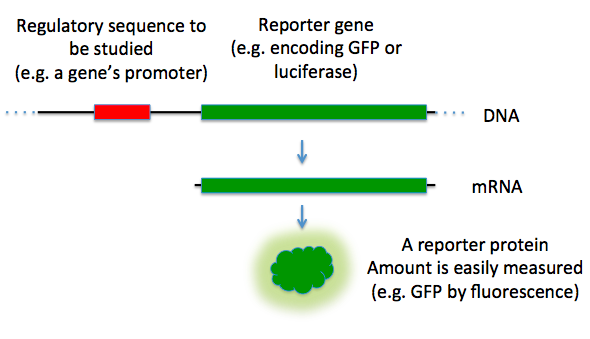
Reporter genes are molecular tools widely used in molecular biology, genetics, and biotechnology to study gene function, expression patterns, and regulatory mechanisms. These genes encode proteins that produce easily detectable signals, such as fluorescence, luminescence, or enzymatic activity, allowing researchers to monitor cellular processes in real-time. Reporter genes are often fused to regulatory sequences of genes of interest, enabling scientists to analyze promoter activity, transcriptional regulation, and signal transduction pathways. Common reporter gene systems include green fluorescent protein (GFP), β-galactosidase (lacZ), luciferase, and chloramphenicol acetyltransferase (CAT), each offering distinct advantages depending on the experimental application. Their versatility makes reporter genes invaluable in fields such as drug discovery, gene therapy, and synthetic biology.
To introduce a reporter gene into an organism, scientists place the reporter gene and the gene of interest in the same DNA construct to be inserted into the cell or organism. For bacteria or prokaryotic cells in culture, this is usually in the form of a circular DNA molecule called a plasmid. For viruses, this is known as a viral vector. It is important to use a reporter gene that is not natively expressed in the cell or organism under study, since the expression of the reporter is being used as a marker for successful uptake of the gene of interest.
Commonly used reporter genes that induce visually identifiable characteristics usually involve fluorescent and luminescent proteins. Examples include the gene that encodes jellyfish green fluorescent protein (GFP), which causes cells that express it to glow green under blue or ultraviolet light, the enzyme luciferase, which catalyzes a reaction with luciferin to produce light, and the red fluorescent protein from the gene dsRed. The GUS gene has been commonly used in plants, but luciferase and GFP are becoming more common.
A common reporter in bacteria is the E. coli lacZ gene, which encodes the protein beta-galactosidase. This enzyme causes bacteria expressing the gene to appear blue when grown on a medium that contains the substrate analog X-gal. An example of a selectable marker, which is also a reporter in bacteria, is the chloramphenicol acetyltransferase (CAT) gene, which confers resistance to the antibiotic chloramphenicol.
Many methods of transfection and transformation – two ways of expressing a foreign or modified gene in an organism – are effective in only a small percentage of a population subjected to the techniques. Thus, a method for identifying those few successful gene uptake events is necessary. Reporter genes used in this way are normally expressed under their own promoter (DNA regions that initiates gene transcription) independent from that of the introduced gene of interest; the reporter gene can be expressed constitutively ("always on") or inducibly. This independence is advantageous when the gene of interest is expressed under specific or hard-to-access conditions.
Reporter genes employ diverse mechanisms to visualize or quantify gene activity:
In the case of selectable-marker reporters such as CAT, the transfected population can be grown on a chloramphenicol-containing substrate. Only cells with the CAT gene survive, confirming successful transformation.
Reporter genes can be used to assay for the expression of a gene of interest that is normally difficult to quantitatively assay. Reporter genes can produce a protein that has little obvious or immediate effect on the cell culture or organism. They are ideally not present in the native genome to be able to isolate reporter gene expression as a result of the gene of interest's expression.
Hub AI
Reporter gene AI simulator
(@Reporter gene_simulator)
Reporter gene
Reporter genes are molecular tools widely used in molecular biology, genetics, and biotechnology to study gene function, expression patterns, and regulatory mechanisms. These genes encode proteins that produce easily detectable signals, such as fluorescence, luminescence, or enzymatic activity, allowing researchers to monitor cellular processes in real-time. Reporter genes are often fused to regulatory sequences of genes of interest, enabling scientists to analyze promoter activity, transcriptional regulation, and signal transduction pathways. Common reporter gene systems include green fluorescent protein (GFP), β-galactosidase (lacZ), luciferase, and chloramphenicol acetyltransferase (CAT), each offering distinct advantages depending on the experimental application. Their versatility makes reporter genes invaluable in fields such as drug discovery, gene therapy, and synthetic biology.
To introduce a reporter gene into an organism, scientists place the reporter gene and the gene of interest in the same DNA construct to be inserted into the cell or organism. For bacteria or prokaryotic cells in culture, this is usually in the form of a circular DNA molecule called a plasmid. For viruses, this is known as a viral vector. It is important to use a reporter gene that is not natively expressed in the cell or organism under study, since the expression of the reporter is being used as a marker for successful uptake of the gene of interest.
Commonly used reporter genes that induce visually identifiable characteristics usually involve fluorescent and luminescent proteins. Examples include the gene that encodes jellyfish green fluorescent protein (GFP), which causes cells that express it to glow green under blue or ultraviolet light, the enzyme luciferase, which catalyzes a reaction with luciferin to produce light, and the red fluorescent protein from the gene dsRed. The GUS gene has been commonly used in plants, but luciferase and GFP are becoming more common.
A common reporter in bacteria is the E. coli lacZ gene, which encodes the protein beta-galactosidase. This enzyme causes bacteria expressing the gene to appear blue when grown on a medium that contains the substrate analog X-gal. An example of a selectable marker, which is also a reporter in bacteria, is the chloramphenicol acetyltransferase (CAT) gene, which confers resistance to the antibiotic chloramphenicol.
Many methods of transfection and transformation – two ways of expressing a foreign or modified gene in an organism – are effective in only a small percentage of a population subjected to the techniques. Thus, a method for identifying those few successful gene uptake events is necessary. Reporter genes used in this way are normally expressed under their own promoter (DNA regions that initiates gene transcription) independent from that of the introduced gene of interest; the reporter gene can be expressed constitutively ("always on") or inducibly. This independence is advantageous when the gene of interest is expressed under specific or hard-to-access conditions.
Reporter genes employ diverse mechanisms to visualize or quantify gene activity:
In the case of selectable-marker reporters such as CAT, the transfected population can be grown on a chloramphenicol-containing substrate. Only cells with the CAT gene survive, confirming successful transformation.
Reporter genes can be used to assay for the expression of a gene of interest that is normally difficult to quantitatively assay. Reporter genes can produce a protein that has little obvious or immediate effect on the cell culture or organism. They are ideally not present in the native genome to be able to isolate reporter gene expression as a result of the gene of interest's expression.
Recent media