Hubbry Logo
DiadectomorphaDiadectomorphaMain
Open search
Diadectomorpha
Community hub
Diadectomorpha
logo
8 pages, 0 posts
0 subscribers
Be the first to start a discussion here.
Diadectomorpha
Diadectomorpha
from Wikipedia

Diadectomorphs
Temporal range: Late Carboniferous–Wuchiapingian [1]
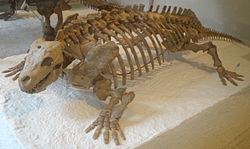
Skeleton of Diadectes sideropelicus in the American Museum of Natural History
Skeleton of Limnoscelis paludis
Scientific classification Edit this classification
Kingdom: Animalia
Phylum: Chordata
Clade: Reptiliomorpha
Order: Diadectomorpha
Watson, 1917
Subgroups

See text.

Diadectomorpha is a clade of large tetrapods that lived in Euramerica during the Carboniferous and Early Permian periods and in Asia during Late Permian (Wuchiapingian),[1] They have typically been classified as advanced reptiliomorphs (transitional between "amphibians" sensu lato and amniotes) positioned close to, but outside of the clade Amniota, though some recent research has recovered them as the sister group to the traditional Synapsida within Amniota, based on inner ear anatomy and cladistic analyses.[2][3][4][5] They include both large (up to 2 meters long) carnivorous and even larger (to 3 meters) herbivorous forms, some semi-aquatic and others fully terrestrial. The diadectomorphs seem to have originated during late Mississippian times, although they only became common after the Carboniferous rainforest collapse and flourished during the Late Pennsylvanian and Early Permian periods.

Anatomy

[edit]
Life restoration of Limnoscelis

Diadectomorphs possessed both amphibian-like and amniote-like characteristics. Originally these animals were included under the order Cotylosauria, and were considered the most primitive and ancestral lineage of reptiles. More recently they have been reclassified either as non-amniote reptiliomorphs lying just outside the clade Amniota, or as early-diverging synapsids (members of the amniote group containing mammals and their extinct relatives).[2][3][5] Contrary to other non-amniote reptiliomorphs, the teeth of the Diadectomorpha lacked the infolding of the dentine and enamel that account for the name Labyrinthodontia for the non-amniote tetrapods.[6]

Classification

[edit]

Diadectomorpha is most commonly given the rank of order when formal taxonomic ranks are applied. It is further divided into three families, representing specialization into different ecological niches. The exact phylogenetic relationship between the three is disputed.[7]

  • The family Diadectidae is perhaps the best known group, comprising medium to large herbivores. Early members were low-slung, but the latter Diadectes (from which the whole group take its name) evolved strong, if sprawling legs, paralleling the anatomy of early herbivorous reptiles. The teeth were chisel-like and lacked the typical labyrinthodont infolding of the enamel. Diadectids were distributed over most of the Northern parts of Pangaea.
  • The family Limnoscelidae contained large carnivores or piscivores. The largest genus, Limnoscelis could grow to at least 1.5 meters. The family had pointed and slightly curved teeth with labyrinthodont enamel.[8] Distribution seem to have been restricted to North America.
  • The family Tseajaiidae, known from a single specimen from North America, were medium-sized, generalized reptiliomorphs. They had blunt teeth and appear to be primarily herbivorous or omnivorous. The known specimen would have been on the order of a meter (3 ft.) long.[9]

Below is a cladogram modified from the 2010 analysis:[1]

Diadectomorpha

Reproduction and the origin of Amniota

[edit]
Life restoration of Diadectes

The reproduction of the Diadectomorphs has been the matter of some debate.[10] If their group lay within the Amniota as has at times been assumed, they would have laid an early version of the amniote egg. Current thinking favours the amniote egg being evolved in very small animals, like Westlothiana or Casineria, leaving the bulky Diadectomorphs just on the amphibian side of the divide.[11][12][13][14]

This would indicate the large and bulky diadectomorphs laid anamniote eggs (in water). However, no unambiguously diadectomorph tadpole is known. Whether this is due to an actual lack of tadpole stage or taphonomy (many diadectomorphs were upland creatures where tadpoles would have a poor probability of being fossilized) is uncertain. Alfred Romer indicated that the anamniote/amniote divide might not have been very sharp, leaving the question of the actual mode of reproduction of these large animals unanswered.[15] Possible reproductive modes include full amphibian spawning with aquatic tadpoles, internal fertilization with or without ovoviviparity, aquatic eggs with direct development or some combination of these. The reproductive mode might also have varied within the group.

Lee and Spencer (1997) argued diadectomorphs probably laid amniote eggs because their adaptations to feed on terrestrial plants rich on fiber mean they were adapted to a niche not seen in unambiguous 'amphibians', and would have required an early acquisition of terrestrial endosymbionts necessary for this diet that supposedly could not have happened if young diadectomorphs were aquatic larvae.[16]

David Berman (2013) ran a phylogenetic analysis, and in this study the analysis resulted in Diadectomorpha being inside amniota as a sister taxon to Synapsida.[17]

References

[edit]
[edit]
Revisions and contributorsEdit on WikipediaRead on Wikipedia
from Grokipedia
Diadectomorpha is an extinct of large-bodied, primarily herbivorous early tetrapods that lived during the Late Carboniferous to Late Permian epochs, approximately 310 to 256 million years ago, and is widely regarded as a key group in understanding the origins of amniotes. These vertebrates are characterized by robust skulls with deep lower jaws and specialized dentition adapted for cropping and grinding tough, high-fiber plant material, marking them as the earliest known tetrapods to evolve such herbivory, which supported their role in late terrestrial ecosystems. Their includes a barrel-shaped likely accommodating an enlarged digestive tract, strong limbs suited for terrestrial locomotion, and features like epidermal scales that hint at early amniote-like adaptations, including recent evidence of horned scales in diadectids. Fossils and trackways of diadectomorphs have been found across equatorial Pangea, including (e.g., ), (e.g., , ), , , and recently Eastern , indicating a broad distribution in warm, humid environments. Phylogenetically, Diadectomorpha's position remains debated but is often placed as the to crown-group Amniota, potentially representing stem-amniotes or early-diverging synapsids within Amniota; some analyses recover them as sister to Synapsida specifically. The clade comprises several families, including the Diadectidae (e.g., , Orobates pabsti, Alveusdectes fenestralis), Limnoscelidae (e.g., ), and Tseajaiidae, with around 13 recognized species, the last known being Alveusdectes from the Upper Permian of , extending the group's temporal range by about 16 million years beyond previous records. Transitional forms in the earliest Permian, such as those inferred from trackways like Ichniotherium cottae and I. sphaerodactylum, reveal evolutionary shifts in posture and locomotion, bridging more basal diadectomorphs to advanced forms. Diadectomorpha's evolutionary significance lies in their contribution to the transition from amphibian-like to fully terrestrial amniotes, including the development of costal respiration and high-fiber herbivory that influenced modern terrestrial food webs; their "ghost lineages" suggest a longer unrecorded history, highlighting gaps in the record. Recent discoveries, such as new species like Diadectes dreigleichenensis from and diadectomorphs from , continue to refine their and , underscoring their role in Permo-Carboniferous .

Discovery and Fossil Record

Historical Discoveries

The initial discoveries of diadectomorph fossils occurred during the late 19th century in , amid the competitive fossil prospecting of the between paleontologists and . The genus Diadectes, now recognized as the namesake of the group, was first described by Cope in 1878 based on a partial lower (AMNH 4360) collected from the Early Permian Clear Fork Formation in ; this specimen featured distinctive multicusped teeth indicative of herbivory. Earlier that year, Marsh had briefly named similar dental material from the same Texas as Nothodon, but Cope's more detailed description and surviving type specimen established Diadectes as the valid name. Cope formally erected the family Diadectidae in 1880 to accommodate these and related forms, initially classifying them within the broader reptilian order Cotylosauria based on their robust, lizard-like skeletons. Subsequent early 20th-century finds expanded the known diversity of diadectomorphs, particularly in the Upper and Lower Permian strata of the . In 1908, Ermine Cowles Case described the genus Desmatodon from isolated teeth and jaw fragments collected from the Late Madera Group (now part of the Sangre de Cristo Formation) in , marking one of the stratigraphically oldest diadectomorph records and confirming the group's presence in pre-Permian deposits. Other genera, such as (Case, 1911) from the Cutler Formation in and , and Tseajaia (Vaughn, 1969) from the Cutler Formation in , were added through excavations in the American Southwest, revealing a range of body sizes and cranial variations among these early tetrapods. These discoveries highlighted diadectomorphs' role as transitional forms between amphibians and amniotes, with their fossils often preserved in red bed deposits signaling arid post- environments. The recognition of Diadectomorpha as a distinct clade came in 1917, when David M. S. Watson coined the name in a study of tetrapod shoulder girdles and forelimbs, grouping Diadectes and allies as a suborder based on shared postcranial features like robust limbs adapted for terrestrial locomotion. European contributions began with fragmentary remains from Germany in the early 20th century, but significant body fossils emerged later; in 1974, Thomas Martens discovered the first articulated diadectomorph skeletons at the Bromacker locality in the Early Permian Tambach Formation of Thuringia, yielding exceptionally preserved specimens that revolutionized understanding of their anatomy and ecology. This site, quarried since the 19th century for tracks but only systematically explored for bones from the 1990s onward, produced key taxa like Orobates pabsti (Berman et al., 2004), underscoring diadectomorphs' global distribution in Euramerica during the Late Paleozoic.

Recent Findings

In 2023, researchers described the first diadectomorph trackways from the Asselian stage of the early Permian in the Intra-Sudetic Basin of southwestern , providing evidence of 'transitional' forms in equatorial Pangea. The specimens include a 14-track trackway of the ichnotaxon Ichniotherium cottae from the Veverská Bítýška Formation at Čebín, featuring six manus-pes couples with Diadectes-like morphology but Orobates-like track spacing, and a manus-pes couple of Ichniotherium sphaerodactylum from the Padochov Formation at Zbýšov. These tracks, attributed to diadectomorphs based on their pentadactyl impressions and gait patterns, represent the most complete Asselian diadectomorph record and the second European occurrence of I. sphaerodactylum, suggesting early diversification and locomotor evolution in the clade shortly after the Carboniferous-Permian boundary. Also in 2023, a reassessment the first diadectomorph tetrapod from , reassigning the vertebra-based Stephanospondylus traati (previously classified under Bolosauridae) to Diadectidae from the Asselian marine carbonates of the Mylva locality in the , . This basal diadectid, characterized by primitive cheek tooth morphology and a simple tooth pattern, indicates an early widespread distribution of Diadectidae across and supports their role as pioneer herbivores in Permian ecosystems. A major taxonomic revision in 2024 erected two new diadectomorph taxa from early Permian sites, enhancing understanding of clade diversity and herbivory origins. Diadectes dreigleichenensis, based on a partial skeleton (MB.Am.9000) from the Tambach Formation at the Bromacker locality in , (late Asselian or Sakmarian, ~290 million years old), features a shallow , triangular coronoid process, and surangular , placing it within as a sister to North American species. Additionally, the New Mexico specimen 'Diadectes' sanmiguelensis was reclassified as the new genus Kuwavaatakdectes sanmiguelensis, distinguished by unique vertebral and dental traits. A phylogenetic of 61 operational taxonomic units and 341 characters recovered Diadectomorpha as the to Synapsida within , with costal respiration inferred as a key adaptation enabling sustained herbivory in early tetrapods. These findings highlight the Bromacker fauna's herbivore-dominated assemblage and refine the tempo of amniote diversification. In May 2024, a rare impression associated with diadectid tracks was reported from the early Permian Słupiec Formation in the Piaskowiec Czerwony near Bieganów, southwest . The specimen (Muz.PIG.1732.II.54), a 20 × 80 cm slab preserving Ichniotherium cottae footprints alongside scaly impressions, reveals the first evidence of horned epidermal scales in diadectids, with conical projections up to 1 mm high suggesting corneous structures homologous to those in modern reptiles. This discovery, attributed to a diadectid trackmaker based on track morphology, implies an early origin of such in stem s, potentially aiding in or protection for herbivorous lifestyles near the amniote crown.

Taxonomy

Families and Genera

Diadectomorpha is traditionally divided into three families: Diadectidae, Limnoscelidae, and Tseajaiidae, based on cranial and postcranial morphological differences that distinguish their evolutionary lineages within the . These families encompass all known genera, reflecting a relatively low diversity for the group, with most taxa known from fragmentary but diagnostic fossils from Late to Early Permian deposits in and . The family Diadectidae, the most species-rich within Diadectomorpha, includes the genera Diadectes, Orobates, Kuwavaatakdectes, and Desmatodon. Diadectes is the nominal genus, comprising multiple species such as D. absitus from the Early Permian Bromacker locality in and the newly described D. dreigleichenensis from the Bromacker locality in , the latter representing a smaller-bodied form with distinct dental features. Orobates pabsti, known from well-preserved skeletons in , is notable for its trackway associations suggesting quadrupedal locomotion. Kuwavaatakdectes sanmiguelensis, recently erected as a new genus to accommodate material previously assigned to Diadectes sanmiguelensis, features a more gracile build and is based on specimens from the Early Permian Cutler Formation of . Desmatodon hesperis, the oldest known diadectid from the Late of , rounds out the family, represented by dentulous fragments indicating herbivorous adaptations. Limnoscelidae is monotypic, containing only the Limnoscelis, with the L. paludis from the Early Permian of ; this is characterized by robust limbs and a sprawling gait, distinguishing it from the more upright diadectids. Similarly, Tseajaiidae includes a single , Tseajaia, known from two : T. brevinasalis and T. campii, both from the Late of , with elongate skulls and reduced dentition suggesting an early divergence within the clade. Recent taxonomic revisions, including the recognition of Kuwavaatakdectes and D. dreigleichenensis, have refined the classification by incorporating phylogenetic analyses of cranial metrics and postcranial proportions, resolving previous uncertainties in generic assignments and emphasizing Diadectidae as the core of the group's diversity. No additional families or genera have been proposed beyond these, underscoring the conservative evolutionary history of Diadectomorpha.

Nomenclatural Revisions

The genus Diadectes, the namesake of the clade, was established by Edward Drinker Cope in 1878 based on a partial lower jaw from the early Permian of Texas, with the name deriving from Greek roots meaning "crosswise biter" in reference to the transverse orientation of its molariform teeth. However, Othniel Charles Marsh had described similar material as Nothodon earlier in 1878, granting it nomenclatural priority, though it was later synonymized with Diadectes under ICZN Article 23.2 to promote taxonomic stability. Cope formalized the family Diadectidae in 1880 to encompass these early-diverging tetrapods, initially classified among the "cotylosaurs" as primitive reptiles. The higher taxon Diadectomorpha was coined by David M. S. Watson in 1917 to group Diadectes with related forms like Limnoscelis and Tseajaia, recognizing their shared derived features such as robust postcranial skeletons and herbivorous dentition, distinct from temnospondyls and other basal tetrapods. Early 20th-century revisions, including those by Alfred Sherwood Romer (1928) and Everett C. Olson (1947), refined species-level taxonomy within Diadectes, synonymizing numerous junior names (e.g., Bolbodon, Empedias, Diadectoides) under a core of five valid species: D. sideropelicus, D. tenuitectes, D. zenos, D. lentus, and D. carinatus, though the latter two were noted as tentatively distinct due to limited material. Subsequent phylogenetic analyses in the late , such as those by Michel Laurin and Robert R. Reisz (1995), confirmed Diadectidae as monophyletic within Diadectomorpha and positioned the clade as the to crown-group Amniota, prompting nomenclatural adjustments to reflect stem-amniote affinities rather than reptilian status. In 2004, David S. Berman and colleagues erected Orobates pabsti as a new diadectid genus from the early Permian of , based on complete skeletons exhibiting advanced locomotor adaptations, expanding the recognized diversity beyond North American taxa. Robert A. Kissel's 2010 dissertation proposed significant revisions, including new genera Oradectes for Diadectes sanmiguelensis (from the Cutler Formation of ) and Silvadectes for D. absitus (from the Bromacker locality in ), alongside synonymizing Diasparactus zenos with Diadectes; however, these names remained nomina nuda due to lack of formal publication. Additionally, Kissel described Ambedus pusillus as a new diminutive genus from the Late of , representing the earliest known diadectid and extending the group's temporal range. A comprehensive cladistic analysis by Jasper Ponstein and colleagues revised diadectomorph further, rendering Diadectes paraphyletic and erecting Kuwavaatakdectes gen. nov. (etymology combining Ute "kuwavaatak" for edge and Latin "dectes" for biter, referencing a unique splenial morphology) to accommodate K. sanmiguelensis comb. nov., formerly Diadectes sanmiguelensis. They also established Diadectes dreigleichenensis sp. nov. (etymology after the "Drei Gleichen" region in ) from Bromacker material previously assigned to D. absitus, distinguished by features like the absence of a labial on the and an interdigitated angular-prearticular suture. This study retained Diasparactus zenos as a valid distinct due to unique postcranial traits, such as elongate neural spines, and upheld the of Diadectomorpha inclusive of Limnoscelidae, positioning it as the sister clade to Synapsida within Amniota.

Phylogeny

Position Within Tetrapoda

Diadectomorpha occupies a pivotal position within , a major clade of tetrapods that includes amniotes and their close relatives, bridging early limbed vertebrates and the fully terrestrial amniote radiation. As large, herbivorous tetrapods from the Late Carboniferous to Permian periods, diadectomorphs exhibit a mosaic of primitive and derived traits that illuminate the evolutionary transition from amphibian-like tetrapods to amniotes, particularly in features like robust skeletal structure and dental adaptations for herbivory. Their placement underscores the diversification of terrestrial ecosystems during the Pennsylvanian and epochs, where they represent one of the earliest lineages of large-bodied, non-aquatic herbivores. The phylogenetic position of Diadectomorpha relative to Amniota has long been debated, with traditional analyses recovering it as the to Amniota (the encompassing synapsids and sauropsids). This stem-amniote hypothesis is supported by shared primitive characters with earlier s, such as aspects of the palatal and mandibular morphology, while lacking definitive amniote synapomorphies like the (inferred from the absence of direct fossil evidence for egg-laying). Seminal cladistic studies in the emphasized this placement, positioning Diadectomorpha outside Amniota but closer to it than groups like temnospondyls or lepospondyls, based on parsimony analyses of 100+ morphological characters across early taxa. Recent phylogenetic investigations, bolstered by high-resolution microcomputed tomography (µCT) data on cranial and postcranial anatomy, have challenged this view by nesting Diadectomorpha within crown Amniota as the sister taxon to Synapsida. For instance, a 2019 analysis incorporating morphology recovered this relationship in both maximum parsimony (with reweighted characters) and Bayesian frameworks, supported by a of 0.92 and shared apomorphies including the configuration of the and braincase patterns. Similarly, a 2021 study on Limnoscelis dynatis found Diadectomorpha and Synapsida as sister clades in approximately 90% of parsimony trees, highlighting mandibular and otic features as key synapomorphies that align diadectomorphs with basal amniotes. A comprehensive 2024 cladistic analysis of 61 operational taxonomic units and 341 characters further corroborated this, yielding a majority-rule consensus tree where Diadectomorpha + Synapsida is upheld by 13 unambiguous apomorphies, though with weak overall support (702 most parsimonious trees of length 1499). Despite these advances, the inclusion of Diadectomorpha within crown remains contentious, with critics arguing that it stems from flawed character scoring, incomplete taxon sampling (e.g., exclusion of lepospondyls), and over-reliance on reweighting methods that may bias results toward derived placements. A 2024 review highlighted potential errors in up to 22 apomorphies proposed for this positioning, suggesting that methodological refinements are needed to resolve whether diadectomorphs truly possess -grade traits or represent a paraphyletic stem assemblage. Consequently, Diadectomorpha is widely regarded as either the closest stem lineage to or a basal crown amniote, emphasizing its critical role in debates over the origin of key amniote innovations like high-fiber herbivory and enhanced . As of 2025, the debate persists without resolution from new major analyses.

Cladistic Analyses

Cladistic analyses have played a central role in resolving the phylogenetic position of Diadectomorpha, initially establishing them as the to Amniota and later supporting their inclusion within Amniota as the to Synapsida. Early phylogenetic studies, such as that of et al. (1988), utilized a parsimony-based approach with 265 morphological characters across 144 and stem- taxa, recovering Diadectomorpha as the immediate outgroup to Amniota based on shared derived traits like a fully ossified braincase and specific palatal structures. This positioning was reinforced by Laurin and Reisz (1995), who analyzed 96 characters in 17 early taxa, emphasizing features such as the absence of lateral-line canals and the presence of a septomaxilla, which supported Diadectomorpha's stem- status with moderate bootstrap support (around 60%). Subsequent analyses in the late 1990s and early 2000s began challenging this view by incorporating more detailed cranial and postcranial data. Berman et al. (1995) conducted a cladistic analysis using 40 cranial characters across nine diadectomorph and basal amniote taxa, including new interpretations of temporal and occipital regions in Diadectes. Their heuristic parsimony search in PAUP yielded trees supporting Diadectomorpha (comprising Diadectidae, Tseajaiidae, and Limnoscelidae) as monophyletic and nested within Amniota, forming a sister clade to pelycosaurs (early synapsids) relative to captorhinomorphs, with key synapomorphies including loss of postparietal-tabular contact and an enlarged supratemporal process. Berman (2013) expanded this framework in a broader study of diadectid phylogeny, employing 48 characters (cranial and postcranial) across 12 OTUs; the analysis produced 24 most parsimonious trees (length 112 steps, consistency index 0.625), consistently placing Diadectomorpha as the sister group to Synapsida within Amniota, supported by apomorphies like a convex glenoid fossa and robust zygomatic arches adapted for herbivory. More recent studies have integrated advanced imaging techniques like micro-CT to refine character scoring, leading to robust support for Diadectomorpha's affinity. Klembara et al. (2019) developed a matrix of 288 osteological characters for 53 early taxa, analyzed via maximum parsimony (TNT software, 421 trees of length 1222 steps) and (MrBayes, 92% ); results from both equal- and reweighted parsimony, as well as implied weighting (k=1–10), recovered Diadectomorpha as sister to Synapsida in over 60% of trees, with morphology (e.g., elongated cochlear duct) as a key synapomorphy linking them to the crown. The most comprehensive analysis to date, by Ponstein, MacDougall, and Fröbisch (2024), updated an earlier matrix with 341 characters (including 12 new mandibular ones from micro-CT data on taxa like Orobates pabsti) across 61 OTUs, employing heuristic searches in PAUP (702 optimal trees, length 1499 steps) with Whatcheeria deltae as outgroup. Bootstrap (50% majority-rule consensus) and Bremer decay indices confirmed Diadectomorpha as monophyletic and sister to Synapsida within , supported by 13 apomorphies such as tooth row geometry and costal ventilation features; Limnoscelidae emerged as the basalmost , with derived diadectids forming a tight (decay index 5). This placement implies early diversification included high-fiber herbivory, contrasting earlier stem-group hypotheses. Ongoing debates, as reviewed by Modesto (2024), highlight potential scoring biases in smaller matrices but affirm the trend toward inclusion based on larger, imaging-informed datasets.

Anatomy

Cranial Features

The skulls of diadectomorphs are characterized by a robust, dorsoventrally flattened overall shape, typically broad with a shortened rostrum relative to the temporal region, reflecting adaptations for a terrestrial herbivorous lifestyle. In genera such as Diadectes absitus and Limnoscelis paludis, the skull measures up to approximately 30 cm in length, with a triangular outline in dorsal view widest posteriorly. The dermal roof features large, interlocking plates of the frontal, parietal, and postparietal bones, with sutures that remain distinct in adults, and lacks temporal fenestrae, aligning with an anapsid condition seen in basal amniotes. The palate is dominated by broad pterygoids that extend posteriorly, separated by interpterygoid vacuities divided by a long, cultriform process of the parasphenoid, which bears posterolateral wings and ventrolateral crests for muscle attachment. In D. absitus, the pterygoid's transverse process has parallel margins and a sharply angled quadrate ramus, with a ventral ridge enhancing structural support. The and bones support marginal , while the parasphenoid remains unfused to the basisphenoid except at the basipterygoid processes, indicating incomplete compared to amniotes. Dentition varies across taxa but generally shows herbivorous specializations, with marginal teeth numbering 13–25 depending on the genus and lacking the labyrinthodont infolding typical of many stem tetrapods. Anterior teeth are procumbent and incisiform, often spatulate or conical for cropping vegetation, as in Orobates pabsti with four enlarged anterior teeth and 13 total in the maxilla. Posterior teeth are molarized, featuring broad crowns with transverse ridges or cusps for grinding, such as the oval-crowned third tooth in Diadectes with a central ridge flanked by smaller ones; a labial parapet may be present in some diadectids for added occlusion efficiency. Tooth replacement occurs via resorption pits, supported by a periodontal ligament akin to that in mammals. The braincase comprises suturally bound elements including the sphenethmoid, prootic, opisthotic, and basioccipital, forming a Y-shaped anterior portion and a plate-like supraoccipital that is longer than wide with dorsolateral margins. A distinctive otic tube, formed by the prootic and opisthotic, connects the fenestra vestibuli to the vestibule, a feature shared with seymouriamorphs but distinct from the vestibular tube in synapsids. The includes a footplate and ossified , suggesting impedance-matching hearing adapted for air conduction. Inner ear anatomy, revealed through micro-CT scans, includes an enclosed endosseous with three , a vestibule, and a cochlear recess positioned posteriorly to the vestibule—a derived trait linking diadectomorphs to origins. In Limnoscelis dynatis, the canals are well-developed for balance, with a shallow subarcuate fossa and endolymphatic duct canal, though ampullae are not preserved; fusion of braincase elements increases with , as seen in comparisons to adult Diadectes. These features indicate enhanced auditory and vestibular capabilities over more basal tetrapods like temnospondyls.

Postcranial Skeleton

The postcranial skeleton of diadectomorphs is characterized by robust, terrestrial adaptations that reflect their position as early tetrapods transitional to amniotes, with features supporting a and herbivorous lifestyle in many taxa. The typically includes 20–26 presacral vertebrae, two sacral vertebrae, and an elongated tail, while the features pentadactyl limbs with short, sturdy elements suited for weight-bearing on land. In the , vertebrae exhibit spool-shaped, amphicoelous centra with well-ossified neural and haemal arches, lacking the notochordal persistence seen in more basal tetrapods. Neural spines are low and diamond-shaped in basal forms like Limnoscelis dynatis, measuring about 40% of vertebral height, but become taller and more rectangular in diadectids such as Diadectes absitus and Orobates pabsti, enhancing torso rigidity for terrestrial locomotion. Many diadectids possess hyposphene-hypantrum articulations for increased vertebral stability, absent in limnoscelids like Limnoscelis, which instead show wing-like transverse processes on cervicals and short caudal processes. are single-headed in limnoscelids, with broad and divided head facets on dorsals for robust thoracic support, while diadectids have progressively widening anterior ribs that form a barrel-shaped cage, as seen in the complete set of Diadectes absitus where ribs 3–7 are notably broad. The emphasizes strength over speed, with fused or robust s and limbs adapted for posture. The pectoral in Diadectes absitus features a tall, narrow blade fused to a semicircular with a screw-shaped glenoid, while limnoscelids like Limnoscelis dynatis have a shorter, broader scapulocoracoid without a distinct suture. Forelimbs are short and robust, exemplified by the of Diadectes absitus with a prominent supinator process and expanded distal trochlea, and a radius-ulna pair with expanded proximal and distal ends for stability; phalangeal formula is typically 2-3-4-5-3 in the manus. The pelvic includes a low ilium with a dorsolateral shelf—a diadectomorph synapomorphy—more pronounced in diadectids than in Limnoscelis, where the ilium is wide but low; the puboischiadic plate is waisted by acetabula, with the pubis forming 38–46% of its length. Hindlimbs mirror this robustness, as in Diadectes absitus where the has prominent internal trochanters, the a cnemial crest with rugosities, and the slightly shorter than the ; the pes follows a 2-3-4-5-3 phalangeal formula, with an L-shaped astragalus. These features, varying slightly by (e.g., taller iliac processes in Silvadectes), underscore diadectomorphs' evolutionary role in bridging amphibian-like flexibility with amniote-like terrestriality.

Paleobiology

Diet and Locomotion

Diadectomorpha represent one of the earliest tetrapod clades to evolve herbivory, with evidence dating back to the Late Carboniferous in taxa such as Desmatodon hesperis. This dietary shift is primarily supported by dental morphology, including broad, leaf-shaped anterior teeth suited for cropping vegetation and transversely expanded, low-crowned molariform posterior teeth adapted for grinding tough plant material. Jaw adaptations further facilitated this, such as a deepened lower jaw in diadectids to enhance occlusal efficiency and the presence of a secondary palatal shelf for precise tooth-to-tooth occlusion. Microstructural evidence, including a periodontal ligament and thick cementum layers on teeth, indicates resistance to abrasive wear from high-fiber foods like ferns and seed plants. Among diadectids, Diadectes species show advanced specializations for high-fiber herbivory, while Orobates pabsti exhibits spatulate anterior teeth and less molarized cheek teeth, suggesting a more omnivorous or less specialized diet. Later forms like Alveusdectes fenestralis display heterodont dentition with procumbent incisiform anterior teeth and ridged molariforms, reinforcing the clade's role in the origin of terrestrial high-fiber herbivory. Locomotion in Diadectomorpha was predominantly quadrupedal and terrestrial, reflecting adaptations to fully life during the Late Carboniferous to Permian. Trackways attributed to the group, such as those of the ichnogenus Ichniotherium, reveal , pentadactyl footprints with a medial-median digit prevalence, indicating a sprawling to semi-erect limb posture. These tracks show an alternating manus-pes arrangement without overstepping, low pace angulation (around 83–87°), and relatively short stride lengths relative to foot size, consistent with a slow, deliberate rather than high-speed movement. Skeletal evidence from taxa like Orobates pabsti links directly to Ichniotherium sphaerodactylum trackways, confirming efficient quadrupedal progression on land with robust limbs supporting body weights up to several hundred kilograms in larger forms. Overall, these features highlight Diadectomorpha's transitional role in evolving stable terrestrial ambulation among early relatives.

Reproduction

Direct fossil evidence for the reproductive biology of Diadectomorpha, such as preserved eggs, embryos, or nesting structures, is entirely absent from the record. Inferences about their therefore rely on indirect evidence from skeletal morphology, paleoenvironmental context, and phylogenetic position relative to Amniota. Diadectomorphs exhibit robust postcranial adaptations for fully , including strong limbs, a sprawling to semi-erect , and thick-skinned impressions indicative of an obligately land-dwelling lifestyle, which would have favored reproductive strategies independent of water. Their specialized herbivorous , with complex multiple-cusped teeth for processing tough vegetation, further suggests a stable terrestrial existence that could support energy-intensive on land without reliance on aquatic breeding sites. Phylogenetic analyses place Diadectomorpha near the base of Amniota; a recent comprehensive study recovers them as the to Synapsida within the crown group in its majority-rule consensus, supported by 13 unambiguous synapomorphies such as bicapitate ribs and specific cranial features. This placement in some analyses implies that diadectomorphs possessed the amniotic egg, a key amniote innovation featuring extraembryonic membranes (, , and ) that enclose the in a self-contained aquatic environment within a leathery or shelled egg, enabling fully terrestrial . Earlier debates placed them as stem-amniotes outside the crown, potentially suggesting intermediate reproductive modes like large, yolky eggs laid near water, but modern datasets refute this in favor of their amniote status. Lee and Spencer (1997) argued strongly for amniotic eggs in diadectomorphs based on their lack of aquatic adaptations (e.g., no system) and the evolutionary logic of their herbivory, which demanded consistent access to terrestrial resources incompatible with amphibious breeding. Similarly, Berman et al. (1992) highlighted cranial and postcranial traits aligning them with amniotes, reinforcing terrestrial reproduction as essential for their as early large herbivores. No evidence exists for or other non-oviparous modes, and their body sizes (up to 3 meters in genera like ) suggest clutch sizes adapted to environmental stability in Carboniferous-Permian floodplains.

Evolutionary Role

Transitional Features

Diadectomorpha exhibit a mosaic of anatomical features that bridge non-amniote tetrapods (amphibians) and crown-group s, supporting their interpretation as stem-amniotes or basal members of Amniota closely allied with Synapsida. Phylogenetically, many recent cladistic analyses recover Diadectomorpha as the to Synapsida within Amniota, as confirmed by a comprehensive study, defined by shared apomorphies such as a well-developed posterodorsal process on the dentary and a single row of conical palatal teeth, alongside otic and braincase structures that align more closely with amniote conditions than those of temnospondyls or lepospondyls. This positioning highlights their role in the early diversification of fully terrestrial tetrapods during the late to Permian, with adaptations for herbivory—such as deep lower jaws with molariform cheek teeth for grinding plant material—representing a key innovation that parallels later amniote ecological expansions. Cranially, diadectomorphs display transitional traits in the and . The braincase features a neural endocranium with a parasphenoid and configuration that shows amniote-like enclosure, while the includes a sub-pyramidal cochlear recess partially separated from the vestibule and housed in the opisthotic , a condition intermediate between the posterior, elongate recess of non-amniotes and the ventrally shifted, fully enclosed recess of derived s. are largely straight and sub-horizontally aligned, retaining plesiomorphic geometry but foreshadowing the more compact . These features, observed in taxa like Diadectes absitus and Orobates pabsti, indicate an evolutionary shift toward enhanced auditory and balance capabilities suited to terrestrial environments. Postcranially, the skeleton reflects adaptations for terrestriality that transcend limitations. Bicapitate enable costal respiration, a hallmark of amniotes that supplements or replaces the buccopharyngeal pumping seen in , as evidenced in Limnoscelis and diadectids. The torso is barrel-shaped in advanced forms like , accommodating an enlarged gut for fermenting high-fiber vegetation, while limb elements support a posture with pentadactyl manus and pes, transitioning from sprawling gaits to more upright locomotion as inferred from trackways showing increasing manus-pes separation ratios (e.g., 1.27 in early Permian ichnofossils). impressions from diadectid trackways reveal rectangular, keratinous epidermal scales approximately 5 × 5 mm, akin to those in early synapsids but distinct from the smoother, glandular of most , suggesting an early origin of scaly among tetrapods.

Implications for Amniote Origins

Diadectomorpha play a pivotal role in elucidating the origins of , as they represent a of large-bodied, Late to Late Permian tetrapods that exhibit a mosaic of primitive and derived traits bridging aquatic-dependent amphibians to fully terrestrial . Phylogenetic analyses position Diadectomorpha as either the to crown-group or as the to Synapsida within , supported by shared apomorphies such as robust costal ventilation enabling efficient terrestrial respiration and advanced dental adaptations for herbivory. This positioning underscores their transitional status, with features like a well-ossified postcranial skeleton and locomotion facilitating the invasion of upland environments during the Late . A key implication arises from their dietary innovations: Diadectomorpha were the earliest tetrapods to evolve high-fiber herbivory, as evidenced by heterodont dentition with procumbent anterior teeth and molariform posterior teeth in taxa like Diadectes and Orobates, which supported the development of complex terrestrial food webs and reduced dependence on aquatic prey. This adaptation, combined with their fully terrestrial lifestyle inferred from trackways showing narrow-gauge posture and efficient gait, suggests that amniote origins involved critical shifts toward endothermy-like metabolic efficiencies and ecological dominance on land. Moreover, the discovery of Late Permian diadectomorphs, such as Alveusdectes fenestralis from China, implies a prolonged ghost lineage extending over 46 million years, indicating greater temporal and geographic breadth in stem-amniote diversification than previously recognized. Inner ear morphology further illuminates their evolutionary significance, revealing a transitional state between amphibian-like conditions and those of crown amniotes. In diadectomorphs like Diadectes absitus and Orobates pabsti, the cochlear recess is sub-pyramidal and posteriorly positioned relative to the vestibule, enclosed primarily in the opisthotic bone—a plesiomorphic trait—yet shows increased complexity foreshadowing the ventral, pyramid-like cochlea of synapsids and sauropsids. Bayesian and parsimony analyses of these features support Diadectomorpha as the sister group to synapsids, with 92% posterior probability, prompting reevaluation of character polarities at the amniote base and highlighting sensory adaptations that enhanced balance and hearing in terrestrial habitats. Collectively, these traits affirm Diadectomorpha's role in the stepwise assembly of the amniote body plan, including waterproof skin precursors.

References

Add your contribution
Related Hubs
User Avatar
No comments yet.