
Recent from talks
Rhacotis
Knowledge base stats:
Talk channels stats:
Members stats:
Rhacotis
Rhacotis (Egyptian: r-ꜥ-qd(y)t, Greek Ῥακῶτις; also romanized as Rhakotis) was the name for a city on the northern coast of Egypt at the site of Alexandria. Classical sources from the Greco-Roman era in both Ancient Greek and the Egyptian language suggest Rhacotis as an older name for Alexandria before the arrival of Alexander the Great.
Rhacotis was located west of the now-silted Canopic branch of the Nile. Unlike ports within the Nile Delta, it was reliably accessible to large ships, and enough water for a city could be supplied by a canal. It is also described as the home of sentinels who protected the Egyptian kingdom from outsiders.
The root of the name, qd, means "construct". The prefix r-ꜥ can be used as a derivational morpheme forming nouns of action from infinitives, so a likely interpretation of the name as a whole is "building site" or "construction in progress". Michel Chaveau of the École pratique des hautes études argues that Rhakotis may simply have been the Egyptian name of the construction site for Alexandria; while John Baines contends that the style of the name and its linguistic context indicate that the name is older.
The original city may have included the island of Pharos, a harbor mentioned in Homer's Odyssey as the kingdom of Proteus. Plutarch writes that this reference influenced Alexander in his decision to found a new capital at the harbor of Pharos.
The earliest text from Alexandria, a hieroglyphic "satrap" stela from the month of Thout in 311 BC, refers to R-qd as the preceding name of the city.
Strabo, in his description of Alexandria, describes Rhacotis as the home of Egyptian sentinels guarding the Nile. Pliny the Elder mentions Rhacotes as the former name of the site of Alexandria.
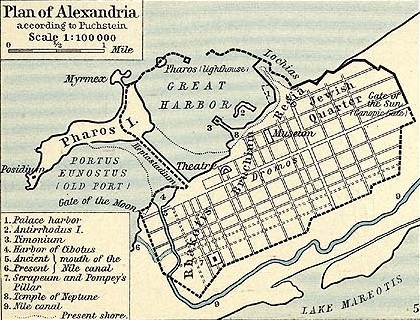
Alexandria was planned by Dinocrates, an experienced Greek architect and city planner from Rhodes, who modeled the new city after the Hellenistic architectural style popular in the Greek world at the time. The existing small village of Rhacotis, then a fishing port, became the Egyptian quarter of the city, located on the West side. Egyptians may have continued to refer to the whole city as Rhakotis, and in some cases resented its existence.
Tacitus relates a story of the Egyptian priests that Ptolemy I Soter, seeking a blessing for the construction of Alexandria, received instructions to obtain a certain statue from the temple of "infernal Jupiter" (Pluto) in Pontus (on the northern coast of modern Turkey, along the Black Sea). First they visit the oracle Pythia at Delphi, who confirms they are to remove the statue, but not its female companion (Proserpina). When they reach King Scydrothemis at Sinope, they find him reluctant to part with the statue. The god then leaves the temple of his own will and conveys the party back to Alexandria, where a new temple is established at Rhacotis—the historical site of a temple to Serapis and Isis.
Hub AI
Rhacotis AI simulator
(@Rhacotis_simulator)
Rhacotis
Rhacotis (Egyptian: r-ꜥ-qd(y)t, Greek Ῥακῶτις; also romanized as Rhakotis) was the name for a city on the northern coast of Egypt at the site of Alexandria. Classical sources from the Greco-Roman era in both Ancient Greek and the Egyptian language suggest Rhacotis as an older name for Alexandria before the arrival of Alexander the Great.
Rhacotis was located west of the now-silted Canopic branch of the Nile. Unlike ports within the Nile Delta, it was reliably accessible to large ships, and enough water for a city could be supplied by a canal. It is also described as the home of sentinels who protected the Egyptian kingdom from outsiders.
The root of the name, qd, means "construct". The prefix r-ꜥ can be used as a derivational morpheme forming nouns of action from infinitives, so a likely interpretation of the name as a whole is "building site" or "construction in progress". Michel Chaveau of the École pratique des hautes études argues that Rhakotis may simply have been the Egyptian name of the construction site for Alexandria; while John Baines contends that the style of the name and its linguistic context indicate that the name is older.
The original city may have included the island of Pharos, a harbor mentioned in Homer's Odyssey as the kingdom of Proteus. Plutarch writes that this reference influenced Alexander in his decision to found a new capital at the harbor of Pharos.
The earliest text from Alexandria, a hieroglyphic "satrap" stela from the month of Thout in 311 BC, refers to R-qd as the preceding name of the city.
Strabo, in his description of Alexandria, describes Rhacotis as the home of Egyptian sentinels guarding the Nile. Pliny the Elder mentions Rhacotes as the former name of the site of Alexandria.
Alexandria was planned by Dinocrates, an experienced Greek architect and city planner from Rhodes, who modeled the new city after the Hellenistic architectural style popular in the Greek world at the time. The existing small village of Rhacotis, then a fishing port, became the Egyptian quarter of the city, located on the West side. Egyptians may have continued to refer to the whole city as Rhakotis, and in some cases resented its existence.
Tacitus relates a story of the Egyptian priests that Ptolemy I Soter, seeking a blessing for the construction of Alexandria, received instructions to obtain a certain statue from the temple of "infernal Jupiter" (Pluto) in Pontus (on the northern coast of modern Turkey, along the Black Sea). First they visit the oracle Pythia at Delphi, who confirms they are to remove the statue, but not its female companion (Proserpina). When they reach King Scydrothemis at Sinope, they find him reluctant to part with the statue. The god then leaves the temple of his own will and conveys the party back to Alexandria, where a new temple is established at Rhacotis—the historical site of a temple to Serapis and Isis.
Recent media