


Community hub
Recent from talks
Contribute something
Nothing was collected or created yet.
Ricky Ray
View on Wikipedia
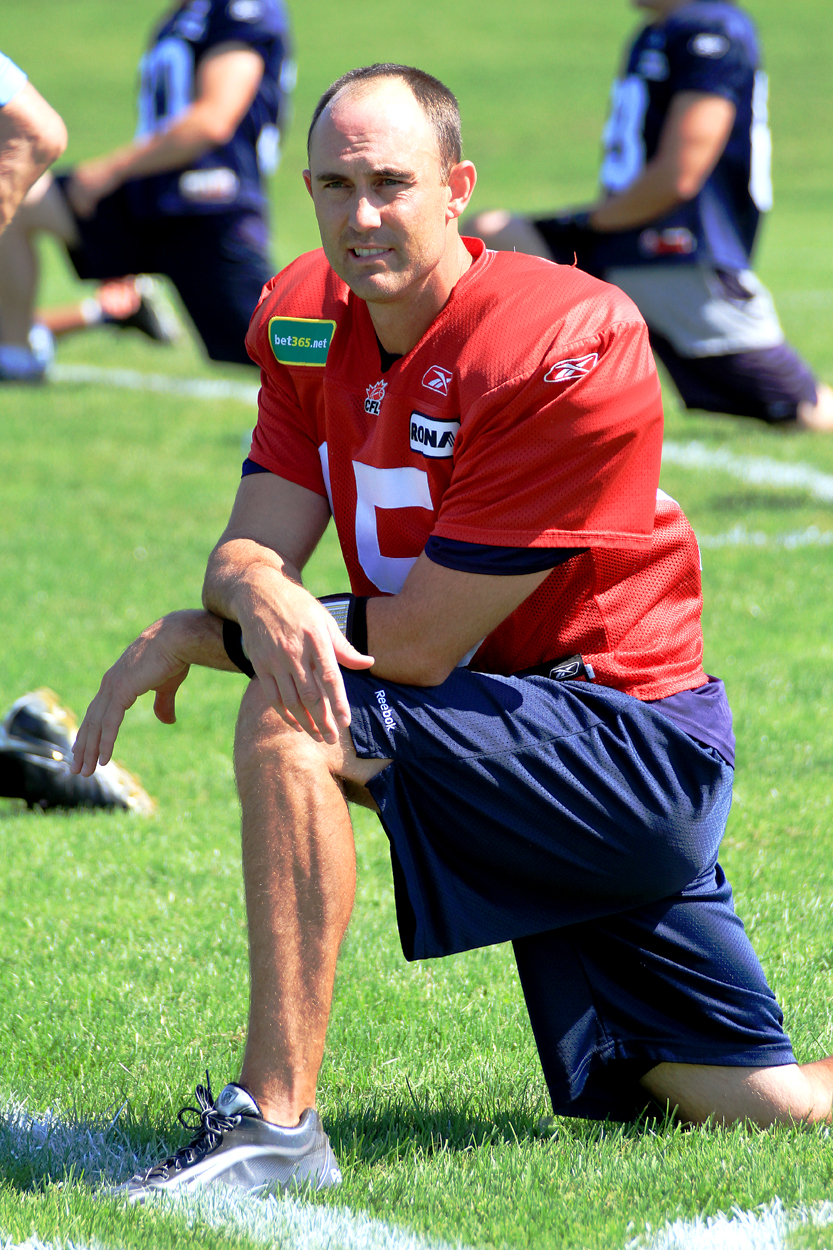
Ricky Ray (born October 22, 1979) is an American former professional football player who was a quarterback in the Canadian Football League (CFL) for the Edmonton Eskimos and Toronto Argonauts. He also briefly spent time in the af2, as well as with the San Francisco 49ers and New York Jets of the National Football League (NFL). Ray is the all-time leader in passing yardage, pass completions, and passing touchdowns for both the Edmonton Elks and Toronto Argonauts. He won the Grey Cup championship a record four times as a starting quarterback, in 2003, 2005, 2012, and 2017. He was inducted into the Canadian Football Hall of Fame in 2022.
Key Information


College career
[edit]In 1997, Ray made his debut for Shasta College, a two-year community college in Redding, California. He became a first-team All-American and state player of the year in 1998. He also set several school records during his time at Shasta, most notably throwing 199 consecutive pass attempts without allowing an interception.[1] On December 20, 2014, Ricky was inducted into the Shasta County Sports Hall Of Fame.[2][3]
Ray moved on to play NCAA college football with Sacramento State University. In 1999, Ray completed 179 of 291 passes for 2,422 yards and 20 touchdowns. In 2000, he completed 168 of 270 passes (62.2%) for 13 touchdowns with 6 interceptions. Ray is still in the top ten for many Sacramento State career passing records.
College statistics
[edit]| Season | Passing | Rushing | |||||||||
|---|---|---|---|---|---|---|---|---|---|---|---|
| Cmp | Att | Yds | TD | Int | Att | Yds | TD | ||||
| Shasta Knights | |||||||||||
| 1997 | 162 | 281 | 1,873 | 17 | 11 | 38 | -78 | 2 | |||
| 1998 | 189 | 307 | 2,759 | 28 | 7 | 72 | 116 | 7 | |||
| CCCAA career | 351 | 588 | 4,632 | 45 | 18 | 110 | 38 | 9 | |||
| Sacramento State Hornets | |||||||||||
| 1999 | 179 | 291 | 2,422 | 20 | 8 | 51 | 58 | 5 | |||
| 2000 | 168 | 270 | 2,200 | 13 | 6 | 100 | 189 | 10 | |||
| NCAA career | 347 | 561 | 4,622 | 33 | 14 | 151 | 247 | 15 | |||
Professional career
[edit]San Francisco 49ers
[edit]After his college career ended in 2000, Ray, having gone undrafted by the NFL, attended training camp with the NFL's San Francisco 49ers, but did not make the team and only dressed for a single pre-season game. He earned the nickname "Frito Ray" by teammates, as he was working as a delivery driver for Frito-Lay chips when he was called up for training camp.
Fresno Frenzy
[edit]Ray made his professional debut with the Fresno Frenzy of the Arena Football League's developmental league af2. He played seven games for the Frenzy, where he was coached by former CFL quarterback Rick Worman. He completed 116 passes for 1,296 yards, 25 touchdowns and 6 interceptions.[4] Worman was instrumental in arranging a tryout with the Eskimos.[5]
Edmonton Eskimos (first stint)
[edit]In 2002, Ray made the CFL's Edmonton Eskimos out of training camp. The Eskimos entered the season as a competitive West Division team and featured notable depth at the quarterback position. Starter Jason Maas had already established himself as a leading quarterback in the league. Ray started the season as the Eskimos' third-string quarterback.
Late in the fourth quarter of a Week Four game against the Saskatchewan Roughriders, Maas was knocked out of the game, and would not be available for the Week Five matchup against the rival BC Lions. Ray made his debut relieving Maas in the Saskatchewan game and his first start against the Lions, throwing for four touchdowns. Ray threw for 2,991 yards, 24 touchdowns, and nine interceptions with a quarterback rating of 101.3, highest in the league.
With Maas still recovering from injury, Ray led the Eskimos to the Grey Cup game against Montréal. Ray threw for 324 yards, but the Eskimos lost the 90th Grey Cup to the Alouettes 26–16 at home. Ray failed to convert on a vital two-point conversion late in the game that could have tied the affair at 18–18. The failure forced the Eskimos into an onside kick attempt, which failed as Montréal returned it for a touchdown and took a lead that they would not lose. During the year, Ray was named Offensive Player of the Week and Month, but was not eligible for the Offensive Rookie of the Year award following a brief stint in the NFL.
Maas returned for the 2003 season, setting up a quarterback duel between Maas and Ray during training camp. However, Maas sustained a back injury during the off-season, a condition that would require surgery. Ray remained the starter even after Maas returned.
Despite splitting time early in the year, Ray ended with a 67.6 completion percentage, 4,640 yards, 35 touchdowns and 13 interceptions and was a candidate for the Most Outstanding Player award. The Eskimos rebounded from their slow start and made the playoffs, defeating the Saskatchewan Roughriders in the Western final as Ray threw for 356 yards. The 91st Grey Cup in Regina, Saskatchewan featured the Eskimos against the Alouettes. The Eskimos defeated the Alouettes 34–22, for the team's first Grey Cup in a decade. Ray played exceptionally against Alouettes coach Don Matthews's renowned blitzing defense, completing 22 of 32 passes for 301 yards and two touchdowns.
New York Jets
[edit]After two years in Canada, Ray began to look south of the border. Former Eskimo Warren Moon, a legend in the NFL and CFL, advised Ray to stay in the CFL a little while longer to improve as a quarterback and receive a better shot at a starting job. But the lure of the league he had dreamed of in his youth proved too strong to keep Ray in Canada, and he signed with the New York Jets.
In the 2004 NFL season, Ray dressed for six games with the Jets. When starter Chad Pennington went down briefly with a rotator cuff injury, backup Quincy Carter came in and played well, relegating Ray to the bench. After the season concluded, Ray asked for his release by the Jets.[6] Ray subsequently returned to the Eskimos.
Edmonton Eskimos (second stint)
[edit]Ray's return was accompanied by controversy. He became the favourite to take the starting job in Edmonton, but, once again, the team was deep at quarterback in 2005. In addition to Ray, Maas remained in Edmonton. While Ray had been in the NFL, Maas had been the starter and had played superbly, becoming only the second Eskimo to pass for 5,000 yards in a single season.
Ray received the starting job out of training camp in 2005. Maas, despite frequent trade rumours, was once again made his backup. Jason Johnson remained on the roster as the third quarterback. Ray started the 2005 season strongly, leading the league in completions and yardage. He set a pro football record with 479 completions in 2005. However, towards the end of the year, Ray's play faltered, concluding in him not throwing a touchdown in the season's last four games.
In the playoffs, Ray was benched twice more, both in the West Semi-Final against Calgary and the West Final against British Columbia, and both times Maas came on the field, threw very well, and recorded the winning points. Head coach Danny Maciocia, however, promised Ray the start in the 93rd Grey Cup, perhaps because of rumours that a trade of Maas to the Hamilton Tiger-Cats had already been arranged. This time, however, Ray seized the opportunity presented to him, throwing for 359 yards and two touchdowns while completing 35 of 45 passes. The Eskimos defeated the Montreal Alouettes 38–35 in overtime, and Ray was named most valuable player of the Grey Cup.
In 2006, Ray started for the Eskimos for every single game of the season, led the league in passing with exactly 5,000 yards, and was near the top in completion percentage at 65.7%, 21 touchdowns, and a passer rating of 89.8.

On September 14, 2007, in a win against the Montreal Alouettes, Ray surpassed CFL and NFL hall-of-famer Warren Moon to capture the Eskimos' all-time record for career passing yards.[7] On September 28, 2007, he suffered a separated shoulder at the hands of Toronto Argonauts safety Willie Pile, ending his season.[8] Without Ray, the Eskimos lost their remaining five games and missed the playoffs for the second consecutive season.
In 2008, Ray completed 422 of 608 pass attempts (69.8% completion) for a league-leading, career-best, and single-season Eskimo record 5,661 yards. Ray threw for 26 touchdowns and 17 interceptions for a 101.8 quarterback rating. Ray also scrambled for 258 yards and 5 touchdowns. One of his best games of the season came in the final week of the season vs. the Alouettes when Ray broke the record for highest completion percentage in a single game (with a minimum of 20 passing attempts) when he went 23 of 25 for 92.0% for 302 yards and 2 touchdowns in only 3 quarters of play. He led the Esks to a win in the crossover playoff game in Winnipeg, but the team lost in the East finals to Montreal. The 2008 Eskimos were the first team to ever win a crossover game.
In 2009, Ray completed 401 of 596 pass attempts (67.3% completion) for a league leading 4,916 yards, 22 touchdowns and 12 interceptions for a 96.4 quarterback rating. Ray scrambled for 206 yards and 6 touchdowns. In a game versus the Saskatchewan Roughriders, Ray completed 20 consecutive passes before receiver Jamaica Rector dropped a pass, ending the streak. This remarkable performance left Ray 2nd all time behind teammate Jason Maas (who completed 22 straight passes on July 30, 2004), in the CFL record books for most consecutive pass completions in a single game.
In 2010, Ray completed 288 of 447 pass attempts (64.4% completion) for 3,565 yards, 11 touchdowns and 16 interceptions for an 82.3 quarterback rating. Additionally, Ray scrambled for 302 yards and three touchdowns. In Game 15, Ray had a career rushing performance, compiling 135 yards on 12 rushes and a touchdown. He started 16 of the 18 games. Statistically, it was the worst year of his career.
In 2011, Ray completed 343 of 526 pass attempts (65.2% completion) for 4,954 yards, 24 touchdowns and 11 interceptions for a 99.3 quarterback rating. Additionally, Ray scrambled for 258 yards and 1 touchdown. Ricky Ray had a bounce back season after struggling in 2010. His solid play earned him Offensive Player of the month for the month of September. Ray lead the Eskimos to a record of 11–7, qualifying for the Playoffs.
Toronto Argonauts
[edit]Ray was traded to the Toronto Argonauts on December 12, 2011, for quarterback Steven Jyles, placekicker Grant Shaw, and a 2012 first round draft pick.[9] Ray went on to win the 100th Grey Cup as the Argonauts' starting quarterback. On May 31, 2013, the Argos extended Ray's contract through the 2015 CFL season.[10]
In 2012, Ray completed 321 of 468 pass attempts (68.6% completion) for 4,059 yards, 20 touchdowns and 11 interceptions for a 99.8 quarterback rating. Rays 68.59% completion rate was a new team record breaking the previous mark of 67.25% set by Kerwin Bell in 1998.[11] Ray injured his knee in the third quarter of a Week 4 win against the Blue Bombers. He missed the Week 5 game and then returned to the starting lineup in Week 7, following a bye in Week 6.[12] Ray was averaging over 300 yards passing per game compiling a total of 3,341 yards in his first 11 games before suffering a knee injury in the 1st quarter of a game against Montreal.[13] Ray would return for the final two games of the season completing 20 of 33 passes for 383 yards, 4 touchdowns and no interceptions vs Winnipeg and 24 of 30 passes for 305 yards, 4 touchdowns and 1 interceptions against Saskatchewan, earning offensive player of the week honors[14] for the latter performance and helping the Argos clinch a playoff spot.
In the 2012 East division semi-final Ray completed 23 of 30 passes for 239 yards, 2 touchdowns no interceptions and a rushing touchdown as they defeated Edmonton 42–26. In the process Ray helped the team set a new CFL playoff record for the most points in a single quarter with 31.[15] In the East division final, Ray completed 28 of 37 passes for 399 yards 1 touchdowns and no interceptions as the team beat Montreal on the road 27–20 in advancing to the finals.[16] The Argos would ultimately emerge victorious in the 100th Grey Cup held at home, beating Calgary 35–22. Ray would finish the game 18 for 30 for 231 yards, 2 touchdowns and 1 interception.[17]
In the 2013, Ray had a phenomenal year setting multiple CFL, pro football and team records, despite suffering a shoulder injury in the first quarter of a game against Calgary in Week 7 which forced him to sit out six games.[18] Ray would return before the end of the season helping the Argos clinch first in the east before sitting out the final game of the season.[19]
Ray completed 234 of 303 for 2,878 yards in 10 games and had a 77.23% completion percentage which broke the previous CFL and pro football single season record of 73.98% set by Dave Dickenson in 2005[20] and his own Argo record of 68.59% set last year. Ray finished with 21 touchdowns and just 2 interceptions, resulting in a 10.5 to 1 touchdown to interception ratio, breaking the single season CFL record of 6 to 1 set by Dave Dickenson in 2000. Ray also set the CFL record for lowest percentage of passes intercepted in a single season with a 0.66% breaking the previous CFL record of 1.09% set by Anthony Calvillo in 2009. Ray had a streak of 222 consecutive pass attempts without throwing an interception to begin the year, going back to the previous year the streak was 247 pass attempts,[21] before throwing his first interception on his last pass of a game in Week 16 against Hamilton. This figure is possibly a CFL record as the Argo team itself set a league record for most consecutive passes without an interception by a team.[22] Ray finished the year with a record passer efficiency rating of 126.37, surpassing the previous pro football record of 122.46 set by Aaron Rodgers in 2011 and the CFL record of 118.77 set by Dave Dickenson in 2005.[23] On July 19, 2013, Ray completed 19 of 20 passes against Winnipeg setting a new single game CFL and pro football completion percentage record of 95.0%, beating the previous record of 94.74% set by Alex Smith in 2012, his own CFL record of 92.0% set in 2008 and the Argos team record of 87.1% set by Condredge Holloway in 1985.[24] In the same game, he tied the Argo record for most consecutive pass completions held by Mike Rae with 17.[25] Only to surpass that mark in his final game of the season against Winnipeg. Ray set a new team record with 21 consecutive pass completions, the second longest such streak in CFL history, falling one shy of the record of 22 held by Jason Maas.[26] In the same game Ray also set a new personal high for passing yards with 505.[27] It was the first time in his career that he had passed for over 500 yards and the third highest single game total in Argos history.[28] Ray did however break a 53-year-old Argo record for most completions in a single game with 39 besting the previous record of 38 set by Tobin Rote in 1960.[29] It was also the 9th time in his career and 2nd time in the year that he had passed for over 400 yards in a game. In addition to the numerous records Ray set, he was named offensive player of the month for September[30] and also named offensive player of week three times. In the first game of the season against Hamilton, Ray complete 24 of 34 passes for 368 yards, 4 touchdowns and no interceptions, earning him offensive player of the week honors.[31] Ray would earn his second offensive player of the week honors after completed 30 of 35 passes for 413 yards with 3 touchdowns and no interceptions against Edmonton in game 6.[32] And lastly for his aforementioned performance against Winnipeg, where he completed 39 of 45 passes for 505 yards, three touchdowns and no interceptions.[33]
In spite of the personal spectacular regular season, Ricky Ray leading the Argonauts to a first-place finish in the East would be ruined by Henry Burris and the Hamilton Tiger-Cats defeating Ray and the Argonauts 36–24 in the 2013 East Division final held at the Rogers Centre, Toronto.

Ricky Ray played in all but one of the 18 regular season games during the 2014 CFL season, however the Argos were unable to qualify for the postseason, finishing with a record of 8–10. Ray had one of his highest volume seasons as a passing quarterback in his career during the 2014 campaign. His 425 pass completions was the second highest of his career, trailing only his 2003 season with the Eskimos when he completed 479 passes. Ray attempted 620 passes over the course of the season, which was the 4th most attempts in his career, and the most since 2008. He racked up a league-leading 4,595 passing yards, his most yards in a season since 2009.
In November 2014, following the conclusion of the Argos season, Ray had surgery to repair a torn labrum in his right (throwing) shoulder and a small tear in his right rotator cuff. The recovery time for the surgery was estimated to be around six months, which would allow Ray to return action in time for CFL training camp in the spring of 2015.[34] However, Ray's recovery went slower than expected: As a result, the Argos placed Ray on the six-game injured list during the preseason.[35] Ray missed the first 16 games of the 2015 CFL season, making his first start of the season in Week 19 against the BC Lions. At the time of his return, the Argos were 8–8, having clinched a playoff berth, they were fighting for a home playoff game (which they lost when they were defeated by the Lions).[36] Ray played in the final regular season game and also the Eastern Semi-Final against the Hamilton Tiger-Cats. In the playoff game Ray completed 22 of 34 pass attempts for 220 yards with 1 touchdown and 1 interception; however Justin Medlock kicked a 47-yard field goal with no time on the clock to eliminate the Argos, thus ending their season.[37] On December 3, 2015, Ray and the Argos agreed on a contract extension; preventing him from becoming a free-agent in February 2015.[38] Entering the 2016 season Ray was finally 100% healed from his shoulder injury which had plagued him since November 2014. Ray started the first five games of the season before sustaining a knee injury as defensive lineman Vaughn Martin rolled up into him in the third quarter. Following the game Ricky Ray was diagnosed with a sprained MCL, and was expected to miss between three and six weeks.[39] Ray missed three games over the following five weeks before returning to play in the Labour Day weekend games against the BC Lions and Hamilton Tiger-Cats. Following their Labour Day game against the Tiger-Cats, reports surfaced suggesting Ray would miss the remainder of the 2016 CFL season with a punctured lung.[40] The following day, it was announced that Ray would miss between four and six weeks with a partially deflated lung. This was Ray's second significant injury in 2016 and he has only played one full season since 2011.[41] After missing six weeks recovering from a partially deflated lung Ray returned to the starting lineup in Week 18 of the regular season. However, he was unable to best the league-leading Stampeders and as a result the Argos were eliminated from playoff contention, falling to a record of 5–12.[42]
On February 28, 2017, at his introductory press conference, newly appointed head coach Marc Trestman declared Ray the Argos starting quarterback for the 2017 season: Despite Ray having only started 12 games over the previous two seasons.[43] In the opening game of the season, Ray threw for a career-high 506 yards in a 32–15 win over the rival Tiger-Cats.[44] On July 29, 2017, Ray surpassed Condredge Holloway to become the franchise leader in passing yards. Holloway threw for 16,616 yards between 1981 and 1986.[45] On August 19, 2017, Ray became the Argonauts' all-time passing touchdown leader with his 99th touchdown pass, surpassing Holloway's 98.[46] In that same game, he threw for his 100th touchdown pass as an Argonaut, becoming the first player in CFL history to throw at least 100 touchdown passes for two franchises. On October 21, 2017, Ray reached the 60,000 career passing-yard mark, becoming just the fourth player in CFL history to accomplish the milestone.[47] In that same game, he also hit 5,000 passing yards for the season, joining Doug Flutie and Anthony Calvillo as the only players to pass for 5,000 yards at least four times in their careers. That game also marked the 12th time he eclipsed the 300-yard mark that season, which is an Argonauts record.[48] The Argonauts finished the season 1st in the East with a 9–9 record, the only .500 team in the division. For his performance, Ray finished as runner-up to Edmonton quarterback Mike Reilly for the CFL's Most Outstanding Player Award. He would go on and win his fourth Grey Cup against the Calgary Stampeders in the 105th Grey Cup game. His four Grey Cups wins are most in CFL history for a starting quarterback.[49] One day after the Argos Grey Cup parade, Ray conveyed to reporters that he was "seriously considering retirement". Ray, 38 years of age, who was a pending free agent for the 2018 season, said there was no timetable for a decision.[50] On February 2, 2018, Ray and the Argos agreed to a one-year contract extension.[51]
In 2018, Ray was carted off the field in the second half of the Argos Week 2 loss to the Calgary Stampeders after being awkwardly tackled between a pair of Stampeder defensive linemen.[52] Ray was hospitalized, and the following day the team confirmed that Ray did indeed have feeling in all of his extremities.[53] Given his age (38), and the severity of the injury, Ray's future as a quarterback was placed in doubt.[54] Only a couple days later team doctors advised Ray to not play again in 2018.[55] On September 24, 2018, Head Coach Marc Trestman confirmed that Ray would not return to the Argos for the 2018 season.[56] In early November 2018 Ray was still considering his options, leaving the door open for a possible return in 2019.[57] By early March Ray had not informed the Argos of his intentions for the 2019 season, and still needed to be cleared by doctors before returning to the field. General manager Jim Popp hinted that if Ray were to return to the Argos it would be as a backup quarterback, possibly transitioning to a coaching role in the future.[58] On May 8, 2019, Ray held a press conference to officially announce his retirement.[59]
Ray was announced as a member of the Canadian Football Hall of Fame 2022 class on June 21, 2022.[60]
CFL statistics
[edit]Regular season
[edit]| Passing | Rushing | |||||||||||||||||
|---|---|---|---|---|---|---|---|---|---|---|---|---|---|---|---|---|---|---|
| Year | Team | Games | Started | Comp | Att | Pct | Yards | TD | Int | Rating | Att | Yards | Avg | Long | TD | Fumb | ||
| 2002 | EDM | 18 | 14 | 227 | 359 | 63.2 | 2,991 | 24 | 9 | 101.3 | 44 | 232 | 5.3 | 32 | 1 | 9 | ||
| 2003 | EDM | 18 | 18 | 348 | 515 | 67.6 | 4,640 | 35 | 13 | 108.1 | 62 | 352 | 5.7 | 35 | 2 | 9 | ||
| 2005 | EDM | 18 | 18 | 479 | 715 | 67.0 | 5,510 | 25 | 24 | 87.7 | 83 | 353 | 4.3 | 26 | 9 | 13 | ||
| 2006 | EDM | 18 | 18 | 406 | 618 | 65.7 | 5,000 | 21 | 18 | 89.8 | 92 | 469 | 5.1 | 27 | 9 | 6 | ||
| 2007 | EDM | 13 | 13 | 311 | 445 | 69.9 | 3,652 | 22 | 10 | 101.6 | 41 | 232 | 5.7 | 26 | 0 | 8 | ||
| 2008 | EDM | 18 | 18 | 422 | 605 | 69.8 | 5,661 | 26 | 17 | 101.8 | 75 | 258 | 3.4 | 15 | 5 | 13 | ||
| 2009 | EDM | 18 | 18 | 401 | 596 | 67.3 | 4,916 | 22 | 12 | 96.4 | 47 | 206 | 4.4 | 27 | 6 | 3 | ||
| 2010 | EDM | 17 | 16 | 288 | 447 | 64.4 | 3,565 | 11 | 16 | 82.3 | 37 | 302 | 8.2 | 45 | 3 | 9 | ||
| 2011 | EDM | 18 | 18 | 343 | 526 | 65.2 | 4,594 | 24 | 11 | 99.3 | 41 | 258 | 6.3 | 27 | 1 | 13 | ||
| 2012 | TOR | 14 | 14 | 321 | 468 | 68.6 | 4,069 | 20 | 11 | 99.8 | 17 | 84 | 4.9 | 12 | 0 | 7 | ||
| 2013 | TOR | 11 | 10 | 234 | 303 | 77.2 | 2,878 | 21 | 2 | 126.4 | 11 | 61 | 5.5 | 18 | 2 | 3 | ||
| 2014 | TOR | 17 | 17 | 425 | 620 | 68.5 | 4,595 | 28 | 15 | 95.1 | 41 | 216 | 5.3 | 15 | 1 | 5 | ||
| 2015 | TOR | 3 | 2 | 47 | 65 | 72.3 | 423 | 2 | 1 | 93.3 | 2 | 5 | 2.5 | 4 | 0 | 1 | ||
| 2016 | TOR | 9 | 9 | 228 | 298 | 74.5 | 2,397 | 15 | 6 | 110.4 | 13 | 53 | 4.1 | 19 | 0 | 1 | ||
| 2017 | TOR | 17 | 17 | 474 | 668 | 71.0 | 5,546 | 28 | 11 | 102.9 | 8 | 52 | 6.5 | 10 | 0 | 7 | ||
| 2018 | TOR | 2 | 2 | 34 | 54 | 62.9 | 307 | 0 | 1 | 70.5 | 1 | 8 | 8 | 8 | 0 | 0 | ||
| CFL totals | 234 | 219 | 4,976 | 7,301 | 68.16 | 60,736 | 324 | 177 | 98.23 | 614 | 3,141 | 5.1 | 45 | 39 | 107 | |||
Playoffs
[edit]| Year & game | Team | GP | GS | ATT | COMP | YD | TD | INT | RUSH | YD | TD | |
|---|---|---|---|---|---|---|---|---|---|---|---|---|
| 2002 West Final | EDM | 1 | 1 | 34 | 19 | 269 | 1 | 1 | 5 | 24 | 0 | |
| 2003 West Final | EDM | 1 | 1 | 32 | 23 | 358 | 1 | 0 | 7 | 49 | 1 | |
| 2005 West Semi-Final | EDM | 1 | 1 | 21 | 12 | 99 | 0 | 0 | 2 | 12 | 0 | |
| 2005 West Final | EDM | 1 | 1 | 28 | 17 | 207 | 0 | 1 | 8 | 17 | 2 | |
| 2008 *East Semi-Final | EDM | 1 | 1 | 37 | 27 | 303 | 0 | 0 | 4 | 25 | 0 | |
| 2008 *East Final | EDM | 1 | 1 | 49 | 26 | 339 | 1 | 0 | 0 | - | - | |
| 2009 West Semi-Final | EDM | 1 | 1 | 30 | 18 | 162 | 0 | 0 | 4 | 17 | 1 | |
| 2011 West Semi-Final | EDM | 1 | 1 | 27 | 19 | 245 | 1 | 0 | 3 | 31 | 0 | |
| 2011 West Final | EDM | 1 | 1 | 40 | 21 | 297 | 2 | 2 | 3 | 36 | 0 | |
| 2012 East Semi-Final | TOR | 1 | 1 | 30 | 23 | 239 | 2 | 2 | 3 | 16 | 1 | |
| 2012 East Final | TOR | 1 | 1 | 37 | 28 | 399 | 1 | 1 | 1 | 3 | 0 | |
| 2013 East Final | TOR | 1 | 1 | 32 | 22 | 329 | 2 | 0 | 1 | 6 | 0 | |
| 2015 East Semi-Final | TOR | 1 | 1 | 34 | 22 | 220 | 1 | 1 | 3 | 15 | 0 | |
| 2017 East Final | TOR | 1 | 1 | 39 | 28 | 266 | 1 | 1 | 0 | - | - | |
| Totals | 14 | 14 | 470 | 303 | 3,732 | 13 | 9 | 44 | 251 | 5 | ||
*team qualified for crossover
Grey Cup
[edit]| Year | Team | GP | GS | ATT | COMP | YD | TD | INT | RUSH | YD | TD | |
|---|---|---|---|---|---|---|---|---|---|---|---|---|
| 2002 | EDM | 1 | 1 | 46 | 24 | 324 | 2 | 1 | 7 | 25 | 0 | |
| 2003 | EDM | 1 | 1 | 32 | 22 | 301 | 2 | 0 | 7 | 13 | 1 | |
| 2005 | EDM | 1 | 1 | 45 | 35 | 359 | 2 | 0 | 4 | 18 | 1 | |
| 2012 | TOR | 1 | 1 | 30 | 18 | 231 | 2 | 1 | 0 | - | - | |
| 2017 | TOR | 1 | 1 | 32 | 19 | 297 | 1 | 0 | 0 | - | - | |
| Totals | 5 | 5 | 185 | 118 | 1,512 | 9 | 2 | 18 | 56 | 2 | ||
See also
[edit]References
[edit]- ^ "Ricky Ray". argonauts.ca. Archived from the original on October 26, 2017. Retrieved October 25, 2017.
{{cite web}}: CS1 maint: bot: original URL status unknown (link) - ^ Induction Ceremony Events & Information Archived June 30, 2018, at the Wayback Machine, Shasta County Sports Hall Of Fame website
- ^ "Ray Headed To Shasta Sports Hall of Fame". KRCRTV. December 17, 2014. Archived from the original on December 19, 2014.
- ^ "Highlights". Archived from the original on July 17, 2015. Retrieved July 16, 2015.
- ^ Dunk, Justin (October 23, 2017). "Ricky Ray has come a long way from the Fresno Frenzy - 3DownNation". 3DownNation. Retrieved October 23, 2017.
- ^ Prince, Gerry (May 11, 2005). "Who wants Ricky Ray?". slam.canoe.com. Archived from the original on November 28, 2017. Retrieved November 27, 2017.
{{cite web}}: CS1 maint: bot: original URL status unknown (link) - ^ CFL.ca Network :: Official site of the Canadian Football League
- ^ edmontonsun.com - Football - Ricky won't be cut
- ^ http://www.esks.com/article/eskimos-and-argos-swing-major-trade Eskimos and Argos swing major trade
- ^ Contract extension through 2015
- ^ "Argos eliminate arch-rival Ticats from playoff hunt". November 2, 2012.
- ^ "Ray injures knee, Week 4, 2013 Season". Archived from the original on September 26, 2015. Retrieved September 10, 2017.
- ^ "Argonauts quarterback Ricky Ray injured in 31-10 loss to Montreal Alouettes". The Toronto Star. September 23, 2012.
- ^ "Toronto Argonauts - Argos".
- ^ "Argos beat Eskimos 42-26, advance to CFL East final". November 11, 2012.
- ^ "Argos-Stamps in 100th Grey Game | the Huddle". Archived from the original on October 29, 2013. Retrieved October 25, 2013.
- ^ "Glenn still ringless: Argos win Grey Cup 35-22 over Stamps". Archived from the original on August 29, 2013. Retrieved October 25, 2013.
- ^ "Argos QB Ricky Ray out 6 weeks with shoulder injury | CBC Sports".
- ^ "Ricky Ray throws for 505 yards, Argos cement 1st in East | CBC Sports".
- ^ "Archived copy" (PDF). Archived from the original (PDF) on August 26, 2013. Retrieved October 24, 2013.
{{cite web}}: CS1 maint: archived copy as title (link) - ^ "Game Notes - Tor @ Wpg - Game 16". Archived from the original on December 13, 2013.
- ^ "2013 CFL.ca Game Notes: A look at Week 8 | CFL.ca | Official Site of the Canadian Football League". Archived from the original on August 19, 2013.
- ^ "Archived copy" (PDF). Archived from the original (PDF) on August 26, 2013. Retrieved October 24, 2013.
{{cite web}}: CS1 maint: archived copy as title (link) - ^ "QB RICKY RAY SETS NEW CFL RECORD FOR SINGLE-GAME COMPLETION PERCENTAGE | Toronto Argonauts". Archived from the original on August 22, 2013.
- ^ "Ricky Ray throws 3 TDs as Argonauts hold off Eskimos | CBC Sports".
- ^ "Ricky Ray rips apart Bombers in Argos win | Winnipeg Sun".
- ^ "Ricky Ray throws for 505 yards, Argos cement 1st in East | CBC Sports".
- ^ "Archived copy" (PDF). Archived from the original (PDF) on May 31, 2013. Retrieved October 25, 2013.
{{cite web}}: CS1 maint: archived copy as title (link) - ^ "RECORD ALERT: Ricky Ray's 39 completions tonight also set an #Argos record. The record was 38 held by Tobin Rote who had 38 in 1960. #CFL : TorontoArgos". Archived from the original on October 29, 2013. Retrieved October 25, 2013.
- ^ "Argonauts: Ricky Ray inching closer to return | The Star". Toronto Star. October 10, 2013.
- ^ "Argos QB Ricky Ray is CFL's offensive player of the week | CBC Sports".
- ^ "Argos QB Ricky Ray named offensive player of week | CBC Sports".
- ^ "CBC Sports - CFL recognizes Ricky Ray's record-setting performance". Archived from the original on November 3, 2013.
- ^ Keiser, Lance (November 24, 2014). "Ricky Ray Undergoes Shoulder Surgery". Last Word Sports. Retrieved November 25, 2014.
- ^ Rush, Curtis (June 16, 2015). "The No. 1 quarterbacking duties fall to Trevor Harris, a player with only one CFL start under his belt". The Toronto Star. ISSN 0319-0781. Retrieved June 17, 2015.
- ^ "Lions spoil Ricky Ray's return to Argos". www.cbc.ca. Retrieved November 2, 2015.
- ^ "Medlock boots Ticats into Eastern Final with win over Argos". CFL.ca. Archived from the original on November 18, 2015. Retrieved December 3, 2015.
- ^ "Ray re-signs with Argonauts". TSN. December 3, 2015. Retrieved December 3, 2015.
- ^ "Argos lose Ray for 3-6 weeks with sprained knee". Retrieved July 27, 2016.
- ^ "Argos mum on Ray's status". September 8, 2016. Retrieved September 8, 2016.
- ^ "Ray out 4-6 weeks with partially deflated lung". September 9, 2016. Retrieved September 9, 2016.
- ^ "Can Ricky Ray rescue the Toronto Argonauts' season? | Toronto Star". thestar.com. October 17, 2016. Retrieved October 22, 2016.
- ^ "Trestman names Ray Argos' starting QB - Article - TSN". TSN. February 28, 2017. Retrieved February 28, 2017.
- ^ "Ray's career day helps Argonauts pound rival Tiger-Cats in opener - Article - TSN". TSN. June 25, 2017. Retrieved June 26, 2017.
- ^ "Ray becomes Argos' all-time leading passer - Article - TSN". TSN. July 29, 2017. Retrieved July 31, 2017.
- ^ "Post game notes:week 9 vs. Montreal". argonauts.ca. August 19, 2017. Retrieved August 20, 2017.
- ^ "Argos defeat Blue Bombers, take over top spot in East". cfl.ca. October 21, 2017. Retrieved October 23, 2017.
- ^ "Post game notes:week 18 vs. Winnipeg". argonauts.ca. October 21, 2017. Retrieved October 23, 2017.
- ^ "Ricky Ray". Canadian Football Hall of Fame. Retrieved August 29, 2025.
- ^ "Argos' Ray says he's considering retiring - Article - TSN". TSN. November 29, 2017. Retrieved November 30, 2017.
- ^ "Ray signs one-year deal to return to Argonauts - Article - TSN". TSN. February 2, 2018. Retrieved February 3, 2018.
- ^ "Quarterback Ricky Ray carted off field in Argonauts' home opener - Sportsnet.ca". Sportsnet.ca. Retrieved June 25, 2018.
- ^ "Argos issue update; say Ray has feeling in all extremities - CFL.ca". CFL.ca. June 24, 2018. Retrieved June 25, 2018.
- ^ "SIMMONS: His career secondary now, Argos, fans pray classy Ricky Ray's injury isn't life-altering". Toronto Sun. June 25, 2018. Retrieved June 25, 2018.
- ^ "Doctors advise Ray not to play rest of season - Article - TSN". TSN. June 27, 2018. Retrieved June 28, 2018.
- ^ "Trestman provides update on Ricky Ray - CFL.ca". CFL.ca. September 24, 2018. Retrieved September 24, 2018.
- ^ "Argos' Ray carefully pondering football future - CFL.ca". CFL.ca. November 3, 2018. Retrieved November 3, 2018.
- ^ "O'Leary: Different role would await Ray should he return to Argos". CFL.ca. March 8, 2019. Retrieved March 9, 2019.
- ^ "Ricky Ray officially retires from CFL". CFL.ca. May 8, 2019. Retrieved May 8, 2019.
- ^ "Canadian Football Hall of Fame welcomes distinguished class of 2022". Canadian Football League. June 21, 2022.
External links
[edit]
- Toronto Argonauts bio
- Ricky Ray at IMDb
- Lawrence, Thomas Ray's success a valuable lesson in heart: Shasta High and Shasta College QB has had incredible Canadian career, The Redding Searchlight, November 30, 2012
Ricky Ray
View on GrokipediaEarly life and college career
Early life and high school
Ricky Ray was born on October 22, 1979, in Happy Camp, a small rural logging community in northern California near the Oregon border. His family relocated to Redding, California, where he spent much of his childhood and attended local schools.[9][4] Ray attended Shasta High School in Redding, participating in football, basketball, and baseball during his high school years. In football, he was not regarded as a highly touted prospect and faced setbacks, including a broken leg sustained in his sophomore year that forced him to miss the entire junior season.[4][10] Despite these challenges, Ray showed versatility across sports; in basketball, he contributed to the Shasta High Wolves' run to the 1997 California state championship game. His multi-sport involvement at Shasta High laid the foundation for his athletic development, though his football path initially lacked significant recognition.[4][10]College career
Ray began his college football career at Shasta College, a junior college in Redding, California, where he played quarterback for two seasons from 1997 to 1998.[5] During this time, he participated in two bowl games and completed passes at a 60.0 percent rate, performing well enough to attract attention from four-year programs. In 1998, he earned first-team All-American honors and was named the California Junior College state player of the year, while setting several school records.[11] One memorable game saw Shasta score 73 points in a 73-71 victory, highlighting the high-scoring nature of his junior college experience.[10] After Shasta, Ray transferred to Sacramento State University, joining the Hornets of the Big Sky Conference for the 1999 and 2000 seasons.[5] As a redshirt sophomore in 1999, he started as the primary quarterback, completing 179 of 291 passes for 2,422 yards, 20 touchdowns, and 8 interceptions, while contributing to 25 total touchdowns responsible for that year.[12] His performance included three 300-yard passing games, one of which was a 377-yard effort against UC Davis that earned him Big Sky Offensive Player of the Week honors.[12] In 2000, Ray continued as the starter, completing 168 of 270 passes for 2,200 yards, 13 touchdowns, and 6 interceptions, with a 62.2 percent completion rate and a team-high 23 touchdowns responsible for.[12] A standout performance came on November 4 against Cal State Northridge, where he threw a school-record 6 touchdown passes, again earning Offensive Player of the Week recognition.[12] Over his two seasons at Sacramento State, Ray amassed 347 completions on 561 attempts for 4,622 yards, 33 touchdowns, and 14 interceptions, achieving a .619 completion percentage and 145.5 passer rating; he ranked eighth in school history for career passing yards and total offense (4,869 yards at 231.9 per game).[12] Ray was named team MVP in 2000 and later inducted into the Sacramento State Football Hall of Fame in recognition of his contributions.[12]College statistics
Ricky Ray played college football as a quarterback for the Sacramento State Hornets from 1999 to 2000, after attending Shasta Junior College. During his two seasons, he established himself as one of the program's top passers, ranking among the all-time leaders in several categories. His performance contributed to the team's offensive output in the Big Sky Conference, where he demonstrated accuracy and touchdown production despite the challenges of Division I-AA competition.[12] Ray's passing statistics highlight his efficiency and productivity. In 1999, as a junior, he completed 179 of 291 passes for 2,422 yards, 20 touchdowns, and 8 interceptions, achieving a completion percentage of 61.5% and a passer rating of 148.6. The following year, in 2000, he improved his completion rate to 62.2%, going 168 of 270 for 2,200 yards, 13 touchdowns, and 6 interceptions across 11 games. Over his career at Sacramento State, Ray amassed 4,622 passing yards on 347 completions out of 561 attempts, with 33 touchdowns and 14 interceptions, for an average of 220.1 yards per game. These totals placed him 8th in program history for passing yards, 9th in attempts, 8th in completions, and 9th in touchdown passes at the time of his graduation.[12][13]| Season | Games | Completions | Attempts | Yards | TD | INT | Completion % | Yards/Game |
|---|---|---|---|---|---|---|---|---|
| 1999 | 10 | 179 | 291 | 2,422 | 20 | 8 | 61.5% | 242.2 |
| 2000 | 11 | 168 | 270 | 2,200 | 13 | 6 | 62.2% | 200.0 |
| Career | 21 | 347 | 561 | 4,622 | 33 | 14 | 61.9% | 220.1 |
Professional career
San Francisco 49ers
After going undrafted in the 2000 NFL Draft following a standout college career at Sacramento State, Ricky Ray attended training camp with the San Francisco 49ers as an undrafted free agent. Despite showing promise in preseason workouts, he was released prior to the regular season and did not secure a spot on the roster or practice squad.[15] Ray returned to the 49ers for the 2001 training camp, where he initially signed a contract in late July. He was waived again on August 28, 2001, as the team trimmed its roster ahead of the season. However, following an injury to fourth-string quarterback Gio Carmazzi, who suffered a season-ending shoulder issue, the 49ers re-signed Ray on September 12, 2001, to provide depth at the position. During this brief period, Ray served primarily as a practice squad candidate and did not appear in any regular-season or preseason games. He was released once more on October 3, 2001, marking the end of his NFL opportunities.[16][17][18][19] These short stints with the 49ers represented Ray's only professional experience in the NFL, where he recorded no statistics over the two years. The experiences, though unsuccessful in securing a lasting role, highlighted his determination to break into the league before transitioning to the Canadian Football League.[20]Fresno Frenzy
After failing to secure a spot on the San Francisco 49ers roster following the 2001 NFL preseason, Ricky Ray turned to the Arena Football League's developmental af2 league, signing with the Fresno Frenzy in 2002.[21] This move came after Ray had given himself one year to find professional playing opportunities, having previously worked delivering potato chips while pursuing football.[21] The Frenzy, based in Fresno, California, competed in the National Conference's Western Division, finishing the season with a 4–12 record.[22] Ray appeared in seven games as the starting quarterback for the Frenzy, marking his professional debut and providing a platform to showcase his skills in the fast-paced, indoor arena format.[23] Earning a modest $200 per game plus a $50 win bonus, he adapted to the league's unique rules, including a smaller field and continuous action, while throwing touchdown passes such as one to wide receiver Darnell Lacy in a close loss to the Quad City Steamwheelers.[24][25] Under head coach Rick Worman, a former Edmonton Eskimos quarterback and coach, Ray benefited from mentorship that emphasized quick decision-making and resilience, skills honed during Sacramento State's indoor practices.[26] The Fresno experience, though brief and low-profile, served as a crucial bridge to Ray's CFL breakthrough. After a Saturday night game, Worman alerted Ray to an opening with the Eskimos, prompting a rapid transition; by Sunday night, Ray was en route to Edmonton's training camp, where he earned a roster spot and started his first CFL game within a month.[26] Reflecting on the stint, Ray noted, "I gave myself a year to find a place to play and I eventually stumbled upon the Fresno Frenzy... That jumped to getting an opportunity to training camp in the CFL."[21] This period underscored Ray's perseverance, transforming a temporary arena role into the foundation of a Hall of Fame career north of the border.Edmonton Eskimos (first stint)
Ricky Ray joined the Edmonton Eskimos as an undrafted free agent in 2002, emerging from training camp to secure a spot on the roster as a rookie quarterback from Sacramento State. In his first season, he started 15 games, completing 227 of 359 passes for 2,991 yards, 24 touchdowns, and 9 interceptions, while leading the Eskimos to a 13-5 record and a berth in the 90th Grey Cup, where they fell 26-16 to the Montreal Alouettes.[27][16][28] Ray built on his debut in 2003, starting all 18 games and throwing for 4,640 yards with 35 touchdowns and 13 interceptions, earning his first All-Star selection and guiding Edmonton to a 9-9 regular season before a dominant playoff run that culminated in a 34-22 overtime victory over the Saskatchewan Roughriders in the 91st Grey Cup for the franchise's 12th championship. Following the title, Ray briefly pursued an NFL opportunity, signing with the New York Jets in February 2004 and spending the entire season on their practice squad without seeing game action. He returned to the Eskimos in May 2005 after being released by the Jets.[16][6][29] Upon rejoining Edmonton, Ray immediately reclaimed the starting role and delivered a career-best performance in 2005, completing 479 of 715 passes—a single-season CFL record at the time—for 5,510 yards, 25 touchdowns, and 24 interceptions, while leading the team to a second consecutive Grey Cup triumph, a 38-35 win over the Montreal Alouettes in the 93rd edition, where he set a Grey Cup record with 35 completions on 45 attempts for 359 yards and two touchdowns, earning MVP honors. From 2006 to 2009, Ray solidified his status as one of the league's elite passers, starting all 18 games in 2006 to lead the CFL with 5,000 yards and earning another All-Star nod, followed by league-leading yardage totals in 2008 (5,663 yards) and 2009 (4,916 yards).[16][27][30] Ray's tenure faced challenges in 2007 and 2010 due to injuries that limited him to 13 and 12 starts, respectively, but he rebounded in 2011 with 4,594 yards, 24 touchdowns, and a league-low 11 interceptions across 18 starts, helping the Eskimos reach the playoffs despite an 8-10 record. Over his nine non-consecutive seasons with Edmonton (2002–2003 and 2005–2011), Ray appeared in 140 games, establishing franchise records with 3,225 completions for 40,531 yards and 210 touchdowns, while earning three West Division All-Star selections and contributing to two Grey Cup championships.[16][31][6]New York Jets
Following his success with the Edmonton Eskimos in the Canadian Football League (CFL), including leading them to the 2003 Grey Cup championship, Ricky Ray signed with the New York Jets as an unrestricted free agent on February 27, 2004, to pursue an opportunity in the National Football League (NFL).[32] The 6-foot-3, 210-pound quarterback from Sacramento State University joined a Jets quarterback room headlined by starter Chad Pennington and backup Brooks Bollinger, with Ray initially competing for the third-string role during training camp and preseason.[33] Ray appeared in the Jets' preseason, completing 13 of 24 passes for 108 yards across multiple games, including a strong performance in one contest where he went 7-for-8 for 53 yards, one interception, and helped orchestrate scoring drives amid Bollinger's injury.[34][35] However, the Jets' acquisition of veteran Quincy Carter as a backup on September 1, 2004, diminished Ray's standing, leading to his release from the 53-man roster on September 5. He was re-signed to the team's practice squad two days later, where he spent much of the season with limited practice repetitions—often receiving only the final few plays in team drills.[34][16] Injuries to Pennington (rotator cuff) and Carter during the regular season elevated Ray to the active roster as the emergency third quarterback, where he dressed for three regular-season games and the Jets' two playoff contests but did not enter any games in an official capacity, recording no statistics.[29][36] Ray's NFL stint provided valuable exposure to professional schemes and facilities, though the limited role and roster instability prompted him to request his release at the end of the season, paving the way for his return to the CFL and the Eskimos in 2005.[29]Edmonton Eskimos (second stint)
Following his 2004 season as a backup with the NFL's New York Jets, where he dressed for six games but did not see action, Ricky Ray returned to the Edmonton Eskimos in May 2005.[37][27] His re-signing as a free agent sparked a quarterback controversy, as he vied for the starting role against incumbent Jason Maas, who had led the team to the 2004 Western Semi-Final.[38] Ray emerged victorious in training camp, reclaiming the position and guiding Edmonton to an 11–7 regular-season record, good for third in the West Division.[39] In the playoffs, he threw for 1,069 yards and seven touchdowns across three games, culminating in a 38–35 Grey Cup victory over the Montreal Alouettes on November 27, 2005. Ray earned Grey Cup MVP honors after setting a single-game record with 35 completions on 45 attempts for 359 yards and two touchdowns.[2] Ray solidified his status as Edmonton's franchise quarterback during the 2005–2011 period, contributing to the franchise records of 40,531 passing yards and 210 touchdowns set over his full Edmonton tenure. He was named a CFL West All-Star in 2006 following a league-leading 5,000-yard season, though injuries limited him to 13 games in 2007.[2] Under his leadership, the Eskimos reached conference finals in 2005, 2008, and 2011 but advanced to only one additional Grey Cup appearance, losing 22–14 to the Montreal Alouettes in 2008. Ray's precision passing helped Edmonton maintain consistent contention during his time as starter.[9] By 2011, with the Eskimos at 8–10 and mired in a rebuilding phase, general manager Eric Tillman traded Ray to the Toronto Argonauts on December 12 for quarterback Steven Jyles, kicker Grant Shaw, and a first-round draft pick (the second overall selection).[40] The move, aimed at injecting youth into the quarterback room, marked the end of Ray's nine seasons in Edmonton, where he set franchise records for passing yards (40,531), completions (3,225), and touchdowns (210).[6]Toronto Argonauts
Ricky Ray was traded to the Toronto Argonauts from the Edmonton Eskimos on December 12, 2011, in exchange for quarterback Steven Jyles, kicker Grant Shaw, and a first-round draft pick.[41] He joined the team for the 2012 season and played through 2018, appearing in 79 regular-season games.[41] In his debut season of 2012, Ray threw for 4,059 yards and 20 touchdowns, leading the Argonauts to a 9–9 record and their first Grey Cup appearance since 2004.[2] Despite missing three games due to a knee injury, he guided the team to a 35–22 victory over the Hamilton Tiger-Cats in the 100th Grey Cup on home soil at Rogers Centre.[7] The following year, 2013, Ray earned East Division Most Outstanding Player honors after passing for 2,878 yards and 21 touchdowns in 11 games, though a shoulder injury sidelined him for the playoffs.[42] Ray's 2014 campaign marked one of his most productive, as he led the CFL with 28 touchdown passes and 4,595 yards while earning East Division Most Outstanding Player and CFL All-Star accolades, despite managing shoulder issues.[2] Injuries continued to impact his play in 2015 and 2016; he underwent shoulder surgery in 2015 after tearing muscles and fraying his rotator cuff, limiting him to nine games each year and totaling 2,820 passing yards combined.[7] A healthy 2017 saw Ray excel with career-high totals of 5,546 yards and 28 touchdowns over 17 starts, securing another East Division Most Outstanding Player award and East All-Star selection.[42] He capped the season by throwing a record 100-yard touchdown pass in snowy conditions during the Argonauts' 27–24 Grey Cup win over the Calgary Stampeders.[41][43] Ray appeared in only two games in 2018 before a serious injury ended his season, after which he retired on May 8, 2019.[7] Over his Toronto tenure, he established franchise records with 20,205 passing yards, 1,757 completions on 2,476 attempts (71.0% completion rate), and 114 touchdown passes.[42] Additional records include the most 300-yard games in a season (13 in 2017), most completions in a season (474 in 2017), most in a single game (40), and longest streak of consecutive completions (21).[41] In July 2017, Ray surpassed Doug Flutie's mark to become the Argonauts' all-time passing leader.[2]Retirement
Ricky Ray announced his retirement from professional football on May 8, 2019, at the age of 39, concluding a 16-season career in the Canadian Football League (CFL).[44][37] The decision followed a season-ending neck injury sustained on June 23, 2018, during a game against the Ottawa Redblacks, which limited him to just three appearances that year and prompted widespread speculation about his future.[44][41] Ray revealed the news during a conference call from his home in Sacramento, California, expressing contentment with his accomplishments and no regrets about stepping away. "I know I’ve given everything and I don’t have anything else to give," he stated, emphasizing his desire to avoid the uncertainty of wondering if he could contribute more.[44] This marked the end of a tenure with the Toronto Argonauts, where he had served as the starting quarterback since 2012, leading the team to Grey Cup victories in 2012 and 2017.[41] Prior to the injury-plagued 2018 season, Ray had seriously contemplated retirement after the 2017 championship but opted to return, driven by his passion for the game.[45] The Toronto Argonauts' general manager, Jim Popp, praised Ray's humility, precision, and leadership in a statement, noting his profound impact on the franchise and the league.[41] Head coach Corey Chamblin echoed the sentiment, describing Ray as a "champion" and one of the most dominant quarterbacks in CFL history.[41] At the time of his retirement, Ray held several franchise records for the Argonauts, including 114 touchdown passes and a 71.0% completion percentage.[41] Although Ray had previously expressed interest in coaching, he indicated no immediate plans to pursue it, preferring to take time away from football with his family, including his wife Allyson and daughters Chloe and Olivia.[44][41] His retirement solidified his legacy as one of the CFL's most accurate and successful quarterbacks, having started in a record four Grey Cups as a quarterback.[37]Career statistics and records
NFL statistics
Ricky Ray's NFL career spanned parts of four seasons from 2001 to 2009, primarily as a practice squad member and inactive backup, with no regular season appearances. After going undrafted in the 2001 NFL Draft out of Sacramento State, he signed with the San Francisco 49ers as a free agent and attended training camp before being released in early September. He briefly re-signed with the 49ers later that month but was waived again in October. In 2004, Ray returned to the 49ers for training camp, was released, and then signed a four-year contract with the New York Jets. With the Jets, he dressed as the third-string quarterback for six regular season games and two playoff games amid injuries to starters Chad Pennington and Brooks Bollinger, but did not enter any contests. He was released from the active roster in September 2004 and spent the rest of the year on the practice squad. Ray rejoined the Jets' practice squad in 2006 and remained affiliated with the team through 2009, including brief stints on the active roster, without recording any playing time.[16] As a result of his inactive status throughout his NFL tenure, Ray accumulated no official statistics in any category.| Statistic | Career Total |
|---|---|
| Games Played | 0 |
| Games Started | 0 |
| Passing Attempts | 0 |
| Passing Completions | 0 |
| Passing Yards | 0 |
| Passing Touchdowns | 0 |
| Interceptions | 0 |
| Rushing Attempts | 0 |
| Rushing Yards | 0 |
| Rushing Touchdowns | 0 |
| Fumbles | 0 |
CFL regular season statistics
Ricky Ray compiled an illustrious CFL regular season career over 16 seasons from 2002 to 2018, appearing in 235 games primarily with the Edmonton Eskimos and Toronto Argonauts. He completed 4,982 of 7,303 pass attempts for 60,736 yards, 324 touchdowns, and 177 interceptions, yielding a league-record completion percentage of 68.2% and a passer rating of 98.3. These figures placed him fourth all-time in passing yards and fifth in touchdowns upon retirement, underscoring his accuracy and productivity as one of the CFL's premier quarterbacks.[16][46][28] During his first stint with Edmonton (2002–2011), Ray threw for 40,931 yards and 210 touchdowns in 152 games, peaking with 5,663 yards and a 101.8 rating in 2008 while leading the league in completions multiple times. His efficiency shone in seasons like 2007 (69.9% completion) and 2011 (99.3 rating), though injuries limited him to 3,565 yards in 2010. Transitioning to Toronto in 2012, Ray revitalized the Argonauts' offense, surpassing 4,000 yards in four of his first five full seasons there, including a career-high 5,546 yards and 28 touchdowns in 2017 with a 102.9 rating.[16][2][16] Ray's 2013 campaign stands out for its precision, setting a single-season completion record at 77.2% on 2,878 yards and 21 touchdowns with just two interceptions, earning a 126.4 rating despite playing only 11 games due to injury. Later years reflected resilience amid health challenges: he managed 2,397 yards in nine starts in 2016 before a dominant 2017 rebound, but injuries restricted him to two games in 2018. Overall, Ray's low interception rate (2.4%) and consistent 4,000-yard capabilities in peak form highlighted his ball security and deep-ball accuracy.[16][44]| Year | Team | Games | Comp/Att | Comp % | Yards | TD | INT | Rating |
|---|---|---|---|---|---|---|---|---|
| 2002 | EDM | 18 | 227/359 | 63.2 | 2,991 | 24 | 9 | 101.3 |
| 2003 | EDM | 18 | 348/515 | 67.6 | 4,640 | 35 | 13 | 108.1 |
| 2005 | EDM | 18 | 479/715 | 67.0 | 5,510 | 25 | 24 | 87.7 |
| 2006 | EDM | 18 | 406/618 | 65.7 | 5,000 | 21 | 18 | 89.7 |
| 2007 | EDM | 13 | 311/445 | 69.9 | 3,652 | 22 | 10 | 101.6 |
| 2008 | EDM | 18 | 422/605 | 69.8 | 5,663 | 26 | 17 | 101.8 |
| 2009 | EDM | 18 | 401/596 | 67.3 | 4,916 | 22 | 12 | 96.4 |
| 2010 | EDM | 17 | 288/448 | 64.3 | 3,565 | 11 | 16 | 82.1 |
| 2011 | EDM | 18 | 343/526 | 65.2 | 4,594 | 24 | 11 | 99.3 |
| 2012 | TOR | 14 | 321/468 | 68.6 | 4,059 | 20 | 11 | 99.8 |
| 2013 | TOR | 11 | 234/303 | 77.2 | 2,878 | 21 | 2 | 126.4 |
| 2014 | TOR | 17 | 425/620 | 68.5 | 4,595 | 28 | 15 | 95.1 |
| 2015 | TOR | 9 | 47/65 | 72.3 | 423 | 2 | 1 | 93.3 |
| 2016 | TOR | 9 | 222/298 | 74.5 | 2,397 | 15 | 6 | 106.1 |
| 2017 | TOR | 17 | 474/668 | 71.0 | 5,546 | 28 | 11 | 102.9 |
| 2018 | TOR | 2 | 34/54 | 63.0 | 307 | 0 | 1 | 70.5 |
| Career | - | 235 | 4,982/7,303 | 68.2 | 60,736 | 324 | 177 | 98.3 |
Playoff statistics
Ricky Ray participated in 14 playoff games over his 16-season CFL career, starting each one and guiding his teams to a 9-5 postseason record. His playoff efficiency mirrored his regular-season prowess, with a career completion percentage exceeding 67 percent in high-stakes games, often delivering precise passes under pressure to advance deep into the postseason. Ray's leadership in playoffs resulted in four Grey Cup victories, establishing him as the only starting quarterback in league history to achieve that feat.[1] Ray's playoff passing statistics highlighted his ability to manage games effectively, accumulating over 3,000 passing yards across those 14 starts while throwing 20 touchdowns against 12 interceptions, according to aggregated performance data from official league records. He demonstrated consistency in division semifinals and finals, such as in the 2012 Eastern Semifinal where he completed 23 of 30 passes for 239 yards and 2 touchdowns with no interceptions, plus a rushing score, propelling Toronto to a 35-16 victory over Edmonton. In the 2017 Eastern Final, Ray orchestrated a comeback, completing key drives that included a game-winning field goal setup after trailing late, underscoring his poise in elimination scenarios.[2][47] Notable playoff performances extended beyond championships. Earlier, during Edmonton's 2005 playoff run, Ray threw for 278 yards and 3 touchdowns in the Western Final, a 41-31 win over British Columbia that clinched a Grey Cup berth. These efforts exemplified Ray's role in elevating team offenses during the playoffs, prioritizing ball security and timely scoring to sustain momentum.[9][48]| Year | Team | Games | Comp/Att | Yards | TD | INT |
|---|---|---|---|---|---|---|
| 2003 | EDM | 1 | 26/37 | 350 | 3 | 0 |
| 2005 | EDM | 3 | 72/91 | 806 | 5 | 1 |
| 2006 | EDM | 1 | 21/35 | 245 | 1 | 2 |
| 2009 | EDM | 1 | 26/39 | 350 | 1 | 1 |
| 2012 | TOR | 3 | 56/76 | 546 | 4 | 0 |
| 2017 | TOR | 2 | 35/49 | 456 | 2 | 0 |
| Career | - | 14 | 349/456 | 3,446 | 20 | 7 |
Grey Cup performances
Ricky Ray appeared in five Grey Cup games during his CFL career, starting all of them and leading his teams to victory in four, a record for most Grey Cup wins by a starting quarterback. His performances in these championship contests showcased his poise under pressure, with a career total of 1,512 passing yards and nine touchdown passes in the Grey Cup, both records at the time of his retirement. Ray's ability to manage games efficiently and minimize turnovers was evident, as he threw only one interception across those five appearances.[28] In his Grey Cup debut during the 90th Grey Cup in 2002, Ray quarterbacked the Edmonton Eskimos against the Montreal Alouettes at Commonwealth Stadium. Despite the Eskimos' 25-16 loss, Ray completed 24 of 46 passes for 324 yards and two touchdowns, demonstrating his arm strength in a high-stakes environment but struggling with efficiency against a stout Montreal defense. The game highlighted Ray's resilience as a rookie starter, though the team fell short in converting opportunities late.[49] Ray rebounded the following year in the 91st Grey Cup in 2003, guiding Edmonton to a 34-22 victory over the Montreal Alouettes in Regina. He completed 22 of 32 passes for 301 yards and two touchdowns, contributing to a balanced offensive effort that ended Edmonton's decade-long championship drought. His precise distribution to receivers like Jason Tucker helped control the game's tempo, securing the Eskimos' 12th Grey Cup title.[50] Ray's most iconic Grey Cup performance came in the 93rd Grey Cup in 2005, where he earned game MVP honors in Edmonton's 38-35 win over the Montreal Alouettes at BC Place. Completing 35 of 45 passes for 359 yards and two touchdowns without an interception, Ray set a single-game Grey Cup record for completions at the time and added a one-yard rushing touchdown in the final minute to seal the victory. His 77.8 passer rating underscored a masterful display of ball control in a back-and-forth thriller remembered as one of the most exciting Grey Cups.[48][2] After joining the Toronto Argonauts, Ray led them to the 100th Grey Cup in 2012 at Rogers Centre, defeating the Calgary Stampeders 35-22. He completed 16 of 22 passes for 231 yards and two touchdowns with one interception, supporting a dominant rushing attack led by Chad Kackert that earned game MVP honors. Ray's steady play in his first season with Toronto was pivotal to the Argonauts' 16th championship, capping a remarkable turnaround for the franchise.[51][52] Ray closed out his Grey Cup legacy in the 105th Grey Cup in 2017, orchestrating Toronto's 27-24 upset win over the Calgary Stampeders in Ottawa amid snowy conditions. He went 19 of 32 for 297 yards and one touchdown, including a franchise-record 100-yard scoring strike to DeVonte Dedmon that shifted momentum. At age 37, Ray's veteran leadership proved decisive in the Argonauts' 17th title, solidifying his status as one of the CFL's clutch performers.[53]| Year | Game | Team | Opponent | Result | Completions-Attempts | Yards | TDs | INTs |
|---|---|---|---|---|---|---|---|---|
| 2002 | 90th | Edmonton Eskimos | Montreal Alouettes | L 16-25 | 24-46 | 324 | 2 | 0 |
| 2003 | 91st | Edmonton Eskimos | Montreal Alouettes | W 34-22 | 22-32 | 301 | 2 | 0 |
| 2005 | 93rd | Edmonton Eskimos | Montreal Alouettes | W 38-35 | 35-45 | 359 | 2 | 0 |
| 2012 | 100th | Toronto Argonauts | Calgary Stampeders | W 35-22 | 16-22 | 231 | 2 | 1 |
| 2017 | 105th | Toronto Argonauts | Calgary Stampeders | W 27-24 | 19-32 | 297 | 1 | 0 |