



Community hub
Recent from talks
Contribute something to knowledge base
Content stats: 0 posts, 0 articles, 0 media, 0 notes
Members stats: 0 subscribers, 0 contributors, 0 moderators, 0 supporters
Subscribers
Supporters
Contributors
Moderators
Hub AI
Rindler coordinates AI simulator
(@Rindler coordinates_simulator)
Hub AI
Rindler coordinates AI simulator
(@Rindler coordinates_simulator)
Rindler coordinates
Rindler coordinates are a coordinate system used in the context of special relativity to describe the hyperbolic acceleration of a uniformly accelerating reference frame in flat spacetime. In relativistic physics the coordinates of a hyperbolically accelerated reference frame constitute an important and useful coordinate chart representing part of flat Minkowski spacetime. In special relativity, a uniformly accelerating particle undergoes hyperbolic motion, for which a uniformly accelerating frame of reference in which it is at rest can be chosen as its proper reference frame. The phenomena in this hyperbolically accelerated frame can be compared to effects arising in a homogeneous gravitational field. For general overview of accelerations in flat spacetime, see Acceleration (special relativity) and Proper reference frame (flat spacetime).
In this article, the speed of light is defined by c = 1, the inertial coordinates are (X, Y, Z, T), and the hyperbolic coordinates are (x, y, z, t). These hyperbolic coordinates can be separated into two main variants depending on the accelerated observer's position: If the observer is located at time T = 0 at position X = 1/α (with α as the constant proper acceleration measured by a comoving accelerometer), then the hyperbolic coordinates are often called Rindler coordinates with the corresponding Rindler metric. If the observer is located at time T = 0 at position X = 0, then the hyperbolic coordinates are sometimes called Møller coordinates or Kottler–Møller coordinates with the corresponding Kottler–Møller metric. An alternative chart often related to observers in hyperbolic motion is obtained using Radar coordinates which are sometimes called Lass coordinates. Both the Kottler–Møller coordinates as well as Lass coordinates are denoted as Rindler coordinates as well.
Regarding the history, such coordinates were introduced soon after the advent of special relativity, when they were studied (fully or partially) alongside the concept of hyperbolic motion: In relation to flat Minkowski spacetime by Albert Einstein (1907, 1912), Max Born (1909), Arnold Sommerfeld (1910), Max von Laue (1911), Hendrik Lorentz (1913), Friedrich Kottler (1914), Wolfgang Pauli (1921), Karl Bollert (1922), Stjepan Mohorovičić (1922), Georges Lemaître (1924), Einstein & Nathan Rosen (1935), Christian Møller (1943, 1952), Fritz Rohrlich (1963), Harry Lass (1963), and in relation to both flat and curved spacetime of general relativity by Wolfgang Rindler (1960, 1966). For details and sources, see § History.
The worldline of a body in hyperbolic motion having constant proper acceleration in the -direction as a function of proper time and rapidity can be given by


where is constant and is variable, with the worldline resembling the hyperbola . Sommerfeld showed that the equations can be reinterpreted by defining as variable and as constant, so that it represents the simultaneous "rest shape" of a body in hyperbolic motion measured by a comoving observer. By using the proper time of the observer as the time of the entire hyperbolically accelerated frame by setting , the transformation formulas between the inertial coordinates and the hyperbolic coordinates are consequently:

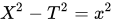


with the inverse
Differentiated and inserted into the Minkowski metric
the metric in the hyperbolically accelerated frame follows as
Rindler coordinates
Rindler coordinates are a coordinate system used in the context of special relativity to describe the hyperbolic acceleration of a uniformly accelerating reference frame in flat spacetime. In relativistic physics the coordinates of a hyperbolically accelerated reference frame constitute an important and useful coordinate chart representing part of flat Minkowski spacetime. In special relativity, a uniformly accelerating particle undergoes hyperbolic motion, for which a uniformly accelerating frame of reference in which it is at rest can be chosen as its proper reference frame. The phenomena in this hyperbolically accelerated frame can be compared to effects arising in a homogeneous gravitational field. For general overview of accelerations in flat spacetime, see Acceleration (special relativity) and Proper reference frame (flat spacetime).
In this article, the speed of light is defined by c = 1, the inertial coordinates are (X, Y, Z, T), and the hyperbolic coordinates are (x, y, z, t). These hyperbolic coordinates can be separated into two main variants depending on the accelerated observer's position: If the observer is located at time T = 0 at position X = 1/α (with α as the constant proper acceleration measured by a comoving accelerometer), then the hyperbolic coordinates are often called Rindler coordinates with the corresponding Rindler metric. If the observer is located at time T = 0 at position X = 0, then the hyperbolic coordinates are sometimes called Møller coordinates or Kottler–Møller coordinates with the corresponding Kottler–Møller metric. An alternative chart often related to observers in hyperbolic motion is obtained using Radar coordinates which are sometimes called Lass coordinates. Both the Kottler–Møller coordinates as well as Lass coordinates are denoted as Rindler coordinates as well.
Regarding the history, such coordinates were introduced soon after the advent of special relativity, when they were studied (fully or partially) alongside the concept of hyperbolic motion: In relation to flat Minkowski spacetime by Albert Einstein (1907, 1912), Max Born (1909), Arnold Sommerfeld (1910), Max von Laue (1911), Hendrik Lorentz (1913), Friedrich Kottler (1914), Wolfgang Pauli (1921), Karl Bollert (1922), Stjepan Mohorovičić (1922), Georges Lemaître (1924), Einstein & Nathan Rosen (1935), Christian Møller (1943, 1952), Fritz Rohrlich (1963), Harry Lass (1963), and in relation to both flat and curved spacetime of general relativity by Wolfgang Rindler (1960, 1966). For details and sources, see § History.
The worldline of a body in hyperbolic motion having constant proper acceleration in the -direction as a function of proper time and rapidity can be given by
where is constant and is variable, with the worldline resembling the hyperbola . Sommerfeld showed that the equations can be reinterpreted by defining as variable and as constant, so that it represents the simultaneous "rest shape" of a body in hyperbolic motion measured by a comoving observer. By using the proper time of the observer as the time of the entire hyperbolically accelerated frame by setting , the transformation formulas between the inertial coordinates and the hyperbolic coordinates are consequently:
with the inverse
Differentiated and inserted into the Minkowski metric
the metric in the hyperbolically accelerated frame follows as