


Community hub
Recent from talks
Contribute something
Nothing was collected or created yet.
Acceleration
View on Wikipedia
| Acceleration | |
|---|---|
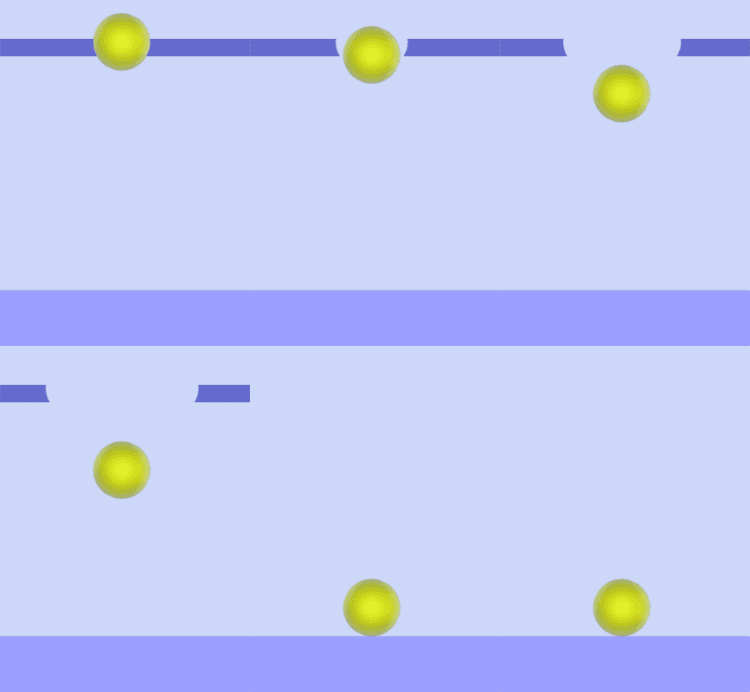
 In vacuum (no air resistance), objects attracted by Earth gain speed at a steady rate. | |
Common symbols | a |
| SI unit | m/s2, m·s−2, m s−2 |
Derivations from other quantities | |
| Dimension | |

| Part of a series on |
| Classical mechanics |
|---|


In mechanics, acceleration is the rate of change of the velocity of an object with respect to time. Acceleration is one of several components of kinematics, the study of motion. Accelerations are vector quantities (in that they have magnitude and direction).[1][2] The orientation of an object's acceleration is given by the orientation of the net force acting on that object. The magnitude of an object's acceleration, as described by Newton's second law,[3] is the combined effect of two causes:
- the net balance of all external forces acting onto that object — magnitude is directly proportional to this net resulting force;
- that object's mass, depending on the materials out of which it is made — magnitude is inversely proportional to the object's mass.
The SI unit for acceleration is metre per second squared (m⋅s−2, ).

For example, when a vehicle starts from a standstill (zero velocity, in an inertial frame of reference) and travels in a straight line at increasing speeds, it is accelerating in the direction of travel. If the vehicle turns, an acceleration occurs toward the new direction and changes its motion vector. The acceleration of the vehicle in its current direction of motion is called a linear acceleration (or tangential acceleration during circular motions), the reaction to which the passengers on board experience as a force pushing them back into their seats. When changing direction, the effecting acceleration is called radial or normal acceleration (or centripetal acceleration during circular motions), the reaction to which the passengers experience as a centrifugal force. If the speed of the vehicle decreases, this is an acceleration in the opposite direction of the velocity vector, sometimes called deceleration[4][5] or retardation, and passengers experience the reaction to deceleration as an inertial force pushing them forward. Such deceleration is often achieved by retrorocket burning in spacecraft.[6] Both acceleration and deceleration are treated the same, as they are both changes in velocity. Each of these accelerations (tangential, radial, deceleration) is felt by passengers until their relative (differential) velocity are neutralised in reference to the acceleration due to change in speed.
Definition and properties
[edit]
Average acceleration
[edit]
An object's average acceleration over a period of time is its change in velocity, , divided by the duration of the period, . Mathematically,


Instantaneous acceleration
[edit]
- an acceleration function a(t);
- the integral of the acceleration is the velocity function v(t);
- and the integral of the velocity is the distance function s(t).
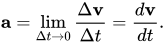
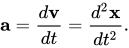
Instantaneous acceleration, meanwhile, is the limit of the average acceleration over an infinitesimal interval of time. In the terms of calculus, instantaneous acceleration is the derivative of the velocity vector with respect to time: As acceleration is defined as the derivative of velocity, v, with respect to time t and velocity is defined as the derivative of position, x, with respect to time, acceleration can be thought of as the second derivative of x with respect to t:
(Here and elsewhere, if motion is in a straight line, vector quantities can be substituted by scalars in the equations.)
By the fundamental theorem of calculus, it can be seen that the integral of the acceleration function a(t) is the velocity function v(t); that is, the area under the curve of an acceleration vs. time (a vs. t) graph corresponds to the change of velocity.

Likewise, the integral of the jerk function j(t), the derivative of the acceleration function, can be used to find the change of acceleration at a certain time:

Units
[edit]Acceleration has the dimensions of velocity (L/T) divided by time, i.e. L T−2. The SI unit of acceleration is the metre per second squared (m s−2); or "metre per second per second", as the velocity in metres per second changes by the acceleration value, every second.
Other forms
[edit]An object moving in a circular motion—such as a satellite orbiting the Earth—is accelerating due to the change of direction of motion, although its speed may be constant. In this case it is said to be undergoing centripetal (directed towards the center) acceleration.
Proper acceleration, the acceleration of a body relative to a free-fall condition, is measured by an instrument called an accelerometer.
In classical mechanics, for a body with constant mass, the (vector) acceleration of the body's center of mass is proportional to the net force vector (i.e. sum of all forces) acting on it (Newton's second law): where F is the net force acting on the body, m is the mass of the body, and a is the center-of-mass acceleration. As speeds approach the speed of light, relativistic effects become increasingly large.

Tangential and centripetal acceleration
[edit]

The velocity of a particle moving on a curved path as a function of time can be written as: with v equal to the speed of travel along the path, and a unit vector tangent to the path pointing in the direction of motion at the chosen moment in time. Taking into account both the changing speed v and the changing direction of ut, the acceleration of a particle moving on a curved path can be written using the chain rule of differentiation[7] for the product of two functions of time as:


where un is the unit (inward) normal vector to the particle's trajectory (also called the principal normal), and r is its instantaneous radius of curvature based upon the osculating circle at time t. The components are called the tangential acceleration and the normal or radial acceleration (or centripetal acceleration in circular motion, see also circular motion and centripetal force), respectively.

Geometrical analysis of three-dimensional space curves, which explains tangent, (principal) normal and binormal, is described by the Frenet–Serret formulas.[8][9]
Special cases
[edit]Uniform acceleration
[edit]
Uniform or constant acceleration is a type of motion in which the velocity of an object changes by an equal amount in every equal time period.
A frequently cited example of uniform acceleration is that of an object in free fall in a uniform gravitational field. The acceleration of a falling body in the absence of resistances to motion is dependent only on the gravitational field strength g (also called acceleration due to gravity). By Newton's second law the force acting on a body is given by:


Because of the simple analytic properties of the case of constant acceleration, there are simple formulas relating the displacement, initial and time-dependent velocities, and acceleration to the time elapsed:[10]
![{\displaystyle {\begin{aligned}\mathbf {s} (t)&=\mathbf {s} _{0}+\mathbf {v} _{0}t+{\tfrac {1}{2}}\mathbf {a} t^{2}=\mathbf {s} _{0}+{\tfrac {1}{2}}\left(\mathbf {v} _{0}+\mathbf {v} (t)\right)t\\\mathbf {v} (t)&=\mathbf {v} _{0}+\mathbf {a} t\\{v^{2}}(t)&={v_{0}}^{2}+2\mathbf {a\cdot } [\mathbf {s} (t)-\mathbf {s} _{0}],\end{aligned}}}](https://wikimedia.org/api/rest_v1/media/math/render/svg/d5bad5bdcb976c98a24324c4f4abd4a3cce7e6fa)
where
- is the elapsed time,
- is the initial displacement from the origin,
- is the displacement from the origin at time ,
- is the initial velocity,
- is the velocity at time , and
- is the uniform rate of acceleration.


In particular, the motion can be resolved into two orthogonal parts, one of constant velocity and the other according to the above equations. As Galileo showed, the net result is parabolic motion, which describes, e.g., the trajectory of a projectile in vacuum near the surface of Earth.[11]
Circular motion
[edit]


In uniform circular motion, that is moving with constant speed along a circular path, a particle experiences an acceleration resulting from the change of the direction of the velocity vector, while its magnitude remains constant. The derivative of the location of a point on a curve with respect to time, i.e. its velocity, turns out to be always exactly tangential to the curve, respectively orthogonal to the radius in this point. Since in uniform motion the velocity in the tangential direction does not change, the acceleration must be in radial direction, pointing to the center of the circle. This acceleration constantly changes the direction of the velocity to be tangent in the neighbouring point, thereby rotating the velocity vector along the circle.
- For a given speed , the magnitude of this geometrically caused acceleration (centripetal acceleration) is inversely proportional to the radius of the circle, and increases as the square of this speed:
- For a given angular velocity , the centripetal acceleration is directly proportional to radius . This is due to the dependence of velocity on the radius .


Expressing centripetal acceleration vector in polar components, where is a vector from the centre of the circle to the particle with magnitude equal to this distance, and considering the orientation of the acceleration towards the center, yields


As usual in rotations, the speed of a particle may be expressed as an angular speed with respect to a point at the distance as

Thus

This acceleration and the mass of the particle determine the necessary centripetal force, directed toward the centre of the circle, as the net force acting on this particle to keep it in this uniform circular motion. The so-called 'centrifugal force', appearing to act outward on the body, is a so-called pseudo force experienced in the frame of reference of the body in circular motion, due to the body's linear momentum, a vector tangent to the circle of motion.
In a nonuniform circular motion, i.e., the speed along the curved path is changing, the acceleration has a non-zero component tangential to the curve, and is not confined to the principal normal, which directs to the center of the osculating circle, that determines the radius for the centripetal acceleration. The tangential component is given by the angular acceleration , i.e., the rate of change of the angular speed times the radius . That is,


The sign of the tangential component of the acceleration is determined by the sign of the angular acceleration (), and the tangent is always directed at right angles to the radius vector.
Coordinate systems
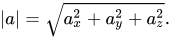
[edit]In multi-dimensional Cartesian coordinate systems, acceleration is broken up into components that correspond with each dimensional axis of the coordinate system. In a two-dimensional system, where there is an x-axis and a y-axis, corresponding acceleration components are defined as[12] The two-dimensional acceleration vector is then defined as . The magnitude of this vector is found by the distance formula as In three-dimensional systems where there is an additional z-axis, the corresponding acceleration component is defined as The three-dimensional acceleration vector is defined as with its magnitude being determined by


Relation to relativity
[edit]Special relativity
[edit]The special theory of relativity describes the behaviour of objects travelling relative to other objects at speeds approaching that of light in vacuum. Newtonian mechanics is exactly revealed to be an approximation to reality, valid to great accuracy at lower speeds. As the relevant speeds increase toward the speed of light, acceleration no longer follows classical equations.
As speeds approach that of light, the acceleration produced by a given force decreases, becoming infinitesimally small as light speed is approached; an object with mass can approach this speed asymptotically, but never reach it.
General relativity
[edit]Unless the state of motion of an object is known, it is impossible to distinguish whether an observed force is due to gravity or to acceleration—gravity and inertial acceleration have identical effects. Albert Einstein called this the equivalence principle, and said that only observers who feel no force at all—including the force of gravity—are justified in concluding that they are not accelerating.[13]
Conversions
[edit]| Base value | (Gal, or cm/s2) | (ft/s2) | (m/s2) | (Standard gravity, g0) |
|---|---|---|---|---|
| 1 Gal, or cm/s2 | 1 | 0.0328084 | 0.01 | 1.01972×10⁻³ |
| 1 ft/s2 | 30.4800 | 1 | 0.304800 | 0.0310810 |
| 1 m/s2 | 100 | 3.28084 | 1 | 0.101972 |
| 1 g0 | 980.665 | 32.1740 | 9.80665 | 1 |
See also
[edit]- Acceleration (differential geometry)
- Four-vector: making the connection between space and time explicit
- Gravitational acceleration
- Inertia
- Orders of magnitude (acceleration)
- Shock (mechanics)
- Shock and vibration data logger measuring 3-axis acceleration
- Space travel using constant acceleration
- Specific force
References
[edit]- ^ Bondi, Hermann (1980). Relativity and Common Sense. Courier Dover Publications. pp. 3. ISBN 978-0-486-24021-3.
- ^ Lehrman, Robert L. (1998). Physics the Easy Way. Barron's Educational Series. pp. 27. ISBN 978-0-7641-0236-3.
- ^ Crew, Henry (2008). The Principles of Mechanics. BiblioBazaar, LLC. p. 43. ISBN 978-0-559-36871-4.
- ^ P. Smith; R. C. Smith (1991). Mechanics (2nd, illustrated, reprinted ed.). John Wiley & Sons. p. 39. ISBN 978-0-471-92737-2. Extract of page 39
- ^ John D. Cutnell; Kenneth W. Johnson (2014). Physics, Volume One: Chapters 1-17, Volume 1 (1st0, illustrated ed.). John Wiley & Sons. p. 36. ISBN 978-1-118-83688-0. Extract of page 36
- ^ Raymond A. Serway; Chris Vuille; Jerry S. Faughn (2008). College Physics, Volume 10. Cengage. p. 32. ISBN 9780495386933.
- ^ Weisstein, Eric W. "Chain Rule". Wolfram MathWorld. Wolfram Research. Retrieved 2 August 2016.
- ^ Larry C. Andrews; Ronald L. Phillips (2003). Mathematical Techniques for Engineers and Scientists. SPIE Press. p. 164. ISBN 978-0-8194-4506-3.
- ^ Ch V Ramana Murthy; NC Srinivas (2001). Applied Mathematics. New Delhi: S. Chand & Co. p. 337. ISBN 978-81-219-2082-7.
- ^ Keith Johnson (2001). Physics for you: revised national curriculum edition for GCSE (4th ed.). Nelson Thornes. p. 135. ISBN 978-0-7487-6236-1.
- ^ David C. Cassidy; Gerald James Holton; F. James Rutherford (2002). Understanding physics. Birkhäuser. p. 146. ISBN 978-0-387-98756-9.
- ^ "The Feynman Lectures on Physics Vol. I Ch. 9: Newton's Laws of Dynamics". www.feynmanlectures.caltech.edu. Retrieved 2024-01-04.
- ^ Greene, Brian (8 February 2005). The Fabric of the Cosmos: Space, Time, and the Texture of Reality. Vintage. p. 67. ISBN 0-375-72720-5.
External links
[edit]
- Acceleration Calculator Simple acceleration unit converter

| International | |
|---|---|
| National | |
| Other | |

Acceleration
View on GrokipediaHistory
The concept of acceleration has roots in the scientific revolution of the 16th and 17th centuries. Galileo Galilei conducted pioneering experiments around 1604–1608 using inclined planes to study the motion of falling objects. By rolling bronze balls down smooth, polished channels on inclined wooden planes, Galileo slowed the motion to measurable speeds, allowing him to time the descents with a water clock. His experiments demonstrated that objects accelerate uniformly during free fall, gaining equal increments of speed in equal time intervals, and that the distance traveled is proportional to the square of the time taken. This finding, detailed in his 1638 work Two New Sciences, refuted Aristotelian notions that heavier objects fall faster and established the foundation for understanding uniform acceleration.[9][10] Building on Galileo's work, Isaac Newton formalized the relationship between force and acceleration in his Philosophiæ Naturalis Principia Mathematica published in 1687. Newton's second law of motion states that the acceleration of an object is directly proportional to the net force acting on it and inversely proportional to its mass, mathematically expressed as . This formulation provided a quantitative link between force, mass, and acceleration, enabling precise predictions of motion and becoming a cornerstone of classical mechanics.[7][11]Definition and Properties
Core Definition
Acceleration is a fundamental concept in classical mechanics, defined as the rate of change of velocity with respect to time.[2] As a vector quantity, acceleration possesses both magnitude and direction, allowing it to describe not only changes in speed but also alterations in the direction of motion, in contrast to scalar quantities like speed.[5] This vector nature distinguishes acceleration from velocity, which itself is a vector representing the rate of change of position.[12] Mathematically, acceleration is expressed as the first derivative of velocity with respect to time, , or equivalently as the second derivative of the position vector , .[13] Velocity, as the prerequisite concept, is the first derivative of position with respect to time, , providing the foundational link between position and acceleration in kinematic descriptions.[12] The understanding of acceleration evolved significantly from ancient to early modern physics. Aristotle's kinematics lacked the notion of acceleration, viewing motion primarily in terms of constant velocity toward a natural place without recognizing changes in speed over time.[14] In contrast, Galileo Galilei, around the early 1600s, pioneered the recognition of acceleration through experiments with falling bodies, demonstrating that objects gain speed at a constant rate under gravity, thus establishing acceleration as a key dynamic property.[15] This conceptual shift laid the groundwork for Newtonian mechanics, where acceleration connects force and motion. Acceleration can be analyzed as average over time intervals or instantaneous at a specific moment, with the latter detailed in subsequent sections.[16]Average Acceleration
Average acceleration is defined as the change in velocity divided by the change in time over a finite interval, providing a measure of how velocity varies on average during that period.[17] The vector formula is , where and are the initial and final velocities, respectively, and .[18] This quantity is a vector, with magnitude indicating the average rate of speed change and direction aligned with the net change in velocity. Geometrically, in a velocity-time graph, the average acceleration corresponds to the slope of the straight line (chord) connecting the initial and final points, representing the overall linear trend of velocity change over the interval.[19] Average acceleration relates to displacement through the average velocity, which equals the total displacement divided by . Since average velocity is also and , substituting yields . Thus, , rearranging to .[20] For example, consider a car accelerating from rest () to 60 km/h (approximately 16.7 m/s) in 10 seconds along a straight road. The average acceleration magnitude is m/s², with direction forward along the road.[17] As the time interval approaches zero, average acceleration approaches instantaneous acceleration.[17]Instantaneous Acceleration
Instantaneous acceleration is defined as the rate of change of velocity at a precise instant in time, obtained by taking the limit of the average acceleration as the time interval approaches zero.[21] Mathematically, for a particle's velocity vector , the instantaneous acceleration is given by [21] This vector quantity captures both changes in the magnitude and direction of velocity and serves as the second derivative of position with respect to time.[21] The instantaneous acceleration can be resolved into two perpendicular components relative to the instantaneous velocity: the tangential component, which arises from changes in the speed of the particle, and the normal component, which arises from changes in the direction of the velocity.[22] For instance, consider a projectile launched at an angle under constant gravity; at the peak of its trajectory, where the vertical component of velocity is zero and the motion is instantaneously horizontal, the tangential acceleration is zero because the speed is at a minimum, while the normal acceleration is non-zero and directed downward with magnitude , reflecting the curvature of the parabolic path.[23][22] Instantaneous acceleration provides an exact measure at a point, whereas average acceleration approximates it over finite intervals when those intervals are sufficiently small.[21] The rate of change of acceleration itself defines the jerk , the third time derivative of position, expressed as .[24]Units and Dimensions
In the International System of Units (SI), the derived unit for acceleration is the metre per second squared, symbolized as m/s², which represents a change in velocity of one metre per second over one second. This unit arises from the base units of length (metre, m) and time (second, s), yielding the dimensional formula , where denotes length and denotes time.[25] Other common units include the foot per second squared (ft/s²) in the US customary system, where 1 ft/s² equals exactly 0.3048 m/s² based on the defined length of one foot as 0.3048 metres. Acceleration is also frequently expressed in multiples of the standard acceleration due to gravity, known as g-force or simply "g," where 1 g is defined exactly as 9.80665 m/s².[26] For instance, 1 ft/s² corresponds to approximately 0.03108 g. Dimensional consistency requires that acceleration's dimensions balance in physical equations, such as Newton's second law , where the dimension of force and mass imply , ensuring the equation's homogeneity across unit systems.[27] This principle verifies the correctness of kinematic relations involving acceleration, maintaining equivalence between SI and non-SI expressions.Components and Decomposition
Tangential Acceleration
Tangential acceleration is the component of an object's acceleration that acts parallel to its instantaneous velocity vector, thereby altering the magnitude of the speed along the trajectory without affecting the direction of motion at that instant. It is mathematically defined as , where represents the scalar speed of the object.[28] This component arises in both rectilinear and curvilinear paths, focusing solely on rate-of-change effects for speed.[29] In curvilinear motion, tangential acceleration points along the tangent to the path at the position of the object, and it is directly related to the net force component in that tangential direction via Newton's second law: , where is the tangential component of the net force and is the mass.[30] This force may stem from applied forces like engine thrust or friction, causing the object to speed up or slow down while following the curve.[31] A clear example of pure tangential acceleration occurs when a car accelerates along a straight road, where the entire acceleration vector aligns with the velocity, increasing the speed uniformly. In contrast, if the same car accelerates while rounding a bend, the tangential component contributes to speed changes, combined with a normal component that handles the directional shift.[29] The sign convention designates tangential acceleration as positive for increases in speed (aligned with velocity) and negative for decreases (opposing velocity), ensuring consistent interpretation along the path.[29] While tangential acceleration modifies speed, normal acceleration addresses velocity direction changes due to curvature.[32]Normal (Centripetal) Acceleration
Normal acceleration, also known as centripetal acceleration, is the component of acceleration in curvilinear motion that is responsible for changing the direction of the velocity vector while acting perpendicular to the instantaneous velocity.[33] It arises due to the curvature of the path and points toward the center of curvature, ensuring the object follows a curved trajectory.[34] Unlike tangential acceleration, which affects speed, normal acceleration does not alter the magnitude of velocity but redirects it continuously.[33] The magnitude of normal acceleration is given by the formula where is the speed of the object and is the radius of curvature of the path at the point of interest.[33] The radius of curvature represents the radius of the osculating circle that best approximates the path locally and is calculated as for a path defined by .[33] This component is always directed along the principal normal vector , perpendicular to the tangent vector and toward the concave side of the path.[35] In general curvilinear motion, normal acceleration applies beyond circular paths, using the instantaneous radius of curvature to account for varying degrees of path bending at each point.[33] For instance, in non-circular trajectories like parabolas or ellipses, changes along the path, leading to a varying even if speed is constant.[34] The total acceleration vector in such motion has a magnitude of , combining this with the tangential component.[33] A key example is uniform circular motion, where the path is a circle of constant radius , so . Here, normal acceleration simplifies to , directed radially inward toward the center.[34] This formula can be derived geometrically by considering the change in velocity over a small angular displacement . The velocity vectors at two points separated by form an isosceles triangle with two sides of length and apex angle , yielding . Dividing by gives the acceleration magnitude as , with direction perpendicular to the velocity and toward the center.[34] In this case, since speed is constant, tangential acceleration is zero, and the total acceleration equals .[34]Acceleration in Curvilinear Motion
In curvilinear motion, a particle's acceleration along a non-linear path is resolved into tangential and normal components that capture changes in speed and direction, respectively. The total acceleration vector is expressed as , where is the tangential component along the unit tangent vector , and is the normal component along the principal unit normal vector directed toward the center of curvature, with denoting the instantaneous speed and the radius of curvature.[36] This decomposition arises within the Frenet-Serret framework, a natural orthogonal triad of unit vectors (, , and binormal ) that evolves along the curve, governed by differential equations describing their rates of change. The curvature quantifies how sharply the path bends, linking directly to the normal acceleration via .[37] A key distinction from rectilinear motion lies in the evolution of the acceleration vector: even with constant magnitude, rotates due to the time-varying orientations of and , reflecting the path's geometry, whereas in straight-line motion the normal component vanishes and aligns fixedly with .[36] For illustration, consider a particle launched horizontally with initial speed under constant downward gravity , tracing the parabolic path (y positive downward). At the point where the tangent angle to the horizontal is 45°, the speed is , the tangential acceleration is the projection of along the tangent, yielding , and the normal acceleration is , with radius of curvature .[38] Circular motion exemplifies a constrained case of this framework with constant .[37]Special Cases and Applications
Uniform Acceleration
Uniform acceleration refers to motion in which the acceleration vector remains constant in both magnitude and direction over time. This constancy implies that the velocity changes at a uniform rate, independent of position or time elapsed. In one dimension, this simplifies to scalar acceleration being constant, while in two dimensions, such motion often results in parabolic trajectories when one component (e.g., horizontal) has zero acceleration and the other (e.g., vertical) is constant. The kinematic equations describe the relationships between position, velocity, acceleration, and time for uniform acceleration. Starting from the definition of acceleration as , integration yields the first equation: , where is the initial velocity. Substituting this into the velocity-position relation and integrating again gives the position equation: , with as the initial position. The remaining equations are and . These apply to linear motion along the direction of constant acceleration and can be extended vectorially for multidimensional cases. A classic example of uniform acceleration is free fall under gravity near Earth's surface, ignoring air resistance, where objects accelerate downward at a constant rate of approximately . For an object dropped from rest (), the position equation simplifies to , yielding a straight-line trajectory in one dimension. This case illustrates how uniform acceleration produces predictable motion, such as the time to fall a given distance.[40] Uniform acceleration serves as an approximation valid for short durations or in regions where external forces vary negligibly, such as near Earth's surface where gravitational acceleration is effectively constant. Deviations arise over longer times or stronger varying fields, but the model remains foundational for analyzing many practical scenarios.[41]Acceleration in Circular Motion
In circular motion, an object follows a curved path where its velocity vector continuously changes direction, resulting in acceleration even if the speed is constant. For uniform circular motion, the speed remains constant, but the acceleration is purely centripetal, directed toward the center of the circle, with magnitude given by , where is the tangential speed and is the radius.[34] This can also be expressed as , where is the constant angular velocity.[42] There is no tangential component in this case, as the angular acceleration .[43] One derivation of the centripetal acceleration magnitude uses vector dot products. In uniform circular motion, the position vector from the center has constant magnitude, so is constant. Differentiating with respect to time yields , implying , meaning the velocity is perpendicular to the position vector. Differentiating again gives , so . Since the acceleration points toward the center and is parallel to , its magnitude is .[44] In non-uniform circular motion, the speed varies, introducing a tangential acceleration component , where is the angular acceleration, directed along the tangent to the path.[34] The total acceleration is the vector sum of the tangential and centripetal components, with magnitude .[45] The directions remain perpendicular: tangential along the velocity and centripetal radial inward.[46] A classic example of uniform circular motion is a passenger on a Ferris wheel operating at constant speed, experiencing only centripetal acceleration toward the center, which varies in direction but not magnitude as the wheel rotates.[47] In contrast, an accelerating carousel, where the angular speed increases due to motor torque, illustrates non-uniform motion: riders feel both tangential acceleration speeding them up and centripetal acceleration keeping them in the circular path.[48] The acceleration of a point at position from the center in circular motion can be expressed in vector form as , where the first term is the tangential contribution and the second is the centripetal term (noting that for planar motion with perpendicular to ).[49] This formulation arises from differentiating the velocity with respect to time.[50]Acceleration Due to Gravity
The acceleration due to gravity, commonly denoted as , represents the gravitational attraction exerted by Earth on objects near its surface, resulting in a downward acceleration for freely falling bodies. This acceleration is directed toward the center of the Earth and is expressed as a vector , with its magnitude varying slightly depending on location.[26] The standard value of at sea level and at 45° latitude is defined as exactly 9.80665 m/s², often approximated as 9.81 m/s² for practical calculations. This value arises from Earth's mass and radius through Newton's law of universal gravitation, given by the formula , where is the gravitational constant (6.67430 × 10^{-11} m³ kg^{-1} s^{-2}),[51] is Earth's mass (approximately 5.972 × 10^{24} kg), and is the distance from Earth's center (about 6.378 × 10^6 m, the equatorial radius).[52] However, is not constant globally; it decreases with increasing altitude because increases, following the inverse-square relationship in the formula, and varies with latitude due to Earth's oblate shape and rotational effects, ranging from about 9.78 m/s² at the equator to 9.83 m/s² at the poles.[53] A classic example of acceleration due to gravity occurs when an object, such as a ball, is dropped from rest near Earth's surface; it accelerates downward at approximately , covering increasing distances in successive equal time intervals until air resistance (drag force) balances the gravitational force, leading to a constant terminal velocity where net acceleration becomes zero.[54] This process highlights how drives the initial motion, with drag opposing it proportionally to velocity squared for higher speeds.[55] Historically, the concept was advanced through experiments by Galileo Galilei, who demonstrated that objects of different masses accelerate at the same rate under gravity, independent of mass, refuting Aristotelian views. A famous but likely apocryphal anecdote, first recorded by his student Vincenzo Viviani, describes Galileo dropping such objects from the Leaning Tower of Pisa in the late 1590s.[56] In modern times, is measured with high precision using methods such as simple pendulums, where the period allows solving for (with as pendulum length), or portable accelerometers and absolute gravimeters that detect free-fall motion over short distances. These techniques achieve accuracies better than 0.01%, enabling detailed gravity maps for geophysical applications.[57][58] Near Earth's surface, gravitational acceleration approximates uniform acceleration, simplifying kinematic analyses of falling objects.Mathematical Representations
Coordinate Systems
In physics, acceleration is often expressed in specific coordinate systems to simplify the analysis of motion, depending on the geometry of the problem. Cartesian coordinates are particularly straightforward for linear or rectilinear motions, while polar coordinates are advantageous for rotational or orbital paths. These representations allow the decomposition of the acceleration vector into components aligned with the chosen basis vectors, facilitating the application of Newton's second law. In Cartesian coordinates, the acceleration vector of a particle is given by , where the components are the second time derivatives of the position coordinates: , , and .[59] This form arises directly from the definition of instantaneous acceleration as the derivative of velocity, with each component independent in inertial frames. For two-dimensional motion, the z-component is zero, reducing to .[59] In polar coordinates, suitable for motions involving radial and angular variations, the acceleration is decomposed into radial and angular components: the radial acceleration and the angular (or transverse) acceleration , where is the radial distance, is the angular position, and dots denote time derivatives.[60] These expressions are derived by differentiating the velocity , accounting for the time-varying unit vectors and .[60] The term represents centripetal acceleration, while is the transverse coupling term in the tangential direction. A representative example of Cartesian coordinates is projectile motion under constant gravity, where acceleration has zero horizontal component () and constant vertical component (), simplifying the kinematic analysis of parabolic trajectories.[23] In contrast, polar coordinates are more natural for planetary motion around a central body, where the acceleration captures the radial gravitational pull and angular momentum conservation, as seen in Keplerian orbits.[61] For transformations between inertial frames moving at constant relative velocity (no rotation), the Galilean transformation preserves acceleration, meaning the components of are identical in both frames, ensuring Newton's laws hold invariantly.[62] These coordinate expressions underpin the derivation of kinematic equations in subsequent analyses.Kinematic Equations
In kinematics, the relationships between position, velocity, and acceleration for arbitrary (non-constant) motion are expressed through integrals of the acceleration function. In one dimension, the velocity at time is obtained by integrating the acceleration from the initial time, yielding , where is the initial velocity.[63] Similarly, the position is found by integrating the velocity, giving , with as the initial position.[63] These relations extend naturally to three-dimensional motion using vector notation. The velocity vector is , and the position vector follows as .[59] These integral forms hold without assuming constant acceleration, allowing description of complex trajectories where acceleration varies with time or position. A classic example of variable acceleration is simple harmonic motion, where the acceleration is proportional to the negative displacement from equilibrium, given by , with as the angular frequency.[64] Solving the resulting differential equation yields oscillatory position , velocity , and acceleration , illustrating how the kinematic integrals capture periodic behavior.[64] When analytical integration is infeasible, numerical methods approximate solutions to these kinematic equations. The Euler method, a first-order technique, updates velocity and position iteratively via and , where is the time step, commonly used in simulations of dynamic systems despite potential accumulation of errors over long times.[65] For constant acceleration cases, these general forms simplify to the familiar "SUVAT" equations, but the integrals provide the foundational approach.[63]Vector and Tensor Forms
In three-dimensional Euclidean space, acceleration is a vector quantity defined as the time derivative of the velocity vector, , where has components along the Cartesian axes.[66] This representation enables the application of vector algebra, including the dot product , which determines the rate of change of kinetic energy through the relation to instantaneous power , derived from .[67] Similarly, the cross product features in rotational dynamics, as torque links linear acceleration to angular motion.[67] To extend this concept to curved manifolds, such as in general relativity, acceleration is formulated using the covariant derivative, which incorporates the geometry of spacetime. For a timelike worldline parameterized by proper time , the four-acceleration component is where is the four-velocity and denotes the covariant derivative operator, , with as the Christoffel symbols encoding curvature.[68] This form ensures that acceleration transforms as a tensor, unlike ordinary partial derivatives, and vanishes for geodesic motion in free fall. In fluid dynamics, tensor representations of acceleration describe the motion of continuum elements. The acceleration tensor components for a fluid particle arise from the material derivative, where are velocity components and the convective term involves the velocity gradient tensor, balancing pressure gradients and viscous stresses in the Navier-Stokes equations.[69] As preparation for relativistic frameworks, proper acceleration in special relativity is the four-vector , where is the four-velocity with Lorentz factor , and this vector is orthogonal to (), measuring the magnitude of acceleration in the instantaneous comoving frame.[70]Relativistic Contexts
Acceleration in Special Relativity
In special relativity, the classical notion of acceleration as the simple time derivative of velocity, , is modified due to the finite speed of light , which imposes a universal speed limit. The relativistic velocity addition formula ensures that no object can exceed ; for two velocities and in the same direction, the combined velocity is , always yielding even if both approach .[71] This implies that sustained acceleration does not produce linearly increasing velocity as in Newtonian mechanics but asymptotically approaches , requiring a distinction between coordinate acceleration in a lab frame and the acceleration experienced by the object itself. Proper acceleration addresses this by representing the acceleration measured in the instantaneous rest frame of the accelerating observer, invariant across inertial frames. For motion along the velocity direction (longitudinal case), the relation between proper acceleration and the coordinate acceleration in an inertial lab frame is , where is the Lorentz factor.[70] This quantity is what the observer "feels," such as the g-forces in an accelerating vehicle. Historically, Albert Einstein introduced concepts akin to this in 1905 by distinguishing longitudinal mass and transverse mass , reflecting how force relates differently to acceleration parallel or perpendicular to velocity in electromagnetic contexts, as observed in early particle experiments.[71] In modern particle accelerators like the Large Hadron Collider, protons reach speeds of , where proper acceleration highlights the immense energy input needed for marginal velocity gains near , validating these relativistic effects.[72] When proper acceleration is constant, the resulting trajectory in spacetime is hyperbolic motion, where position and time satisfy in suitable coordinates, leading to velocity as a function of proper time .[73] This motion underscores the observer-dependent nature of time and space intervals during acceleration. The four-acceleration , the covariant derivative of the four-velocity along the worldline, is orthogonal to the four-velocity (satisfying ) and has invariant magnitude given by in the mostly-plus metric signature, providing a spacetime scalar that generalizes proper acceleration.[74] In the low-speed limit (), these reduce to classical acceleration, recovering Newtonian results.[75]Acceleration in General Relativity
In general relativity, the concept of acceleration is framed within the geometry of curved spacetime, where proper acceleration quantifies an observer's deviation from free-fall motion along a geodesic, distinct from coordinate-dependent descriptions. Free-falling objects experience zero proper acceleration, as their worldlines follow geodesics determined by the spacetime metric. The geodesic equation encapsulates this: Here, is the proper time, are spacetime coordinates, and are the Christoffel symbols derived from the metric tensor, representing gravitational effects through curvature. This equation, central to general relativity, shows that gravity manifests as inertial motion in curved space rather than a force inducing acceleration. Stationary observers in a gravitational field, however, require non-zero proper acceleration to maintain their position against the tendency toward geodesic paths. Proper acceleration is the norm of the four-acceleration vector, measured in the observer's instantaneous rest frame, and points away from the gravitational source to counteract curvature. For an observer at rest on Earth's surface in the weak-field approximation of the Schwarzschild metric, this proper acceleration equals the local gravitational field strength of approximately 9.8 m/s², directed radially outward, ensuring the observer does not follow a free-fall trajectory.[76] Einstein's equivalence principle, exemplified by the 1907 elevator thought experiment, illustrates the local indistinguishability of uniform acceleration and gravitation. Consider an observer in a sealed elevator: if accelerating upward at 9.8 m/s² in flat spacetime, they feel a downward "force" equivalent to Earth's gravity; conversely, in free fall within a uniform gravitational field, they experience weightlessness, as both scenarios follow locally geodesic motion. This principle, foundational to general relativity, equates the proper acceleration in an accelerated frame to that in a gravitational field, blurring the distinction locally while highlighting tidal effects over larger scales.[77] Near a black hole's event horizon, the proper acceleration for a stationary observer diverges dramatically. In the Schwarzschild spacetime describing a non-rotating black hole, an observer attempting to remain at fixed radial coordinate experiences escalating proper acceleration as they approach the horizon at , where it becomes infinite due to the extreme spacetime curvature. This divergence implies that no finite acceleration can keep such an observer stationary at or beyond the horizon, underscoring the horizon's role as a one-way boundary for information and matter.Measurement and Conversions
Experimental Measurement
One of the earliest experimental methods for measuring acceleration was the Atwood machine, invented in 1784 by British mathematician George Atwood to accurately determine the acceleration due to gravity, g.[78] This apparatus consists of two masses connected by a string over a pulley, where the difference in masses produces a measurable linear acceleration that can be timed over a known distance to calculate g with reduced sensitivity to timing errors compared to free-fall experiments.[79] Modern experimental measurement of acceleration primarily relies on accelerometers, which detect changes in motion through mechanical or electrical transduction. Piezoelectric accelerometers operate on the piezoelectric effect, where certain crystals generate an electric charge in response to mechanical stress from an inertial mass under acceleration, making them ideal for dynamic measurements such as vibration and shock with high-frequency response up to several kHz.[80] These sensors are commonly used in industrial monitoring and aerospace applications due to their durability and sensitivity to transient events.[81] Capacitive accelerometers, particularly micro-electro-mechanical systems (MEMS) variants, measure acceleration by detecting changes in capacitance between a moving proof mass and fixed electrodes, enabling both static and dynamic detection suitable for low-frequency motions like tilt or constant acceleration.[82] MEMS capacitive accelerometers are widely integrated into consumer devices, such as smartphones, where they typically operate in ranges from ±2g to ±16g to capture everyday activities like orientation changes or impacts while maintaining compact size and low power consumption.[83] In specialized environments, such as microgravity simulations, drop towers provide controlled free-fall conditions to study near-weightlessness, with residual accelerations measured using high-precision accelerometers to quantify deviations from ideal zero-g, often in the range of 10^{-5} to 10^{-6} g.[84] For instance, facilities like the ZARM drop tower in Germany use quartz-flexure or capacitive sensors to record these minute accelerations during 4.7-9.3 second drops, enabling validation of space experiment payloads.[85] Calibration of accelerometers ensures measurement accuracy and is often performed using Earth's gravitational field by orienting the device in multiple positions to exploit the known value of g (approximately 9.81 m/s²), allowing determination of scale factors, offsets, and cross-axis sensitivities through least-squares fitting.[86] Common error sources include environmental vibrations, which introduce noise and bias, particularly in low-frequency ranges, necessitating vibration-isolated setups or reference standards during calibration to achieve uncertainties below 1%.[87]Unit Conversions and Formulas
Acceleration units are frequently converted between the International System of Units (SI) and imperial systems for applications in engineering, physics, and transportation. In the SI system, the base unit is meters per second squared (m/s²), while common imperial units include feet per second squared (ft/s²) and miles per hour per second (mph/s). For instance, 1 m/s² is equivalent to approximately 2.237 mph/s, derived from the conversion factors where 1 mile equals 1609.344 meters and 1 hour equals 3600 seconds.[88] A standard non-dimensional unit for acceleration is the g-force, where 1 g represents the standard acceleration due to gravity, defined exactly as 9.80665 m/s². To convert an acceleration value to g, divide the magnitude in m/s² by 9.80665; for example, an acceleration of 19.6133 m/s² equals 2 g.[26] Another key relationship is between linear and angular acceleration, given by the formula , where is the tangential (linear) acceleration, is the radius of the circular path, and is the angular acceleration. For unit consistency in SI, must be in meters, in radians per second squared (rad/s²), yielding in m/s²; in imperial units, in feet with in rad/s² gives in ft/s². This formula applies in rotational dynamics, such as in vehicle turning or centrifuge operations.[89] In historical contexts, such as NASA's Apollo missions, spacecraft reentry accelerations provide a practical conversion example. The maximum deceleration during Apollo 11 reentry was 6.3 g, equivalent to approximately 61.78 m/s² or 0.06178 km/s² (since 1 km/s² = 1000 m/s²).[90] Similar peaks around 6.2 g occurred in Apollo 14, highlighting the need for precise unit conversions in aerospace design to ensure crew safety.[91] The following table summarizes common conversions between imperial and metric acceleration units, using the standard g as a reference for scale:| Unit | Value in m/s² | Equivalent in g |
|---|---|---|
| 1 ft/s² | 0.3048 | 0.0311 |
| 1 in/s² | 0.0254 | 0.00259 |
| 1 mph/s | 0.4470 | 0.0456 |
| 1 g | 9.80665 | 1 |
References
- https://galileoandeinstein.phys.[virginia](/page/Virginia).edu/tns244.htm