



Community hub
Recent from talks
Contribute something
Nothing was collected or created yet.
Relativistic mechanics
View on WikipediaIn physics, relativistic mechanics refers to mechanics compatible with special relativity (SR) and general relativity (GR). It provides a non-quantum mechanical description of a system of particles, or of a fluid, in cases where the velocities of moving objects are comparable to the speed of light c. As a result, classical mechanics is extended correctly to particles traveling at high velocities and energies, and provides a consistent inclusion of electromagnetism with the mechanics of particles. This was not possible in Galilean relativity, where it would be permitted for particles and light to travel at any speed, including faster than light. The foundations of relativistic mechanics are the postulates of special relativity and general relativity. The unification of SR with quantum mechanics is relativistic quantum mechanics, while attempts for that of GR is quantum gravity, an unsolved problem in physics.
As with classical mechanics, the subject can be divided into "kinematics"; the description of motion by specifying positions, velocities and accelerations, and "dynamics"; a full description by considering energies, momenta, and angular momenta and their conservation laws, and forces acting on particles or exerted by particles. There is however a subtlety; what appears to be "moving" and what is "at rest"—which is termed by "statics" in classical mechanics—depends on the relative motion of observers who measure in frames of reference.
Some definitions and concepts from classical mechanics do carry over to SR, such as force as the time derivative of momentum (Newton's second law), the work done by a particle as the line integral of force exerted on the particle along a path, and power as the time derivative of work done. However, there are a number of significant modifications to the remaining definitions and formulae. SR states that motion is relative and the laws of physics are the same for all experimenters irrespective of their inertial reference frames. In addition to modifying notions of space and time, SR forces one to reconsider the concepts of mass, momentum, and energy all of which are important constructs in Newtonian mechanics. SR shows that these concepts are all different aspects of the same physical quantity in much the same way that it shows space and time to be interrelated.
The equations become more complicated in the more familiar three-dimensional vector calculus formalism, due to the nonlinearity in the Lorentz factor, which accurately accounts for relativistic velocity dependence and the speed limit of all particles and fields. However, they have a simpler and elegant form in four-dimensional spacetime, which includes flat Minkowski space (SR) and curved spacetime (GR), because three-dimensional vectors derived from space and scalars derived from time can be collected into four vectors, or four-dimensional tensors. The six-component angular momentum tensor is sometimes called a bivector because in the 3D viewpoint it is two vectors (one of these, the conventional angular momentum, being an axial vector).
Relativistic kinematics
[edit]The relativistic four-velocity, that is the four-vector representing velocity in relativity, is defined as follows:
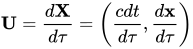
In the above, is the proper time of the path through spacetime, called the world-line, followed by the object velocity the above represents, and


is the four-position; the coordinates of an event. Due to time dilation, the proper time is the time between two events in a frame of reference where they take place at the same location. The proper time is related to coordinate time t by:

where is the Lorentz factor:


(either version may be quoted) so it follows:

The first three terms, excepting the factor of , is the velocity as seen by the observer in their own reference frame. The is determined by the velocity between the observer's reference frame and the object's frame, which is the frame in which its proper time is measured. This quantity is invariant under Lorentz transformation, so to check to see what an observer in a different reference frame sees, one simply multiplies the velocity four-vector by the Lorentz transformation matrix between the two reference frames.


Relativistic dynamics
[edit]Rest mass and relativistic mass
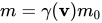
[edit]The mass of an object as measured in its own frame of reference is called its rest mass or invariant mass and is sometimes written . If an object moves with velocity in some other reference frame, the quantity is often called the object's "relativistic mass" in that frame.[1] Some authors use to denote rest mass, but for the sake of clarity this article will follow the convention of using for relativistic mass and for rest mass.[2]


Lev Okun has suggested that the concept of relativistic mass "has no rational justification today" and should no longer be taught.[3] Other physicists, including Wolfgang Rindler and T. R. Sandin, contend that the concept is useful.[4] See mass in special relativity for more information on this debate.
A particle whose rest mass is zero is called massless. Photons and gravitons are thought to be massless, and neutrinos are nearly so.
Relativistic energy and momentum
[edit]There are a couple of (equivalent) ways to define momentum and energy in SR. One method uses conservation laws. If these laws are to remain valid in SR they must be true in every possible reference frame. However, if one does some simple thought experiments using the Newtonian definitions of momentum and energy, one sees that these quantities are not conserved in SR. One can rescue the idea of conservation by making some small modifications to the definitions to account for relativistic velocities. It is these new definitions which are taken as the correct ones for momentum and energy in SR.
The four-momentum of an object is straightforward, identical in form to the classical momentum, but replacing 3-vectors with 4-vectors:

The energy and momentum of an object with invariant mass , moving with velocity with respect to a given frame of reference, are respectively given by
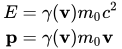
The factor comes from the definition of the four-velocity described above. The appearance of may be stated in an alternative way, which will be explained in the next section.

The kinetic energy, , is defined as (see #Kinetic energy)


and the speed as a function of kinetic energy is given by

The spatial momentum may be written as , preserving the form from Newtonian mechanics with relativistic mass substituted for Newtonian mass. However, this substitution fails for some quantities, including force and kinetic energy. Moreover, the relativistic mass is not invariant under Lorentz transformations, while the rest mass is. For this reason, many people prefer to use the rest mass and account for explicitly through the 4-velocity or coordinate time.

A simple relation between energy, momentum, and velocity may be obtained from the definitions of energy and momentum by multiplying the energy by , multiplying the momentum by , and noting that the two expressions are equal. This yields


may then be eliminated by dividing this equation by and squaring,


dividing the definition of energy by and squaring,

and substituting:

This is the relativistic energy–momentum relation.
While the energy and the momentum depend on the frame of reference in which they are measured, the quantity is invariant. Its value is times the squared magnitude of the 4-momentum vector.


The invariant mass of a system may be written as
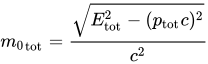
Due to kinetic energy and binding energy, this quantity is different from the sum of the rest masses of the particles of which the system is composed. Rest mass is not a conserved quantity in special relativity, unlike the situation in Newtonian physics. However, even if an object is changing internally, so long as it does not exchange energy or momentum with its surroundings, its rest mass will not change and can be calculated with the same result in any reference frame.
Mass–energy equivalence
[edit]The relativistic energy–momentum equation holds for all particles, even for massless particles for which m0 = 0. In this case:

When substituted into Ev = c2p, this gives v = c: massless particles (such as photons) always travel at the speed of light.
Notice that the rest mass of a composite system will generally be slightly different from the sum of the rest masses of its parts since, in its rest frame, their kinetic energy will increase its mass and their (negative) binding energy will decrease its mass. In particular, a hypothetical "box of light" would have rest mass even though made of particles which do not since their momenta would cancel.
Looking at the above formula for invariant mass of a system, one sees that, when a single massive object is at rest (v = 0, p = 0), there is a non-zero mass remaining: m0 = E/c2. The corresponding energy, which is also the total energy when a single particle is at rest, is referred to as "rest energy". In systems of particles which are seen from a moving inertial frame, total energy increases and so does momentum. However, for single particles the rest mass remains constant, and for systems of particles the invariant mass remain constant, because in both cases, the energy and momentum increases subtract from each other, and cancel. Thus, the invariant mass of systems of particles is a calculated constant for all observers, as is the rest mass of single particles.
The mass of systems and conservation of invariant mass
[edit]For systems of particles, the energy–momentum equation requires summing the momentum vectors of the particles:

The inertial frame in which the momenta of all particles sums to zero is called the center of momentum frame. In this special frame, the relativistic energy–momentum equation has p = 0, and thus gives the invariant mass of the system as merely the total energy of all parts of the system, divided by c2
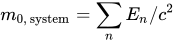
This is the invariant mass of any system which is measured in a frame where it has zero total momentum, such as a bottle of hot gas on a scale. In such a system, the mass which the scale weighs is the invariant mass, and it depends on the total energy of the system. It is thus more than the sum of the rest masses of the molecules, but also includes all the totaled energies in the system as well. Like energy and momentum, the invariant mass of isolated systems cannot be changed so long as the system remains totally closed (no mass or energy allowed in or out), because the total relativistic energy of the system remains constant so long as nothing can enter or leave it.
An increase in the energy of such a system which is caused by translating the system to an inertial frame which is not the center of momentum frame, causes an increase in energy and momentum without an increase in invariant mass. E = m0c2, however, applies only to isolated systems in their center-of-momentum frame where momentum sums to zero.
Taking this formula at face value, we see that in relativity, mass is simply energy by another name (and measured in different units). In 1927 Einstein remarked about special relativity, "Under this theory mass is not an unalterable magnitude, but a magnitude dependent on (and, indeed, identical with) the amount of energy."[5]
Closed (isolated) systems
[edit]In a "totally-closed" system (i.e., isolated system) the total energy, the total momentum, and hence the total invariant mass are conserved. Einstein's formula for change in mass translates to its simplest ΔE = Δmc2 form, however, only in non-closed systems in which energy is allowed to escape (for example, as heat and light), and thus invariant mass is reduced. Einstein's equation shows that such systems must lose mass, in accordance with the above formula, in proportion to the energy they lose to the surroundings. Conversely, if one can measure the differences in mass between a system before it undergoes a reaction which releases heat and light, and the system after the reaction when heat and light have escaped, one can estimate the amount of energy which escapes the system.
Chemical and nuclear reactions
[edit]In both nuclear and chemical reactions, such energy represents the difference in binding energies of electrons in atoms (for chemistry) or between nucleons in nuclei (in atomic reactions). In both cases, the mass difference between reactants and (cooled) products measures the mass of heat and light which will escape the reaction, and thus (using the equation) give the equivalent energy of heat and light which may be emitted if the reaction proceeds.
In chemistry, the mass differences associated with the emitted energy are around 10−9 of the molecular mass.[6] However, in nuclear reactions the energies are so large that they are associated with mass differences, which can be estimated in advance, if the products and reactants have been weighed (atoms can be weighed indirectly by using atomic masses, which are always the same for each nuclide). Thus, Einstein's formula becomes important when one has measured the masses of different atomic nuclei. By looking at the difference in masses, one can predict which nuclei have stored energy that can be released by certain nuclear reactions, providing important information which was useful in the development of nuclear energy and, consequently, the nuclear bomb. Historically, for example, Lise Meitner was able to use the mass differences in nuclei to estimate that there was enough energy available to make nuclear fission a favorable process. The implications of this special form of Einstein's formula have thus made it one of the most famous equations in all of science.
Center of momentum frame
[edit]The equation E = m0c2 applies only to isolated systems in their center of momentum frame. It has been popularly misunderstood to mean that mass may be converted to energy, after which the mass disappears. However, popular explanations of the equation as applied to systems include open (non-isolated) systems for which heat and light are allowed to escape, when they otherwise would have contributed to the mass (invariant mass) of the system.
Historically, confusion about mass being "converted" to energy has been aided by confusion between mass and "matter", where matter is defined as fermion particles. In such a definition, electromagnetic radiation and kinetic energy (or heat) are not considered "matter". In some situations, matter may indeed be converted to non-matter forms of energy (see above), but in all these situations, the matter and non-matter forms of energy still retain their original mass.
For isolated systems (closed to all mass and energy exchange), mass never disappears in the center of momentum frame, because energy cannot disappear. Instead, this equation, in context, means only that when any energy is added to, or escapes from, a system in the center-of-momentum frame, the system will be measured as having gained or lost mass, in proportion to energy added or removed. Thus, in theory, if an atomic bomb were placed in a box strong enough to hold its blast, and detonated upon a scale, the mass of this closed system would not change, and the scale would not move. Only when a transparent "window" was opened in the super-strong plasma-filled box, and light and heat were allowed to escape in a beam, and the bomb components to cool, would the system lose the mass associated with the energy of the blast. In a 21 kiloton bomb, for example, about a gram of light and heat is created. If this heat and light were allowed to escape, the remains of the bomb would lose a gram of mass, as it cooled. In this thought-experiment, the light and heat carry away the gram of mass, and would therefore deposit this gram of mass in the objects that absorb them.[7]
Angular momentum
[edit]In relativistic mechanics, the time-varying mass moment

and orbital 3-angular momentum

of a point-like particle are combined into a four-dimensional bivector in terms of the 4-position X and the 4-momentum P of the particle:[8][9]

where ∧ denotes the exterior product. This tensor is additive: the total angular momentum of a system is the sum of the angular momentum tensors for each constituent of the system. So, for an assembly of discrete particles one sums the angular momentum tensors over the particles, or integrates the density of angular momentum over the extent of a continuous mass distribution.
Each of the six components forms a conserved quantity when aggregated with the corresponding components for other objects and fields.
Force
[edit]In special relativity, Newton's second law does not hold in the form F = ma, but it does if it is expressed as

where p = γ(v)m0v is the momentum as defined above and m0 is the invariant mass. Thus, the force is given by

Derivation Starting from
Carrying out the derivatives gives
If the acceleration is separated into the part parallel to the velocity (a∥) and the part perpendicular to it (a⊥), so that:
one gets
By construction a∥ and v are parallel, so (v·a∥)v is a vector with magnitude v2a∥ in the direction of v (and hence a∥) which allows the replacement:
then




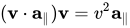
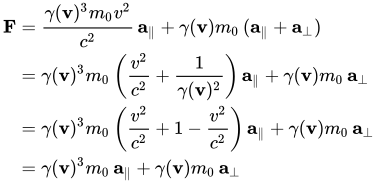
Consequently, in some old texts, γ(v)3m0 is referred to as the longitudinal mass, and γ(v)m0 is referred to as the transverse mass, which is numerically the same as the relativistic mass. See mass in special relativity.
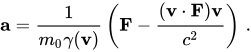
If one inverts this to calculate acceleration from force, one gets
The force described in this section is the classical 3-D force which is not a four-vector. This 3-D force is the appropriate concept of force since it is the force which obeys Newton's third law of motion. It should not be confused with the so-called four-force which is merely the 3-D force in the comoving frame of the object transformed as if it were a four-vector. However, the density of 3-D force (linear momentum transferred per unit four-volume) is a four-vector (density of weight +1) when combined with the negative of the density of power transferred.
Torque
[edit]The torque acting on a point-like particle is defined as the derivative of the angular momentum tensor given above with respect to proper time:[10][11]
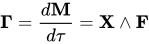
or in tensor components:

where F is the 4d force acting on the particle at the event X. As with angular momentum, torque is additive, so for an extended object one sums or integrates over the distribution of mass.
Kinetic energy
[edit]The work-energy theorem says[12] the change in kinetic energy is equal to the work done on the body. In special relativity:
![{\displaystyle {\begin{aligned}\Delta K=W=[\gamma _{1}-\gamma _{0}]m_{0}c^{2}.\end{aligned}}}](https://wikimedia.org/api/rest_v1/media/math/render/svg/bc89ae0cb8f161d560e2900fbe6968467fc8742a)
Derivation
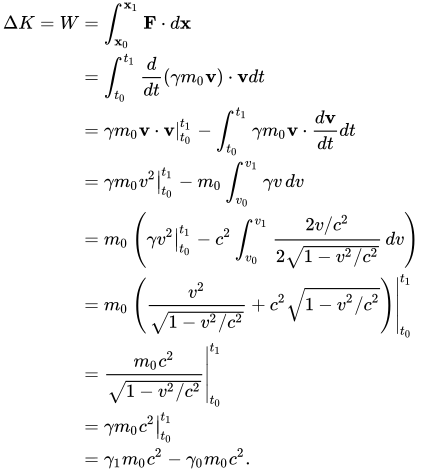
If in the initial state the body was at rest, so v0 = 0 and γ0(v0) = 1, and in the final state it has speed v1 = v, setting γ1(v1) = γ(v), the kinetic energy is then;
![{\displaystyle K=[\gamma (v)-1]m_{0}c^{2}\,,}](https://wikimedia.org/api/rest_v1/media/math/render/svg/e46c795b5262cc66c64992a6ccdaf1f71cdbe677)
a result that can be directly obtained by subtracting the rest energy m0c2 from the total relativistic energy γ(v)m0c2.
Newtonian limit
[edit]The Lorentz factor γ(v) can be expanded into a Taylor series or binomial series for (v/c)2 < 1, obtaining:

and consequently


For velocities much smaller than that of light, one can neglect the terms with c2 and higher in the denominator. These formulas then reduce to the standard definitions of Newtonian kinetic energy and momentum. This is as it should be, for special relativity must agree with Newtonian mechanics at low velocities.
See also
[edit]References
[edit]- ^ Philip Gibbs, Jim Carr & Don Koks (2008). "What is relativistic mass?". Usenet Physics FAQ. Retrieved 2008-09-19. Note that in 2008 the last editor, Don Koks, rewrote a significant portion of the page, changing it from a view extremely dismissive of the usefulness of relativistic mass to one which hardly questions it. The previous version was: Philip Gibbs & Jim Carr (1998). "Does mass change with speed?". Usenet Physics FAQ. Archived from the original on 2007-06-30.
- ^ See, for example: Feynman, Richard (1998). "The special theory of relativity". Six Not-So-Easy Pieces. Cambridge, Massachusetts: Perseus Books. ISBN 0-201-32842-9.
- ^ Lev B. Okun (July 1989). "The Concept of Mass" (PDF). Physics Today. 42 (6): 31–36. Bibcode:1989PhT....42f..31O. doi:10.1063/1.881171. Archived from the original (subscription required) on 2008-12-17. Retrieved 2012-06-04.
- ^ T. R. Sandin (November 1991). "In defense of relativistic mass". American Journal of Physics. 59 (11): 1032–1036. Bibcode:1991AmJPh..59.1032S. doi:10.1119/1.16642.
- ^ Einstein on Newton
- ^ Randy Harris (2008). Modern Physics: Second Edition. Pearson Addison-Wesley. p. 38. ISBN 978-0-8053-0308-7.
- ^ E. F. Taylor and J. A. Wheeler, Spacetime Physics, W.H. Freeman and Co., New York. 1992. ISBN 0-7167-2327-1, see pp. 248–9 for discussion of mass remaining constant after detonation of nuclear bombs, until heat is allowed to escape.
- ^ R. Penrose (2005). The Road to Reality. Vintage books. pp. 437–438, 566–569. ISBN 978-0-09-944068-0. Note: Some authors, including Penrose, use Latin letters in this definition, even though it is conventional to use Greek indices for vectors and tensors in spacetime.
- ^ M. Fayngold (2008). Special Relativity and How it Works. John Wiley & Sons. pp. 137–139. ISBN 978-3-527-40607-4.
- ^ S. Aranoff (1969). "Torque and angular momentum on a system at equilibrium in special relativity". American Journal of Physics. 37 (4): 453–454. Bibcode:1969AmJPh..37..453A. doi:10.1119/1.1975612. This author uses T for torque, here we use capital Gamma Γ since T is most often reserved for the stress–energy tensor.
- ^ S. Aranoff (1972). "Equilibrium in special relativity" (PDF). Nuovo Cimento. 10 (1): 159. Bibcode:1972NCimB..10..155A. doi:10.1007/BF02911417. S2CID 117291369. Archived from the original (PDF) on 2012-03-28. Retrieved 2013-10-13.
- ^ R.C.Tolman "Relativity Thermodynamics and Cosmology" pp 47–48
Further reading
[edit]- General scope and special/general relativity
- P.M. Whelan; M.J. Hodgeson (1978). Essential Principles of Physics (2nd ed.). John Murray. ISBN 0-7195-3382-1.
- G. Woan (2010). The Cambridge Handbook of Physics Formulas. Cambridge University Press. ISBN 978-0-521-57507-2.
- P.A. Tipler; G. Mosca (2008). Physics for Scientists and Engineers: With Modern Physics (6th ed.). W.H. Freeman and Co. ISBN 978-1-4292-0265-7.
- R.G. Lerner; G.L. Trigg (2005). Encyclopaedia of Physics (2nd ed.). VHC Publishers, Hans Warlimont, Springer. ISBN 978-0-07-025734-4.
- Concepts of Modern Physics (4th Edition), A. Beiser, Physics, McGraw-Hill (International), 1987, ISBN 0-07-100144-1
- C.B. Parker (1994). McGraw Hill Encyclopaedia of Physics (2nd ed.). McGraw Hill. ISBN 0-07-051400-3.
- T. Frankel (2012). The Geometry of Physics (3rd ed.). Cambridge University Press. ISBN 978-1-107-60260-1.
- L.H. Greenberg (1978). Physics with Modern Applications. Holt-Saunders International W.B. Saunders and Co. ISBN 0-7216-4247-0.
- A. Halpern (1988). 3000 Solved Problems in Physics, Schaum Series. Mc Graw Hill. ISBN 978-0-07-025734-4.
- Electromagnetism and special relativity
- G.A.G. Bennet (1974). Electricity and Modern Physics (2nd ed.). Edward Arnold (UK). ISBN 0-7131-2459-8.
- I.S. Grant; W.R. Phillips; Manchester Physics (2008). Electromagnetism (2nd ed.). John Wiley & Sons. ISBN 978-0-471-92712-9.
- D.J. Griffiths (2007). Introduction to Electrodynamics (3rd ed.). Pearson Education, Dorling Kindersley. ISBN 978-81-7758-293-2.
- Classical mechanics and special relativity
- J.R. Forshaw; A.G. Smith (2009). Dynamics and Relativity. Wiley. ISBN 978-0-470-01460-8.
- D. Kleppner; R.J. Kolenkow (2010). An Introduction to Mechanics. Cambridge University Press. ISBN 978-0-521-19821-9.
- L.N. Hand; J.D. Finch (2008). Analytical Mechanics. Cambridge University Press. ISBN 978-0-521-57572-0.
- P.J. O'Donnell (2015). Essential Dynamics and Relativity. CRC Press. ISBN 978-1-4665-8839-4.
- General relativity
- D. McMahon (2006). Relativity DeMystified. Mc Graw Hill. ISBN 0-07-145545-0.
- J.A. Wheeler; C. Misner; K.S. Thorne (1973). Gravitation. W.H. Freeman & Co. ISBN 0-7167-0344-0.
- J.A. Wheeler; I. Ciufolini (1995). Gravitation and Inertia. Princeton University Press. ISBN 978-0-691-03323-5.
- R.J.A. Lambourne (2010). Relativity, Gravitation, and Cosmology. Cambridge University Press. ISBN 978-0-521-13138-4.
Relativistic mechanics
View on GrokipediaRelativistic Kinematics
Spacetime and Lorentz Transformations
Relativistic mechanics is built upon the framework of special relativity, which redefines space and time as interconnected components of a four-dimensional continuum known as Minkowski spacetime. This structure emerged from efforts to reconcile the invariance of the speed of light with the principle of relativity, leading to transformations that preserve the laws of physics across inertial frames. The foundational elements of this framework are the Lorentz transformations, which relate coordinates between frames in relative motion. The Lorentz transformations were initially proposed by Hendrik Lorentz in 1904 to explain electromagnetic phenomena observed in systems moving at velocities less than the speed of light, addressing discrepancies in the classical ether theory.[8] In 1905, Albert Einstein formalized these transformations within special relativity, deriving them from two fundamental postulates: the principle of relativity, stating that the laws of physics are identical in all inertial frames, and the constancy of the speed of light in vacuum, independent of the source's motion.[9] Einstein's derivation ensures that Maxwell's equations for electromagnetism remain form-invariant under these transformations, unifying mechanics and electrodynamics.[9] In 1908, Hermann Minkowski reconceptualized Einstein's ideas by introducing Minkowski spacetime as a four-dimensional manifold, where the coordinates are the three spatial dimensions and the time coordinate (with the speed of light), forming an "absolute world" that fuses space and time inseparably.[10] This spacetime is endowed with a pseudo-Euclidean metric of signature , expressed through the line element although the opposite signature is also commonly used in some conventions.[10][11] The spacetime interval between two events is the invariant quantity preserved under Lorentz transformations, distinguishing timelike, spacelike, and lightlike separations and serving as the geometric foundation for relativistic effects.[10] Along a timelike worldline, the proper time is given by , measuring the time experienced by an observer following that path.[10] The Lorentz transformations for a boost along the x-axis, connecting coordinates in one frame to in a frame moving at velocity relative to the first, are derived by assuming linear coordinate mappings due to the homogeneity of space and time, combined with the invariance of .[9] Consider a light pulse emitted from the origin at , satisfying and in both frames; this implies the transformation must satisfy and , with and .[9] To determine , apply the same to a light pulse in the opposite direction, and , yielding the Lorentz factor [9] Substituting into the interval invariance confirms this form, ensuring the transformations form a group that preserves the metric.[9] For boosts in arbitrary directions, the Lorentz transformations are generalized using the rapidity parameter , defined such that , with and , parameterizing the boost as a hyperbolic rotation in the spacetime plane of motion.[12] This formulation, which highlights the Lorentz group's isomorphism to the orthogonal group , facilitates compositions of non-collinear boosts and was employed in early developments following Einstein's work, such as by Edmund Whittaker in 1910.[12] The rapidity's additivity for collinear boosts simplifies velocity addition in relativity.[12]Proper Time and Time Dilation
In relativistic mechanics, proper time is defined as the time interval measured by a clock traveling along a specific timelike worldline in spacetime, given by the infinitesimal element , where is the proper length of the spacetime interval along that path and is the speed of light.[13] This quantity represents the invariant "aging" experienced by the clock, independent of the observer's frame, as it arises from the geometry of Minkowski spacetime. Lorentz transformations provide the basis for understanding how time measurements differ between inertial frames in relative motion, leading to frame-dependent coordinate times. The phenomenon of time dilation emerges when comparing proper time to the coordinate time measured in a lab frame for a clock moving at constant velocity . To derive the formula, consider a clock at rest in frame , which moves at velocity along the -axis relative to the lab frame . In , the clock ticks a proper time interval between two events at the same spatial position, so . Applying the Lorentz transformation for the time coordinates, the interval in becomes , where . This result follows from substituting the transformation equations and into the spacetime interval invariance , yielding after simplification for . Thus, moving clocks appear to run slower in the lab frame by the factor . The twin paradox illustrates time dilation through a thought experiment where one twin remains inertial on Earth while the other travels at relativistic speed to a distant star and returns. In spacetime diagrams, the Earth twin's worldline is a straight vertical line (pure time-like displacement), maximizing the proper time interval between departure and reunion events. The traveling twin's path, involving acceleration to turn around, forms a V-shaped trajectory with two slanted segments; the total proper time along this broken path is shorter due to the spatial components reducing the integrated . This asymmetry resolves the apparent paradox: the traveling twin ages less (), as their non-geodesic path accumulates less proper time, even though inertial segments alone would suggest symmetry. Experimental confirmation of time dilation came from observations of cosmic-ray muons, which decay with a proper lifetime of about 2.2 s but reach Earth's surface in greater numbers than expected without relativity. In the 1941 Rossi-Hall experiment, counters at different altitudes measured the decay rate of high-momentum muons at relativistic speeds (, to 20 depending on altitude), showing an extended mean lifetime consistent with , allowing more muons to survive the atmospheric transit.[14] Proper time applies to any timelike worldline, but a key distinction arises between inertial and accelerated paths: inertial observers follow straight geodesics in Minkowski spacetime, yielding the maximum possible proper time between two events (twin geodesic principle), whereas accelerated paths, like the traveling twin's, are curved or segmented, resulting in shorter proper time due to the Pythagorean-like geometry of the interval . For accelerated clocks, the proper time remains well-defined as the integral along the worldline, assuming the clock hypothesis that local measurements match instantaneous comoving inertial frames.Length Contraction
In special relativity, the proper length of an object is defined as the length measured by an observer at rest relative to that object, using rulers and clocks in the object's rest frame.[15] This invariant length serves as the baseline for comparing measurements across different inertial frames. When an object moves with velocity relative to an observer, and the direction of motion is parallel to the object's length, the observer measures a contracted length , where is the Lorentz factor and is the speed of light.[15] This length contraction arises directly from the Lorentz transformations, which ensure the invariance of the spacetime interval. To derive it, consider measuring the positions of the object's endpoints simultaneously in the observer's frame; due to the relativity of simultaneity, these simultaneous events in the observer's frame correspond to non-simultaneous events in the object's rest frame, where the endpoints are separated by the proper length . The mismatch in simultaneity effectively shortens the measured distance in the direction of motion.[16] Length contraction applies only to the component parallel to the velocity; dimensions perpendicular to the motion remain unchanged, preserving volumes and transverse measurements.[15] This effect has been experimentally verified through observations in particle physics, where relativistic predictions including length contraction are essential for consistency. A seminal confirmation comes from the Rossi and Hall experiment in 1941, which measured the decay rates of cosmic-ray muons at different altitudes.[14] In the Earth's frame, the muons' lifetimes are dilated, allowing more to reach the surface than expected classically; equivalently, from the muon's rest frame, the atmospheric distance is length-contracted by a factor of at typical speeds (), enabling the journey within the muon's brief proper lifetime of about 2.2 microseconds.[17] Similar relativistic beam dynamics, accounting for contracted bunch lengths in the lab frame, have been observed and required for the operation of particle accelerators since the early cyclotrons of the 1930s, where deviations from classical predictions confirmed the need for Lorentz-invariant corrections.[17]Velocity Addition
In classical mechanics, velocities add vectorially, allowing the combination of two sub-luminal speeds to exceed the speed of light , which contradicts the postulates of special relativity that the speed of light is invariant and the maximum speed for massive objects.[18] Relativistic velocity addition resolves this by incorporating the Lorentz transformations, ensuring that no object can reach or surpass while preserving causality.[18] The collinear velocity addition formula, derived by applying the Lorentz transformations to the coordinates and times of events, gives the relative velocity of an object moving at speed relative to a frame moving at speed along the same line, both with respect to a rest frame: This formula was obtained by Albert Einstein in 1905 by considering the transformation of infinitesimal displacements between frames, yielding the velocity components as ratios of these differentials.[18] For example, if and , then , less than , demonstrating the non-additive nature at high speeds.[18] For non-collinear velocities, the general addition formula arises directly from the Lorentz transformations applied to the velocity components. If a frame moves at velocity relative to frame , and an object has velocity in , the components in are: where .[18] This ensures the magnitude and accounts for the perpendicular components being scaled by the Lorentz factor . Einstein derived this in 1905 by differentiating the Lorentz coordinate transformations to obtain the velocity relations.[18] In the low-speed limit where , the denominator approaches 1, recovering the Galilean addition . For light, if or , then regardless of , upholding the invariance of .[18] A related effect is the aberration of light, where the apparent direction of light rays changes due to relative motion, derived from the velocity addition applied to photons. If light approaches at angle in the source frame, the angle in the observer's frame moving at speed parallel to the line of sight is: This formula, obtained by Einstein in 1905 via Lorentz transformations on light propagation, causes stars to appear shifted forward when observed from a moving platform, such as Earth orbiting the Sun.[18] Historically, the velocity addition formula resolved the Fizeau experiment of 1851, which measured the speed of light in moving water and found partial dragging of light by the medium, inconsistent with full classical addition but explained by relativity's composition rule for light velocity in convected media.[18] Einstein applied the formula in 1905 to derive the effective light speed in a medium moving at with dragging coefficient , matching Fizeau's results without invoking an aether.[18]Relativistic Dynamics
Four-Momentum and Relativistic Mass
In relativistic mechanics, the four-momentum of a particle is defined as the four-vector , where denotes the total energy of the particle, is the speed of light in vacuum, and is the three-dimensional momentum vector.[19] This formulation unifies the spatial and temporal aspects of momentum in a covariant manner, ensuring consistency across inertial reference frames.[20] The invariant magnitude of the four-momentum is given by the Minkowski inner product (using the (+,-,-,-) metric signature), where is the invariant rest mass of the particle, a scalar quantity independent of the observer's frame. The three-momentum component of the four-momentum is expressed as , where is the three-velocity of the particle and is the Lorentz factor.[21] This relation generalizes the Newtonian momentum to account for relativistic effects at high speeds, where .[22] Historically, the concept of relativistic mass was introduced by Henri Poincaré in 1905 to describe the effective inertia of a moving particle, extending the idea that mass increases with velocity.[23] However, in modern physics, relativistic mass is considered frame-dependent and is rarely used, as it can lead to conceptual confusion; instead, the invariant rest mass is preferred, with relativistic effects incorporated through the Lorentz factor in expressions for momentum and energy. Under Lorentz boosts, the components of the four-momentum transform according to the standard Lorentz transformation rules for four-vectors, mixing the energy and momentum terms between frames while preserving the invariant .[24] For a boost along the x-direction with velocity , the transformed components are and , where and , with the transverse components and unchanged.[20] This ensures that the four-momentum behaves covariantly, aligning with the principles of special relativity.[19]Relativistic Energy
In relativistic mechanics, the total energy of a free particle with rest mass and speed is given by where is the Lorentz factor and is the speed of light in vacuum./University_Physics_III_-Optics_and_Modern_Physics(OpenStax)/05%3A__Relativity/5.10%3A_Relativistic_Energy) One standard derivation of this expression follows from the relativistic work-energy theorem, which states that the work done on a particle equals the change in its kinetic energy./University_Physics_III_-Optics_and_Modern_Physics(OpenStax)/05%3A__Relativity/5.10%3A_Relativistic_Energy) In relativity, the force is , where is the relativistic momentum, so the infinitesimal work is ./University_Physics_III_-Optics_and_Modern_Physics(OpenStax)/05%3A__Relativity/5.10%3A_Relativistic_Energy) Integrating from rest (, ) to velocity yields the kinetic energy , implying the total energy ./University_Physics_III_-Optics_and_Modern_Physics(OpenStax)/05%3A__Relativity/5.10%3A_Relativistic_Energy) An alternative derivation arises from the normalization of the four-momentum four-vector , whose magnitude squared equals the rest mass invariant . In Minkowski space with metric signature , this gives , or where is the magnitude of the three-momentum; solving for recovers for positive energy solutions. Historically, Albert Einstein first derived the relation in 1905 by analyzing the energy-momentum balance of electromagnetic radiation emitted from a body, showing that the body's inertia changes with its energy content.[25] In this thought experiment, Einstein considered a body emitting two equal pulses of light in opposite directions in its rest frame, then examined the mass change in another frame, leading to the conclusion that energy carries inertial mass via in the low-velocity limit, extended to the full relativistic form.[25] The rest energy , defined for a particle at rest (, ), is ./University_Physics_III_-Optics_and_Modern_Physics(OpenStax)/05%3A__Relativity/5.10%3A_Relativistic_Energy) The kinetic energy is then the difference , which reduces to the Newtonian for ./University_Physics_III_-Optics_and_Modern_Physics(OpenStax)/05%3A__Relativity/5.10%3A_Relativistic_Energy) For massless particles like photons, where , the energy-momentum relation simplifies to . This follows directly from the four-momentum normalization, as the four-momentum is null (), with along the direction of propagation.Mass-Energy Equivalence
Mass-energy equivalence is a fundamental principle of special relativity, stating that mass and energy are interchangeable manifestations of the same underlying entity. Proposed by Albert Einstein in 1905, this equivalence implies that a quantity of mass possesses an intrinsic energy content given by , where is the speed of light in vacuum.[25] This relation reveals that even at rest, mass embodies a tremendous amount of potential energy, far exceeding typical kinetic or chemical energies encountered in everyday phenomena.[26] The rest energy , where denotes the rest mass of a particle, represents the inherent energy associated with that mass when the particle is at rest relative to an observer. This rest energy is frame-invariant, meaning it remains constant across all inertial reference frames, underscoring its fundamental nature in relativistic physics./University_Physics_III_-Optics_and_Modern_Physics(OpenStax)/05%3A__Relativity/5.10%3A_Relativistic_Energy) In this interpretation, mass is not merely a measure of inertia but a concentrated form of energy that can be released or converted under appropriate conditions.[27] One way to appreciate the rest energy's significance is through the low-velocity approximation of the total relativistic energy. The relativistic kinetic energy for speeds much less than expands as where the leading term recovers the Newtonian kinetic energy, and higher-order corrections arise from relativistic effects; the constant rest energy term emerges naturally as the zeroth-order contribution when considering the full energy expression.[28] This expansion demonstrates how the equivalence bridges classical and relativistic regimes without altering the core Newtonian limit for slow-moving objects./University_Physics_III_-Optics_and_Modern_Physics(OpenStax)/05%3A__Relativity/5.10%3A_Relativistic_Energy) Thought experiments illustrate the convertibility of mass to energy, particularly in bound systems where binding energy reduces the total rest mass. For instance, in electron-positron annihilation, an electron and positron at rest, each with rest mass , combine to produce photons whose total energy equals , effectively converting the entire rest mass into radiant energy while conserving total energy and momentum.[26] This process highlights how the rest masses "disappear," replaced by an equivalent energy output, demonstrating the equivalence in action for particle-antiparticle pairs.[26] Experimental verification of mass-energy equivalence came in the 1930s through measurements of nuclear binding energy deficits. In 1932, John Cockcroft and Ernest Walton used their accelerator to bombard lithium nuclei with protons, inducing the reaction , which released energy consistent with a mass defect of approximately 0.018 atomic mass units, converted via to match the observed 17.2 MeV output. This marked the first laboratory confirmation of the equivalence, showing that the binding energy in nuclei manifests as a reduction in total rest mass.[29] Philosophically, mass-energy equivalence shifted the foundational view of matter and energy from distinct entities to unified aspects of a single reality, with Einstein emphasizing that "the mass of a body is a measure of its energy-content."[27] This perspective eliminated the classical separation between mass as a static property and energy as dynamic, implying that all mass inherently carries energy, capable of transformation under relativistic principles.[26]Conservation of Energy and Momentum
In relativistic mechanics, the conservation of energy and momentum is unified through the four-momentum, a four-vector that combines the energy and three-momentum of a particle, where and with . For a system of multiple particles, the total four-momentum is the vector sum of the individual four-momenta, , reflecting the additivity inherent in the linear structure of Minkowski spacetime.[2] This total four-momentum is conserved in any isolated system across all inertial frames, as required by the Lorentz invariance of the laws of physics; thus, the initial total four-momentum equals the final total four-momentum, .[2] In elastic collisions, where no rest mass is created or destroyed, this conservation law ensures that both the total energy and total three-momentum are preserved in every inertial frame, analogous to Newtonian mechanics but with relativistic expressions.[30] For inelastic processes, such as those involving excitation, absorption, or particle creation, the total four-momentum remains conserved, meaning the total energy (including rest and kinetic contributions) is unchanged, but the invariant rest mass of the system—defined via —may increase or decrease depending on the interaction.[2] The center-of-momentum frame, in which the total three-momentum vanishes (), provides a particularly useful reference for analyzing such collisions, as it isolates internal dynamics and simplifies the application of conservation laws by setting the spatial momentum components to zero.[2] In the low-speed limit where velocities are much less than the speed of light (), the relativistic conservation of four-momentum reduces to the separate Newtonian conservations of mechanical energy (approximately ) and three-momentum (), without violating classical principles.[2]Systems and Interactions
Invariant Mass of Composite Systems
In relativistic mechanics, the invariant mass of a composite system consisting of multiple particles is a Lorentz-invariant scalar quantity that represents the effective rest mass of the entire system as measured in its center-of-momentum frame. It is defined mathematically as where is the total energy of all particles in the system, is the vector sum of their three-momenta, and is the speed of light. This definition arises from the invariance of the spacetime interval and the four-momentum's Minkowski norm, ensuring remains constant across all inertial frames related by Lorentz transformations.[31][32] For a simple case of two particles, the invariant mass simplifies to where and are the energies and momenta of the individual particles. This expression generalizes directly to any number of particles by replacing the sums with totals over all constituents. In the center-of-momentum frame, where , the formula reduces to , providing a direct measure of the system's total rest energy. For non-interacting particles at rest relative to each other in this frame, equals the sum of their individual rest masses, , highlighting the additive nature under these conditions.[31] The invariant mass is conserved in any closed system, as it follows from the conservation of the total four-momentum, which is a fundamental postulate of special relativity. External interactions or emissions can alter the system's invariant mass only if energy or momentum is exchanged with the surroundings, but within an isolated composite, remains unchanged regardless of internal rearrangements or relative motions of the constituents. This conservation property makes invariant mass a key tool for analyzing interactions, such as particle decays or collisions, where frame-independent thresholds can be determined.[33][31] Unlike the simple sum of individual rest masses, the invariant mass of a composite system typically differs due to contributions from the particles' relative kinetic energies and any interaction potentials. In scenarios with relative motion, kinetic energy increases beyond ; conversely, in bound systems, negative potential energy (binding) reduces , as anticipated by mass-energy equivalence where internal energies manifest as adjustments to the effective mass. This distinction underscores how relativity treats composite systems holistically, beyond mere additive rest masses.[26][32]Closed Systems and Center-of-Momentum Frame
In relativistic mechanics, a closed system, also known as an isolated system, is defined as one in which no net external forces act, ensuring that the total four-momentum remains constant throughout the system's evolution.[34] The four-momentum of the system is the vector sum , where for each constituent particle, and its invariance under Lorentz transformations underscores the conservation of both energy and momentum in all inertial frames.[34] This conservation holds because the system's dynamics are governed solely by internal interactions, without external perturbations altering the overall four-momentum.[35] The center-of-momentum (CM) frame is a particularly useful reference frame for analyzing such closed systems, defined as the unique inertial frame where the total three-momentum vanishes, .[35] In this frame, the total energy equals the invariant rest energy of the system, , where is the invariant mass derived from the Minkowski norm of the total four-momentum, .[36] Since in the CM frame, directly corresponds to the measurable total energy available for internal processes.[34] To transform to the CM frame from an arbitrary lab frame, a Lorentz boost is applied along the direction of the total three-momentum with velocity , where is the total energy in the lab frame.[35] This boost velocity ensures that the transformed total momentum is zero, simplifying the kinematics.[35] The advantages of working in the CM frame are significant: it symmetrizes the problem by eliminating net motion, thereby facilitating calculations in scattering and collision processes where momentum conservation must be enforced.[34] Additionally, the invariant mass becomes directly observable as the rest energy , providing a frame-independent measure of the system's internal structure without complications from overall motion.[36] In contrast, open systems are those subject to external forces or influences, which cause the total four-momentum to vary over time, violating the isolation condition and requiring separate treatment of external contributions to energy and momentum.[34]Relativistic Forces and Acceleration
In relativistic mechanics, the three-force acting on a particle is defined as the time derivative of its three-momentum with respect to coordinate time : , where and , with the rest mass, the three-velocity, and the speed of light.[37] This definition generalizes Newton's second law while preserving the invariance of physical laws across inertial frames. The power delivered by this force, representing the rate at which work is done on the particle, is given by , where is the total energy of the particle. This relation follows from differentiating the energy expression and substituting the momentum definition, highlighting how force contributes to energy increase in a frame-dependent manner. Acceleration in relativity is characterized by the proper acceleration , which is the three-acceleration measured in the particle's instantaneous rest frame and is invariant under Lorentz transformations. For a force parallel to the velocity, the proper acceleration relates to the coordinate acceleration by . When the proper acceleration is constant—as felt by the particle—the resulting trajectory is hyperbolic motion, described by the equation assuming motion along the -axis from rest at the origin.[38] This path arises from integrating the equations of motion under constant proper acceleration, contrasting with the parabolic trajectories of constant coordinate acceleration in Newtonian mechanics. Historically, early formulations attempted to express the force-acceleration relation using direction-dependent effective masses. The transverse mass applies when the force is perpendicular to , while the longitudinal mass applies when parallel, as derived from transforming the equations of motion in Einstein's 1905 analysis of electron dynamics. These concepts, though useful for intuition, are now largely superseded by the invariant rest mass and four-vector formalism, as they imply an anisotropic inertia that complicates generalizations.[37] Unlike the Newtonian case where , the relativistic second law does not yield a simple proportionality between force and coordinate acceleration due to the velocity dependence of . For instance, even a constant parallel to produces diminishing as approaches , preventing superluminal speeds. This limitation underscores the need for four-momentum to fully capture force effects in a Lorentz-covariant way.[37]Angular Momentum and Torque
In relativistic mechanics, the angular momentum of a single particle is described by the antisymmetric angular momentum tensor , defined as , where is the four-position and is the four-momentum.[39] This tensor generalizes the classical orbital angular momentum to four-dimensional spacetime, ensuring Lorentz covariance, with its spatial components (for ) corresponding to the three-vector , where is the relativistic three-momentum.[39] The time components relate to the center-of-momentum position, linking boosts and rotations in the Poincaré group.[40] For a system of particles, the total angular momentum tensor is the sum over individual contributions, , and is conserved in closed systems without external torques due to rotational invariance, as derived from Noether's theorem applied to the Lorentz group symmetries of the action.[40] In the absence of external influences, the conservation law holds for the total tensor, mirroring the conservation of linear four-momentum.[41] This extends the Newtonian principle, where total angular momentum remains constant for isolated systems, but now in a frame-independent manner.[41] The three-dimensional torque is defined as the rate of change of the orbital angular momentum vector, , evaluated in a specific frame such as the lab frame.[39] Covariantly, torque emerges from the four-torque tensor components related to the four-force , specifically through terms like , which drive the evolution of along the worldline.[39] For particles with intrinsic spin, such as electrons, an additional spin angular momentum tensor contributes to the total, transforming covariantly under Lorentz boosts and remaining orthogonal to the four-velocity .[42] This spin term accounts for the internal degrees of freedom, ensuring the full angular momentum tensor satisfies conservation in interacting systems.[42]Applications and Approximations
Kinetic Energy and Newtonian Limit
In relativistic mechanics, the kinetic energy of a particle with rest mass moving at velocity is given by , where is the Lorentz factor and is the speed of light. This expression arises from integrating the relativistic force over distance, ensuring consistency with the work-energy theorem in special relativity.[43] For velocities much less than (), the Lorentz factor can be expanded using the binomial approximation: Substituting this into the kinetic energy formula yields recovering the Newtonian kinetic energy as the leading term, with higher-order corrections becoming negligible.[44] Similarly, the relativistic momentum approximates to in this limit, aligning with classical mechanics.[43] The Newtonian approximation is valid when the kinetic energy is much smaller than the rest energy, i.e., , which holds for everyday mechanics involving macroscopic objects at non-relativistic speeds.[43] Relativistic effects on kinetic energy and momentum become significant when exceeds approximately 0.1, where the term contributes noticeably (e.g., a few percent deviation), as seen in high-speed projectiles or subatomic particles in accelerators.[44]Chemical and Nuclear Reactions
In chemical reactions, such as the combustion of hydrogen and oxygen to form water (2H₂ + O₂ → 2H₂O), the energy released arises from electronic binding energies on the order of a few electronvolts (eV) per molecule, corresponding to an exceedingly small mass defect Δm = E/c², where E is the binding energy.[45] This mass change is approximately 10^{-9} grams per mole of reaction, negligible compared to the atomic masses involved (around 36 grams for the reactants), rendering relativistic effects undetectable and the process describable by classical mechanics.[45] Consequently, the mass-energy equivalence plays no practical role in chemical energetics, as the fractional mass loss is on the order of 10^{-10} or smaller.[46] Nuclear reactions, however, exhibit significant mass-energy conversion due to nuclear binding energies in the mega-electronvolt (MeV) range, leading to observable relativistic contributions via the invariance of the total four-momentum. In stellar fusion, for instance, the proton-proton chain converts about 0.7% of the hydrogen mass into energy, with a net Q-value of approximately 26.7 MeV for the full cycle producing helium from four protons.[47] A representative example is the deuterium-tritium (D-T) fusion reaction: ²H + ³H → ⁴He + n, which releases a Q-value of 17.59 MeV, equivalent to a mass defect of about 0.0186 atomic mass units (u), where 1 u corresponds to 931.494 MeV/c².[48] This energy release stems directly from the mass-energy equivalence, with the invariant mass of the initial system exceeding that of the products by Δm c² = Q.[49] The feasibility of a nuclear reaction is determined by its Q-value in the center-of-momentum (CM) frame, where Q = (m_initial - m_final) c²; if Q > 0, the reaction is exothermic and can proceed spontaneously once the Coulomb barrier is overcome, without requiring additional kinetic energy input beyond thermal conditions.[49] For endothermic reactions (Q < 0), a minimum CM kinetic energy threshold of -Q (1 + m_projectile / m_target) is needed to conserve energy and momentum.[49] In fission, such as the thermal neutron-induced splitting of uranium-235 (²³⁵U + n → fission fragments + 2–3 n), approximately 200 MeV is released per event, primarily as kinetic energy of the fragments, corresponding to a mass defect of about 0.215 u and powering nuclear reactors.[50] Relativistic corrections to reaction kinematics are minimal for processes involving thermal neutrons (kinetic energies ~0.025 eV), as their velocities (~2200 m/s) yield Lorentz factors γ ≈ 1 + 10⁻¹⁰, far below relativistic regimes; thus, non-relativistic approximations suffice for describing neutron capture and fission in such cases.[51] However, for high-energy nuclear reactions where incident particles approach or exceed MeV speeds, relativistic effects on momentum conservation and invariant mass calculations become essential to accurately predict energy release and product distributions.[52]Examples in Particle Physics
In high-energy particle physics, relativistic mechanics is essential for describing processes where particles approach the speed of light, making kinetic energies far exceed rest masses and necessitating the use of four-momentum conservation and Lorentz invariance. Collisions in accelerators like the Large Hadron Collider (LHC) exemplify this regime, where protons collide at center-of-mass energies up to 13.6 TeV, producing particles with total energies orders of magnitude above their rest masses.[53] These interactions highlight the dominance of relativistic effects, such as time dilation in particle lifetimes and the transformation of momenta between reference frames. Pair production illustrates a fundamental relativistic process where a high-energy photon (γ) converts into an electron-positron pair (e⁺ + e⁻) in the presence of a nearby nucleus to conserve momentum. This requires the photon energy to exceed the threshold of twice the electron rest energy, MeV, beyond which the process becomes kinematically allowed due to the relativistic energy-momentum relation.[54] In the lab frame, the nucleus provides the necessary recoil to balance transverse momentum, ensuring the total four-momentum is conserved; without it, the process violates relativistic invariance in free space. Compton scattering demonstrates relativistic kinematics in photon-electron interactions, where an incoming photon collides with a free or loosely bound electron, resulting in a scattered photon with increased wavelength. The change in wavelength is given by where is Planck's constant, is the electron mass, is the speed of light, and is the photon's scattering angle relative to its initial direction.[55] This formula arises from conserving energy and three-momentum in the relativistic framework, treating both photon and electron as four-vectors; the maximum shift occurs at , corresponding to backscattering where the electron gains significant relativistic kinetic energy. Hadron colliders like the LHC probe relativistic mechanics through proton-proton collisions at a center-of-momentum energy of 13.6 TeV, enabling the production of heavy particles such as the Higgs boson. The Higgs boson, with a mass of approximately 125 GeV/, was discovered in 2012 by the ATLAS and CMS experiments using data from 7-8 TeV collisions, where the boson's production and decay products were analyzed via relativistic invariant quantities to confirm its properties.[56] At 13.6 TeV, these collisions yield vastly higher event rates, with the Higgs often produced via gluon fusion or vector boson fusion, followed by decays into relativistic jets or leptons, underscoring how Lorentz boosts distort particle distributions in the lab frame.[57] Invariant mass reconstruction is a cornerstone of particle physics analysis, using the relativistic formula to identify resonances from their decay products. For the Z boson, decaying into fermion pairs like electrons or muons, the invariant mass is computed as where and are the summed energies and three-momentum of the decay products in the lab frame; this yields the Z mass peak around 91 GeV/, invariant under Lorentz transformations.[58] This method exploits the Minkowski metric to reconstruct the parent particle's rest mass, filtering signal from background in high-multiplicity events. Lorentz boosts are crucial for event analysis, transforming four-momenta from the lab frame—where one beam is often at rest or the target is fixed—to the center-of-momentum frame, where total momentum vanishes and symmetries simplify decay angular distributions. In LHC analyses, boosting events reveals isotropic decays for spin-0 particles like the Higgs, aiding in spin-parity determinations, while lab-frame boosts account for the rapid motion of produced particles (v ≈ c) to correct for detector biases.[59]References
- https://en.wikisource.org/wiki/Translation:Space_and_Time