
.jpg/250px-Robert_John_(circa_70-80's_Disney_Press_Photo).jpg)


.jpg)
Community hub
Recent from talks
Contribute something
Nothing was collected or created yet.
Robert John
View on Wikipedia
Robert John Pedrick Jr. (January 3, 1946 – February 24, 2025), known professionally as Robert John, was an American singer perhaps best known for his 1979 hit single, "Sad Eyes", which reached number 1 on the US Billboard Hot 100.
Key Information

.jpg)
Life and career
[edit]John was born in Brooklyn, New York, on January 3, 1946.[1] Under the name of Bobby Pedrick, Jr., he first hit the pop chart in 1958 when he was only 12 years old with "White Bucks and Saddle Shoes", written by Doc Pomus and Mort Shuman.[1] As the lead singer of Bobby & The Consoles, he had the minor 1963 hit entitled "My Jelly Bean" on Diamond Records. By 1965, he had changed his name and signed with MGM Records for two ill-fated singles.[1] In 1967, he signed a contract with Columbia Records and released a string of singles with help from writing partner Mike Gately.
After a short tenure from 1970 to 1971 with Herb Alpert's A&M Records, 1971 brought his next hit, a cover version of The Tokens' 1961 hit, "The Lion Sleeps Tonight",[1] which climbed to number 3 on the Billboard Hot 100 in 1972, selling over one million copies and receiving a gold disc awarded by the Recording Industry Association of America on March 15, 1972.[2] John also wrote the track "I Can't Move No Mountains" for jazz rock band Blood, Sweat and Tears, released on their 1972 album New Blood. The song was eventually released as a single but did not chart. Several years later, while working in construction in Long Branch, New Jersey, John was approached by George Tobin, a record producer and songwriter based in California, who wanted to produce a record for John. Tobin recalled in Fred Bronson's The Billboard Book of #1 Hits: "I had him come out and he lived in my house. He was actually a laborer in New Jersey at the time, carrying bricks on a construction job. I was looking for material for him and I heard a song called "My Angel Baby" (by Toby Beau) and said, 'That's the kind of song Robert should be doing.' So we used that as a frame of reference. Robert wrote 'Sad Eyes' and rewrote it for about three months. Every time he'd write it I'd go, 'Nah, change this and change that.' " Eventually signing with EMI America Records, John hit number one with "Sad Eyes",[1] in 1979.
John recorded for Arista Records with guitarist Bobby Mancari and keyboardist Steve Butera,[citation needed] as well as Bread and Butter on Motown in 1984. A re-recorded version of "The Lion Sleeps Tonight" was released on his 1992 greatest hits album.
John, who had not performed often in recent decades, received a chance to appear in his hometown of New York City as part of a "70s Reunion Concert" produced by radio station WPLJ-FM on March 24, 1995. Among the acts who took the stage at the sold-out concert were Three Dog Night, Rupert Holmes, Looking Glass featuring Elliot Lurie, Andrew Gold, Alan O'Day, Ian Lloyd (lead singer of Stories), Sonny Geraci (lead singer of the Outsiders and Climax), and John.[citation needed]
John lived in Las Vegas, Nevada, with his wife Diane Pedrick. They had two sons, Thomas Pedrick and Matthew Pedrick.
John died on February 24, 2025, at the age of 79. Several years prior, he had suffered a severe stroke from which he had never fully recovered.[3]
Select discography
[edit]Albums
[edit]- 1968: If You Don't Want My Love
- 1971: On the Way Up
- 1979: Robert John – US No. 68, CAN No. 81[4]
- 1980: Back on the Street – US No. 205
Singles
[edit]| Year | Title | Chart positions | ||||
|---|---|---|---|---|---|---|
| US | US AC | Australia[5] | UK | CAN | ||
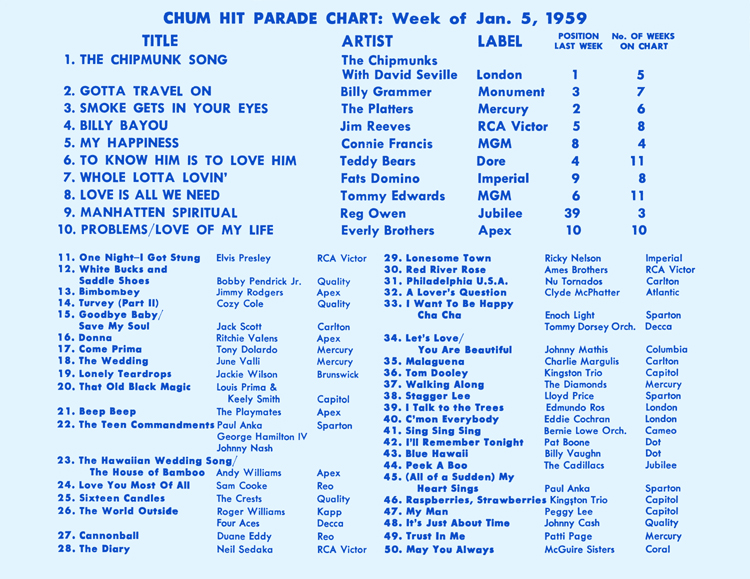
| 1958 | "White Bucks and Saddle Shoes" (as Bobby Pedrick, Jr.) | 74 | — | — | — | 12[6] |
| 1963 | "My Jelly Bean" (as Bobby & The Consoles) | — | — | — | — | — |
| 1968 | "If You Don't Want My Love" | 49 | — | — | 42 | 21 |
| "Don't Leave Me" | 108 | — | — | — | — | |
| 1970 | "When the Party is Over" | 71 | — | — | — | 60 |
| 1972 | "The Lion Sleeps Tonight" | 3 | 6 | 31 | — | 15 |
| "Hushabye" | 99 | — | — | — | 70 | |
| 1979 | "Sad Eyes" | 1 | 10 | 9 | 31 | 3 |
| "Only Time" | 102 | 42 | — | — | — | |
| "Lonely Eyes" | 41 | 49 | — | — | 80 | |
| 1980 | "Hey There Lonely Girl" | 31 | 10 | — | — | 81 |
| "Sherry" | 70 | — | — | — | — | |
| 1983 | "Bread and Butter" | 68 | — | — | — | — |
| 1984 | "Greased Lightning"* | — | — | — | — | — |
- *"Greased Lightning" – peaked at No. 60 on the US Dance chart
Source:[7]
References
[edit]- ^ a b c d e Colin Larkin, ed. (1992). The Guinness Encyclopedia of Popular Music (First ed.). Guinness Publishing. p. 1290. ISBN 0-85112-939-0.
- ^ Murrells, Joseph (1978). The Book of Golden Discs (2nd ed.). London: Barrie and Jenkins Ltd. pp. 295–296. ISBN 0-214-20512-6.
- ^ Blistein, Jon (February 25, 2025). "Robert John, Crooner Behind Number One Hit 'Sad Eyes,' Dead at 79". Rolling Stone. Retrieved February 25, 2025.
- ^ "RPM Magazine - December 15, 1979 - Page 10" (PDF).
- ^ Kent, David (1993). Australian Chart Book 1970–1992 (illustrated ed.). St Ives, N.S.W.: Australian Chart Book. p. 159. ISBN 0-646-11917-6.
- ^ "CHUM Hit Parade - January 5, 1959".
- ^ Roberts, David (2006). British Hit Singles & Albums (19th ed.). London: Guinness World Records Limited. p. 286. ISBN 1-904994-10-5.
External links
[edit]- Robert John at IMDb
- Allmusic entry
- Robert John discography at Discogs
| International | |
|---|---|
| National | |
| Artists | |
| People | |
| Other | |

   | This article about a singer-songwriter from the United States is a stub. You can help Wikipedia by adding missing information. |
Robert John
View on GrokipediaEarly life and career
Childhood and debut recordings
Robert John Pedrick Jr. was born on January 3, 1946, in Brooklyn, New York.[7][6] Raised in a working-class neighborhood during the height of the doo-wop era, he developed an early passion for music through participation in street corner vocal groups.[8][9] At the age of 12, Pedrick was discovered by talent scouts and signed to Big Top Records, a New York-based label known for rock and roll releases.[4][10] Billed as Bobby Pedrick Jr., his debut single "White Bucks and Saddle Shoes," released in September 1958 on Big Top 45-3004, captured the doo-wop and rock & roll influences of the era with lyrics celebrating teenage fashion trends like white buck shoes and saddle oxfords.[11][12] The track, backed by "Stranded," was recorded in a straightforward session emphasizing Pedrick's high tenor voice and youthful energy, reflecting the label's focus on teen-oriented pop sounds.[4][13] "White Bucks and Saddle Shoes" entered the Billboard Hot 100 in November 1958 and peaked at No. 74, marking Pedrick's first and only chart entry as a child performer.[13][12] Subsequent releases, including the 1959 single "Pajama Party" b/w "Betty Blue Eyes" on Big Top 45-3008, failed to achieve commercial success or chart, signaling the conclusion of his brief phase as a child star under the Bobby Pedrick Jr. moniker.[14][13]1960s recordings and development
In the early 1960s, following his childhood recordings as Bobby Pedrick Jr., Robert John joined the instrumental group Bobby & the Consoles as lead vocalist, contributing to their 1963 single "My Jelly Bean" on Diamond Records, which achieved modest regional success in New York but did not chart nationally.[7] This brief stint marked a transitional phase, blending his youthful pop style with group dynamics amid the evolving rock and soul landscape. Around 1964–1965, he adopted the professional name Robert John, distancing himself from his child-star image, and signed with smaller labels such as MGM Records, releasing unsuccessful singles in 1965.[2] John's solo efforts in the mid-to-late 1960s included recordings for Verve and Columbia Records, culminating in the 1968 single "If You Don't Want My Love" on Columbia (4-44435), a soul-inflected pop track that showcased his developing high tenor and falsetto range. The song received regional airplay and peaked at No. 49 on the Billboard Hot 100, representing his closest brush with national success during the decade but failing to sustain momentum.[2] Concurrently, he began exploring songwriting, which honed his creative skills amid persistent challenges in the industry.[2] To support himself, John took non-musical jobs, including construction work, during this period of obscurity, while supplementing his income through background vocals on sessions for other artists.[2] These experiences refined his versatile vocal abilities and built resilience, laying the groundwork for his perseverance into the 1970s.Commercial success
1972 hit and EMI period
After years of modest recordings on small labels during the 1960s, Robert John achieved his first major commercial breakthrough in 1972 with a revival of "The Lion Sleeps Tonight."[2] The track, originally a No. 1 hit for the Tokens in 1961 and derived from the 1939 South African Zulu song "Mbube" by Solomon Linda, was adapted by John in a style emphasizing his high falsetto vocals, giving it a lighter, more ethereal pop feel compared to the Tokens' doo-wop arrangement.[2] Produced by Dave Appell and Hank Medress (a member of the Tokens), the single was released on Atlantic Records and climbed to No. 3 on the Billboard Hot 100, where it held for three weeks.[15][16][17] The success of "The Lion Sleeps Tonight" led to John's debut full-length album, On the Way Up, issued later in 1972 on Columbia Records.[18] The LP showcased a polished pop sound with blue-eyed soul influences, featuring mostly covers of contemporary hits alongside one original composition. Key tracks included reinterpretations of Glen Campbell's "By the Time I Get to Phoenix," the Monkees' "I'm a Believer" (notable for its funky drum break), "I've Said It Before," as well as Smokey Robinson's "Ooo Baby Baby" and Gary Puckett & the Union Gap's "Woman, Woman."[18] John's sole songwriting contribution was "Children in the Making," highlighting his emerging role as a composer amid the era's emphasis on interpretive performances.[18] Critics noted the album's smooth, radio-friendly production but viewed it as derivative, with limited commercial impact beyond the lead single's momentum.[19] Follow-up singles from the album and period achieved moderate airplay but fell short of the breakthrough hit's success. "Hushabye," a cover of the Mystics' 1959 doo-wop standard, peaked at No. 99 on the Billboard Hot 100, signaling a brief window of visibility before John returned to songwriting and session work.[16][17] To capitalize on the single's popularity, John undertook promotional tours across the U.S., including live performances at key venues and appearances on television programs such as American Bandstand, which helped expose his falsetto-driven style to a broader audience.[2]1979 breakthrough with "Sad Eyes"
After a period of hiatus from recording following his 1972 success, Robert John signed with the newly launched EMI America label in 1978, marking a pivotal shift in his career amid personal hardships that included working construction jobs to make ends meet.[2][20] Producer George Tobin, who had previously collaborated with John, helped secure the opportunity at EMI America.[20] John's self-penned "Sad Eyes," released as a single in April 1979, became his breakthrough, a soft rock ballad blending doo-wop harmonies with introspective lyrics about an extramarital affair, prominently featuring his signature falsetto vocals.[21][22] Produced by Tobin at Studio 55 in Los Angeles, the track's smooth production emphasized layered backing vocals and a gentle rhythm section, evoking late-1950s nostalgia while fitting the adult contemporary sound of the era. The song debuted on the Billboard Hot 100 on May 19, 1979, climbing to No. 1 for one week in October, displacing The Knack's "My Sharona" and spending 21 weeks on the chart overall; it also reached No. 10 on the Adult Contemporary chart and earned a gold certification from the RIAA for over one million units shipped. The success of "Sad Eyes" propelled the accompanying self-titled album, Robert John, released in 1979 on EMI America, which showcased his matured songwriting and vocal range across tracks like "Lonely Eyes."[23] Critics noted the album's polished soft rock arrangements and John's evolved falsetto delivery, praising it as a demonstration of his artistic growth from teen pop covers to original material, though it achieved modest commercial performance compared to the single's dominance, peaking at No. 68 on the Billboard 200.[24] This era represented John's singular moment of major stardom, highlighted by media appearances including a promotional music video and live television performances that captured the song's emotional intimacy.[25] Throughout this period, John's songwriting extended beyond his own recordings, building on partnerships like his 1972 collaboration with Michael Gately on "I Can't Move No Mountains," recorded by Blood, Sweat & Tears on their New Blood album, underscoring his ongoing influence in the industry.[26]Later career and death
Post-1980 activities
Following the success of his 1979 hit "Sad Eyes," Robert John released his final major-label album, Back on the Street, in 1980 on EMI America. The record featured self-penned tracks like "(So Long) Since I Felt This Way" and covers such as "Hey There Lonely Girl," but it failed to achieve commercial traction despite positive notices for its smooth pop-soul arrangements.[27][28] Throughout the 1980s, John issued sporadic singles on various labels, including "Sherry" and a remake of "Hey There Lonely Girl" in 1980, the latter becoming his last Top 40 entry at No. 31 on the Billboard Hot 100. His final charting single arrived in 1983 with a cover of The Newbeats' "Bread and Butter" on Motown, peaking at No. 68 and marking the end of his mainstream visibility.[7] During this period, John sustained his career through session work, providing background vocals on Smokey Robinson's 1981 album Being with You, including the title track that reached No. 2 on the Billboard Hot 100. He also contributed backing vocals to recordings by Al Kooper, leveraging his versatile falsetto in support roles amid diminishing solo opportunities.[29][30] In the 1990s and 2000s, John maintained a low profile, focusing on occasional local performances and recording into the early 1990s while occasionally benefiting from reissues of his earlier hits on compilations like Classic Masters (2002). Despite the "one-hit wonder" label, he persisted as a journeyman artist, reflecting in later accounts on the challenges of longevity in the industry after his brief peak.[31][28]Death and tributes
Robert John died on February 24, 2025, at the age of 79, while still recovering from a severe stroke he suffered several years earlier.[2][32][7] No immediate cause of death was disclosed.[6] The announcement was made by his son, Michael Pedrick, who confirmed the news to Rolling Stone.[2][32] Coverage quickly appeared in prominent music publications such as Billboard and Ultimate Classic Rock, which noted his residence in Las Vegas at the time.[6][7] Pedrick paid tribute to his father, stating, "He was a really great dad."[32] He is survived by four sons and several grandsons, as well as his partner of the last decade, Susan.[32] Obituaries emphasized John's signature falsetto vocal style and his key role in 1970s soft rock, particularly crediting his sky-high delivery on tracks like "The Lion Sleeps Tonight" as a precursor to the success of "Sad Eyes."[7] These accounts underscored his one-hit wonder status while celebrating the lasting impact of his 1979 Billboard Hot 100 No. 1 single.[2][6] No immediate plans for reissues or memorials were reported in the initial coverage.[2][32]Discography
Studio albums
Robert John's debut studio album, If You Don't Want My Love, was released in 1968 by Columbia Records and features 10 tracks in a pop style, including the title track. Produced by David Rubinson, it reflects his early work as a solo artist.[33] His second studio album, On the Way Up, was released in 1972 by Columbia Records and features 10 tracks primarily consisting of pop covers such as "By the Time I Get to Phoenix" and "I'm a Believer." Arranged by Charlie Calello and produced by David Rubinson, the album reflects a straightforward pop style with elements of blue-eyed soul and northern soul arrangements.[34][18] After a period of singles releases, John returned with his self-titled third major-label album Robert John in 1979 on EMI America, comprising 10 tracks that marked a transition to soft rock ballads.[23] Produced by George Tobin, the album peaked at No. 68 on the Billboard 200 chart.[35] His fourth and final major-label effort, Back on the Street, followed in 1980 on EMI America with 10 tracks incorporating R&B influences alongside soft rock.[36] Again produced by George Tobin, it did not achieve notable commercial success.[37] Over the course of these releases, John's production evolved from cover-heavy pop to more introspective soft rock compositions emphasizing his falsetto vocals.[38]Singles
Robert John's recording career as a solo artist under his own name began in the late 1960s, following his early work as Bobby Pedrick Jr., and spanned several decades with approximately 20 singles released across various labels. His singles often featured his distinctive high tenor voice in pop, soft rock, and doo-wop-influenced styles, with the most successful charting on the Billboard Hot 100 during the 1970s. While many early and later releases did not achieve significant commercial traction, his top-performing singles, such as "The Lion Sleeps Tonight" and "Sad Eyes," marked pivotal moments in his career and demonstrated his ability to reinterpret classic and original material for contemporary audiences.[39][1] The following table highlights his key singles, focusing on those that charted, with details on release year, label, and peak Billboard Hot 100 position (unless otherwise noted):| Year | Title | Label | Peak Position |
|---|---|---|---|
| 1958 | White Bucks and Saddle Shoes (as Bobby Pedrick Jr.) | Big Top | 73 |
| 1968 | If You Don't Want My Love | Columbia | 49 |
| 1970 | Raindrops, Love and Sunshine | A&M | 71 |
| 1972 | The Lion Sleeps Tonight | Atlantic | 3 |
| 1979 | Sad Eyes | EMI America | 1 |
| 1979 | Lonely Eyes | EMI America | 41 |
| 1980 | Hey There Lonely Girl | EMI America | 31 |
| 1980 | Sherry | EMI America | 70 |
| 1983 | Bread and Butter | Motown | 68 |