Hubbry Logo
Roger BéteilleRoger BéteilleMain
Open search
Roger Béteille
Community hub
Roger Béteille
logo
8 pages, 0 posts
0 subscribers
Be the first to start a discussion here.
Roger Béteille
Roger Béteille
from Wikipedia

Roger Béteille (28 August 1921 – 14 June 2019) was a French aeronautical engineer and businessman who was associated with Airbus. Regarded as one of the founding fathers of the company, he is known for his contributions towards Airbus, which contributed towards the airline company's initial success.[1][2] He also worked for Air France, Lufthansa, United, TWA and American Airlines.

Key Information

Early life

[edit]

Béteille was born in Vors, Aveyron, France.[3] After graduating from École Polytechnique, he chose the Corps de l'armement and studied at Supaéro and at the Centre des hautes études de l'armement (CHEAr).[4]

Career

[edit]

In 1952, he joined Sud-Aviation in Toulouse where he held senior posts: Head of Flight Testing (1952 to 1957), Head of Rockets and Satellites division (1957 to 1967)[5] and the deputy technical director and A300 programme manager.[6] He also played a decisive role in the "Armagnac" and "Caravelle" programmes.[3]

He was one of the key players in the formation of the European Airbus consortium.[7] Béteille had spent time listening to airlines such as Air France and Lufthansa, as well as visiting U.S. airlines such as United, TWA and American Airlines.[2] He also decided that English should be the working language and that measurements should not be metric because most airlines already had American-built aircraft.[8]

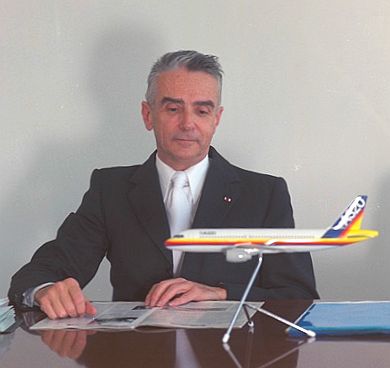
Béteille in 1972

A large part of the initial success of Airbus can be traced back to Béteille, whose nickname was Mister Airbus.[1] His contributions include the "Airbus fuselage" – the 222-in fuselage cross section with the ability to carry two LD-3 freight containers – and the basic work-share agreement of the various partners in Airbus.[1][9][10]

Béteille purchased Super Guppy transport aircraft to bring the pieces of the aircraft to its final assembly point in Toulouse.[11][12] He long served as the company's chief operating officer and was regarded as one of the founding fathers, along with Henri Ziegler and Felix Kracht.[2][13]

In 1983, he became a founding member of the French Académie de l'air et de l'espace (AAE).[14] He retired in March 1984.[15]

Personal life

[edit]

Béteille was awarded the Ludwig Prandtl Ring from the Deutsche Gesellschaft für Luft- und Raumfahrt (German Society for Aeronautics and Astronautics) in 1986.[16] The Final Assembly Building for the Airbus A350 in Toulouse is named after him.[17]

Béteille was married to opera singer Josette Jasmin and the two lived in Cannes and on the Midi.[18]

He died on 14 June 2019, at age 97.[19]

Tribute

[edit]

In tribute for his involvement within the Airbus Group, the A350XWB assembly plant in Toulouse was named after him.[20]

References

[edit]
[edit]
Revisions and contributorsEdit on WikipediaRead on Wikipedia
from Grokipedia
Roger Béteille (28 August 1921 – 14 June 2019) was a French aeronautical engineer and executive renowned as a founding father of , where he played a pivotal role in developing the company's first commercial aircraft and establishing its multinational structure. Born in , , Béteille graduated from École Polytechnique before studying at the prestigious École Nationale Supérieure de l'Aéronautique et de l'Espace (Supaéro) in and joining the Société Nationale des Constructions Aéronautiques du Sud-Est (SNCASE, later ) in 1943. He earned his pilot's license in 1945 and advanced to flight test engineer by 1952, serving as a crew member on the maiden flight of the jet airliner in 1955. From 1957 to 1967, he directed the missiles and satellites division in . In 1967, Béteille was appointed chief engineer for the A300 program at , leading the design of the wide-body A300B—a 250-seat twin-engine jet that became Europe's first successful commercial airliner, with its first flight in 1972. He spearheaded the redesign of the A300 to attract international customers, securing the landmark order from Eastern Airlines in 1977—the first U.S. purchase of an aircraft, comprising 23 units. Rising through Industrie's ranks, he served as senior vice president of engineering from 1970, general manager from 1975, and president until his retirement in 1985. Béteille's innovations extended to launching the A310 in 1978 and the revolutionary A320 in 1984, which introduced controls and a common cockpit design across the family, revolutionizing airliner efficiency and safety. He pioneered 's collaborative European production model, assigning component responsibilities to partner nations, and formed a multinational team based in , solidifying the company's hub there. Among his honors, Béteille was named a Commander of the , Grande Officier of the , and a founding member of the Académie de l'Air et de l'Espace; he became an Honorary Fellow of the Royal Aeronautical Society in 1983, and in 2012, dedicated its A350 XWB final assembly line in to him. He passed away in at age 97, shortly before the 2019 celebrating 's 50th anniversary.

Early Life and Education

Childhood and Family Background

Roger Béteille was born on August 28, 1921, in Vors, a rural commune in the department of . Growing up in this agricultural region during the , Béteille experienced the challenges of post-World War I recovery in a family environment typical of provincial . His early years were marked by the onset of in 1939, when Béteille was 18, leading to disruptions in daily life under the Vichy regime and subsequent German occupation. The war prompted relocations and adaptations for many in , exposing young Béteille to the broader impacts of conflict on French society.

Academic Training and Early Influences

Roger Béteille enrolled at the in 1940, at the outset of , when the prestigious institution faced significant disruptions due to the German occupation of France. The school was relocated to in the unoccupied zone, temporarily lost its military status, and its Paris facilities were requisitioned by occupying forces, yet Béteille persisted in his studies under these challenging conditions. Upon graduation, he selected the Aeronautics Engineers corps, aligning his career path with aviation engineering amid the wartime emphasis on technological advancements in defense and transport. Following his time at , Béteille advanced his specialization in aeronautical engineering at the École Nationale Supérieure de l'Aéronautique et de l'Espace (Supaéro) in , completing his studies before joining SNCASE in 1943. This elite institution, renowned for its rigorous curriculum in , , and aircraft structures, provided Béteille with foundational technical expertise that would shape his future contributions to the field. His training at Supaéro emphasized practical applications of engineering principles, fostering an early appreciation for collaborative innovation in European aerospace amid the recovery from wartime devastation. These academic experiences, conducted in an era of national rebuilding, profoundly influenced Béteille's approach to aeronautical design, instilling a commitment to precision and interdisciplinary problem-solving that became hallmarks of his professional ethos.

Professional Career

Initial Roles in French Aviation Industry

Following his graduation from the École Nationale Supérieure de l'Aéronautique et de l'Espace (Supaéro) in , Roger Béteille joined the Société Nationale des Constructions Aéronautiques du Sud-Est (SNCASE) in 1943 as a junior engineer, where he contributed to post-war projects amid France's aeronautical reconstruction efforts. His technical training at Supaéro enabled rapid progression in practical engineering roles within the nationalized industry. In 1945, Béteille earned his pilot's license, which positioned him for hands-on involvement in evaluation. By 1952, after SNCASE merged into , he advanced to head of , a role he maintained until 1957, overseeing validation for both military and civilian programs. Key among these was his participation in the flight test team for the SE 210 Caravelle short-haul . From 1960 to 1967, Béteille directed the missiles and satellites division of in , overseeing projects such as the Véronique . Béteille served as one of four crew members on the Caravelle's on 27 May 1955, helping validate its rear-engine configuration and aerodynamic performance during a period of intense European competition in jet transport development. A notable challenge arose in design decisions, such as rejecting a proposed fuselage widening suggested by Douglas Aircraft, which preserved the aircraft's compact profile but constrained its adaptability for larger U.S. market demands and contributed to limited transatlantic sales. This experience honed Béteille's expertise in balancing innovation with production realities in resource-constrained environments.

Key Involvement in Airbus Formation

In 1967, Roger Béteille was appointed technical director at , tasked with spearheading the development of a new European airliner to challenge American dominance in the market. In this role, he led critical negotiations with British firm and the German consortium Deutsche Airbus, forging the initial workshare agreements that distributed design and production responsibilities across the partners to ensure a viable pan-European project. These discussions laid the groundwork for collaborative , with Béteille advocating for a balanced allocation of tasks, such as handling the wings and Deutsche Airbus focusing on sections. Béteille played a pivotal role in drafting the technical framework for the September 1967 memorandum of understanding signed by the governments of , , and the , which formalized the launch of the program as a . This agreement outlined the project's scope, including a 300-seat twin-engine jet, and committed the nations to shared funding and risk, though the soon joined as a partner through Fokker-VFW in 1969, contributing to tail assembly and other components. Béteille's prior experience in French aviation projects equipped him to navigate the complex inter-company dynamics, ensuring the memorandum emphasized technological integration over national rivalries. The formation process faced significant diplomatic challenges, including the UK's withdrawal in April 1969 due to funding pressures and a shift in priorities toward the Rolls-Royce RB.211 engine for other programs, which threatened the project's viability. Béteille worked tirelessly to overcome these hurdles, coordinating with French and German officials amid disputes over cost-sharing and engine selection after the initial RB.207 was canceled. These tensions culminated in a breakthrough at the 1969 Paris Air Show, where France and Germany signed a bilateral cooperation agreement to proceed with the smaller A300B variant, equally splitting development costs and securing the project's future without full British government backing—though Hawker Siddeley remained as a key subcontractor. By 1970, Béteille's efforts culminated in the establishment of Airbus Industrie's headquarters in , , selected as the central hub for final assembly to streamline operations and symbolize Franco-German leadership. As one of the founding directors and senior vice president of engineering and production, he assumed a key managerial position in the newly formed Groupement d'Intérêt Économique (GIE), overseeing the transition from studies to full-scale production and ensuring the entity's operational cohesion. This structure marked as a groundbreaking multinational entity, with Béteille's strategic diplomacy instrumental in its survival during the early, precarious years.

Leadership Positions at Airbus Industrie

Upon joining the newly formed Airbus Industrie GIE in 1970 as Senior Vice President for , Roger Béteille took charge of coordinating the technical and programmatic aspects of the consortium's launch, overseeing the and of an initial core staff to manage the A300 development across European partners. This role positioned him at the forefront of day-to-day governance, ensuring alignment between the contributing nations' industries during the formative years following the company's establishment as a joint economic interest group. Béteille played a central role in managing Airbus Industrie's complex structure, where work allocation and profit-sharing were distributed based on equity stakes held by the partner companies: 37.9% for France's , 37.9% for Germany's Deutsche Airbus, 20% for the UK's , and 4.2% for Spain's CASA. This arrangement facilitated collaborative production while balancing national interests, with Béteille advocating for centralized headquarters near Toulouse's final assembly line to enhance coordination among the partners. In his role as Senior Vice President for , Béteille drove efforts to secure launch customers, culminating in a breakthrough order from on November 9, 1971, for six A300B2 aircraft, which validated the program and enabled production to proceed. In 1975, Béteille was promoted to General Manager of Industrie, a position that amplified his influence over strategic decisions as the company pursued its first commercial commitments. During this period, Béteille implemented internal reforms in 1974 to centralize activities, streamlining processes to meet rigorous requirements under the U.S. (FAR Part 25) and emerging European Joint Airworthiness Requirements (). These changes were critical for the A300's successful by French and German authorities in March 1974, followed by FAA approval in May, marking Airbus's entry into global markets.

Post-Retirement Contributions

After retiring as president of Industrie in 1985, Roger Béteille transitioned to advisory and mentorship roles that leveraged his extensive experience in European collaboration. His expertise from leading the A300 program and subsequent initiatives at formed the foundation for these contributions, enabling him to guide strategic decisions in the industry. During the 1980s, he served as a consultant for the , offering insights on the Ariane rocket programs to enhance European launch capabilities. Béteille further extended his influence through mentorship of young engineers, delivering lectures on management at his , the École nationale supérieure de l'aéronautique et de l'espace (Supaéro, now ISAE-SUPAERO), from 1985 to 2000. These sessions emphasized practical leadership in multinational projects and the challenges of innovation in aviation. In 2005, he published his memoirs, Airbus: Naissance d'un Géant, which explored the hurdles faced during 's formative years and the importance of sustained investment in European industry.

Major Contributions to Aviation

Pioneering the Airbus A300 Program

In 1967, Roger Béteille was appointed chief engineer for the project at Sud-Aviation, where he led the conceptualization of a 300-seat twin-engine wide-body designed to prioritize and lower operating costs compared to the quad-engine 747. Under his technical direction, the A300 was envisioned as a more economical alternative for medium- to long-haul routes, leveraging advancements in engine technology to achieve better specific fuel consumption while maintaining capacity for up to 300 passengers. This approach marked a bold departure from prevailing industry trends toward larger, multi-engine designs, positioning the A300 as the world's first twin-engine wide-body jet. Béteille oversaw the selection of high-bypass engines to power the A300, initially focusing on the General Electric CF6-50, which provided up to 50,000 lbf of thrust, with the added as a second option offering similar performance ratings of approximately 48,000 to 50,000 lbf. These engines were integrated with the to optimize efficiency, featuring a that reduced fuel burn by about 20% relative to earlier turbojets, enabling the twin-engine configuration to compete with four-engine rivals on transatlantic routes. His team's engineering decisions ensured compatibility with existing airport infrastructure while emphasizing reliability through redundant systems and . As technical director, Béteille directed the prototype's assembly and rollout on September 28, 1972, at the facility, followed by the just one month later on October 28, 1972, piloted by test crew members who confirmed the aircraft's stability and performance. A key structural innovation under his oversight was the incorporation of composite materials, including fiber-reinforced plastics, in the (tail assembly), which reduced weight by up to 20% compared to all-metal construction and improved fatigue resistance without compromising strength. This marked one of the earliest uses of composites in a commercial airliner's primary structure, setting a precedent for future designs. The A300 program ultimately led to over 800 aircraft built across variants, cementing 's viability. Béteille played a pivotal role in navigating the certification challenges in 1974, coordinating extensive —totaling over 1,500 hours—to secure approvals from European authorities in March and the U.S. (FAA) on May 23. This testing laid the groundwork for demonstrating the twin-engine design's reliability. A major subsequent development was compliance with Extended-range Twin-engine Operational Performance Standards (ETOPS) rules; in 1977, the A300 became the first aircraft certified for ETOPS-90 operations by the FAA, enabling safer oceanic routes through engine-out simulations and reliability data. This certification breakthrough validated the A300's safety for transatlantic flights, enabling its entry into service with in 1974 and paving the way for global adoption.

Advancements in Wide-Body Aircraft Design

Roger Béteille advocated for a approach in the development of the A300B4 variant, which first flew in December 1974 and entered service in 1975, featuring additional fuel capacity to extend range while maintaining the cross-section for over 250 . This allowed for flexible configurations between and operations, with the enabling side-by-side LD3 containers in the hold, a feature Béteille prioritized to enhance versatility for airlines. Béteille played a key role in advancing (FBW) systems with the A310, which achieved its first flight in 1982 and incorporated electrical signaling for secondary flight controls, building on partial implementations in the A300. His championship of FBW technology reduced structural weight through digital controls and improved flight safety by enabling envelope protection, laying the groundwork for fuller adoption in subsequent models. During the 1980s, Béteille collaborated on the A330 and A340 programs as part of his vision for an integrated family, launching their development before his 1985 retirement and emphasizing range extensions through aerodynamic refinements. These twin- and quad-engine wide-bodies extended the A300's foundational design, optimizing for long-haul efficiency while promoting scalability across the lineup. Béteille's emphasis on commonality across wide-body models, particularly through standardized cockpit interfaces enabled by FBW, significantly lowered operator training costs by facilitating cross-crew qualification for pilots transitioning between types. This philosophy not only streamlined and operations but also solidified Airbus's competitive edge in the global market.

Influence on European Aerospace Collaboration

Roger Béteille played a pivotal role in establishing work-sharing agreements among European partners for the program starting in 1970, which distributed production responsibilities to foster and leverage national strengths. Under his leadership as , France handled the cockpit, flight controls, and lower center section; the United Kingdom's produced the wings; West Germany's firms manufactured the forward and rear sections along with the upper center ; the contributed flaps and spoilers; and built the horizontal . This structure ensured equitable industrial participation while integrating diverse expertise to compete globally. In 1971, Béteille led negotiations to incorporate the more deeply into the A300 project, securing Fokker-VFW's involvement in producing components such as wing flaps and spoilers to expand the beyond the initial tripartite agreement. This move strengthened multinational ties by addressing Dutch industrial interests and enhancing the program's . Béteille strongly advocated for the Airbus GIE (Groupement d'Intérêt Économique) model established in December 1970, which operated as a collaborative entity without requiring full corporate mergers, thereby circumventing entrenched national rivalries and protecting individual company identities. As senior vice president of , he pushed for the GIE's in to centralize operations near final assembly, promoting seamless integration across borders. This framework enabled focused program management and cultural unity among partners. Béteille's long-term vision for European aerospace unity extended into the 1990s through advisory papers emphasizing stimulated cooperation, which influenced the 2000 formation of EADS by providing a blueprint for deeper integration of national entities into a unified structure. His writings, such as contributions to discussions on aircraft development and European stimulation, underscored the need for ongoing collaboration to sustain competitiveness, laying ideological groundwork for EADS as the parent company of Airbus.

Personal Life and Legacy

Family and Personal Interests

Roger Béteille was married to the opera singer Josette Jasmin, and the couple resided in and the region of , where he spent much of his later life. His professional commitments at , centered in from the 1950s onward, involved extensive international travel, which he balanced with his family responsibilities despite the demands of his role. Béteille's personal passion for was evident early on, as he earned his pilot's license in 1945 and later served as a , reflecting a lifelong interest that complemented his engineering career.

Death and Immediate Tributes

Roger Béteille died on June 14, 2019, at the age of 97. released an official statement on June 25, 2019, mourning the loss of one of its founding fathers and visionaries, crediting him with shaping the company's first commercial aircraft, the A300B, and establishing Industrie as a cornerstone of European aerospace collaboration. Immediate media coverage was widespread in French outlets, with publishing an obituary on June 22, 2019, that emphasized Béteille's pivotal role as a co-founder and former of Industrie, noting the timing just before the Air Show's opening.

Long-Term Honors and Recognition

In recognition of his pivotal role in advancing European through the program and beyond, Roger Béteille received the Ludwig Prandtl Ring, the highest honor from the Deutsche Gesellschaft für Luft- und Raumfahrt, in 1986. This prestigious award acknowledged his outstanding contributions to aeronautical engineering and international collaboration in aircraft design. Béteille was elevated to Commandeur in the Ordre national de la Légion d'honneur for his lifetime achievements in aerospace innovation and leadership. He also held the rank of Grand officier in the , further honoring his impact on France's industry. In 1977, Béteille was named a by Aviation Week for his instrumental leadership in developing and launching the A300B, marking a breakthrough for European commercial aviation. Béteille's legacy was formally enshrined in 2001 during an Airbus Heritage ceremony organized by EADS in , where he was honored as an "Airbus Pioneer" for founding the company and shaping its early successes. In 2012, Airbus dedicated its new A350 XWB Final Assembly Line hall in to him, naming it the Roger Béteille Hall to commemorate his foundational contributions to production. As a founding and honorary member of the Académie de l'air et de l'espace, Béteille's biographical materials and artifacts related to his career are featured in exhibits at institutions like the Ailes Anciennes Toulouse museum, underscoring his lasting societal impact on . He was also conferred honorary fellowship by the Royal Aeronautical Society, reflecting his international stature in the field.

References

Add your contribution
Related Hubs
User Avatar
No comments yet.