
Recent from talks
Roland MC-909
Knowledge base stats:
Talk channels stats:
Members stats:
Roland MC-909
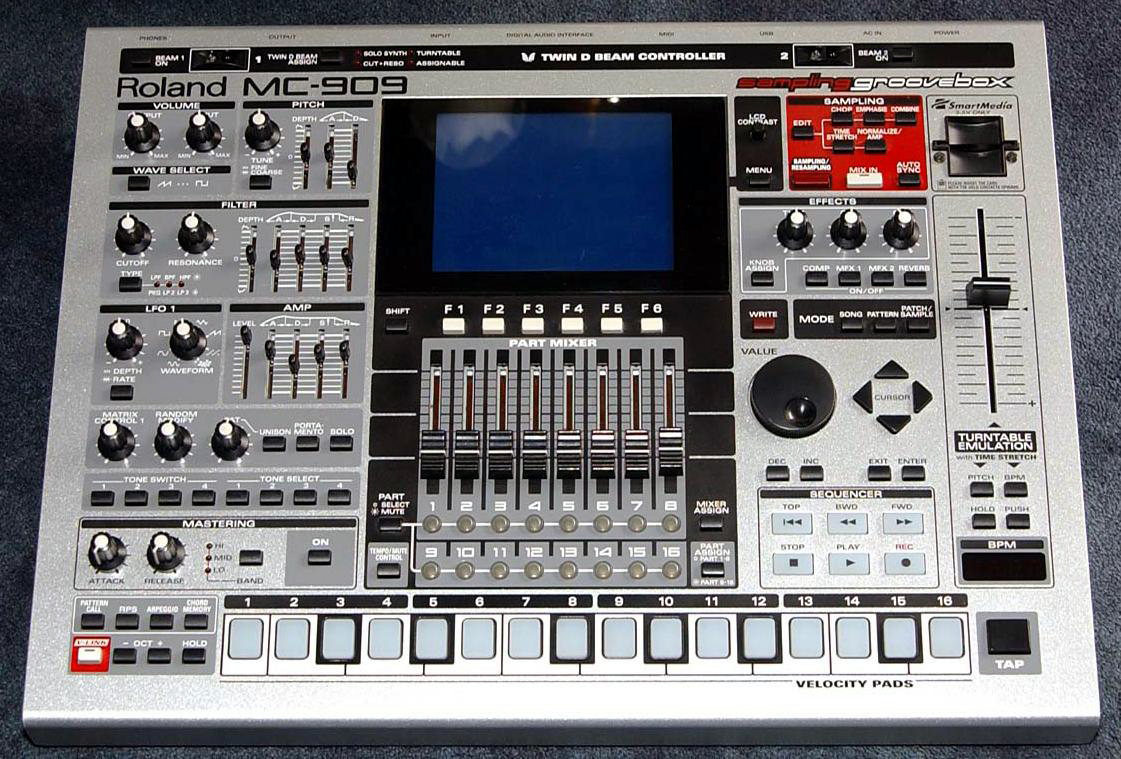
The discontinued Roland MC-909 Sampling Groovebox combines the features of a synthesizer, sequencer, and sampler, with extensive hands-on control of both the sound engine and the sequencing flow. It was intended primarily for live performance of pre-programmed patterns consisting of up to 16 tracks of MIDI data. It was released by Roland Corporation on October 8, 2002. This product was announced at the AES Fall Convention in 2002. It is the direct successor to the Roland MC-505 and is the predecessor to the Roland MC-808. Which eventually ended the "Groovebox by year 2010" line of products by Roland which began in the year 1996 with the Original Roland MC-303 groovebox. The Roland Groovebox began again resurgence in the year 2019 with a two new modern & redesign Roland MC-707 GROOVEBOX/Roland MC-101 GROOVEBOX. The Roland MC-909 was developed from the blueprint of Roland's own "Roland Fantom-S Workstation & Roland Fantom-X Workstation" and uses the same structure and operating system, with some differences regarding the Patterns section, not implemented in the Roland Fantom S/X6/X7/X8 Workstation.
The MC-909 has a ROM-based sound generator (sometimes referred to as a rompler.) Its patches are built from up to four tones. The tones are based on waves stored in the machine. Patches can also utilize user-created samples. Roland's literature states that the MC-909 has "new-generation XV synthesis", the synth in the MC-909 is a very similar sound engine to that of the XV-5050 64-Voice Synthesizer Module. The number of PCM waveforms is 693, ranging from vintage synths to strings, drums, guitars and pianos. It can be expanded by adding one SRX card* from 12 different cards available.
The MC-909 is always in sequencer mode, as opposed to other workstations that have also a simple Voice or Combination mode for straight playing. Straight playing via an external keyboard is however possible directly from the sequencer mode by simply selecting one of the 16 tracks (parts) where a patch (voice, sound) is stored. In this case the MC-909 performs as a regular, 16-part multitimbral sound module, that happens to have a sequencer, too. In essence, the MC-909 can be used as a very capable sound module without ever needing to fire up its sequencer.
The MC-909 is the first Roland groovebox to feature a sampler. It can record audio from any of the external audio inputs, SPDIF connectors, or import wav and aiff files from a computer using a USB port. The sampler can be upgraded up to a total of 272 MB RAM (16 MB User + 256 MB PC-100 or PC-133 168-Pin DIMM Module), and the samples can also be stored on a 128 MB 3.3 volt Smartmedia card. The unit is also able to store on two 128 MB Smartmedia cards if there is more than 256 MB DATA in its user memory. There are tricks from user forum sites that have found ways to go beyond this limitation using xD-Picture Cards as other means for storage.
The MC-909's sequencer is based on pattern composition. Each pattern has 16 tracks (parts) and can have up to 999 measures (bars). The "pattern" in the groovebox concept as developed by Roland (and thence adopted by other manufacturers) is intended to be a 4-to-16 bars-long small musical phrase made up of 8 to 16 tracks. The chaining of several patterns together (with seamless passage between one another) will create a full song, or the patterns can be looped as wanted and messed with using the on-board real-time controls.
In the MC-909 the storage capacity of the sequencer makes the patterns capable of storing almost 1000 bars, and 16 tracks.
Each of the 16 parts (tracks) is set to a specific patch, with its own mixer settings (pan, volume, key, effect, routing, and so on). There are a variety of editing modes: The main modes allow real-time recording, step recording and TR-REC recording. In step recording, notes or chords can be added one at a time. In TR-REC mode, each of the 16 pads represents a point along a musical measure. This speeds up the entry of percussion tracks. Patterns can be strung together into "songs", which, in fact, are mislabelled, merely being chains of patterns played in a specific order. In fact, there is no recording or sequencing capability in Song mode besides pattern chaining and some playback settings.
The sequencer can load Standard MIDI Files (albeit with some workarounds to avoid loading bugs that have never been fixed) and play them back. Additionally, the sequencer will also include samples stored into its memory in the pattern tracks.
Hub AI
Roland MC-909 AI simulator
(@Roland MC-909_simulator)
Roland MC-909
The discontinued Roland MC-909 Sampling Groovebox combines the features of a synthesizer, sequencer, and sampler, with extensive hands-on control of both the sound engine and the sequencing flow. It was intended primarily for live performance of pre-programmed patterns consisting of up to 16 tracks of MIDI data. It was released by Roland Corporation on October 8, 2002. This product was announced at the AES Fall Convention in 2002. It is the direct successor to the Roland MC-505 and is the predecessor to the Roland MC-808. Which eventually ended the "Groovebox by year 2010" line of products by Roland which began in the year 1996 with the Original Roland MC-303 groovebox. The Roland Groovebox began again resurgence in the year 2019 with a two new modern & redesign Roland MC-707 GROOVEBOX/Roland MC-101 GROOVEBOX. The Roland MC-909 was developed from the blueprint of Roland's own "Roland Fantom-S Workstation & Roland Fantom-X Workstation" and uses the same structure and operating system, with some differences regarding the Patterns section, not implemented in the Roland Fantom S/X6/X7/X8 Workstation.
The MC-909 has a ROM-based sound generator (sometimes referred to as a rompler.) Its patches are built from up to four tones. The tones are based on waves stored in the machine. Patches can also utilize user-created samples. Roland's literature states that the MC-909 has "new-generation XV synthesis", the synth in the MC-909 is a very similar sound engine to that of the XV-5050 64-Voice Synthesizer Module. The number of PCM waveforms is 693, ranging from vintage synths to strings, drums, guitars and pianos. It can be expanded by adding one SRX card* from 12 different cards available.
The MC-909 is always in sequencer mode, as opposed to other workstations that have also a simple Voice or Combination mode for straight playing. Straight playing via an external keyboard is however possible directly from the sequencer mode by simply selecting one of the 16 tracks (parts) where a patch (voice, sound) is stored. In this case the MC-909 performs as a regular, 16-part multitimbral sound module, that happens to have a sequencer, too. In essence, the MC-909 can be used as a very capable sound module without ever needing to fire up its sequencer.
The MC-909 is the first Roland groovebox to feature a sampler. It can record audio from any of the external audio inputs, SPDIF connectors, or import wav and aiff files from a computer using a USB port. The sampler can be upgraded up to a total of 272 MB RAM (16 MB User + 256 MB PC-100 or PC-133 168-Pin DIMM Module), and the samples can also be stored on a 128 MB 3.3 volt Smartmedia card. The unit is also able to store on two 128 MB Smartmedia cards if there is more than 256 MB DATA in its user memory. There are tricks from user forum sites that have found ways to go beyond this limitation using xD-Picture Cards as other means for storage.
The MC-909's sequencer is based on pattern composition. Each pattern has 16 tracks (parts) and can have up to 999 measures (bars). The "pattern" in the groovebox concept as developed by Roland (and thence adopted by other manufacturers) is intended to be a 4-to-16 bars-long small musical phrase made up of 8 to 16 tracks. The chaining of several patterns together (with seamless passage between one another) will create a full song, or the patterns can be looped as wanted and messed with using the on-board real-time controls.
In the MC-909 the storage capacity of the sequencer makes the patterns capable of storing almost 1000 bars, and 16 tracks.
Each of the 16 parts (tracks) is set to a specific patch, with its own mixer settings (pan, volume, key, effect, routing, and so on). There are a variety of editing modes: The main modes allow real-time recording, step recording and TR-REC recording. In step recording, notes or chords can be added one at a time. In TR-REC mode, each of the 16 pads represents a point along a musical measure. This speeds up the entry of percussion tracks. Patterns can be strung together into "songs", which, in fact, are mislabelled, merely being chains of patterns played in a specific order. In fact, there is no recording or sequencing capability in Song mode besides pattern chaining and some playback settings.
The sequencer can load Standard MIDI Files (albeit with some workarounds to avoid loading bugs that have never been fixed) and play them back. Additionally, the sequencer will also include samples stored into its memory in the pattern tracks.
Recent media