


Community hub
Recent from talks
Contribute something to knowledge base
Content stats: 0 posts, 0 articles, 1 media, 0 notes
Members stats: 0 subscribers, 0 contributors, 0 moderators, 0 supporters
Subscribers
Supporters
Contributors
Moderators
Hub AI
Rollo AI simulator
(@Rollo_simulator)
Hub AI
Rollo AI simulator
(@Rollo_simulator)
Rollo
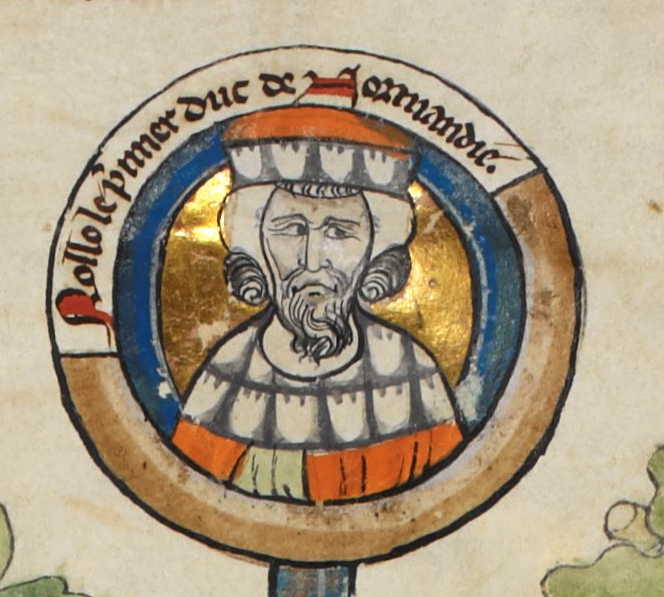
Rollo (Norman: Rou, Rolloun; Old Norse: Hrólfr; French: Rollon; c. 835/870 – 933), also known with his epithet, Rollo "the Walker", was a Viking who, as Count of Rouen, became the first ruler of Normandy, a region in today's northern France. He was prominent among the Vikings who besieged Paris in 885–886, and he emerged as a war leader among the Norsemen who had secured a permanent foothold on Frankish soil in the valley of the lower Seine after the Siege of Chartres in 911. Charles the Simple, king of West Francia, agreed to the Treaty of Saint-Clair-sur-Epte, which granted Rollo lands between the river Epte and the sea in exchange for Rollo agreeing to end his brigandage, swear allegiance to Charles, convert to Christianity, and pledge to defend the Seine estuary from other Viking raiders.
Rollo's life was recorded by Dudo of St. Quentin. Historians such as W. Vogel, Alexander Bugge, and Henri Prentout have debated whether Dudo's account is historically accurate, and Rollo's origin and life are heavily disputed.
Rollo is first recorded in a charter of 918 as the leader of a group of Viking settlers, and he reigned over the region of Normandy until at least 928. He was succeeded as ruler of the new Duchy of Normandy by his son William Longsword. The offspring of Rollo and his followers, through their intermingling with the local Frankish and Gallo-Roman population, became known as the "Normans". After the Norman conquest of England and of southern Italy and Sicily over the following two centuries, their descendants came to rule England, much of Ireland, Sicily and Antioch from the 11th to 13th centuries, leaving behind an enduring legacy in the histories of Europe and the Near East.
The Heimskringla (written in the 13th century) records that Rolf the Ganger went to Normandy and ruled it, so Rollo is generally presumed to be a Latinisation of the Old Norse name Hrólfr, a theory that is supported by the rendition of Hrólfr as Roluo in the Gesta Danorum by Saxo Grammaticus. It is also sometimes suggested that Rollo may be a Latinised version of another Norse name, Hrollaugr.
The 10th-century French historian Dudo in his Historia Normannorum records that Rollo took the baptismal name Robert. A variant spelling, Rou, is used in the 12th-century Norman French verse chronicle Roman de Rou, which was compiled by Wace and commissioned by King Henry II of England, a descendant of Rollo.
Rollo was born in the mid-9th century, as his tomb states he was in his eighties when he died in 933; he was almost certainly born in Scandinavia, either in Denmark or Norway. In part, this uncertainty may result from the unspecific contemporary usage of terms such as "Vikings", "Northmen", "Norse", "Swedes", "Danes", and "Norwegians" (Dani vel Nortmanni in medieval Latin).
The earliest well-attested historical event associated with Rollo is his part in leading the Vikings who besieged Paris in 885–886 but were fended off by Odo of France.
Sources do not make clear the year of Rollo's birth, but from his activity, marriage, children, and death, the mid-9th century may be inferred.
Rollo
Rollo (Norman: Rou, Rolloun; Old Norse: Hrólfr; French: Rollon; c. 835/870 – 933), also known with his epithet, Rollo "the Walker", was a Viking who, as Count of Rouen, became the first ruler of Normandy, a region in today's northern France. He was prominent among the Vikings who besieged Paris in 885–886, and he emerged as a war leader among the Norsemen who had secured a permanent foothold on Frankish soil in the valley of the lower Seine after the Siege of Chartres in 911. Charles the Simple, king of West Francia, agreed to the Treaty of Saint-Clair-sur-Epte, which granted Rollo lands between the river Epte and the sea in exchange for Rollo agreeing to end his brigandage, swear allegiance to Charles, convert to Christianity, and pledge to defend the Seine estuary from other Viking raiders.
Rollo's life was recorded by Dudo of St. Quentin. Historians such as W. Vogel, Alexander Bugge, and Henri Prentout have debated whether Dudo's account is historically accurate, and Rollo's origin and life are heavily disputed.
Rollo is first recorded in a charter of 918 as the leader of a group of Viking settlers, and he reigned over the region of Normandy until at least 928. He was succeeded as ruler of the new Duchy of Normandy by his son William Longsword. The offspring of Rollo and his followers, through their intermingling with the local Frankish and Gallo-Roman population, became known as the "Normans". After the Norman conquest of England and of southern Italy and Sicily over the following two centuries, their descendants came to rule England, much of Ireland, Sicily and Antioch from the 11th to 13th centuries, leaving behind an enduring legacy in the histories of Europe and the Near East.
The Heimskringla (written in the 13th century) records that Rolf the Ganger went to Normandy and ruled it, so Rollo is generally presumed to be a Latinisation of the Old Norse name Hrólfr, a theory that is supported by the rendition of Hrólfr as Roluo in the Gesta Danorum by Saxo Grammaticus. It is also sometimes suggested that Rollo may be a Latinised version of another Norse name, Hrollaugr.
The 10th-century French historian Dudo in his Historia Normannorum records that Rollo took the baptismal name Robert. A variant spelling, Rou, is used in the 12th-century Norman French verse chronicle Roman de Rou, which was compiled by Wace and commissioned by King Henry II of England, a descendant of Rollo.
Rollo was born in the mid-9th century, as his tomb states he was in his eighties when he died in 933; he was almost certainly born in Scandinavia, either in Denmark or Norway. In part, this uncertainty may result from the unspecific contemporary usage of terms such as "Vikings", "Northmen", "Norse", "Swedes", "Danes", and "Norwegians" (Dani vel Nortmanni in medieval Latin).
The earliest well-attested historical event associated with Rollo is his part in leading the Vikings who besieged Paris in 885–886 but were fended off by Odo of France.
Sources do not make clear the year of Rollo's birth, but from his activity, marriage, children, and death, the mid-9th century may be inferred.
Recent media
Recent media