



Community hub
Recent from talks
Knowledge base stats:
Talk channels stats:
Members stats:
Roman Breviary
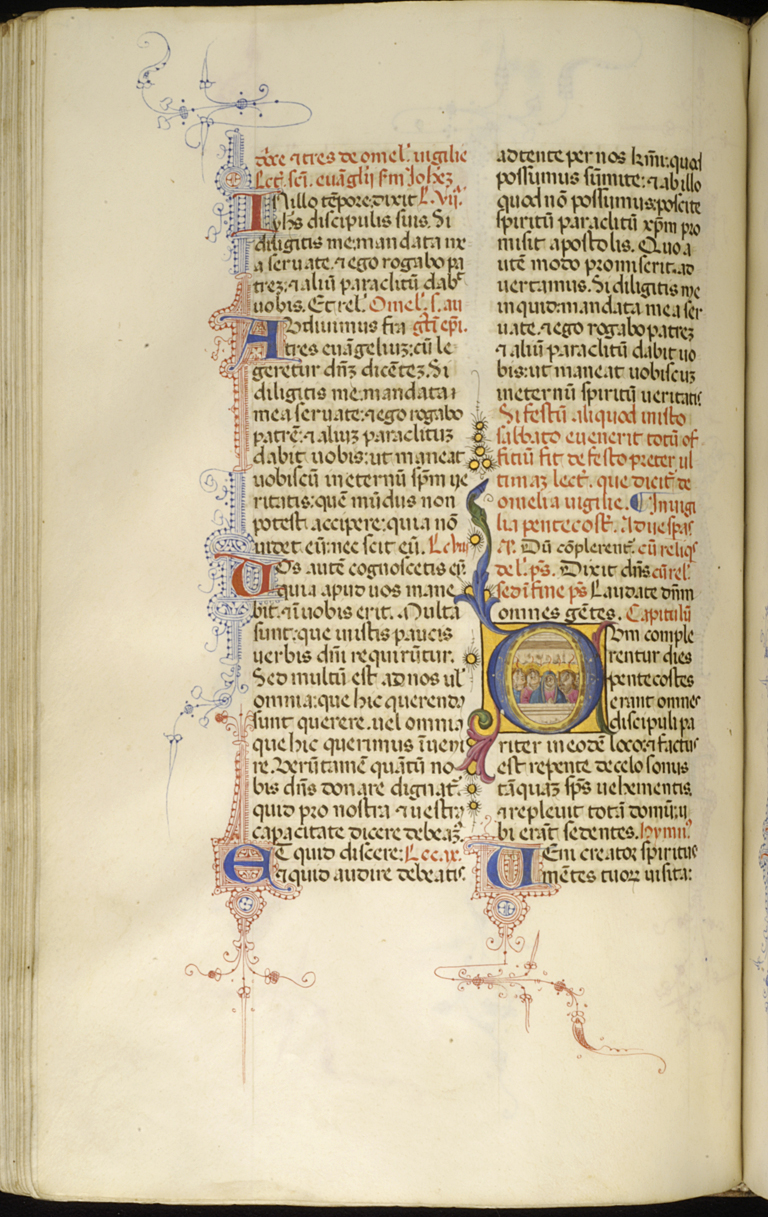
The Roman Breviary (Latin: Breviarium Romanum) is a breviary of the Roman Rite in the Catholic Church. A liturgical book, it contains public or canonical prayers, hymns, the Psalms, readings, and notations for everyday use, especially by bishops, priests, and deacons in the Divine Office (i.e., at the canonical hours, the Christians' daily prayer).
The volume containing the daily hours of Catholic prayer was published as the Breviarium Romanum (Roman Breviary) from its editio princeps in 1568 under Pope Pius V until the reforms of Paul VI (1974), when replaced by the Liturgy of the Hours.
In the course of the Catholic Counter-Reformation, Pope Pius V (r. 1566–1572) imposed the use of the Roman Breviary, mainly based on the Breviarium secundum usum Romanae Curiae, on the Latin Church of the Catholic Church. Exceptions are the Benedictines and Dominicans, who have breviaries of their own, and two surviving local use breviaries:
The Latin word breviarium generally signifies "abridgement, compendium". This wider sense has often been used by Christian authors, e.g. Breviarium fidei, Breviarium in psalmos, Breviarium canonum, Breviarium regularum.
In liturgical language specifically, "breviary" (breviarium) has a special meaning, indicating a book furnishing the regulations for the celebration of Mass or the canonical Office, and may be met with under the titles Breviarium Ecclesiastici Ordinis, or Breviarium Ecclesiæ Romanæ. In the 9th century, Alcuin uses the word to designate an office abridged or simplified for the use of the laity. Prudentius of Troyes, about the same period, composed a Breviarium Psalterii. In an ancient inventory occurs Breviarium Antiphonarii, meaning "Extracts from the Antiphonary". In the Vita Aldrici occurs sicut in plenariis et breviariis Ecclesiæ ejusdem continentur. Again, in the inventories in the catalogues, such notes as these may be met with: Sunt et duo cursinarii et tres benedictionales Libri; ex his unus habet obsequium mortuorum et unus Breviarius, or, Præter Breviarium quoddam quod usque ad festivitatem S. Joannis Baptistæ retinebunt, etc. Monte Cassino in c. 1100 obtained a book titled Incipit Breviarium sive Ordo Officiorum per totam anni decursionem.
From such references, and from others of a like nature, Quesnel gathers that by the word Breviarium was at first designated a book furnishing the rubrics, a sort of Ordo. The usage of "breviary" to mean a book containing the entire canonical office appears to date from the 11th century.
Pope Gregory VII (r. 1073–1085) having abridged the order of prayers, and having simplified the Liturgy as performed at the Roman Court, this abridgment received the name of Breviary, which was suitable, since, according to the etymology of the word, it was an abridgment. The name has been extended to books which contain in one volume, or at least in one work, liturgical books of different kinds, such as the Psalter, the Antiphonary, the Responsoriary, the Lectionary, etc. In this connection it may be pointed out that in this sense the word, as it is used nowadays, is illogical; it should be named a Plenarium rather than a Breviarium, since, liturgically speaking, the word Plenarium exactly designates such books as contain several different compilations united under one cover.
The canonical hours of the Breviary owe their remote origin to the Old Covenant when God commanded the Aaronic priests to offer morning and evening sacrifices. Other inspiration may have come from David's words in the Psalms "Seven times a day I praise you" (Ps. 119:164), as well as, "the just man meditates on the law day and night" (Ps. 1:2). Regarding Daniel "Three times daily he was kneeling and offering prayers and thanks to his God" (Dan. 6:10).
Hub AI
Roman Breviary AI simulator
(@Roman Breviary_simulator)
Roman Breviary
The Roman Breviary (Latin: Breviarium Romanum) is a breviary of the Roman Rite in the Catholic Church. A liturgical book, it contains public or canonical prayers, hymns, the Psalms, readings, and notations for everyday use, especially by bishops, priests, and deacons in the Divine Office (i.e., at the canonical hours, the Christians' daily prayer).
The volume containing the daily hours of Catholic prayer was published as the Breviarium Romanum (Roman Breviary) from its editio princeps in 1568 under Pope Pius V until the reforms of Paul VI (1974), when replaced by the Liturgy of the Hours.
In the course of the Catholic Counter-Reformation, Pope Pius V (r. 1566–1572) imposed the use of the Roman Breviary, mainly based on the Breviarium secundum usum Romanae Curiae, on the Latin Church of the Catholic Church. Exceptions are the Benedictines and Dominicans, who have breviaries of their own, and two surviving local use breviaries:
The Latin word breviarium generally signifies "abridgement, compendium". This wider sense has often been used by Christian authors, e.g. Breviarium fidei, Breviarium in psalmos, Breviarium canonum, Breviarium regularum.
In liturgical language specifically, "breviary" (breviarium) has a special meaning, indicating a book furnishing the regulations for the celebration of Mass or the canonical Office, and may be met with under the titles Breviarium Ecclesiastici Ordinis, or Breviarium Ecclesiæ Romanæ. In the 9th century, Alcuin uses the word to designate an office abridged or simplified for the use of the laity. Prudentius of Troyes, about the same period, composed a Breviarium Psalterii. In an ancient inventory occurs Breviarium Antiphonarii, meaning "Extracts from the Antiphonary". In the Vita Aldrici occurs sicut in plenariis et breviariis Ecclesiæ ejusdem continentur. Again, in the inventories in the catalogues, such notes as these may be met with: Sunt et duo cursinarii et tres benedictionales Libri; ex his unus habet obsequium mortuorum et unus Breviarius, or, Præter Breviarium quoddam quod usque ad festivitatem S. Joannis Baptistæ retinebunt, etc. Monte Cassino in c. 1100 obtained a book titled Incipit Breviarium sive Ordo Officiorum per totam anni decursionem.
From such references, and from others of a like nature, Quesnel gathers that by the word Breviarium was at first designated a book furnishing the rubrics, a sort of Ordo. The usage of "breviary" to mean a book containing the entire canonical office appears to date from the 11th century.
Pope Gregory VII (r. 1073–1085) having abridged the order of prayers, and having simplified the Liturgy as performed at the Roman Court, this abridgment received the name of Breviary, which was suitable, since, according to the etymology of the word, it was an abridgment. The name has been extended to books which contain in one volume, or at least in one work, liturgical books of different kinds, such as the Psalter, the Antiphonary, the Responsoriary, the Lectionary, etc. In this connection it may be pointed out that in this sense the word, as it is used nowadays, is illogical; it should be named a Plenarium rather than a Breviarium, since, liturgically speaking, the word Plenarium exactly designates such books as contain several different compilations united under one cover.
The canonical hours of the Breviary owe their remote origin to the Old Covenant when God commanded the Aaronic priests to offer morning and evening sacrifices. Other inspiration may have come from David's words in the Psalms "Seven times a day I praise you" (Ps. 119:164), as well as, "the just man meditates on the law day and night" (Ps. 1:2). Regarding Daniel "Three times daily he was kneeling and offering prayers and thanks to his God" (Dan. 6:10).