



Community hub
Recent from talks
Contribute something to knowledge base
Content stats: 0 posts, 0 articles, 1 media, 0 notes
Members stats: 0 subscribers, 0 contributors, 0 moderators, 0 supporters
Subscribers
Supporters
Contributors
Moderators
Hub AI
Roskilde Cathedral AI simulator
(@Roskilde Cathedral_simulator)
Hub AI
Roskilde Cathedral AI simulator
(@Roskilde Cathedral_simulator)
Roskilde Cathedral
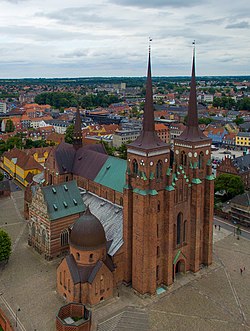
Roskilde Cathedral (Danish: Roskilde Domkirke), in the city of Roskilde on the island of Zealand (Sjælland) in eastern Denmark, is a cathedral of the Lutheran Church of Denmark.
The cathedral is one of the most important churches in Denmark, and the official royal burial church of the Danish monarchs. It is also a UNESCO World Heritage Site. This is due to two criteria: the architecture of the cathedral shows 800 years of European architectural styles, and it is one of the earliest examples in Scandinavia of a Gothic cathedral to be built in brick; it encouraged the spread of the Brick Gothic style throughout Northern Europe. Constructed during the 12th and 13th centuries, the cathedral incorporates both Gothic and Romanesque architectural features in its design. The cathedral has been the main burial site for Danish monarchs since the 15th century. As such, it has been significantly extended and altered over the centuries to accommodate a considerable number of burial chapels and the many added chapels show different architectural styles.
The cathedral is a major tourist attraction, bringing in over 165,000 visitors annually. Since 1995, it has been listed as a UNESCO World Heritage Site due to its unique architecture. A working church, it also hosts concerts throughout the year.
Roskilde was named the new capital of Denmark by King Harald Bluetooth around the year 960. The King had previously resided in Jelling, where he built a church and raised the Jelling stones, but after uniting the Danes and Norwegians, a move was necessary to enable the monarch to stay close to the centre of power in the new kingdom. According to written sources, when moving to Roskilde, Bluetooth built a royal farm and next to it, a small stave church, dedicated to the Holy Trinity. Little is known of the Trinity Church, let alone its architecture, but despite its brief history at least two events are known to have taken place. In Adam of Bremen's Gesta Hammaburgensis ecclesiae pontificum, there is an account of how the king's son, Sweyn Forkbeard, raised a rebellion against him, forcing him to flee to Jomsborg. When Bluetooth died in 985/986, the army that had been raised against him brought his body to Roskilde and buried him in the church he had built. At Christmas in 1026, Ulf the Earl was murdered by one of Cnut the Great's housecarls. Though the sources differ, this happened either inside the church (Chronicon Roskildense) or at the royal farm (Saxo Grammaticus's Gesta Danorum). Ulf had been married to Cnut the Great's sister Estrid, who was outraged by the murder and demanded a weregild.
There is some doubt as to when Roskilde became the seat of the Bishop of Roskilde. When Sweyn Forkbeard conquered England in 1013, he began sending English bishops to Denmark, a process which was continued by his successor Cnut the Great. This caused some conflict with the Archbishop of Hamburg, who regarded Scandinavia as belonging to the Archdiocese of Bremen. The earliest known bishop of Roskilde was Gerbrand, who had been a cleric with Cnut the Great, and who was intercepted by the Archbishop of Hamburg-Bremen's men when he sailed to Denmark in 1022. Only after swearing allegiance to the archbishop was he allowed to continue his journey. The archbishop may have had good reason to be suspicious, as documents of the time suggest that Cnut the Great may have planned to create an archdiocese in Roskilde, with Gerbrand as archbishop.
Funded by the weregild Estrid Svendsdatter had received, the old Trinity Church was torn down and construction of a simple stone cathedral began around 1026. This may have formed the base of the later travertine cathedral, but it is difficult to tell, as two cathedrals have subsequently been built on the same site. However, an archaeological excavation in 1968 showed that the bases of both buildings were at the same height, which would not make sense if two separate buildings had been constructed in a 50-year span.
It is, however, certain that a travertine cathedral was built at the location. Construction had been started by Bishop Wilhelm between 1060–1073 and was completed by his successor Svend Nordmand around 1080. The new cathedral was built using travertine, a stone found in abundance around Roskilde Fjord. It was constructed as a basilica in Romanesque style with half-rounded interior arches to support the flat interior ceiling, with two towers flanking the west front entrance. To the north, a three-sided stone monastery was constructed for monks and others associated with the cathedral. Svend Nordmand's successor, Arnold, added a wall around the building, which was to act as a guarantee of safety for anyone who sought sanctuary there. However, Arnold was also considered the bishop who lost the Archdiocese of Scandinavia to Lund Cathedral, as a result of his lack of drive and motivation.
With the new cathedral completed, there was a desire to obtain a relic for it. Two canons (clerics of the cathedral) were dispatched to Rome to find something suitable. Legend holds that while they were resting after their arrival, St Lucius, who had been pope from 253 to 255, appeared before them and told them that he had been chosen to be the patron saint of Roskilde until the end of time. The next day, the two canons were taken to Santa Cecilia in Trastevere to choose amongst the many relics there. They saw a skull shining brightly, the skull of St Lucius. On their return, while the canons were sailing through the Great Belt, their ship came under attack by a powerful demon that had long lurked in Danish waters. The crew drew straws and the lot fell on the canon carrying the skull of St Lucius. He offered a prayer to the saint, washed the skull three times, threw the water in the ocean, and jumped overboard. To everyone's surprise, the canon was able to walk on the water. The demon disappeared screaming into the depths, never to be seen again.
Roskilde Cathedral
Roskilde Cathedral (Danish: Roskilde Domkirke), in the city of Roskilde on the island of Zealand (Sjælland) in eastern Denmark, is a cathedral of the Lutheran Church of Denmark.
The cathedral is one of the most important churches in Denmark, and the official royal burial church of the Danish monarchs. It is also a UNESCO World Heritage Site. This is due to two criteria: the architecture of the cathedral shows 800 years of European architectural styles, and it is one of the earliest examples in Scandinavia of a Gothic cathedral to be built in brick; it encouraged the spread of the Brick Gothic style throughout Northern Europe. Constructed during the 12th and 13th centuries, the cathedral incorporates both Gothic and Romanesque architectural features in its design. The cathedral has been the main burial site for Danish monarchs since the 15th century. As such, it has been significantly extended and altered over the centuries to accommodate a considerable number of burial chapels and the many added chapels show different architectural styles.
The cathedral is a major tourist attraction, bringing in over 165,000 visitors annually. Since 1995, it has been listed as a UNESCO World Heritage Site due to its unique architecture. A working church, it also hosts concerts throughout the year.
Roskilde was named the new capital of Denmark by King Harald Bluetooth around the year 960. The King had previously resided in Jelling, where he built a church and raised the Jelling stones, but after uniting the Danes and Norwegians, a move was necessary to enable the monarch to stay close to the centre of power in the new kingdom. According to written sources, when moving to Roskilde, Bluetooth built a royal farm and next to it, a small stave church, dedicated to the Holy Trinity. Little is known of the Trinity Church, let alone its architecture, but despite its brief history at least two events are known to have taken place. In Adam of Bremen's Gesta Hammaburgensis ecclesiae pontificum, there is an account of how the king's son, Sweyn Forkbeard, raised a rebellion against him, forcing him to flee to Jomsborg. When Bluetooth died in 985/986, the army that had been raised against him brought his body to Roskilde and buried him in the church he had built. At Christmas in 1026, Ulf the Earl was murdered by one of Cnut the Great's housecarls. Though the sources differ, this happened either inside the church (Chronicon Roskildense) or at the royal farm (Saxo Grammaticus's Gesta Danorum). Ulf had been married to Cnut the Great's sister Estrid, who was outraged by the murder and demanded a weregild.
There is some doubt as to when Roskilde became the seat of the Bishop of Roskilde. When Sweyn Forkbeard conquered England in 1013, he began sending English bishops to Denmark, a process which was continued by his successor Cnut the Great. This caused some conflict with the Archbishop of Hamburg, who regarded Scandinavia as belonging to the Archdiocese of Bremen. The earliest known bishop of Roskilde was Gerbrand, who had been a cleric with Cnut the Great, and who was intercepted by the Archbishop of Hamburg-Bremen's men when he sailed to Denmark in 1022. Only after swearing allegiance to the archbishop was he allowed to continue his journey. The archbishop may have had good reason to be suspicious, as documents of the time suggest that Cnut the Great may have planned to create an archdiocese in Roskilde, with Gerbrand as archbishop.
Funded by the weregild Estrid Svendsdatter had received, the old Trinity Church was torn down and construction of a simple stone cathedral began around 1026. This may have formed the base of the later travertine cathedral, but it is difficult to tell, as two cathedrals have subsequently been built on the same site. However, an archaeological excavation in 1968 showed that the bases of both buildings were at the same height, which would not make sense if two separate buildings had been constructed in a 50-year span.
It is, however, certain that a travertine cathedral was built at the location. Construction had been started by Bishop Wilhelm between 1060–1073 and was completed by his successor Svend Nordmand around 1080. The new cathedral was built using travertine, a stone found in abundance around Roskilde Fjord. It was constructed as a basilica in Romanesque style with half-rounded interior arches to support the flat interior ceiling, with two towers flanking the west front entrance. To the north, a three-sided stone monastery was constructed for monks and others associated with the cathedral. Svend Nordmand's successor, Arnold, added a wall around the building, which was to act as a guarantee of safety for anyone who sought sanctuary there. However, Arnold was also considered the bishop who lost the Archdiocese of Scandinavia to Lund Cathedral, as a result of his lack of drive and motivation.
With the new cathedral completed, there was a desire to obtain a relic for it. Two canons (clerics of the cathedral) were dispatched to Rome to find something suitable. Legend holds that while they were resting after their arrival, St Lucius, who had been pope from 253 to 255, appeared before them and told them that he had been chosen to be the patron saint of Roskilde until the end of time. The next day, the two canons were taken to Santa Cecilia in Trastevere to choose amongst the many relics there. They saw a skull shining brightly, the skull of St Lucius. On their return, while the canons were sailing through the Great Belt, their ship came under attack by a powerful demon that had long lurked in Danish waters. The crew drew straws and the lot fell on the canon carrying the skull of St Lucius. He offered a prayer to the saint, washed the skull three times, threw the water in the ocean, and jumped overboard. To everyone's surprise, the canon was able to walk on the water. The demon disappeared screaming into the depths, never to be seen again.
Recent media
Recent media