Hubbry Logo
Ruger RedhawkRuger RedhawkMain
Open search
Ruger Redhawk
Community hub
Ruger Redhawk
logo
8 pages, 0 posts
0 subscribers
Be the first to start a discussion here.
Ruger Redhawk
Ruger Redhawk
from Wikipedia

The Ruger Redhawk is a DA/SA, large-frame revolver introduced in 1979 by Sturm, Ruger & Company.

Key Information

Design and construction

[edit]

The Redhawk is the first large-bore double-action revolver introduced by Ruger. It was designed by Roy Melcher and Harry Sefried. Sefried previously worked for High Standard Manufacturing Company, where he designed the High Standard Sentinel revolver.[1][2]

Announced in 1979, the Redhawk began shipping to customers in 1980, and was chambered in .44 Magnum caliber. The revolver featured a square butt grip, adjustable sights, and 5.5- and 7.5-inch barrel lengths, and was available in blue or stainless steel finishes. While the grip profile and no-sideplate construction of the Redhawk was similar to that of the earlier Ruger Security-Six, it was in fact a new design, incorporating a much larger and heavier frame.[3]

Designed for use with the heaviest .44 Magnum loads, the Redhawk included a triple lock, where the cylinder is locked in place at front, rear, and bottom (a feature previously found solely on Smith & Wesson's triple lock .44 Hand Ejector design, out of production since 1915).[4][5] Sefried himself observed that the triple lockup design "would last almost indefinitely".[5] To simplify the design and cut the number of parts, the Redhawk used a single coil spring to power both hammer and trigger, resulting in a slightly heavier trigger pull in single action mode.[5] Because of the single power spring, Redhawk revolvers typically show little disparity between single and double-action pull weights - often three pounds or less in variation.[6]

The revolver has forward ramp sights with four different interchangeable sight inserts. The rear sights are fully adjustable, featuring a white outline. The Redhawk is available with scope mounts and rings.[7] The Redhawk holds six or eight cartridges depending upon caliber, and has been produced with 4-inch, 4.2-inch, 5.5-inch, and 7.5-inch barrels.

Calibers

[edit]
Model 5027 .45 Colt Ruger Redhawk

When first introduced, the Redhawk was offered only in .44 Magnum caliber, which also chambered the .44 Special cartridge. In the following years, the Redhawk was offered in .41 Magnum, .357 Magnum, and .45 Colt. In 2015, a dual-caliber .45 ACP/.45 Colt chambering was introduced.[8] Redhawks in .41 Magnum and .45 Colt calibers have since been discontinued.

Variants

[edit]

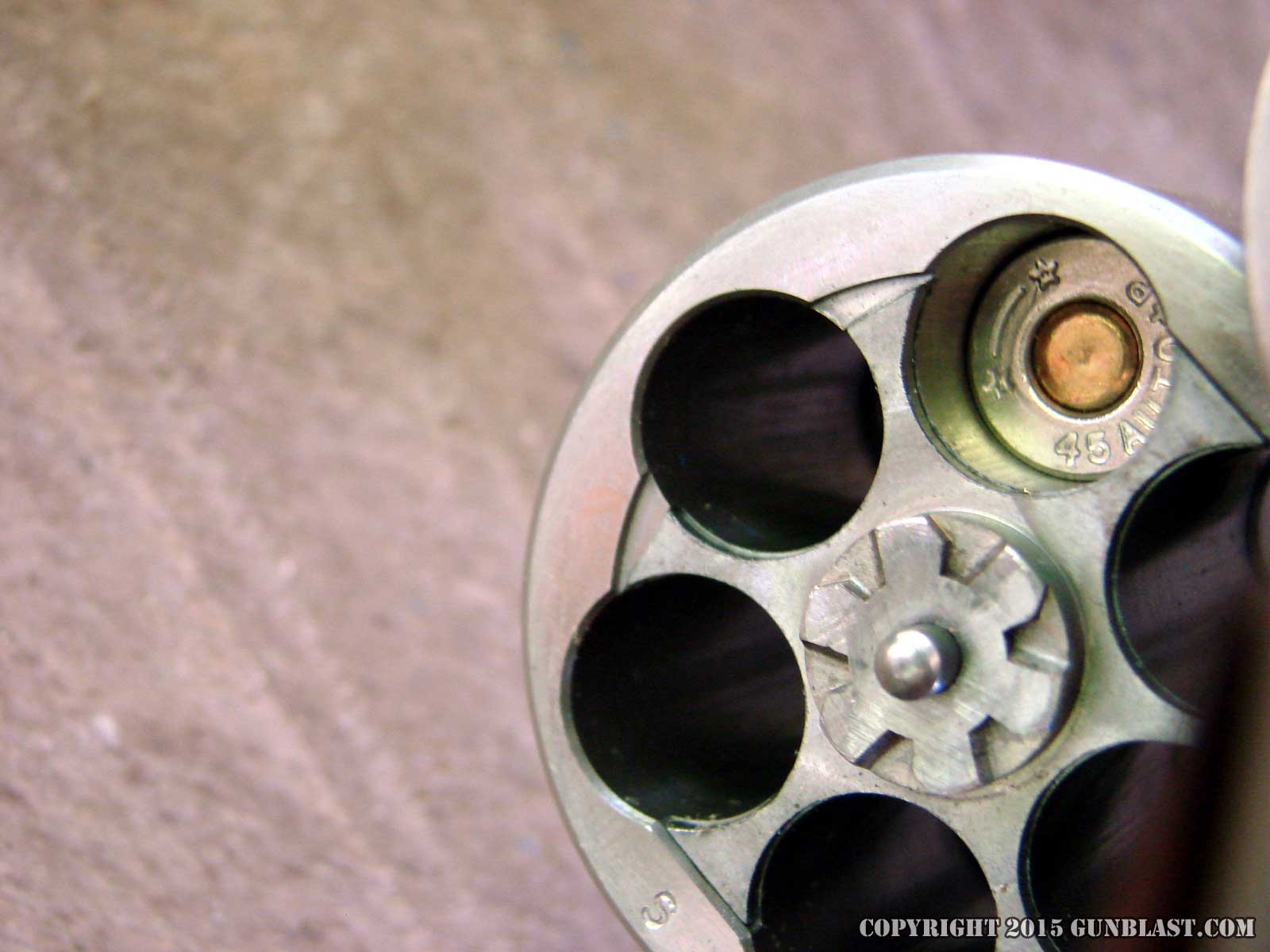
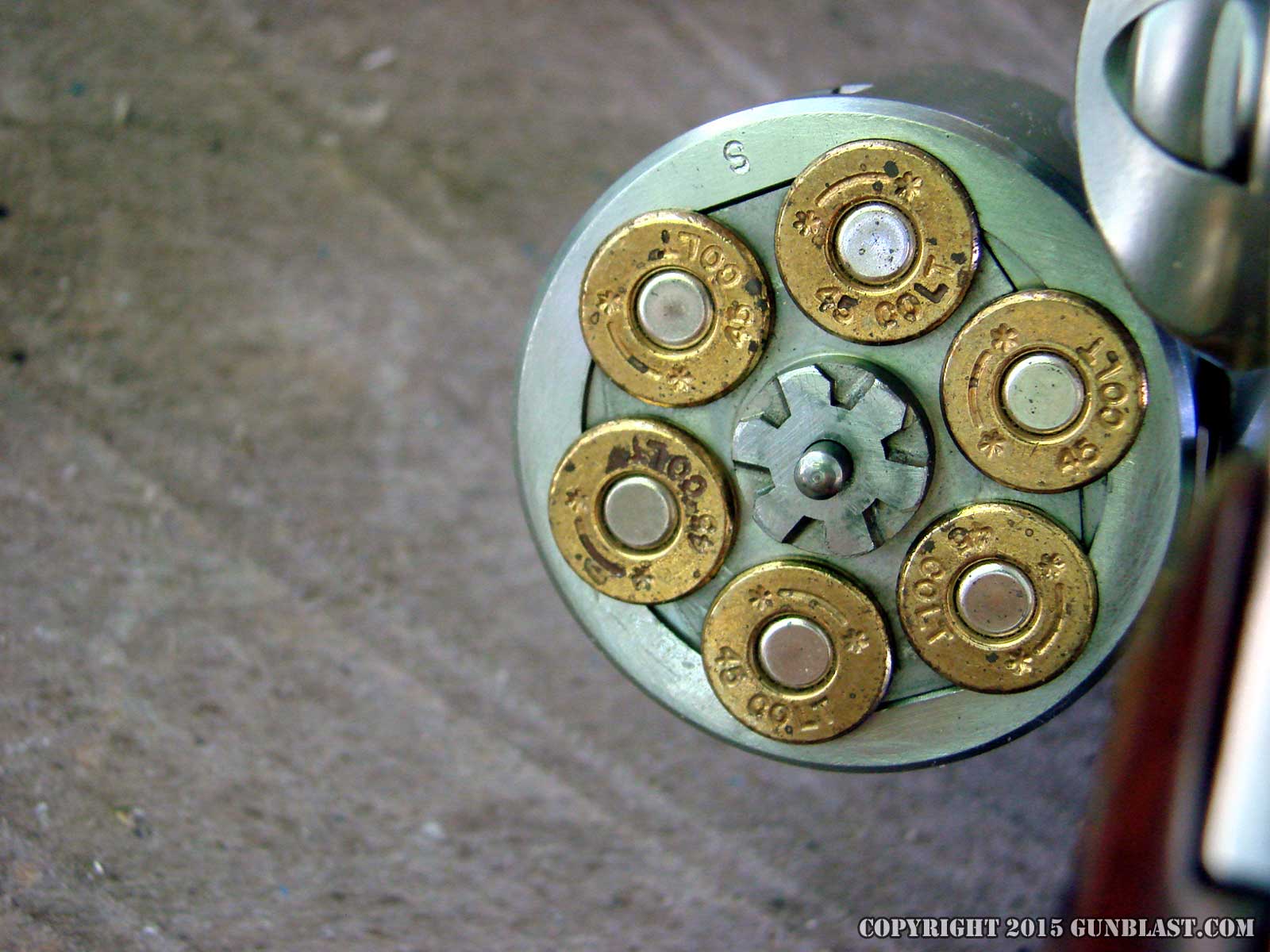
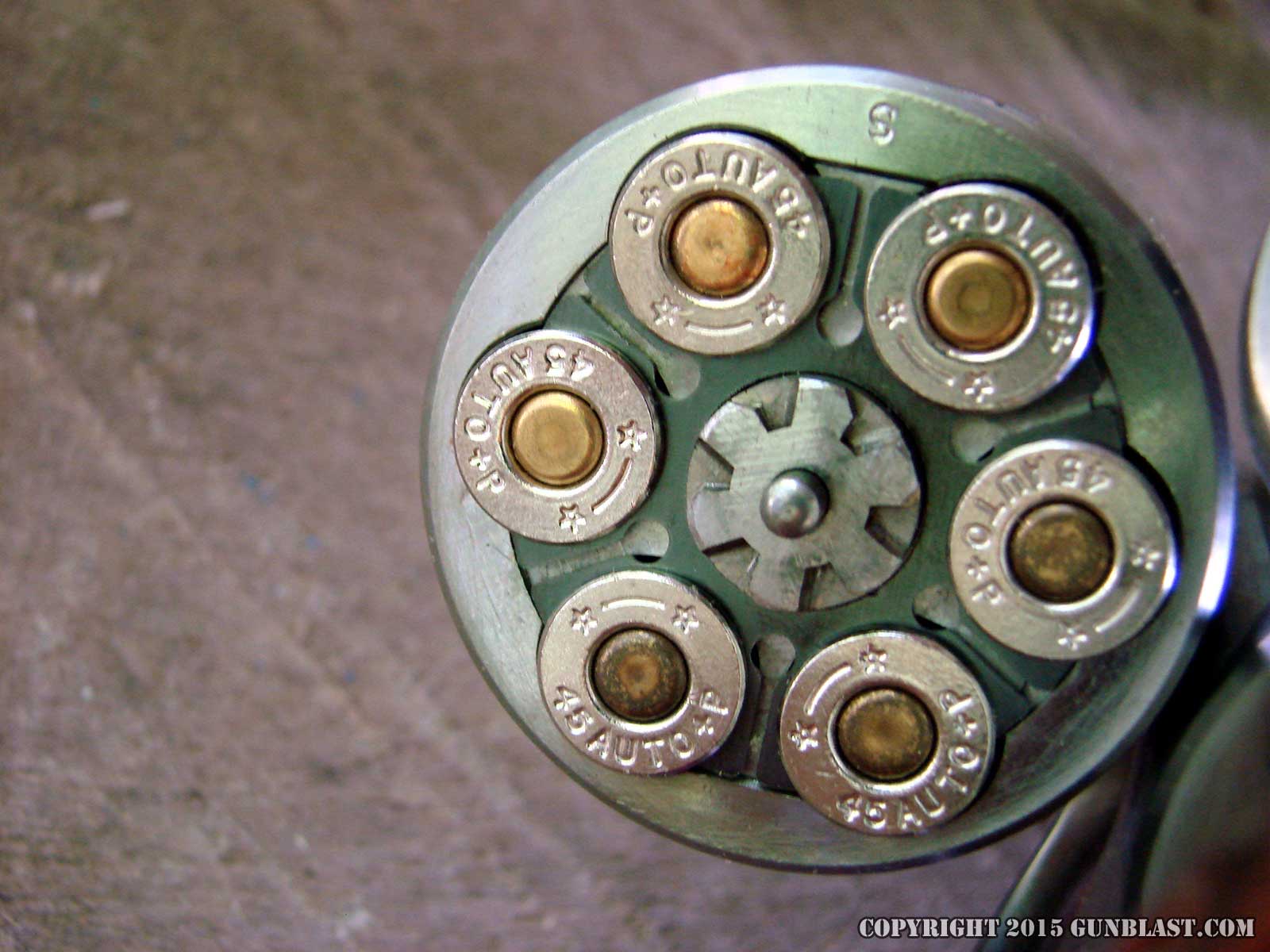
In June 2015 Ruger announced a .45 Colt / .45 ACP dual caliber chambering for the Redhawk that incorporates a redesigned grip frame with round-butt grip.[9][10] Ruger achieves this multi-cartridge functionality by partially machining the cylinder to allow use of thin-gauge moon clips for the rimless .45 ACP while still retaining enough cylinder surface for proper headspace of the rimmed .45 Colt cartridge.[11],[12]

Usage

[edit]

Despite the introduction of the Ruger Super Redhawk, the Redhawk remains in production today.[7] Many shooters prefer the more compact frame of the Redhawk for hunting and self-protection, especially those who do not plan to use a scope.[7][13]

The explorer Sir Ranulph Fiennes carried a .44 magnum Redhawk on the 14-month-long Transglobe Expedition and used it to ward off a polar bear.[14]

Production issues

[edit]
A 1980s Ruger Redhawk Hunter in .44 Magnum with a custom scope.

During the mid-1980s, Ruger received reports of barrel failures in the Redhawk.[7] The barrels of some Redhawk revolvers had separated at the junction between barrel and frame. The cause of the barrel separation was not known at the time, nor why it had not occurred before, since the Redhawk had been on the market since 1980. Ruger initially addressed the issue by introducing a new receiver design, lengthening the frame 2.5 inches past the cylinder face to the end of the ejector rod. The new design greatly increased barrel support.[7] The extended frame also provided enough length to allow scope bases to be mounted on the frame, rather than the barrel mount required on scoped versions of the older Redhawk.[7] This new design, dubbed the Ruger Super Redhawk also introduced a revised stub grip similar to that of the Ruger GP100 revolver.[15]

It was later determined by Ruger engineers that the Redhawk barrel separations were the result of overtorquing threads on pre-lubricated barrels as they were being screwed to the frame, causing stress fractures.[15] Ruger corrected this problem with revised assembly procedures. However, since the new Super Redhawk design was already complete, and because the original Redhawk remained in popular demand, the decision was made to retain both the Redhawk and the Super Redhawk in production.[7][16][15]

References

[edit]

Footnotes

[edit]
[edit]
Revisions and contributorsEdit on WikipediaRead on Wikipedia
from Grokipedia
The Ruger Redhawk is a large-frame, double-action manufactured by Sturm, Ruger & Company, introduced in 1979 as a robust designed for powerful magnum cartridges. Featuring construction and a triple-locking that secures the cylinder at the front, rear, and bottom of the frame, it emphasizes durability and precise alignment for reliable operation under heavy recoil. Initially chambered in .44 Remington Magnum with a 7.5-inch barrel and walnut grips, the Redhawk was engineered to handle sustained firing of high-pressure loads, setting it apart from contemporaries like the Model 29. The Redhawk's development built on Ruger's earlier double-action revolvers, such as the 1972 Security-Six in , but incorporated significant advancements including a crane lock to prevent cylinder timing issues and an easily replaceable front sight blade for customized zeroing. Production began in 1980, with early serial numbers starting at 500-00001, and the model quickly gained popularity among hunters and outdoorsmen for its ability to accommodate advanced handloads in an extended cylinder that allowed greater powder capacity than many rivals. Over time, design refinements included a frame extension in the mid-1980s for better weight distribution in shorter-barrel variants, along with the adoption of a single-spring mechanism in later models to deliver a smoother double-action trigger pull. Today, the Redhawk remains in production with a range of configurations, including six-shot models in (dual-chambered for ) and , as well as eight-shot versions in (dual-chambered for ), offered in barrel lengths from 2.75 to 7.5 inches and priced around $1,399 MSRP. Calibers have expanded to include .41 Magnum and in historical variants, though current offerings focus on versatile, modern applications like , hunting, and target shooting. Its reputation for ruggedness is underscored by features like a transfer bar safety mechanism and cushioned grips, making it a staple in the double-action category.

Overview

Introduction

The Ruger Redhawk is a large-frame double-action/single-action introduced by in 1979, with first customer shipments occurring in 1980. Designed by engineers Roy Melcher and Harry Sefried, it marked Ruger's entry into the big-bore double-action revolver market, building on the company's earlier medium-frame designs like the Security-Six. Developed specifically for powerful magnum calibers such as the , the Redhawk emphasized exceptional durability to handle high-pressure loads, featuring innovations like a for enhanced stability under . It was positioned as a modern, robust alternative to established competitors like the , offering construction as standard—which provided superior corrosion resistance—from its debut, at a more accessible price point. As of , the Redhawk remains in active production, available through Ruger's official channels, with ongoing refinements while retaining its core design for reliability in , sporting, and defensive applications.

General Specifications

The Ruger Redhawk is a double-action designed for heavy magnum loads, featuring a triple-locking that enhances strength and reliability. Its base model, chambered primarily in .44 Remington Magnum, offers a standard capacity of 6 rounds. Select variants, such as those in , provide an 8-round capacity. Physical dimensions vary by barrel length, with the unloaded typically ranging from 47 to 54 ounces (approximately 1.33 to 1.53 kg), exemplified by the 49-ounce of the 5.5-inch barrel configuration. Overall length spans 9.5 to 13 inches, depending on the barrel, such as 9.5 inches for the 4.2-inch barrel model and 13 inches for the 7.5-inch version. Available barrel lengths include 4.2, 5.5, and 7.5 inches in standard configurations, with additional options like 2.75 inches in certain models. Finishes are offered in blued steel or , though current production emphasizes satin construction without side plates for added durability. Grip options feature a square-butt frame as standard with panels, while later models like the 2015 variant introduce round-butt designs.
SpecificationDetails
Mass47–54 oz (1.33–1.53 kg), e.g., 49 oz for 5.5-inch barrel
Overall Length9.5–13 in (241–330 mm), varying by barrel length
Capacity6 rounds (.44 Mag); 8 rounds (.357 Mag variants)
Barrel Lengths4.2 in, 5.5 in, 7.5 in (standard)
FinishesBlued steel or satin
GripsSquare-butt (standard); round-butt in select models

Design and Features

Frame and Locking Mechanism

The Ruger Redhawk features a rugged frame constructed via , forming a one-piece solid design without side plates to enhance structural integrity. This investment-cast approach allows for precise shaping and added thickness in critical areas, such as the top strap, sidewalls, and barrel mounting regions, providing extra metal to absorb and manage the intense from magnum cartridges like the . The frame's extended length compared to standard double-action revolvers further contributes to recoil distribution, distributing forces more evenly across the structure to maintain alignment during repeated high-pressure firing. Central to the Redhawk's durability is its triple-locking mechanism, which secures the to the frame at three distinct points: the rear via the cylinder bolt, the front through the ejector rod housing, and the bottom by a lug on the crane engaging a notch in the frame. This three-point lockup ensures precise alignment and resists the stresses of powerful loads, outperforming traditional two-point locking systems—typically limited to rear and single front engagement—in maintaining cylinder-frame rigidity under heavy and . The design promotes dependable operation shot after shot, minimizing play or timing issues that can arise in conventional revolvers when handling cartridges generating pressures exceeding 36,000 psi, as in the . The front locking incorporates a crane-mounted that engages a slot in the frame below the barrel threads, providing secure closure while allowing smooth swing-out for reloading. Complementing this is the offset ejector rod, positioned to the side rather than centered, which avoids interference with the frame's thickened lug at lock point and prevents binding or deformation under firing stress. This offset configuration permits greater material mass in high-stress zones, bolstering overall reliability for sustained use with magnum ammunition compared to aligned ejector rods in earlier designs.

Action and Internal Components

The Ruger Redhawk operates as a double-action/single-action (DA/SA) , allowing versatility in firing modes. In double-action mode, pulling the trigger performs multiple functions simultaneously: it rotates the to align the next chamber with the barrel, cocks the to full position, and then releases it to strike the transfer bar, which in turn drives the into the primer. This process ensures a single fluid motion for rapid follow-up shots, with the trigger pull typically measuring around 10-12 pounds due to the integrated mechanics. In contrast, single-action mode involves manually cocking the with the thumb, which rotates the and positions the at full cock; the subsequent trigger pull is shorter and lighter, often around 4-5 pounds, providing greater precision for aimed fire. A key innovation in the Redhawk's internal design is its single coil spring system, which replaces the traditional multiple springs found in many revolvers with one heavy-duty that powers both the and trigger mechanisms. This spring drives two linkages—one to propel the forward upon release and the other to return the trigger to its forward position—reducing the total number of moving parts, minimizing friction, and enhancing overall reliability under high-pressure magnum loads. The result is a smoother double-action trigger pull compared to multi-spring designs, with less creep and more consistent performance across repeated firings. Cylinder rotation and indexing in the Redhawk are managed through a robust optimized for the stresses of magnum cartridges. As the trigger or is cocked, the pawl rises to engage the notches on the 's star ratchet, advancing the clockwise in precise increments to position the next chamber. Simultaneously, the cylinder bolt drops out of engagement early in the cycle to allow free rotation, then precisely times its re-engagement (bolt-drop timing) to lock the firmly before the falls, ensuring alignment and preventing misalignment under . This timing is calibrated for the larger dimensions and higher pressures of magnum rounds, contributing to the action's . The triple-locking integrates with this system to maintain smoothness during operation. For maintenance, the Redhawk features a user-serviceable that allows basic disassembly without specialized tools, facilitating cleaning and lubrication of internal components. To disassemble, first unload the completely, then remove the grip panels using a . Cock the fully and insert the provided disassembly pin through the mainspring housing to retain the ; slowly lower the while holding the trigger to the rear. Pivot out the assembly, remove the mainspring and strut, then depress the forward latch to swing down the and extract the trigger, , and related parts as a unit. The and crane assembly can then be lifted out for individual cleaning of the chambers, ratchet, and pawl. Reassembly reverses these steps, with care taken to ensure the link hook engages properly. This highlights the 's accessibility for routine upkeep, though deeper internal work should be performed by qualified gunsmiths. Barrel configurations, such as longer lengths, can influence perceived recoil during double-action pulls but do not alter the core disassembly sequence.

Sights and Barrel Configurations

The Ruger Redhawk features a standard sighting system consisting of a ramp-style front sight with a replaceable colored blade insert and an adjustable rear sight with a white outline blade. The front sight, present on all models except those with 4-inch barrels, is secured by a spring-loaded in the barrel rib, allowing for easy interchangeability to suit different lighting conditions or user preferences. The rear sight is micrometer-adjustable for both and , with each click moving the point of impact approximately 3/4 inch at 25 yards, providing precise alignment for accurate . Certain Redhawk configurations include a wide on the barrel designed specifically for mounting , featuring special cuts that accommodate Ruger scope rings with locating tabs for secure, repeatable positioning. This integral mounting system enhances customization for precision shooting without requiring frame modifications, though aftermarket options like drilled-and-tapped topstraps are available for broader compatibility. The frame's robust construction supports these heavier barrel setups, ensuring stability under . Barrel configurations on the Redhawk emphasize versatility and , with lengths ranging from 2.75 inches for compact carry to 7.5 inches for extended sight and . The 5.5-inch barrel, for instance, offers a balanced handling profile in models, optimizing maneuverability while maintaining sufficient for applications. All current production models utilize sleeve-and-shroud barrel designs, which provide added rigidity and protection compared to earlier fixed-barrel variants, contributing to improved accuracy and longevity. twist rates are adapted per , such as 1:20" right-hand for .44 Remington Magnum and 1:18.75" for , to stabilize projectiles effectively. Ported barrels, while not standard from the factory, can be added via reputable aftermarket services to mitigate recoil in high-powered loads.

Calibers and Variants

Supported Calibers

The Ruger Redhawk revolver has been chambered in several powerful handgun calibers designed for high-pressure magnum loads, with its robust frame and triple-locking cylinder enabling reliable performance across these configurations. Primary calibers include the , which is dual-chambered to also accept ammunition, providing versatility for both full-power and reduced-recoil shooting. The .41 Magnum was also offered, catering to shooters seeking a balance of power and controllability in a magnum cartridge. Additional calibers encompass the , available in both standard 6-round and 8-round variants for increased capacity without compromising the revolver's strength. A multi-caliber model supports both and using a single , with .45 ACP requiring moon clips for reliable extraction. Performance across these calibers benefits from the Redhawk's design tolerances, which align with SAAMI specifications for chamber pressures; for instance, the accommodates full-house loads up to 36,000 psi, ensuring safe handling of maximum factory . Similar pressure limits apply to the .41 Magnum at 36,000 psi and at 35,000 psi, while the (standard) is rated for 14,000 psi and for 21,000 psi, though the frame's construction supports higher Ruger-specific loads in the where applicable. Cylinder capacities vary by caliber, typically 6 rounds for , .41 Magnum, , and , and up to 8 rounds for , all accommodated by the revolver's magnum-rated frame.

Model Variants

The Ruger Redhawk was initially introduced in 1979 as the KRH series chambered in , featuring barrel lengths of 7.5 inches (model KRH-44), 5.5 inches (KRH-445), and later 4.2 inches, with production continuing to the present day. These original models utilized a square-butt frame and were designed for heavy magnum loads, establishing the Redhawk's reputation for durability in and field applications. In 2015, Ruger released a multi-caliber model chambered for both and , designated model 5050 with a 4.2-inch barrel and round-butt grip frame for improved concealability and balance at 44 ounces unloaded. This model ships with three full moon clips that serve as speed loaders for ammunition, allowing seamless switching between rimmed cartridges and semi-rimmed rounds without modification. The multi-caliber design catered to handloaders and enthusiasts seeking versatility in a single revolver, maintaining the Redhawk's robust construction while adding practical adaptability. The 8-shot variant, introduced in 2017, expanded the Redhawk lineup with models featuring fluted cylinders to reduce weight, including the 2.75-inch barrel (model 5051), 4.2-inch (model 5059), and 5.5-inch (model 5060), all dual-chambered for . These configurations provided a 33% increase in capacity over traditional 6-shot .357 revolvers, enhancing firepower for while preserving the platform's heavy-frame reliability for magnum recoil. Limited production runs have included a reintroduction of the .41 Magnum chambering in the through a collaboration with distributor Davidson's, offering models like the 4.2-inch barrel exclusive (model 5031) and a 5.5-inch barrel version in for collectors and big-game hunters. Earlier blued RH series models, produced from 1979 and discontinued by the early 1980s, mirrored the KRH variants in but with a blued finish for a more traditional aesthetic, though they are no longer manufactured. Factory accessories for Redhawk variants include optional grip sets such as Hogue Monogrips or lasered hardwood panels for customized ergonomics, and while barrel swaps are not standard, Ruger supports aftermarket modifications through compatible parts for select models.

Production History

Development and Timeline

The development of the Ruger Redhawk revolver occurred during the 1970s, a period marked by surging demand for powerful magnum handguns following the cultural impact of the .44 Magnum cartridge popularized in films like Dirty Harry (1971). Sturm, Ruger & Company recognized the need for a robust, large-frame double-action revolver capable of handling high-pressure loads, leading to the design of a new platform that built upon the company's earlier Security-Six series with enhancements like a triple-locking cylinder and extended frame for durability. The Redhawk was unveiled in May 1979 at the NRA Annual Meetings in , Texas, initially chambered exclusively in with a finish and 7.5-inch barrel. Production commenced later that year, with the first serial numbers (prefix 500-) shipped in 1980 starting at 500-00001. By 1981, serial numbers had progressed to approximately 500-03611, reflecting steady early output focused on the .44 Magnum model. Caliber expansions began in 1984, when Ruger introduced and .41 Magnum variants, broadening the Redhawk's appeal for both hunting and target shooting while maintaining the original as the flagship. These models, including blued steel options added alongside stainless versions, were produced until 1991 for the .357 and .41 calibers, after which they were temporarily discontinued amid shifts in market demand. Blued Redhawk models, which had been offered in limited configurations since the mid-1980s, were fully phased out by 2009. The Redhawk line saw periodic reintroductions in subsequent decades to meet evolving preferences. In 2015, Ruger introduced a .45 ACP variant dual-chambered for .45 Colt with a 4.2-inch barrel. In 2017, Ruger relaunched an eight-shot .357 Magnum version with a 2.75-inch barrel, featuring a relieved cylinder for moon clips to enhance capacity for self-defense applications. The .41 Magnum caliber returned as a limited-production exclusive model in 2015, available primarily through select dealers like Davidson's in a 4.2-inch barrel configuration. Production has continued uninterrupted into 2025, underscoring the revolver's enduring design.

Manufacturing Processes

The Ruger Redhawk revolver employs investment casting, also known as the lost-wax process, for producing its frame, enabling the creation of complex, near-net-shape components with high dimensional accuracy and design flexibility suitable for firearms. This method, utilized by Sturm, Ruger & Co. since 1963 through its Pine Tree Castings division, involves creating wax patterns that are coated in ceramic to form molds, followed by melting out the wax and pouring molten metal into the preheated shells. For precision elements like the cylinder chambers and barrel threads, computer numerical control (CNC) machining is applied, including horizontal milling to achieve tolerances as tight as 0.002 inches in chamber diameters and 0.001 inches in alignment for high-pressure applications. Material sourcing for the Redhawk focuses on stainless steel to ensure corrosion resistance and structural integrity under magnum loads, with the frame and barrel constructed from rugged stainless steel featuring extra thickness in the top strap and sidewalls. Components such as the cylinder utilize advanced martensitic, age-hardenable stainless alloys, which are heat-treated post-machining to attain tensile strengths exceeding 260 , enhancing durability for proof loads up to 92,000 psi in models like the related Super Redhawk. This heat treatment process optimizes toughness and resistance to fatigue, allowing the revolver to handle repeated high-pressure cycles without deformation. Assembly of the Redhawk incorporates innovations such as a single-spring mechanism that serves dual roles as both the mainspring and trigger return spring, thereby reducing the overall part count and simplifying the internal configuration for reliability. The triple-locking is precisely fitted to the frame during production, with specifications applied at the barrel-cylinder junction to maintain alignment and lockup integrity. Quality control at Ruger's facilities includes rigorous in-house testing, where each revolver's chambers are individually proof-fired with loads 50 percent above SAAMI maximum pressures to verify structural endurance before final approval. This protocol, combined with dimensional inspections during casting and machining, ensures consistent performance across production runs that began in 1980.

Issues and Resolutions

Early Production Problems

During the mid-1980s, early production Ruger Redhawk revolvers chambered in .44 Magnum suffered from barrel separation failures, where the barrel shank cracked and detached from the frame under stress. These incidents were primarily linked to stress corrosion cracking initiated by an unsuitable lubricant applied to the barrel threads during assembly, which, combined with overtorquing of the barrel into the frame, created uneven stress concentrations at the mounting point. The problem was exacerbated by the frame design's stress points but was confirmed by Ruger to be isolated to a limited production batch, affecting models with serial numbers prefixed by 500-, manufactured from 1980 through 1984. User reports documented field failures, particularly when firing full-power loads, with the barrel separating after relatively low round counts in some cases, posing safety risks to shooters. Ruger's internal investigation attributed the cracking to the lubricant-induced , prompting the company to issue service warnings and offer free inspections and repairs for suspect firearms without a formal recall. As of 2025, Ruger continues to offer free inspections and repairs for Redhawks with 500- serial numbers upon request. By the mid-1980s, Ruger addressed early production concerns with the Redhawk's barrel-to-frame attachment by revising assembly procedures, including adjustments to torque specifications and thread lubricant application, which eliminated instances of stress corrosion cracking. These changes ensured greater durability without altering the core frame design of the original Redhawk. In 1987, Ruger introduced the Super Redhawk as a related model to overcome the Redhawk's limitations in handling extreme magnum pressures, featuring an extended frame for increased barrel thread engagement and integral scope mounting cuts on the topstrap. Initially chambered in , the Super Redhawk was later adapted for the , providing enhanced stability for big-game loads. Later enhancements to the Redhawk line included a 2015 redesign of the grip frame for the .45 ACP/.45 Colt model, incorporating a round-butt profile with laser-engraved checkering on a deep grip to improve and reduce weight to 44 ounces. In 2017, Ruger released an 8-shot variant in with a 2.75-inch barrel, offering increased capacity, reduced recoil, and faster reloading via included full-moon clips for greater efficiency in defensive or field applications. The Super Redhawk, introduced in 1987, features reinforced construction with extra metal in the topstrap, sidewalls, and barrel areas, enabling it to withstand unlimited full-power magnum loads without compromise. Post-issue Redhawk models benefited from improved assembly procedures for enhanced reliability. This design evolution has established long-term reliability, with the revolvers praised for their ruggedness in handling high-pressure cartridges over extended use.

Applications

Hunting and Self-Defense

The Ruger Redhawk, particularly in , has been favored by hunters for pursuing big game such as deer and black bear due to its robust construction and ability to handle powerful loads that deliver sufficient . Factory-loaded 240-grain bullets are effective for ethical harvests out to approximately 100 yards, providing reliable penetration and expansion on medium to large animals when using appropriate optics or . Shorter barrel variants, such as the 5.5-inch model, achieve muzzle velocities around 1,200 feet per second with these loads, balancing portability in dense brush while maintaining ballistic performance suitable for close- to mid-range shots. In scenarios, the Redhawk's variant stands out for its eight-round capacity, offering extended firepower compared to traditional six-shot revolvers, making it viable for home where concealability is less critical than reliability under stress. The / model enhances defensive utility through the use of moon clips, which enable rapid reloading by holding six rounds for quick insertion and ejection, though their fragility limits field reliability. For personal against , such as in country, the revolver's heavy-frame design absorbs recoil effectively, allowing follow-up shots with or .357 loads. Accessories like chest holsters and padded slings facilitate secure carry during extended hunts or travel, distributing the Redhawk's weight across the torso for improved mobility and quick access without restricting movement. These options, often constructed from durable or , are tailored for scoped models to prevent snags in rugged terrain.

Notable Uses and Media Appearances

The Ruger Redhawk gained notable historical prominence during the 1979–1982 , led by Sir , where it served as a defensive against s in conditions. Expedition member Charles Burton was documented carrying a .44 Magnum Redhawk , holstered while dressed in a fur parka, highlighting its selection for extreme cold and reliability in remote environments. Fiennes himself reportedly used the Redhawk to fire warning shots and deter an advancing polar bear during a on an , underscoring the revolver's role in survival scenarios. Its durable frame, capable of withstanding rigorous similar to earlier Ruger models used in service, has appealed to those seeking a powerful for backup or niche operations in harsh environments, such as rugged terrain or , where semi-automatics might falter. The Redhawk has appeared prominently in media, often portraying its power as an iconic . In the 1990 film Tremors, character Burt Gummer (played by Michael Gross) wields a Redhawk with a 5.5-inch barrel and Pachmayr grips, handing it to another character during a sequence against subterranean creatures, which popularized the model among enthusiasts. It features in video games like , where it is depicted as a high-damage for tactical scenarios, and titles such as World of Guns: Gun Disassembly, allowing interactive exploration of its mechanics. In literature, the Redhawk appears in pulp fiction like Sharpshooter Terror (2025), where protagonists employ it for high-stakes confrontations, reinforcing its image as a formidable big-bore sidearm.) Among collectors, early Redhawk serial numbers and variant models hold significant value due to their and . In auction trends, used examples average around $747, with pristine early-production pieces from the 1980s often exceeding $1,000, driven by demand for stainless or blued finishes in collectible calibers like . Stainless variants, prized for corrosion resistance, have seen particular appreciation in markets focused on expedition-grade firearms.

References

Add your contribution
Related Hubs
User Avatar
No comments yet.