Hubbry Logo
Johannes de SacroboscoJohannes de SacroboscoMain
Open search
Johannes de Sacrobosco
Community hub
Johannes de Sacrobosco
logo
8 pages, 0 posts
0 subscribers
Be the first to start a discussion here.
Johannes de Sacrobosco
from Wikipedia

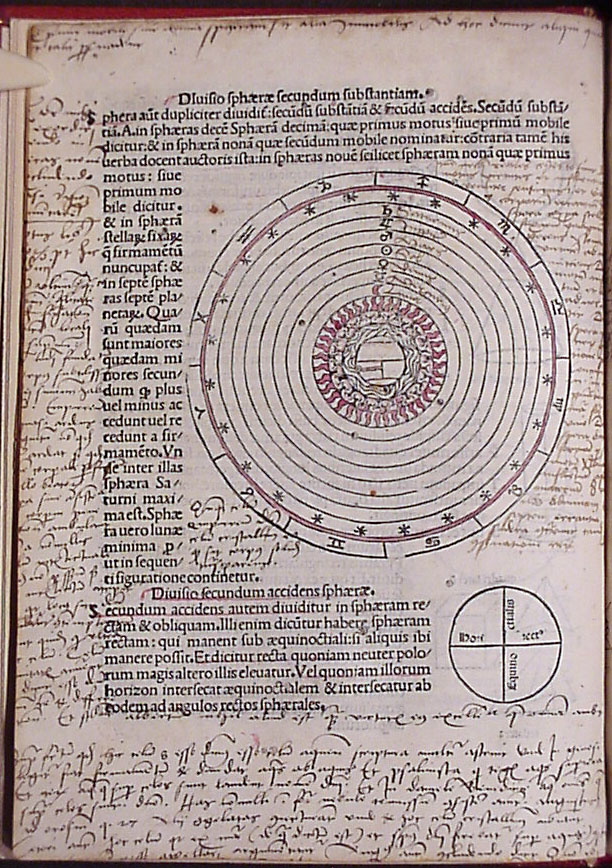
Heavily annotated copy of De Sphaera of Sacrobosco.

Johannes de Sacrobosco, also written Ioannes de Sacro Bosco, later called John of Holywood or John of Holybush (c. 1195 – c. 1256), was a scholar, Catholic monk, and astronomer who taught at the University of Paris.

He wrote a short introduction to the Hindu-Arabic numeral system. Judging from the number of manuscript copies that survive today, for the next 400 years it became the most widely read book on that subject.[1][2] He also wrote a short textbook which was widely read and influential in Europe during the later medieval centuries as an introduction to astronomy. In his longest book, on the computation of the date of Easter, Sacrobosco correctly described the defects of the then-used Julian calendar, and recommended a solution similar to the modern Gregorian calendar three centuries before its implementation.[1]

Very little is known about the education and biography of Sacrobosco. For one thing, his year of death has been guessed at 1236, 1244, and 1256, each of which is plausible and each lacking adequate evidence.[1]

Place of birth

[edit]

The country in which he was born is uncertain. Robertus Anglicus wrote in 1271 that Sacrobosco was born in England.[3] That could be true, yet there is neither good supporting nor good contradicting evidence for it. Based on Anglicus writing so soon after Sacrobosco's death, a birthplace in England may deserve greater credence than later suggestions.

Among those other possibilities, several different tenuous efforts have been made to figure out his birthplace from his appellative name de Sacrobosco. Long after his death, Johannes de Sacrobosco was called and sometimes is still called by the name "John of Holywood" or "John of Holybush", a name which was constructed by post-hoc reverse translation of the Medieval Latin sacer boscus, "holy (sacred) wood". Sacer Boscus or Romance Sacro Bosco as such is an unknown town or region. One traditional report, that he was born in Halifax, West Yorkshire, is the speculation of a 16th-century antiquary, John Leland,[1]: 176–177  which was discredited by William Camden: Halifax[4] means "holy hair", not "holy wood".[1]: 177 

Thomas Dempster identified Sacrobosco with an Augustinian canon from Holywood Abbey, Nithsdale,[a] which would be a reason for supposing him to have been born in Scotland.[1][5] The historian John Veitch claimed that he was born in Galloway and studied the classics among the monks of Whithorn and Dryburgh.[6]

Based on a suggestion by Stanihurst, Holywood, County Down also claims Sacrobosco. However, Pedersen attributes this assertion to Holywood being familiar to Stanihurst. A similar claim is made that he was born in Holywood, County Wicklow, but there is no known supporting historical document.

Pedersen mentioned that James Ware, writing in 1639, believed that the birthplace of Sacrobosco was near Dublin.[1] Stanihurst and even Pedersen were probably unaware that the seat of the Sacrobosco / Hollywood family in Ireland was in Artane, a suburb of Dublin.[7] Local historical records in Ireland seem to indicate that Johannes de Sacrobosco was a member of the Hollywood family, born in Artane Castle.[8][1]: 177–178 

Life

[edit]

The story that he was educated at the University of Oxford is no better documented than the stories on his place of birth.[1]: 177 

According to a seventeenth-century account, he arrived at the University of Paris on 5 June 1221, but whether as a student or as a graduate (licentiate – one already having a Master of Arts degree from another university, and thus qualified to teach) is unclear.[1]: 175–182  In due course, he began to teach the mathematical disciplines at the University of Paris.

The year of his death is uncertain, with evidence supporting the years 1234, 1236, 1244, and 1256.[1]: 186–189, 192  The inscription marking his burial place in the monastery of Saint-Mathurin, Paris, described him as a "computist" – one who was an expert on calculating the date of Easter.[1]: 181 

De Sacrobosco qui computista Joannes
tempora discrevit, iacet hic a tempore raptus.
Tempora qui sequeris, memor esto quod morieris.
Si miser es, plora: miserans pro me procor ora.

On 14 May 2021, asteroid 14541 Sacrobosco, discovered by Czech astronomers Jana Tichá and Miloš Tichý in 1997, was named in his memory.[9]

Tractatus de Sphaera

[edit]
Line engraving from 1584, depicting an imagined Johannes de Sacrobosco.

About 1230, his best-known work, Tractatus de Sphaera / De Sphaera Mundi (Treatise on the Sphere / On the Sphere of the World) was published. In this book, Sacrobosco gives a readable account of the Ptolemaic universe. Ptolemy's (updated) Almagest had been translated into Latin in 1175 by Gerard of Cremona from the Arabic translation held in Toledo and copies had quickly found their way to Paris. In addition Sacrobosco was able to draw on translations of the Arabic astronomers Thabit ibn Qurra, al-Biruni, al-Urdi, and al-Fargani.[10]

The "sphere" Sacrobosco was referring to is the celestial sphere – an imaginary backdrop of the stars in the sky – which was the meaning of the word mundi ("world") at that time, not the planet Earth. Though principally about astronomy, in its first chapter the book also contains a clear description of the Earth as a sphere. De Sphaera Mundi was required reading by students in all western European universities for the next four hundred years.

Algorismus

[edit]

Sacrobosco's Algorismus a.k.a. De Arte Numerandi is thought to have been his first work, written c. 1225. The Hindu–Arabic methods of numerical calculation had arrived in Latin Europe during the previous fifty years but had not been disseminated on a wide scale. Sacrobosco's Algorismus was the first text to introduce Hindu–Arabic numerals and arithmetical procedures into the European university curriculum.[2][1]: 199–200 

De Anni Ratione

[edit]

Sacrobosco may now be most famous for his criticism of the Julian calendar. In his c. 1235 book on computation of Easter's date, De Anni Ratione [On Reckoning Years], he maintained that the calendar had accumulated an error of 10 days and that some correction was needed.

The Julian calendar was instituted in the 1st century BCE. The Julian calendar year contained 365.25 days, with the 0.25 day provided for by a Leap year once every fourth year. However, the more precise length of a solar year is about 365.2422 days. By the 13th century, the less accurate 365.25 days had resulted in an accumulated error of about 10 days in the date of the vernal equinox. Sacrobosco made no proposal on how to get rid of the accumulated error. But looking to the future, he proposed to leave one day out of the calendar every 288 years to prevent further error.[1]: 209–210 [b] His criticism would foreshadow the introduction of the Gregorian calendar in 1582, which corrected the error observed by Sacrobosco by skipping 10 days, and dropping three of the century leap years in every 400-year period.

Footnotes

[edit]

Bibliography

[edit]

References

[edit]
[edit]
Revisions and contributorsEdit on WikipediaRead on Wikipedia
from Grokipedia
Johannes de Sacrobosco (c. 1195 – c. 1256), also known as John of Holywood, was a medieval scholar, , and renowned for his foundational textbooks on astronomy and arithmetic that shaped European education for centuries. Born c. 1195, place unknown (possibly in or ), he studied at the before moving to around 1220, where he entered the church and was appointed a teacher of mathematics at the in 1221. His works, written in accessible Latin, bridged and Islamic scientific traditions with Western medieval learning, emphasizing empirical observation and practical computation over speculative philosophy. Sacrobosco's most celebrated contribution is the Tractatus de Sphaera (c. 1230), a concise four-chapter treatise on that explained the geocentric Ptolemaic model, the sphericity of , and using geometric principles derived from and Islamic scholars like . This text became the standard introductory astronomy curriculum in European universities from the late until the 17th, with over 200 manuscripts surviving and the first printed edition appearing in 1472; it was often illustrated with diagrams of the nine and influenced figures like Copernicus, who referenced it in his own works. Complementing this, his De Algorismo (early ) introduced Hindu-Arabic numerals and basic arithmetic operations—, , multiplication, division, and extraction of roots—to Western audiences, promoting their use over for efficiency in calculations. In addition to these, Sacrobosco authored De Anni Ratione (c. 1232), a computus treatise critiquing the inaccuracies of the Julian calendar and proposing reforms, such as omitting a leap day every 288 years to align solar and ecclesiastical years; this work addressed practical needs for determining Easter and other movable feasts. He also wrote Tractatus de Quadrante (after 1239), a practical guide to constructing and using the quadrant for astronomical measurements, including latitude and time-finding. Though his life details remain sparse—his exact birthplace is unknown and debated, with possible ties to Holywood in Scotland or Ireland—Sacrobosco's legacy endures as a pivotal educator who standardized scientific pedagogy, fostering a transition from monastic to university-based learning in the High Middle Ages.

Biography

Origins and Place of Birth

The origins of Johannes de Sacrobosco remain largely obscure due to the absence of contemporary biographical records, with much of the available information derived from later interpretations of his name and indirect historical evidence. His birthplace is particularly debated among scholars, with proposed locations including Holywood in Yorkshire, England (sometimes identified with Halifax); Holywood in Nithsdale, Scotland; and Holywood in County Wicklow, Ireland, the latter proposed by 16th-century Irish scholars like Richard Stanyhurst based on Anglo-Norman naming patterns. These claims stem from post-medieval efforts to nationalize prominent intellectuals, but none are supported by primary documents from Sacrobosco's lifetime. Recent scholarship (2018) favors the Irish site in County Wicklow as most plausible due to its historical prominence in the early 13th century, while critiquing English and Scottish claims for lack of evidence. The Latin name "de Sacrobosco," meaning "of the holy wood," is widely interpreted as a toponymic reference to a place called Holywood, potentially tied to monastic communities in , , or where such names denoted sacred groves or wooded religious sites. This suggests an early connection to environments, though it does not resolve the geographic ambiguity. A 1271 commentary by Robertus Anglicus describes Sacrobosco as English, influencing later English claims. Pedersen's comprehensive 1985 study critiques these traditions, emphasizing the lack of definitive evidence and favoring a origin without specifying a precise locale. Sacrobosco's birth year is estimated at around 1195, inferred indirectly from the composition dates of his works (circa 1220–1240) and his documented activity as a in during the early , which would place him in his prime during that period. No records detail his family background, though his clerical status and academic pursuits imply origins within a scholarly or ecclesiastical milieu, with no mentions of parents or siblings in surviving sources.

Education and Early Career

Little is definitively known about Johannes de Sacrobosco's early life, but he is widely regarded as having received his education at the , where he studied the arts and possibly astronomy under prominent English scholars of the early thirteenth century. This period at Oxford provided foundational training in the , emphasizing arithmetic, , , and astronomy as essential components of a liberal arts curriculum. Following his studies, Sacrobosco likely entered religious life as a cleric; later traditions, possibly erroneous, associate him with Holywood Priory in Nithsdale, (now ), a Premonstratensian house, though his exact religious affiliation and connection remain uncertain and debated among scholars. This possible tie to a scholarly monastic tradition may have influenced his pursuit of intellectual endeavors, blending theological discipline with academic inquiry into and . The location's ties to English and Scottish networks may have shaped his early exposure to continental ideas. Around 1220, Sacrobosco transitioned to the , a leading center for arts and in medieval , where he joined the Faculty of Arts as a master shortly thereafter. He was formally admitted to the university on 5 June 1221 under the syndics of the English-German nation, reflecting his likely English background despite ongoing scholarly debates about his precise origins. In these initial years at Paris, Sacrobosco began delivering lectures on basic , focusing on arithmetic and computational methods, which laid the groundwork for his later instructional materials aimed at university students. This early academic activity positioned him as an emerging authority in the within the Parisian scholastic environment.

Teaching and Later Life

Around 1221, Johannes de Sacrobosco established his academic career at the , where he was appointed as a teacher on 5 June and soon became a in the Faculty of . There, he taught astronomy and mathematics to students pursuing the liberal arts curriculum, emphasizing practical and introductory aspects of these disciplines suitable for arts scholars rather than advanced specialists. His instruction drew on his prior studies, including time at , to deliver structured lessons that made complex topics accessible. In his teaching, Sacrobosco integrated key elements of Aristotelian with Ptolemaic astronomical models, adapting them for the studies in the Faculty of while steering clear of the sophisticated theological interpretations handled exclusively by the university's higher faculties. This approach ensured his courses remained focused on empirical and geometric foundations of the heavens and calculations, promoting a balanced synthesis of classical and medieval learning without encroaching on doctrinal debates. He also advocated for Arabic-influenced methods in arithmetic and , enhancing the mathematical toolkit available to his students. Little is documented about Sacrobosco's beyond his scholarly commitments; as an English cleric, he likely adhered to vows, with no records of marriage or descendants. His existence appears to have been one of dedicated academic isolation, centered on and textual work rather than or social engagements. Sacrobosco died around 1256, probably in , though no direct accounts of his final years, burial, or precise circumstances survive; indirect comes from revisions to his works that continued posthumously, suggesting his influence persisted immediately after his death.

Major Works

Tractatus de Sphaera

The Tractatus de Sphaera, also known as , was composed around 1230 by Johannes de Sacrobosco during his tenure as an astronomer and teacher at the . This introductory textbook on Ptolemaic astronomy is structured in four chapters that progressively build foundational knowledge for students: the first addresses the and the Earth's position; the second explores the zones of latitude and climatic divisions; the third examines the principal circles of the heavens; and the fourth discusses planetary motions and eclipses. Central to the work is Sacrobosco's description of the geocentric cosmos as a series of nine concentric celestial spheres surrounding the immobile Earth at the center. These include the spheres of the seven planets (Moon, Mercury, Venus, Sun, Mars, Jupiter, and Saturn, ordered by increasing distance), the sphere of the fixed stars (the firmament), and the outermost primum mobile, which imparts daily rotation to all inner spheres. The second chapter delineates the Earth's latitude zones into five parallel bands: a central torrid zone between the tropics, uninhabitable due to excessive heat; two flanking temperate zones suitable for human life; and two polar frigid zones, too cold for habitation. Sacrobosco further refines this into seven climes based on variations in the length of the longest day, from 13 hours at Meroe to 16 hours at the Riphean Mountains, using these to explain regional habitability and climate. Basic use of the astrolabe is introduced as a practical tool, such as sighting the pole star through its sights to measure degrees of latitude and estimate the Earth's circumference at 252,000 stadia. In treating planetary motions, Sacrobosco adopts Ptolemy's deferents—large eccentric circles centered near but not on the —and epicycles, smaller circles on which revolve to account for observed irregularities like retrogression, while providing only a qualitative, non-mathematical explanation without the full computational complexity of Ptolemy's equant mechanism. This approach prioritizes empirical observations of celestial appearances, such as the varying speeds and stations of , over intricate geometric calculations, making the models accessible through description rather than derivation. Written in straightforward Latin, the Tractatus de Sphaera was designed for beginners in the , distilling elaborate astronomical theories into concise explanations suitable for university instruction. Over 300 medieval manuscripts survive, attesting to its widespread copying and use in European scholastic centers before printing. The first printed edition appeared in 1472, followed by numerous incunabula and later versions featuring woodcut diagrams to illustrate spheres, zones, circles, and planetary paths, enhancing visual comprehension for readers.

Algorismus

The Tractatus de Arte Numerandi, commonly referred to as Algorismus, was composed by Johannes de Sacrobosco circa 1230 as an introductory textbook on arithmetic. The title derives from "algorism," a term rooted in the name of the ninth-century Persian mathematician Muḥammad ibn Mūsā al-Khwārizmī, whose works on calculation influenced the transmission of Hindu-Arabic numerals to Europe. Sacrobosco advocated for this numeral system—featuring digits 1 through 9 and zero—as markedly superior to Roman numerals, which lacked a place-value mechanism and complicated even basic computations. The treatise systematically covers the fundamental operations of addition, subtraction, multiplication, and division, demonstrating their execution within the place-value framework. Zero, termed cifra, plays a pivotal role by denoting empty positions and enabling the representation of large numbers efficiently; for instance, Sacrobosco notes that seven digits suffice to express values up to millions. These explanations prioritize clarity for students transitioning from classical arithmetic traditions. Practical utility forms a core emphasis, with examples drawn from commercial transactions, calendrical date computations, and geometric problem-solving. To support , the text incorporates dedicated tables listing products of digits, facilitating quick reference in real-world scenarios. Sacrobosco positions finger reckoning— a manual gesture-based method for tallying—as a foundational step, serving as a bridge to the more advanced written techniques of the Hindu-Arabic system. At approximately 20 folios in length across extant manuscripts, the concise Algorismus became a staple in university curricula, underscoring its role in standardizing numerical practices. Its arithmetic foundations also supported computations in Sacrobosco's astronomical treatises.

De Anni Ratione

De Anni Ratione, also known as Computus Ecclesiasticus, is a treatise on computus composed by Johannes de Sacrobosco around 1230–1240, shortly after his Tractatus de Sphaera. The work primarily addresses the calculation of Easter and other movable feasts in the Christian liturgical calendar, relying on the interplay between solar and lunar cycles to ensure alignment with ecclesiastical requirements. Sacrobosco divides the text into two main parts: the first detailing solar year divisions and their relation to the civil calendar, and the second examining lunar movements essential for determining Paschal full moons. A central theme in De Anni Ratione is the identification of flaws in the , particularly the drift caused by its rule, which overestimates the solar year by 1/12 of an hour annually, leading to an accumulated error of one day every 288 years. Sacrobosco critiques these inaccuracies for disrupting the alignment of es and solstices with fixed dates, such as the vernal equinox on , and proposes basic reforms to suppress intercalary days periodically—every 288 years—to correct the drift without altering the existing structure significantly. These suggestions anticipate later reforms, though they were not implemented until the in 1582. The treatise introduces key computistical tools for aligning dates, including the golden number, which tracks the 19-year of lunar phases to identify the date of the Paschal ; epacts, representing the moon's age at the start of the calendar year to adjust for lunar-solar discrepancies; and dominical letters, which indicate the weekday of January 1 to compute Sundays throughout the year. Sacrobosco critiques earlier computists, notably Bede's De Temporum Ratione, for inconsistencies in lunar cycle calculations and overreliance on outdated astronomical data, arguing that such errors lead to incorrect dates. To facilitate practical application, Sacrobosco integrates arithmetic techniques—drawing briefly on methods from his Algorismus for numerical computations—and provides tables for constructing a , enabling users to determine feast dates for any year without advanced astronomical knowledge. Aimed at and scholars, the work emphasizes liturgical precision, ensuring that movable feasts like maintain their theological significance relative to fixed holy days.

Other Attributed Works

In addition to his major textbooks, several lesser-known treatises have been attributed to Johannes de Sacrobosco, though their authorship remains uncertain or secondary in scope. One such work is De Quattuor Circulis, a brief exposition on the four minor circles of the and their application to instruments like the , often appearing as an appendix or extension to the Tractatus de Sphaera. This text overlaps thematically with the astronomical concepts in his primary work, emphasizing practical for stellar . The Tractatus de Quadrante (after 1239) is a practical guide describing the construction and use of the quadrant (quadrans vetus) for astronomical measurements, such as finding , time, and altitudes of celestial bodies. It draws on earlier Islamic sources but was widely used in medieval . Another attributed composition is the Computus Manualis, a practical guide to calendrical computations featuring step-by-step aids for manual calculations of ecclesiastical dates, distinct from the more theoretical De Anni Ratione. Manuscripts containing this work frequently appear alongside Sacrobosco's other texts, suggesting it served as a supplementary tool for students in computus studies. Disputed attributions include possible connections to anonymous treatises on advanced arithmetic, such as the Quadripartitum Numerorum, which explores complex numerical operations and has occasionally been linked to Sacrobosco due to stylistic similarities with his Algorismus, though modern scholarship assigns it primarily to Jean de Murs. These minor works survive in fewer than 50 manuscripts, far less than the hundreds extant for Sacrobosco's core texts, reflecting their narrower circulation and primarily instructional use within settings.

Influence and Legacy

Educational Impact in Medieval Europe

Johannes de Sacrobosco's Tractatus de Sphaera profoundly shaped astronomical education across medieval , becoming required reading in the curricula of prominent universities such as , , , and from the 13th century onward. As an introductory text on Ptolemaic cosmology, it provided students with foundational knowledge of the , their motions, and basic astronomical computations, filling a gap in accessible teaching materials during the quadrivium's emphasis on astronomy. This work's adoption marked a shift toward standardized, university-level instruction in the liberal arts, where it was often paired with commentaries to facilitate lectures and examinations. The enduring demand for Tractatus de Sphaera is reflected in its extensive publication history, with over 350 printed editions appearing between 1472 and , disseminated across more than 40 European cities. This proliferation underscored its role in democratizing astronomical learning, as it supplanted earlier, more complex texts like Ptolemy's for undergraduates by offering a concise synthesis of spherical astronomy tailored to beginners. Through these editions, often including glosses and diagrams, the treatise ensured consistent pedagogical approaches, influencing generations of scholars and embedding geocentric models into the intellectual framework of the era. Sacrobosco's Algorismus further extended his educational legacy by championing the adoption of Hindu-Arabic numerals, which revolutionized arithmetic practices among merchants for commercial calculations and scholars for scientific computations. As the first Latin to gain widespread acceptance, it introduced decimal-based operations—including , , , division, and root extraction—directly into the curriculum, bypassing cumbersome . Integrated into the quadrivium's arithmetic component, the work underwent at least 12 editions within its first 33 years of circulation, fostering practical mathematical literacy that bridged academic and everyday applications across . Complementing these contributions, De Anni Ratione (also known as Computus ecclesiasticus) served as a vital tool for computus instruction, equipping with methods to determine key liturgical dates like based on lunar and solar cycles. Widely disseminated in monastic schools, it supported the Church's calendrical needs by simplifying complex chronological calculations, ensuring accurate observance of feasts and holy days. This text's focus on ecclesiastical computation reinforced Sacrobosco's influence in , where it was routinely studied alongside biblical and theological works to maintain the rhythm of monastic and parish life.

Long-Term Significance and Modern Scholarship

Sacrobosco's Tractatus de Sphaera exerted significant influence on key astronomers, serving as a foundational text for advancing . studied the treatise during his early education at the University of and referenced it in his works while developing his heliocentric ideas. Similarly, Georg Peurbach and his student Johannes Regiomontanus expanded upon Sacrobosco's introductory framework in their Theoricae novae planetarum, a work frequently printed alongside the Tractatus to provide more advanced planetary theory, thereby bridging basic education with observational refinements. The transition of Sacrobosco's works to print marked a pivotal expansion of their reach beyond circulation. The first printed edition of the Tractatus de Sphaera appeared in in 1472, initiating a prolific publication history that included over 350 editions by 1650. By the sixteenth century, translations into vernacular languages such as German, French, Italian, and Spanish made the text accessible to non-Latin readers, facilitating its integration into broader educational and cultural contexts across . Modern scholarship continues to illuminate Sacrobosco's historical context through targeted analyses and digital innovations. Debates over his birthplace persist, with twentieth- and twenty-first-century studies weighing evidence for origins in Yorkshire, Scotland's Nithsdale, or Ireland's Holywood; a 2018 analysis favors the Irish locale based on toponymic and biographical clues. Recent projects, such as Aylin Malcolm's interactive digital reconstruction of diagrams from a University of Pennsylvania manuscript (Codex 1881), enable scholars to explore the treatise's visual elements and their variations across copies. In , Sacrobosco is often positioned as a crucial bridge between ancient Ptolemaic astronomy and medieval scholastic traditions, synthesizing classical concepts into a standardized that shaped European cosmology for centuries. However, contemporary critiques highlight how his uncritical adoption of the geocentric model, rooted in Aristotelian-Ptolemaic sources, perpetuated outdated assumptions and delayed the acceptance of heliocentric alternatives until the seventeenth century.

References

Add your contribution
Related Hubs
User Avatar
No comments yet.