

Recent from talks
Sagnac effect
Knowledge base stats:
Talk channels stats:
Members stats:
Sagnac effect
The Sagnac effect, also called Sagnac interference, named after French physicist Georges Sagnac, is a phenomenon encountered in interferometry that is elicited by rotation. The Sagnac effect manifests itself in a setup called a ring interferometer or Sagnac interferometer. A beam of light is split and the two beams are made to follow the same path but in opposite directions. On return to the point of entry the two light beams are allowed to exit the ring and undergo interference. The relative phases of the two exiting beams, and thus the position of the interference fringes, are shifted according to the angular velocity of the apparatus. In other words, when the interferometer is at rest with respect to a nonrotating frame, the light takes the same amount of time to traverse the ring in either direction. However, when the interferometer system is spun, one beam of light has a longer path to travel than the other in order to complete one circuit of the mechanical frame, and so takes longer, resulting in a phase difference between the two beams. Georges Sagnac set up this experiment in 1913 in an attempt to prove the existence of the aether that Einstein's theory of special relativity makes superfluous.
A gimbal mounted mechanical gyroscope remains pointing in the same direction after spinning up, and thus can be used as a rotational reference for an inertial navigation system. With the development of so-called laser gyroscopes and fiber optic gyroscopes based on the Sagnac effect, bulky mechanical gyroscopes can be replaced by those with no moving parts in many modern inertial navigation systems. A conventional gyroscope relies on the principle of conservation of angular momentum whereas the sensitivity of the ring interferometer to rotation arises from the invariance of the speed of light for all inertial frames of reference.
Typically three or more mirrors are used, so that counter-propagating light beams follow a closed path such as a triangle or square (Fig. 1). Alternatively fiber optics can be employed to guide the light through a closed path (Fig. 2). If the platform on which the ring interferometer is mounted is rotating, the interference fringes are displaced compared to their position when the platform is not rotating. The amount of displacement is proportional to the angular velocity of the rotating platform. The axis of rotation does not have to be inside the enclosed area. The phase shift of the interference fringes is proportional to the platform's angular frequency and is given by a formula originally derived by Sagnac:where is the oriented area of the loop and the wavelength of light.

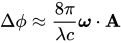


The effect is a consequence of the different times it takes right and left moving light beams to complete a full round trip in the interferometer ring. The difference in travel times, when multiplied by the optical frequency determines the phase difference


The rotation thus measured is an absolute rotation, that is, the platform's rotation with respect to an inertial reference frame.
The Michelson–Morley experiment of 1887 had suggested that the hypothetical luminiferous aether, if it existed, was completely dragged by the Earth. To test this hypothesis, Oliver Lodge in 1897 proposed that a giant ring interferometer be constructed to measure the rotation of the Earth; a similar suggestion was made by Albert Abraham Michelson in 1904. They hoped that with such an interferometer, it would be possible to decide between a stationary aether, versus aethers which are partially or completely dragged by the Earth. That is, if the hypothetical aether were carried along by the Earth (or by the interferometer) the result would be negative, while a stationary aether would give a positive result.
The first description of the Sagnac effect in the framework of special relativity was done by Max von Laue in 1911, two years before Sagnac conducted his experiment. By continuing the theoretical work of Michelson (1904), von Laue confined himself to an inertial frame of reference (which he called a "valid" reference frame), and in a footnote he wrote "a system which rotates in respect to a valid system is not valid". Assuming constant light speed , and setting the rotational velocity as , he computed the propagation time of one ray and of the counter-propagating ray, and consequently obtained the time difference . He concluded that this interferometer experiment would indeed produce (when restricted to terms of first order in ) the same positive result for both special relativity and the stationary aether (the latter he called "absolute theory" in reference to the 1895-theory of Lorentz). He also concluded that only complete-aether-drag models (such as the ones of Stokes or Hertz) would give a negative result.




The first interferometry experiment aimed at observing the correlation of angular velocity and phase-shift was performed by the French scientist Georges Sagnac in 1913. Its purpose was to detect "the effect of the relative motion of the ether". Sagnac believed that his results constituted proof of the existence of a stationary aether. However, as explained above, von Laue already showed in 1911 that this effect is consistent with special relativity. Unlike the carefully prepared Michelson–Morley experiment which was set up to prove an aether wind caused by earth drag, the Sagnac experiment could not prove this type of aether wind because a universal aether would affect all parts of the rotating light equally.
Hub AI
Sagnac effect AI simulator
(@Sagnac effect_simulator)
Sagnac effect
The Sagnac effect, also called Sagnac interference, named after French physicist Georges Sagnac, is a phenomenon encountered in interferometry that is elicited by rotation. The Sagnac effect manifests itself in a setup called a ring interferometer or Sagnac interferometer. A beam of light is split and the two beams are made to follow the same path but in opposite directions. On return to the point of entry the two light beams are allowed to exit the ring and undergo interference. The relative phases of the two exiting beams, and thus the position of the interference fringes, are shifted according to the angular velocity of the apparatus. In other words, when the interferometer is at rest with respect to a nonrotating frame, the light takes the same amount of time to traverse the ring in either direction. However, when the interferometer system is spun, one beam of light has a longer path to travel than the other in order to complete one circuit of the mechanical frame, and so takes longer, resulting in a phase difference between the two beams. Georges Sagnac set up this experiment in 1913 in an attempt to prove the existence of the aether that Einstein's theory of special relativity makes superfluous.
A gimbal mounted mechanical gyroscope remains pointing in the same direction after spinning up, and thus can be used as a rotational reference for an inertial navigation system. With the development of so-called laser gyroscopes and fiber optic gyroscopes based on the Sagnac effect, bulky mechanical gyroscopes can be replaced by those with no moving parts in many modern inertial navigation systems. A conventional gyroscope relies on the principle of conservation of angular momentum whereas the sensitivity of the ring interferometer to rotation arises from the invariance of the speed of light for all inertial frames of reference.
Typically three or more mirrors are used, so that counter-propagating light beams follow a closed path such as a triangle or square (Fig. 1). Alternatively fiber optics can be employed to guide the light through a closed path (Fig. 2). If the platform on which the ring interferometer is mounted is rotating, the interference fringes are displaced compared to their position when the platform is not rotating. The amount of displacement is proportional to the angular velocity of the rotating platform. The axis of rotation does not have to be inside the enclosed area. The phase shift of the interference fringes is proportional to the platform's angular frequency and is given by a formula originally derived by Sagnac:where is the oriented area of the loop and the wavelength of light.
The effect is a consequence of the different times it takes right and left moving light beams to complete a full round trip in the interferometer ring. The difference in travel times, when multiplied by the optical frequency determines the phase difference
The rotation thus measured is an absolute rotation, that is, the platform's rotation with respect to an inertial reference frame.
The Michelson–Morley experiment of 1887 had suggested that the hypothetical luminiferous aether, if it existed, was completely dragged by the Earth. To test this hypothesis, Oliver Lodge in 1897 proposed that a giant ring interferometer be constructed to measure the rotation of the Earth; a similar suggestion was made by Albert Abraham Michelson in 1904. They hoped that with such an interferometer, it would be possible to decide between a stationary aether, versus aethers which are partially or completely dragged by the Earth. That is, if the hypothetical aether were carried along by the Earth (or by the interferometer) the result would be negative, while a stationary aether would give a positive result.
The first description of the Sagnac effect in the framework of special relativity was done by Max von Laue in 1911, two years before Sagnac conducted his experiment. By continuing the theoretical work of Michelson (1904), von Laue confined himself to an inertial frame of reference (which he called a "valid" reference frame), and in a footnote he wrote "a system which rotates in respect to a valid system is not valid". Assuming constant light speed , and setting the rotational velocity as , he computed the propagation time of one ray and of the counter-propagating ray, and consequently obtained the time difference . He concluded that this interferometer experiment would indeed produce (when restricted to terms of first order in ) the same positive result for both special relativity and the stationary aether (the latter he called "absolute theory" in reference to the 1895-theory of Lorentz). He also concluded that only complete-aether-drag models (such as the ones of Stokes or Hertz) would give a negative result.
The first interferometry experiment aimed at observing the correlation of angular velocity and phase-shift was performed by the French scientist Georges Sagnac in 1913. Its purpose was to detect "the effect of the relative motion of the ether". Sagnac believed that his results constituted proof of the existence of a stationary aether. However, as explained above, von Laue already showed in 1911 that this effect is consistent with special relativity. Unlike the carefully prepared Michelson–Morley experiment which was set up to prove an aether wind caused by earth drag, the Sagnac experiment could not prove this type of aether wind because a universal aether would affect all parts of the rotating light equally.
Recent media