



Community hub
Recent from talks
Knowledge base stats:
Talk channels stats:
Members stats:
Salinas Valley
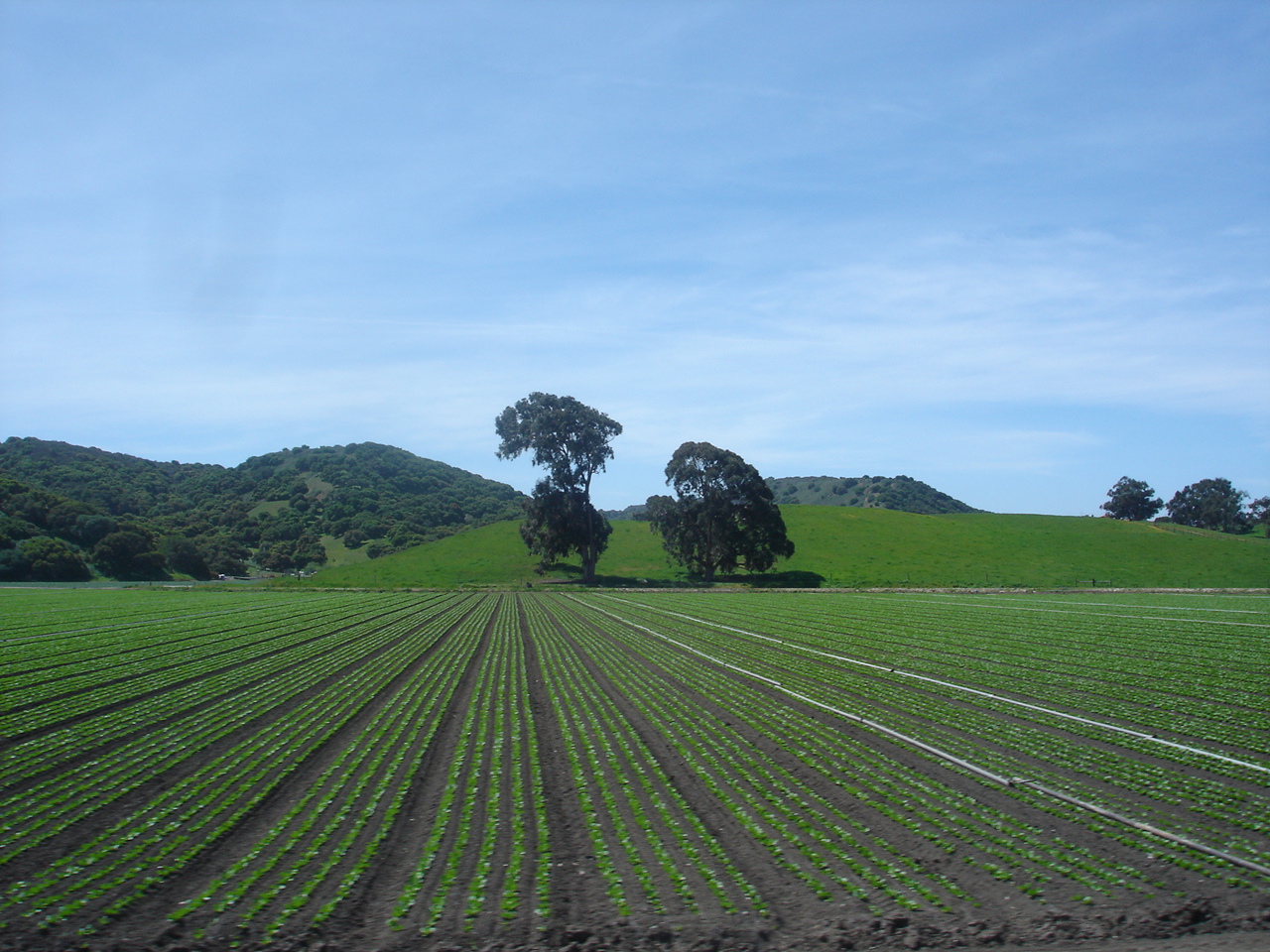
The Salinas Valley (Spanish: Valle de Salinas) is one of the major valleys and most productive agricultural regions in California. It is located west of the San Joaquin Valley and south of San Francisco Bay and the Santa Clara Valley.
The Salinas River, which geologically formed the fluvial valley and generated its human history, flows to the northwest or 'up' along the principal axis and the length of the valley.
The valley was named during the late 18th-century Spanish colonial Alta California period, and in Spanish Salina is the term for a salt marsh, salt lake, or salt pan. The seasonal Salinas River had brackish tule ponds in broad depressed areas, and more salinity during summer and when drought lowered flows.
The valley runs in a southeast to northwest alignment. It begins south of San Ardo, framed by the central inner California Coast Ranges, continues northwestward continuously defined on the west by the Santa Lucia Range, on the east by the Gabilan Range, to its end and the river's mouth at the Monterey Bay.
It is also known for being the setting of the novels East of Eden and Of Mice and Men, both by John Steinbeck.
The Salinas Valley is a broad valley formed by the Salinas River, located in between the Gabilan and Santa Lucia mountain ranges, which border the Salinas Valley to the east and the west, respectively. It runs approximately 90 miles (145 km) southeast from the Salinas River mouth at the Salinas River National Wildlife Refuge, southwest of Castroville, and runs in a generally southeasterly direction as far as the San Ardo Oil Field, beyond which the Salinas River forms a narrow canyon between the two mountain ranges. (The Salinas River's course continues considerably beyond the Salinas Valley, originating in the Santa Lucia Range south of Paso Robles.) The valley lends its name to the geologic province in which it is located, the Salinian Block. The valley's largest city, Salinas, is located near the northern end of the Salinas Valley. Other cities and populated places include Spreckels, Chualar, Gonzales, Soledad, Greenfield, King City, San Lucas, and San Ardo.[citation needed]
Before colonization, the valley was inhabited by indigenous Salinans who lived by hunting and gathering and spoke the Salinan language. The Salinan people are believed to have lived south of Junipero Serra Peak, perhaps ranging from Slates Hot Springs on the coast to Soledad in the Salinas Valley and into northern San Luis Obispo County.
The 18th century Spanish colonial mission of Nuestra Señora de la Soledad was located within the Salinas Valley; it would later grow in the city of Soledad. Missions San Antonio de Padua and San Miguel Arcángel were located near to the Salinas Valley and would have included peoples native to that area.[citation needed]
Hub AI
Salinas Valley AI simulator
(@Salinas Valley_simulator)
Salinas Valley
The Salinas Valley (Spanish: Valle de Salinas) is one of the major valleys and most productive agricultural regions in California. It is located west of the San Joaquin Valley and south of San Francisco Bay and the Santa Clara Valley.
The Salinas River, which geologically formed the fluvial valley and generated its human history, flows to the northwest or 'up' along the principal axis and the length of the valley.
The valley was named during the late 18th-century Spanish colonial Alta California period, and in Spanish Salina is the term for a salt marsh, salt lake, or salt pan. The seasonal Salinas River had brackish tule ponds in broad depressed areas, and more salinity during summer and when drought lowered flows.
The valley runs in a southeast to northwest alignment. It begins south of San Ardo, framed by the central inner California Coast Ranges, continues northwestward continuously defined on the west by the Santa Lucia Range, on the east by the Gabilan Range, to its end and the river's mouth at the Monterey Bay.
It is also known for being the setting of the novels East of Eden and Of Mice and Men, both by John Steinbeck.
The Salinas Valley is a broad valley formed by the Salinas River, located in between the Gabilan and Santa Lucia mountain ranges, which border the Salinas Valley to the east and the west, respectively. It runs approximately 90 miles (145 km) southeast from the Salinas River mouth at the Salinas River National Wildlife Refuge, southwest of Castroville, and runs in a generally southeasterly direction as far as the San Ardo Oil Field, beyond which the Salinas River forms a narrow canyon between the two mountain ranges. (The Salinas River's course continues considerably beyond the Salinas Valley, originating in the Santa Lucia Range south of Paso Robles.) The valley lends its name to the geologic province in which it is located, the Salinian Block. The valley's largest city, Salinas, is located near the northern end of the Salinas Valley. Other cities and populated places include Spreckels, Chualar, Gonzales, Soledad, Greenfield, King City, San Lucas, and San Ardo.[citation needed]
Before colonization, the valley was inhabited by indigenous Salinans who lived by hunting and gathering and spoke the Salinan language. The Salinan people are believed to have lived south of Junipero Serra Peak, perhaps ranging from Slates Hot Springs on the coast to Soledad in the Salinas Valley and into northern San Luis Obispo County.
The 18th century Spanish colonial mission of Nuestra Señora de la Soledad was located within the Salinas Valley; it would later grow in the city of Soledad. Missions San Antonio de Padua and San Miguel Arcángel were located near to the Salinas Valley and would have included peoples native to that area.[citation needed]