Hubbry Logo
Mineral lickMineral lickMain
Open search
Mineral lick
Community hub
Mineral lick
logo
8 pages, 0 posts
0 subscribers
Be the first to start a discussion here.
Mineral lick
Mineral lick
from Wikipedia
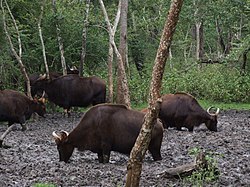
Gaur at a natural salt lick

A mineral lick (also known as a salt lick) is a place where animals can go to lick essential mineral nutrients from a deposit of salts and other minerals. Mineral licks can be naturally occurring or artificial (such as blocks of salt that farmers place in pastures for livestock to lick). Natural licks are common, and they provide essential elements such as phosphorus and the biometals (sodium, calcium, iron, zinc, and trace elements) required for bone, muscle and other growth in herbivorous mammals such as deer, moose, elephants, hippos, rhinos, giraffes, zebras, wildebeests, tapirs, woodchucks, fox squirrels, mountain goats, porcupines, and frugivorous bats.[1] Such licks are especially important in ecosystems such as tropical rainforests and grasslands with poor general availability of nutrients. Harsh weather exposes salty mineral deposits that draw animals from miles away for a taste of needed nutrients. It is thought that certain fauna can detect calcium in salt licks.[2]

Overview

[edit]

Many animals regularly visit mineral licks to consume clay, supplementing their diet with nutrients and minerals. In tropical bats, lick visitation is associated with a diet based on wild figs (Ficus), which have very low levels of sodium,[3][4] and licks are mostly used by females that are pregnant or lactating.[5]

Some animals require the minerals at these sites not for nutrition, but to ward off the effects of secondary compounds that are included in the arsenal of plant defences against herbivory.[6][failed verification] The minerals of these sites usually contain calcium, magnesium, sulfur, phosphorus, potassium, and sodium.[7][8][9][10] Mineral lick sites play a critical role in the ecology and diversity of organisms that visit these sites, but little is still understood about the dietary benefits.

The paths animals made to natural mineral licks and watering holes became the hunting paths predators and early humans used for hunting. It is hypothesized that these salt and water paths became trails and later roads for early humans.[11]

Nonetheless, many studies have identified other uses and nutritional benefits from other micronutrients that exist at these sites, including selenium, cobalt and/or molybdenum.[12][13] In addition to the utilization of mineral licks, many animals suffer from traffic collisions as they gather to lick salts accumulated on road surfaces. Animals also consume soil (geophagy) to obtain minerals, such as moose from Canada mining for minerals from the root wads of fallen trees.[14][15]

Artificial salt licks

[edit]

Artificial salt licks are used in the husbandry of livestock and to attract or maintain wildlife, whether it be for viewing, photography, farming, or hunting purposes.[16] Maintaining artificial salt licks as a form of baiting is illegal in some states in the United States, but legal in others.[10]: 413  Inadvertent salt licks may lead to unintended wildlife-human interactions.[17]

History

[edit]

In the Americas

[edit]

The indigenous peoples of the Americas and the longhunter watched salt licks to hunt game. Many became well-known, including Bledsoe Lick in Sumner County, Tennessee; the Blue Lick in central Kentucky; 'Great Buffalo Lick' in Kanawha Salines, now present-day Malden, West Virginia; the French Lick in southern Indiana; and the Blackwater Lick in Blackwater, Lee County, Virginia.[18][unreliable source?]

Mythology

[edit]

In Norse mythology, before the creation of the world, the divine cow Auðumbla licked salty ice for three days and uncovered Búri, ancestor of the gods and grandfather of Odin. On the first day as Auðumbla licked, Buri's hair appeared from the ice, on the second day his head, and the third his body.[19]

See also

[edit]

References

[edit]

Further reading

[edit]
[edit]
Revisions and contributorsEdit on WikipediaRead on Wikipedia
from Grokipedia
A mineral lick, also known as a salt lick, is a natural deposit of essential minerals such as sodium, calcium, , magnesium, and trace elements like and , where animals consume , , or rock to supplement their intake. These sites occur in wet, muddy areas fed by mineral-rich springs or as dry exposures, serving as critical resources in nutrient-deficient ecosystems for herbivores to maintain acid-base balance, support function, development, and rumen . Mineral licks attract a wide range of , including all major North American ungulates such as , caribou, deer, , and , as well as bears, hares, birds, , and carnivores in tropical regions. Usage peaks in spring and to support , and horn growth, and post-winter recovery, with animals sometimes traveling over 15–24 kilometers to reach them, following established trails that can persist for centuries. In addition to natural formations, artificial mineral licks are created by landowners using salts and phosphates to enhance nutrition, particularly for deer, though they may not fully replicate the diversity of natural sites, carry risks of overuse, and may be restricted or banned in some jurisdictions due to concerns. Ecologically, mineral licks play a vital role in health and distribution but also pose risks, as high concentrations of animals at these hotspots can facilitate transmission among . Physical characteristics like substrate type (muddy versus rocky), vegetation density, and canopy cover influence visitation patterns, with denser areas favoring ungulates for safety and open sites attracting diverse taxa for better visibility. Conservation efforts emphasize protecting natural licks through buffers, restricted access, and avoidance of disturbances to preserve their function in supporting .

Definition and Characteristics

Formation Processes

Mineral licks form primarily through a combination of geological and chemical processes that expose and concentrate mineral-rich materials at the Earth's surface. These natural features arise when underlying mineral deposits, such as salts, clays, or trace elements in , become accessible due to physical disruption and subsequent environmental interactions. Geological origins of mineral licks often involve the exposure of mineral-rich soils or rocks via , , or tectonic activity. , particularly along riverbanks, can reveal subsurface layers; for instance, in the , clay licks develop on the outer bends of meandering rivers where river currents erode banks to expose clay seams embedded in the soil. breaks down rocks over time, liberating minerals from parent materials like or , while tectonic uplift in regions such as the Canadian can bring deep-seated deposits closer to the surface, facilitating their exposure. Additionally, natural springs emerge when percolates through fractured , carrying dissolved minerals upward, as seen in salt springs like Big Bone Lick in , where mineral-laden water surfaces from deep underground sources. Chemical processes contribute significantly by concentrating minerals through leaching, where soluble elements are dissolved and transported by before redepositing in accessible forms. or rainfall infiltrates surrounding soils, selectively dissolving minerals via cation exchange and , leading to accumulation in low-lying or saturated areas; this is evident in wet licks associated with seeps, where further concentrates the deposits. Dry licks, in contrast, form from the leaching and cycles on exposed slopes, temporarily wetting during precipitation to enhance mineral and redeposition. These processes are driven by the of in , influenced by the bedrock's composition. Environmental factors modulate the formation and persistence of mineral licks, including , cover, and . affects mineral availability, with acidic conditions promoting leaching of certain cations and more neutral allowing base cation buildup through reduced leaching. Sparse cover accelerates exposure by minimizing stabilization, whereas dense cover in tropical rainforests like the Amazon can slow surface but enhances chemical via organic acids from decaying plant matter. plays a key role: heavy rainfall in tropical regions facilitates leaching and river , forming prominent clay licks, whereas semi-arid s in parts of support salt flat development through episodic wetting and cycles. further influences site selection, with slopes and depressions concentrating runoff and minerals.

Mineral Composition

Mineral licks typically consist of a variety of essential minerals that accumulate through geological processes, including (commonly known as salt), calcium, magnesium, , , and iron, along with trace elements such as and . These primary components provide concentrated sources of macronutrients and micronutrients, with sodium often dominating in saline environments and calcium prevalent in carbonate-rich settings. The chemical makeup of mineral licks varies significantly by geographic location and underlying geology. For instance, licks associated with coastal or evaporite deposits exhibit elevated sodium levels due to the precipitation of and other saline minerals. In contrast, riverine areas often feature clay-rich licks containing and , which contribute to higher aluminum content and moderate levels of magnesium and . These regional differences arise from local sedimentary environments, such as evaporative basins near coasts or alluvial deposits along rivers. To determine the precise composition of mineral licks, researchers employ soil sampling techniques combined with spectrometric analysis, such as (AAS), which quantifies element concentrations with high accuracy. Samples are typically collected from the surface and subsurface of the lick site, dried, and digested before analysis to measure levels like sodium (ranging from 7 to 129 ppm in some Iranian sites) or calcium (up to 4.4% in Kenyan licks). This methodology allows for the identification of both major and trace elements without contamination from surrounding . Several factors influence the mineral composition of licks, primarily the type of parent rock material from which they derive. For example, licks formed from parent material are enriched in calcium due to the high content of the source rock. , including , can further alter compositions by facilitating dissolution and translocation through organic acids that enhance and nutrient mobility in the profile. These exudates, released by nearby vegetation, interact with soil particles to concentrate certain elements over time.

Types of Mineral Licks

Natural Licks

Natural mineral licks are naturally occurring sites where essential minerals such as sodium, calcium, magnesium, and others concentrate in soil, rock, or water, attracting wildlife in various ecosystems worldwide. These sites are particularly prevalent in nutrient-poor environments where vegetation provides limited mineral access, including tropical rainforests of the Amazon Basin, African savannas and forests, and boreal forests of North America. In the Amazon, mineral licks serve as hotspots for diverse mammal and bird species engaging in geophagy, while in African savannas like the Serengeti, they provide critical sodium supplementation. Similarly, in North American boreal regions, such as those in Alaska and Canada, licks support ungulates by addressing seasonal mineral deficiencies in coniferous-dominated landscapes with low soil nutrient levels. Notable examples illustrate the global significance of these sites. In Alaska's boreal forests, natural mineral licks, such as those in the central , are vital for , where animals visit to consume mineral-rich mud and water from seeps. In , mineral lick soils exhibit elevated levels of key elements like sodium compared to surrounding areas, drawing and to these geothermal-influenced sites. In , geophagy sites in places like Dzanga National Park in the and attract forest elephants to clay-rich soils for mineral intake, with licks often forming around natural springs or exposed earth. Physically, natural mineral licks vary widely in form and scale, ranging from small depressions or seeps a few in to expansive cliff faces or bare patches covering up to 18 square or more. They are often visible as denuded areas with little to no cover due to animal activity and exposure, and many are associated with wet springs that keep the ground muddy. Usage peaks seasonally, particularly in spring and when ungulates require minerals for growth and , coinciding with transitions to new types. In the wild, natural mineral licks can be identified by distinctive signs of heavy use, including radiating trails leading to the site, excavated or pits from digging, and persistent bare patches devoid of plant growth. These features result from repeated visitation, creating clear pathways and cleared areas that persist even in vegetated habitats. Such indicators help researchers and conservationists map and protect these ecologically important locations.

Artificial Licks

Artificial mineral licks are human-created sites designed to provide supplemental to animals, typically through the placement of commercial blocks, salts, or custom mixtures in accessible forms such as blocks, piles, or troughs. Construction often involves simple excavation in well-drained clay soils, where a hole approximately 12 inches deep and 36 inches in diameter is dug and filled with 25 pounds of trace salt to encourage animal visitation and intake. For , custom blends like urea-molasses mixtures are prepared by combining , , cement, and other additives into a paste, which is then molded in wooden boxes or metal containers and allowed to dry for several days to form durable blocks suitable for ruminants. Commercial blocks, containing salts and essential nutrients like , are commonly placed directly in troughs or on the ground, requiring 20 to 50 pounds annually per site to maintain efficacy. These artificial licks serve critical purposes in both agricultural and contexts. In , they supplement diets for grazing phosphorus-deficient pastures, where free-choice mineral blocks help address widespread phosphorus shortages that impair and growth in grazing . In , they attract species like deer for hunting, , or conservation efforts by providing vital minerals absent in natural , thereby supporting overall , antler development, and . Such supplementation is particularly valuable in nutrient-poor environments, enhancing herd vitality without relying on natural geological formations. Placement strategies emphasize accessibility and safety, typically locating licks near water sources or established animal trails to maximize use while minimizing environmental disruption. Sites are often positioned in corners of food plots or along travel corridors with nearby cover to encourage regular visitation by target species. Monitoring is essential to prevent overuse, such as in high-traffic areas where licks can facilitate disease transmission like prions, which persist in soil and attract multiple animals, potentially amplifying spread. Recent advancements highlight the efficacy of artificial licks, with a 2025 study in Malaysian forests—as of a study published on January 2, 2025—demonstrating their equivalence to natural licks in delivering minerals to mammals, including and , particularly in secondary forests where habitat degradation limits natural options. This research, using camera traps across 20 sites, found similar and visitation rates, with artificial licks showing higher concentrations of key minerals like sodium, magnesium, and in and , underscoring their role in conserving in altered ecosystems.

Ecological Significance

Nutritional Benefits to Wildlife

Mineral licks serve as critical sources of essential minerals that address dietary deficiencies in , particularly in habitats where is nutrient-poor. Animals engage in geophagy at these sites to obtain sodium, which is vital for nerve function, , and maintaining fluid balance, as well as calcium and for development and metabolic processes. Trace elements like magnesium, iron, , and from licks also support enzymatic functions and overall physiological health. For ungulates such as deer and elephants, mineral licks provide targeted benefits that enhance growth and reproduction. In , calcium and intake from licks supports development in males and production in lactating females, addressing imbalances in phosphorus-poor diets. African elephants rely on licks for sodium supplementation during the , when browse offers insufficient amounts, with females showing increased visitation to meet heightened demands during and ; licks help fulfill these needs to prevent deficiencies impacting regulation. Similarly, Asian elephants benefit from higher levels of certain trace minerals like in natural licks compared to artificial ones, supporting overall nutritional needs. In parrots, such as macaws in neotropical forests, clay licks supply sodium scarce in fruit-based diets and adsorb plant alkaloids to neutralize toxins, reducing gastrointestinal distress and supporting nutrient absorption. Usage of mineral licks intensifies during specific seasons and life stages when mineral demands peak, such as post-winter recovery or periods. Alaskan ungulates like visit licks in spring and early summer to counteract sodium deficits from potassium-rich new growth, obtaining sodium to restore electrolyte balance. Lactating females across , including and , prioritize licks to secure calcium for production and for fetal development, ensuring offspring viability. These nutritional inputs yield measurable health improvements, particularly in mineral-deficient environments, by mitigating metabolic disorders like and enhancing survival rates. For instance, sodium supplementation via licks in ungulates prevents neuromuscular impairments and supports efficiency, leading to better utilization and reduced mortality in sodium-scarce regions. In elephants, access to diverse minerals from licks correlates with improved and lower incidence of nutritional stress-related ailments in habitats. Overall, such benefits underscore the role of licks in sustaining populations where natural diets fall short.

Behavioral and Community Interactions

Animals are drawn to mineral licks through a combination of sensory cues and physiological needs, exhibiting distinct behavioral patterns such as licking, grooming, and wallowing. For instance, African forest elephants (Loxodonta cyclotis) at Dzanga Bai in the actively excavate pits up to several meters deep during the dry season (December to March) to access mineral-rich and , thereby expanding the lick's surface area and facilitating communal use. These elephants display both diurnal and nocturnal visitation, with family groups averaging 2-3 individuals engaging in social licking and occasional wallowing in the sandy clearings, though activity peaks in late afternoon and extends into the night to avoid human observers. Similarly, in the Peruvian Amazon, scarlet macaws (Ara macao) and other parrots arrive at clay licks primarily in the morning, performing sequential licking behaviors influenced by dominance hierarchies, followed by and vigilant scanning for threats. Mineral licks serve as aggregation sites that foster interspecies interactions, drawing diverse wildlife into close proximity and promoting both symbiotic relationships and competitive dynamics. In African savannas and forests, such as at salt licks in Nigeria's Kainji Lake National Park, over a dozen mammal species—including elephants, African buffalo (Syncerus caffer), roan antelope (Hippotragus equinus), and bushbuck (Tragelaphus scriptus)—congregate seasonally, leading to mutualistic behaviors like birds perching on larger herbivores to access dislodged minerals or insects. In the Amazon, mineral licks attract up to 20 mammal species (e.g., tapirs, deer, and peccaries) and 13 bird species simultaneously, creating temporary multispecies assemblages where subordinate animals wait for dominant ones to finish licking, potentially facilitating social information transfer about food sources or dangers. These gatherings can escalate into competition, as observed among parrots jostling for prime licking positions at clay banks. Due to their role as predictable congregation points, mineral licks function as ecological "traplines" that heighten predation risks for visiting animals. In the Peruvian Amazon, jaguars (Panthera onca) and other carnivores exploit these sites by ambushing distracted herbivores and birds, with camera trap data showing elevated predator sightings during peak visitation hours at licks where macaws and mammals aggregate. Parrots mitigate this vulnerability through anti-predator behaviors, such as staggered arrivals and explosive flock departures upon detecting threats like harpy eagles (Harpia harpyja), which has shaped their lick usage to minimize exposure time. In African contexts, lions (Panthera leo) similarly target ungulate gatherings at salt licks, forcing prey species to balance mineral intake against the elevated danger of these hotspots. As keystone resources, mineral licks play a pivotal in structuring community dynamics and offer valuable models for investigating interactions amid changes. Recent emphasizes that these sites concentrate and facilitate processes like predator-prey encounters and , with up to 24 mammal recorded across natural licks in tropical forests, underscoring their influence on local food webs. Analyses as of 2025 highlight licks as overlooked model systems for studying interactions, including transfer and social information use. Additionally, high animal concentrations at licks can facilitate transmission across , serving as hotspots for spread and reservoirs in populations, as documented in studies from May 2025.

Historical and Cultural Contexts

Prehistoric and Indigenous Uses

Archaeological evidence from eastern indicates that prehistoric humans targeted mineral licks as strategic locations, where large herbivores gathered to consume essential salts and s, facilitating communal drives and ambushes. At Big Bone Lick in , a prominent saline spring site, excavations have uncovered stone tools, projectile points, and faunal remains suggesting human predation on such as mastodons and , with activity dating back at least 12,000 years ago during the . Similar patterns appear at other licks, where early Paleoindian artifacts imply the use of these sites for trapping and processing game around 10,000 to 11,000 years ago, exploiting the predictable animal concentrations for efficient . Indigenous peoples across North America integrated mineral licks into their subsistence strategies, relying on them to track and harvest wildlife drawn to the nutrient-rich deposits. Tribes such as the Shawnee in the Ohio Valley had settlements near licks like those along the Licking River, using the areas to access game such as deer, bison, and elk, which enhanced hunting success in resource-scarce environments. In the Amazon Basin, groups like the Maijuna of Peru viewed mineral licks—known locally as collpas—as culturally vital hunting grounds, where they employed traditional techniques to target tapirs, peccaries, and other species. Beyond hunting, some indigenous communities practiced geophagy, consuming clays to bind and neutralize plant toxins in their diets, such as cyanogenic glycosides from bitter manioc, thereby reducing gastrointestinal distress and enabling safer consumption of local flora. In the Andean region, the Inca Empire systematically exploited salt licks and brine springs, such as those at Maras, extracting the mineral for widespread trade along extensive road networks, where it served as a high-value currency exchanged for textiles, metals, and foodstuffs from distant provinces. Inca salt was also essential for food preservation, curing meats like llama and guinea pig through salting processes that extended shelf life in high-altitude storage, and held medicinal applications, applied topically to wounds or ingested to treat digestive ailments and electrolyte imbalances. These practices underscored salt's role in Inca society as a symbol of abundance, sometimes incorporated into rituals honoring Pachamama, the earth mother, to invoke fertility and communal prosperity.

Modern Exploitation and Conservation

European settlers in the Americas began exploiting natural mineral licks for salt production shortly after colonization, recognizing their value as sources of brine for industrial-scale extraction. In the 18th century, colonists in Virginia and surrounding regions established saltworks near prominent licks, boiling saline water to produce salt essential for food preservation and livestock supplementation, which fueled economic growth and westward expansion. For instance, in the Ohio Country, settlers expanded operations by digging wells and building furnaces to process brine from licks, transforming these sites into key industrial hubs that supported colonial settlement patterns. This historical exploitation evolved into broader economic activities, including commercial and development at notable sites. At Big Bone Lick in , early operations in the 18th and 19th centuries supplied regional markets, while the site's paleontological significance later drove through guided tours, museums, and recreational facilities that attract visitors to view active salt springs and fossil exhibits. Such developments highlight how mineral licks transitioned from raw resource extraction to managed attractions, generating revenue while preserving historical contexts for public education. Contemporary conservation efforts face significant challenges from habitat loss, , and , which directly threaten the integrity of mineral licks as critical wildlife features. In the Amazon, deforestation driven by , , and has led to the degradation of forested areas containing mineral licks, reducing their availability and disrupting the ecosystems that depend on them for mineral supplementation. from mining activities contaminates and water around licks, introducing heavy metals and toxins that affect foraging animals and alter soil chemistry essential for lick formation. by exacerbates these issues by causing and vegetation loss, compacting the ground and diminishing the natural regeneration of saline deposits at lick sites. To counter these threats, various protection measures have been implemented, including legal designations and restoration initiatives. In , mineral licks are classified as wildlife habitat features under provincial guidelines, requiring avoidance during resource extraction activities and protection during critical wildlife use periods from May to November to minimize disturbance. Restoration projects focus on rehabilitating degraded sites through vegetation replanting and , while recent 2025 research demonstrates the efficacy of sustainable artificial mineral licks as alternatives to natural ones, providing comparable nutritional benefits to mammals in tropical forests and reducing pressure on vulnerable sites. For example, in March 2025, conservationists in Thailand's initiated artificial salt lick creation to support local wildlife populations. These approaches emphasize integrated to balance human interests with ecological preservation.

References

Add your contribution
Related Hubs
User Avatar
No comments yet.