Hubbry Logo
SandraudigaSandraudigaMain
Open search
Sandraudiga
Community hub
Sandraudiga
logo
8 pages, 0 posts
0 subscribers
Be the first to start a discussion here.
Sandraudiga
Sandraudiga
from Wikipedia
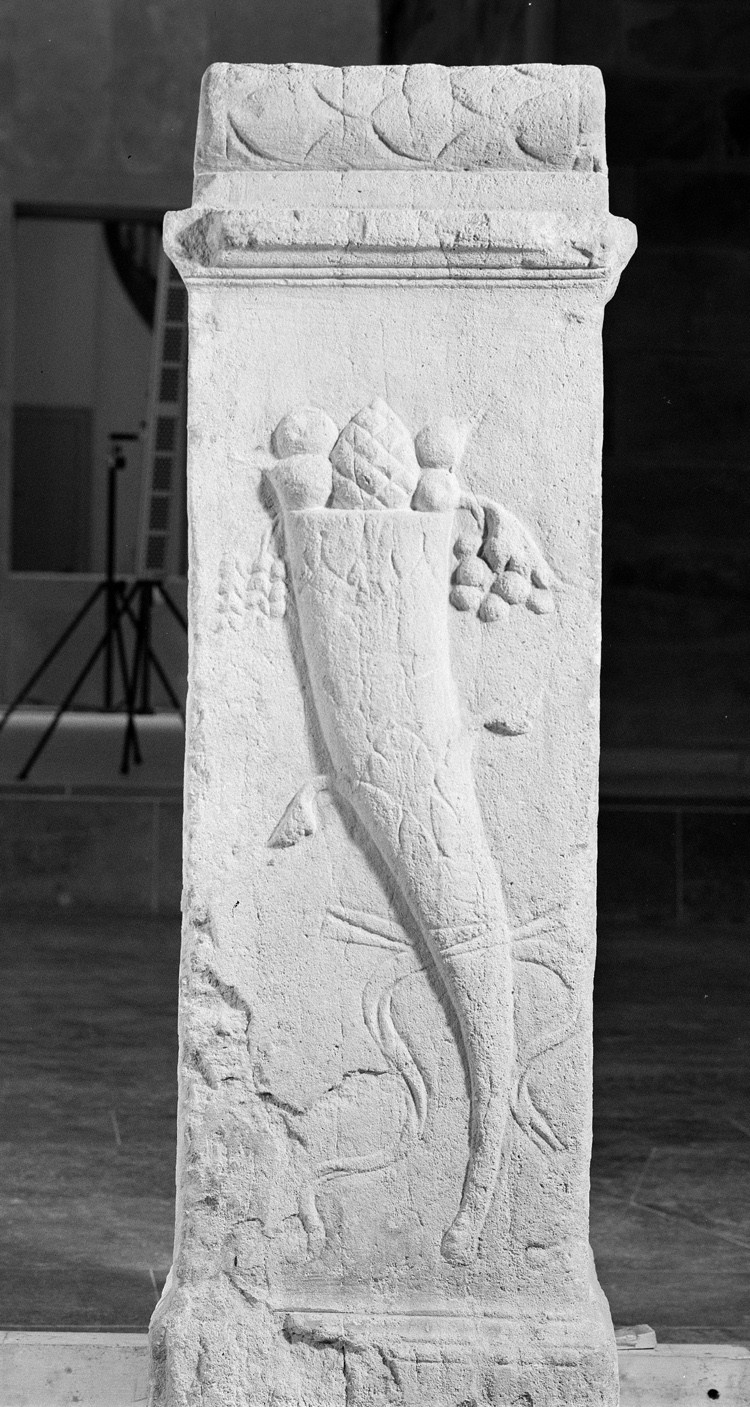
Side of the altar of Sandraudiga from Zundert. Limestone altar, dedicated to the goddess Sandraudiga. Sides decorated with cornucopiae in relief. The left cornucopiae is wrapped in a bow. The top of the altar has a triangular facade at the front, decorated with a leaf motif. On the left and right is a roll scaled along the entire length with a rosette on the front, in the middle 3 large apples in a row, which are badly damaged. On the front only the inscription.

Sandraudiga is a Germanic goddess, attested on a stone with a Latin inscription, found in North Brabant, the Netherlands. Today the stone is housed in the National Museum of Antiquities, Leiden, the Netherlands. The meaning of her name is still subject of discussion, but it has been suggested that it might mean "she who dyes the sand red".[1] Other indigenous (southern) Dutch deities who are locally known at that time are: Vagdavercustis, Burorina, Hludana, Viradectis, Hurstrga/Hurst(ae)rga, Nehalennia and Seneucaega.

Discovery and Inscription

[edit]

The stone was discovered in 1812 in Tiggelt, Zundert near the village of Rijsbergen and is now in the Rijksmuseum van Oudheden in Leiden. It is made of limestone (139 × 81 × 41 cm). Above the circular base there is an inscription panel and above it a cornice corresponding to the base with an attachment with foliage or scaled decorated scrolls on both sides. The narrow sides each show different cornices as decoration. The four-line inscription is slightly eroded, yet clearly legible. The final A and E of the theonym are carved as a ligature Æ.

Deae / Sandraudigae / cultores / templi

The inscription testifies that "Cultores" (cult personnel or functionaries) donated the stone, which is connected to a temple. Based on the region it was found, it seem to have been dedicated by the Batavi. The remains of a possible temple were discovered during subsequent excavations at the site of the stone in the 1950s. Painted remains of the wall, brick fragments, Roman and local ceramics and a number of iron products such as nails and hooks were found that can be dated to the 2nd century. Not far from the site in tiggelt, a Roman-era Germanic settlement from the middle of the 2nd century to the middle of the 3rd century was uncovered in the Rijswijker district "de Bult", which consisted of three courtyards.

Name and Meaning

[edit]

The two-part name shows Germanic lexemes in its respective parts. Theodor von Grienberger sees the derivation Sandr(i) from Germanic *sanþ (with grammatical alternation d <þ) in the first term, and compares it with the evidence in Old Norse sannr, Old English sóð ('true'). He also compares the link with the Visigothic personal name Sandri-mer ('the truly famous') from the early 7th century. He attributes the second link, audiga, to Gothic audags and further related terms in the Old Germanic languages with the meaning of 'rich', 'blessed' or 'happy'.

Richard M. Meyer rejected Grienberger's explanations as being too abstractly constructed, and considers the connection to the personal name Sandrimer to be problematic, since the 'r' in the theonym must be analogous to stem. The copulation of an abstract concept of “true” with the concept of “wealth” is unusual for the naming of Germanic deities. Meyer sees the goddess as a local special phenomenon that is associated with the place name Zundert and creates the name from the terms Old Saxon, Old English *sand ('sand'), and Gothic rauds and Old Norse rauðs ('reddish, red') as "goddess who reddens the sand" shown.[2][3]

Siegfried Gutenbrunner has another view with the connection to Germanic *Sundra for 'special' and considers it a reference to the name of the place where it was found, Zundert, as *Sundrauda 'divine special', so that the name could mean “the truly rich”.

Norbert Wagner sees an -ra extension in the first member of the name. In the addition of Grienberger's personal name Sandrimer to the theonym Sandraudiga, he sees only a Romance sonorisation in both documents in the '-d-', a vulgar Latin appearance as in the epithet of Mars Halamardus (đ < þ). He does not see Grienberger's assumption of a grammatical change as given.[4]

For von Grienberger, who emphasized that the stone is decorated with cornucopia on both sides, the name is evidence of a goddess of abundance and fertility. Jan de Vries also sees a “goddess of abundance” in the name, but he is skeptical of Grienberger's linguistic conclusions and leans towards Gutenbrunner's approach; Rudolf Simek on the synthesis.

Lauran Toorians derives the name of Sandraudiga from a Celtic (substratum) place or place name. He sees specifically in the Germanic form sand-raud-iga ("red sand") a Germanization of the older Celtic place name *sfonda-roudo ("red pole"),[5] whereby he does not explain the conspicuous apositioning of the adjective.[6] He also argues that the soil in the vicinity of the site contains a lot of iron, giving it a red color, which is also continued in the color of the local rivers. Thus, the topical reference of the name shows the goddess as the protector of the place / settlement. He also sees the same process in the name of Zundert as the adaptation of a Celtic predecessor name by new Germanic-speaking settlers.

Literature

[edit]
  • Theodor von Grienberger. "Germanische Götternamen auf rheinischen Inschriften". In: Zeitschrift für deutsches Alterthum und deutsche Literatur 35, 1891, S. 389–391.
  • Siegfried Gutenbrunner. Germanische Götternamen der antiken Inschriften. Niemeyer, Halle/S. 1936, S. 98–99.
  • Rudolf Simek. Lexikon der germanischen Mythologie (= Kröners Taschenausgabe. Band 368). 3., völlig überarbeitete Auflage. Kröner, Stuttgart 2006, ISBN 3-520-36803-X, S. 360.
  • Lauran Toorians. "From a "red post" to Sandraudiga and Zundert". In: Oudheidkundige Mededelingen 75, 1995, S. 131–136.
  • Anna-Barbara Follmann-Schulz. "Die römischen Tempelanlagen in der Provinz Germania inferior". In: Wolfgang Haase (Hrsg.): Aufstieg und Niedergang der römischen Welt Band II, 18, 1 Religion (Heidentum: Die religiösen Verhältnisse in den Provinzen). de Gruyter, Berlin/New York 1986. ISBN 3-11-010050-9, S. 672–793; hier 762, 782, Tafel VIII.
  • Jan de Vries. Altgermanische Religionsgeschichte. Band 2, de Gruyter, Berlin/New York 3. unveränd. Auflage Reprint 2010, ISBN 978-3-11-002807-2, S. 322–323.

References

[edit]
Revisions and contributorsEdit on WikipediaRead on Wikipedia
from Grokipedia
Sandraudiga is a goddess attested in a region of mixed Germanic and Celtic influences, known solely through a single Latin votive inscription from the Roman period, discovered in 1812 at Zundert in Noord-Brabant, the Netherlands. The inscription, dated between 101 and 300 AD, was dedicated by the cultores templi (temple worshippers) and reads Deae Sandraudigae cultores templi, expressing devotion to the goddess in connection with a local temple. The altar, carved from limestone and measuring 142 cm in height, 81 cm in width, and 40 cm in depth, features relief carvings of cornucopiae on the sides and a gabled top with decorative motifs including rosettes and apples, and is now housed in the Rijksmuseum van Oudheden in Leiden. The name Sandraudiga is a Latinized form of a , with scholarly interpretations suggesting it derives from elements meaning "she who dyes the sand red" or "realgar-colored ," potentially linking the deity to , deposits, or regional pigmentation rituals in the sandy soils of the area. This , proposed in linguistic analyses of ancient theonyms, underscores her possible role as a local or regional protectress, though no myths or further attributes are recorded. The inscription's reference to temple personnel implies an organized practice among the Texandri or Tungri tribes in , blending indigenous worship with Roman epigraphic traditions. Archaeological evidence from the site supports the existence of a center, including temple remains uncovered in 1950 and earlier findings such as an approximately 1.96-meter-tall iron-ore , Roman pottery fragments, iron nails, and animal teeth near the altar's location, indicating prolonged activity possibly involving offerings or iron-related symbolism. These findings, detailed in studies of rural sanctuaries in the , highlight Sandraudiga's significance in the syncretic religious landscape of the Roman frontier, where native deities were honored alongside imperial . No other dedications or survive, making her one of the most obscure yet evocative figures in the corpus of continental divinities.

Discovery and Artifact

Location and Circumstances of Discovery

The altar stone dedicated to the goddess Sandraudiga was discovered in 1812 in Tiggelt, a locality within the municipality of in , . The find occurred in a layer, highlighting the role of local resource extraction in unearthing Roman-era artifacts in the region. In the , archaeological excavations at the discovery site revealed remnants of a temple structure, including scattered building materials and other debris, as well as a 1.96-meter-tall iron-ore , Roman pottery fragments, iron nails, and animal teeth, dated to the 2nd century CE based on associated and structural features. These investigations confirmed the site's religious significance during the Roman period but yielded limited intact remains due to prior disturbance. The stone was initially documented by local antiquarian Prosper Cuypers of Ginneken, with publication of the find by L.J.F. Janssen in 1844, establishing its provenance. It was subsequently donated to the in in November 1823 and has remained in the museum's collection since. The artifact originates from the Roman province of , a region inhabited by Germanic groups including the Texandri tribe.

Description of the Altar Stone

The Altar Stone of Sandraudiga is a votive , measuring 142 cm in height, 81 cm in width, and 40 cm in depth, characteristic of Roman-period dedications found in Germanic regions of the . Crafted from local , the artifact exemplifies the syncretic religious practices of the 2nd to 3rd centuries AD, where indigenous deities were honored through standardized Roman architectural forms, including a rectangular base supporting a taller, narrower shaft topped by a triangular . The sides feature carvings of cornucopiae, symbols of abundance, with the left one bound by a , while the top displays a central rosette flanked by three damaged apple motifs within a scaly frame and leaf-patterned edges, suggesting possible original pigmentation to enhance visibility in temple settings. The front face bears the sole inscription, arranged in four lines: Deae / Sandraudigae / cultores / templi, translating to "To the goddess Sandraudiga, [from] the cult personnel of the temple." This dedication follows the conventional of Roman votive inscriptions, where the divine recipient is invoked first, followed by the dedicants, here identified as temple cultores—likely the official attendants or worshippers responsible for maintenance and rituals. The text occupies the central panel, with the area below the final line left blank, indicating a concise epigraphic style typical of provincial Roman production. Epigraphically, the inscription employs capital letter forms consistent with 2nd-century Roman monumental script, featuring seriffed capitals and even spacing that reflect influence from imperial stonecutting traditions adapted in the frontier. The division of words across lines (Deae on the first, Sandraudigae on the second, cultores on the third, and templi split at the end) adheres to Roman epigraphic conventions for readability on vertical surfaces, without ligatures or decorative flourishes, underscoring a functional rather than ornate approach suited to a rural Germanic temple context.

The Inscription and Its Translation

The inscription on the altar stone is rendered in Latin as DEAE SANDRAUDIGAE CVLTORES TEMPLI, divided across four lines for emphasis, with the final word spanning the base. This translates to "To the Sandraudiga, the worshippers of the temple," a concise dedicatory common in Roman votive . The dedicatory nature of the text reveals that the was erected by the cultores templi, referring to the organized personnel or devoted worshippers responsible for maintaining the 's sanctuary. Such group dedications were a hallmark of Roman religious practice, where collectives—often drawn from local communities or temple staff—offered altars to secure divine favor, express gratitude, or fulfill vows. The absence of individual names among the dedicants underscores the communal aspect of the , aligning with patterns observed in provincial Roman inscriptions where corporate bodies like cultores or collegia participated in rituals. Within the corpus of Roman epigraphy from , this inscription to a native Germanic highlights , as the and standardized votive structure were employed to honor Sandraudiga, blending imperial religious norms with indigenous beliefs. Similar dedications to local gods, such as those to the Matronae or other provincial divinities, demonstrate how Roman administrative and cultural influence facilitated the integration of Germanic spiritual elements into the empire's polytheistic framework. The explicit mention of a temple (templi) carries significant implications, pointing to an established cult site with dedicated infrastructure, likely involving rituals and maintenance by the cultores. This suggests Sandraudiga's worship formed part of an organized, localized religious complex in the region, comparable to other temple-based cults in the Lower Rhine area. The paleographic features of the inscription—capital letters with serifs and even spacing typical of provincial Roman stone carving—support a dating to the 2nd–3rd century AD, consistent with the artifact's stylistic and contextual evidence. The altar stone is preserved in the National Museum of Antiquities in Leiden, Netherlands.

Etymology and Linguistic Analysis

Components of the Name

The name Sandraudiga is attested in Latin as Sandraudigae, the dative singular form of a Germanic theonym in the inscription Deae Sandraudigae cultores templi, indicating a dedication to the goddess by temple worshippers. This rendering reflects the Roman practice of adapting local divine names into Latin grammatical structures while preserving approximate Germanic phonetics. Linguists reconstruct the underlying Proto-Germanic form as *Sandraudigō or a closely related variant, based on comparative analysis of early Germanic naming conventions and sound laws. The name likely comprises compounded morphemes typical of Proto-Germanic theonyms: *sand- (possibly from *samdaz "sand" or *sanþaz "true"), *raud- (from *raudaz "red," with some proposals linking it to *rēdō "counsel"), *aud- (from *auþuz "wealth" or *audaz "empty/desolate"), and *-ig- as a feminine derivational suffix denoting personification or quality, akin to forms in *frijigō "beloved" or "lady." Latinization influenced the original Germanic pronunciation by substituting Latin letters for non-native sounds, such as 'v' for the labiovelar /w/ in *aud, and appending the dative ending -ae, which may have slightly altered vowel qualities from the Proto-Germanic nominative.

Historical Etymological Proposals

Early scholarly efforts to etymologize the name Sandraudiga focused on its Germanic roots, with proposals emphasizing themes of , , and divine selection. Theodor von Grienberger, in his 1891 analysis of Rhenish inscriptions, broke the name into sanþ- ("true") and audags ("rich"), rendering it as "true rich one" and implying a embodying genuine or abundance. This interpretation aligned with broader patterns in Germanic theonyms associated with and material bounty, setting a foundational view for subsequent studies. Proposals for a more meaning include derivations linking sand- ("") with raud- (""), suggesting "she who dyes the " or "the one of the red ," evoking connotations such as offerings or connections to red pigmentation in sandy regions. This interpretation, noted in early 20th-century scholarship and echoed by Lauran Toorians in 1995, hints at ties to local environmental and ceremonial practices in the . In 1936, Siegfried Gutenbrunner advanced a distinct proposal in his catalog of Germanic god names, deriving Sundra- from a root meaning "special" or "separate" and pairing it with auda to yield "special divine" or "chosen one." This emphasized an or consecrated status for the , diverging from material wealth toward notions of sacred distinction. Jan de Vries, building on these ideas in his comprehensive work on ancient Germanic , reinforced the abundance motif by associating Sandraudiga with goddesses, viewing her as a variant embodying in agrarian societies. These pre-1950s proposals illustrate a progression from economic symbolism to and hierarchical divine attributes, shaped by evolving philological methods. Later scholarship has continued to refine these interpretations. In 2022, Patrizia de Bernardo Stempel analyzed the name as a descriptive mixed-language (Germanic-Latin) invocation, Sandraudiga, referring to a goddess of red iron ore (eine Göttin des roten Eisenerzes), potentially linking the theonym to the iron-related artifacts found at the site.

Interpretations and Significance

Proposed Divine Roles and Attributes

Scholars have proposed that Sandraudiga functioned primarily as a of abundance and , drawing from etymological analyses that interpret her name as denoting or richness. Theodor von Grienberger suggested a connection to the Proto-Germanic root *audag- meaning "rich" or "prosperous," positioning her as a embodying material and . Jan de Vries similarly viewed her as a " of abundance," aligning her attributes with those of and deities in Germanic traditions, such as , who was associated with and prosperous yields from the land. As a local protector , Sandraudiga is hypothesized to have safeguarded communal interests among the Texandri or Tungri tribes in , reflecting the pattern of regional tutelary figures in Roman-era rural communities. Archaeological context from the inscription site supports this role, suggesting tied to communal protection and fertility in agrarian communities. Her protective functions may have extended to ensuring bountiful harvests and territorial security, common among localized Germanic divinities. These interpretations remain speculative due to the scarcity of evidence. Interpretations of her name involving "red sand" link her primarily to local geography rather than other attributes, underscoring the multifaceted but obscure nature of such Germanic goddesses. Sandraudiga shares similarities with figures like , another attested but enigmatic deity, though no direct equivalence exists between them.

Connections to Local Geography and Culture

The area around in is characterized by iron-rich red soils that have long influenced local place names and landscapes. This geological feature supports etymological interpretations linking the goddess's name to "red sand" or similar concepts, potentially reflecting the region's distinctive reddish terrain formed by deposits. Excavations at the site revealed iron nails and a 1.96-meter-tall , underscoring the integration of local natural resources into cultic practices. Scholar Lauran Toorians has proposed that the name derives from a germanized form of the Celtic compound sfonda-roudo, meaning "red pole," which may refer to wooden votive poles or boundary markers erected in the . In his analysis, Toorians connects this to the village of nearby, suggesting that the place name could stem from similar involving a "red post" or landmark associated with the , tying her directly to territorial and demarcations in the . Such poles would have served as focal points for offerings, embedding the in the everyday spatial and symbolic organization of the community. The Texandri or Tungri, indigenous to this region of under Roman administration from the CE, exhibited a cultural synthesis of Germanic and Celtic elements, further shaped by Roman imperial influences. This is evident in their religious practices, where indigenous deities like Sandraudiga were honored alongside Roman equivalents, fostering a hybrid Romano-Germanic that reinforced tribal identity amid provincial integration. The temple site's artifacts, including Roman and structural remains, indicate active in the 2nd century CE, likely involving communal rituals that blended local traditions with imperial cultic norms to maintain social cohesion.

Scholarly Literature

Early 19th- and 20th-Century Studies

Early 20th-century scholarship shifted toward linguistic and mythological analysis within Germanic studies. In 1891, von Grienberger examined the inscription in Zeitschrift für deutsches Alterthum und deutsche Literatur, proposing an for Sandraudiga derived from Proto-Germanic sanþaz ('true' or 'abundant'), suggesting the name connoted a of abundance or ; he positioned her among Rhenish Germanic deities attested in Roman inscriptions. Building on such etymological work, Siegfried Gutenbrunner provided a comprehensive catalog and analysis in his 1936 Die germanischen Götternamen der antiken Inschriften, emphasizing Sandraudiga as denoting a "special divine" entity through components like sand- (possibly 'special' or 'true') and audigō- (related to '' or ''), framing her as a localized Germanic in the Roman frontier context. By the mid-20th century, Jan de Vries incorporated Sandraudiga into the pantheon of Germanic gods in the second edition of his Altgermanische Religionsgeschichte (1956–1957), integrating her with broader mythological patterns of and abundance deities; he referenced the inscription's basic as a votive dedication while linking her attributes to Proto-Germanic prosperity motifs, underscoring her in pre-Christian .

Late 20th- and 21st-Century

In the mid-1990s, Lauran Toorians analyzed the name within the framework of Celtic-Germanic linguistic interactions in the , proposing that it incorporates Celtic substratum elements adapted into Germanic forms, potentially reflecting regional place-name patterns near in . Toorians specifically connected the to local environmental features, interpreting components like sand- and raud- as evoking the reddish sandy soils prevalent in the area's , which may have held symbolic significance in cult practices. Building on such etymological discussions, Rudolf Simek's entry in the 2007 edition of Dictionary of Northern Mythology synthesizes scholarly debates on Sandraudiga, portraying her as an obscure local deity known solely from the single inscription, with interpretations ranging from a fertility goddess to one associated with natural coloration processes, while underscoring the challenges posed by sparse evidence. Contemporary Dutch archaeological reports have incorporated findings from 1950s excavations at the Rijsbergen-Zundert site, where temple remnants including wall paintings, bricks, and votive artifacts were uncovered, linking these to Sandraudiga's cult and suggesting a modest rural sanctuary active from the 2nd to 3rd centuries CE. These integrations highlight cross-disciplinary approaches, combining epigraphy with material culture to contextualize the goddess within broader Romano-Germanic religious networks in the Rhine delta. Later has critiqued 19th- and early 20th-century theories for overemphasizing speculative Germanic parallels without sufficient archaeological corroboration, instead stressing the inscription's isolation and the need for renewed geophysical surveys and targeted digs to uncover additional votives or structural features at the site. This cautious stance prioritizes verifiable data over broad mythological reconstructions, advocating for comparative studies with nearby Celtic-influenced cults like that of .
Add your contribution
Related Hubs
User Avatar
No comments yet.