Hubbry Logo
Sanna 77Sanna 77Main
Open search
Sanna 77
Community hub
Sanna 77
logo
8 pages, 0 posts
0 subscribers
Be the first to start a discussion here.
Sanna 77
Sanna 77
from Wikipedia

The Sanna-77 (from South Africa) is the end of a line of submachine guns which can trace their existence and lineage to the days of Rhodesia and their Unilateral Declaration of Independence in 1965.

Key Information

History

[edit]

The small landlocked Rhodesian state faced international sanctions and an arms-embargo from 1965 as well as guerrilla warfare from 1966 and so began producing their own arms. Having been supplied a quantity of the now ubiquitous Uzi submachine gun, Rhodesia set up facilities to produce a similar sub-gun based on the CZ-25 which incidentally was also the inspiration for the Uzi.

The first attempt was the LDP, which was taken from the initials of the manufacturing firm (Lacoste Engineering) and the engineer/designer (Alex DuPlessis), although many Rhodesians felt that it stood for "Land Defence Pistol". The LDP was strikingly based upon the CZ or Vz-25 series of sub-guns, which was the first to have a telescoping bolt and a magazine situated inside the pistol grip of the weapon.

It is unknown when its production was transferred from Rhodesia to South Africa, but it appears that some production began in the early 1970s. The name changed to the Kommando-LDP, the Kommando making extensive use of plastics in the frame. The Kommando was tested as a potential submachine gun for use with "Counter-Terror Forces" as well as having a semi-auto version for civilian use with a three-round burst facility. However the Kommando, which used an Uzi magazine, proved somewhat unreliable as the selector would sometimes trip between semi-, burst- or full-auto mode. It essentially failed as both a civilian product as well as a military one, the South African Defence Force using either the Israeli Uzi or the locally South African produced Milkor BXP submachine gun.

Dogged by unreliability, legislative restrictions on licences and being no more than a heavy semi-auto pistol, the Sanna-77 was a commercial failure. The Sanna-77 has long since ceased to be produced and is no longer commercially available.

Description

[edit]

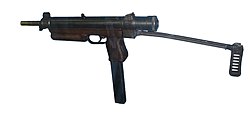
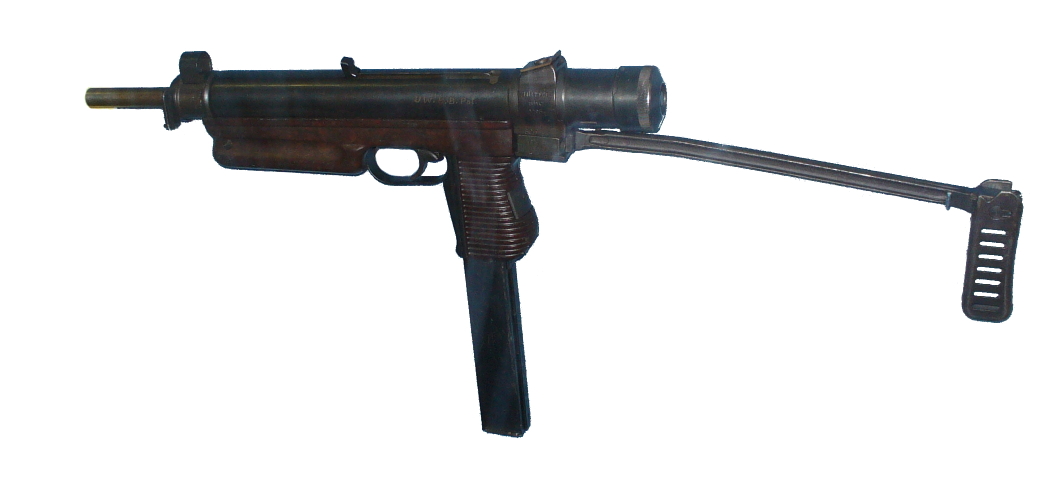
The Sanna-77 was of all metal construction, unlike the plastic framed Kommando LDP, and has the magazine in the grip and a folding metal stock. The front sight was hooded and the cocking handle located high on the left side of the receiver. The Sanna-77 is not really a submachine gun, being made for civilian use only and therefore, due to legal restrictions, only available in the semi-auto mode of fire. It is therefore better termed a pistol-caliber carbine rather than a submachine gun.

See also

[edit]

References

[edit]
Revisions and contributorsEdit on WikipediaRead on Wikipedia
from Grokipedia
The Sanna 77 is a semi-automatic chambered in , developed in as an unlicensed derivative of the Czechoslovak Sa 25 submachine gun. Introduced in 1978 by Dan Pienaar Enterprises in , it evolved from earlier Rhodesian productions known as the GM-15 (semi-automatic) and GM-16 (select-fire), which were manufactured by GM Steel to equip security forces amid sanctions during the . The design incorporates a blowback-operated mechanism with an , a folding stock, and a 40-round detachable box magazine, resulting in an unloaded weight of 2.8 kilograms and an overall length of 650 millimeters (450 millimeters with stock collapsed). Production continued until approximately 1983, with several hundred units made primarily for civilian and markets, though South African military trials revealed reliability issues, limiting its adoption.

Origins and Development

Rhodesian Precursors

The Sanna 77 originated from Rhodesian efforts to produce indigenous small arms amid sanctions imposed in the 1960s and intensified during the (1964–1979), which restricted imports of military equipment. In response, the GM Steel company in manufactured the GM-15 (also known as GM Model 15) starting in the mid-1970s, a direct copy of the Czechoslovak Sa vz. 25 (Samopal vz. 25) chambered in . The Sa vz. 25 design, developed in the late 1940s but produced into the 1950s, featured a blowback-operated mechanism and similar to the Israeli , which influenced its adoption for close-quarters combat roles. Rhodesian engineers reverse-engineered available vz. 25 samples, enabling local fabrication using limited industrial capabilities to equip security forces, including the , which reported the GM-15's effectiveness in bush warfare despite rudimentary production standards. Production of the GM-15 remained small-scale, focused on military needs rather than export, with estimates of several hundred units assembled before Rhodesia's transition to in 1980 disrupted operations. This Rhodesian initiative laid the groundwork for the Sanna 77, as designs and expertise transferred to , where similar embargo pressures from apartheid-era sanctions drove further development.

South African Design and Production

Following the cessation of production in amid escalating conflict, manufacturing of the Sanna 77 was relocated to , where it entered serial production in the late 1970s. Dan Pienaar Enterprise Ltd, based in , handled fabrication from 1977 to 1980, producing a semi-automatic version marketed primarily as a for civilian and police use. The , attributed to Dan Pienaar, drew from the Czech Sa 25 —a blowback-operated weapon inspired by the —but incorporated modifications such as a polymer stock in place of earlier metal variants and restrictions to semi-automatic fire only, limiting its tactical utility compared to full-automatic predecessors. The South African iteration featured a cylindrical receiver, collapsible , and , with specifications including a 9x19mm Parabellum chambering, 40-round magazine capacity, unloaded weight of 2.8 kilograms, overall length of 650 mm (450 mm with stock collapsed), and a 290 mm barrel. Intended to address local security needs under arms embargoes, the weapon underwent trials with the but failed to gain adoption due to reliability issues, including frequent stock breakage and subpar performance. Production remained limited, ceasing by the early amid lack of demand and competition from more robust alternatives, though examples persist in South African collections despite their tarnished reputation.

Technical Design

Specifications and Features

The Sanna 77 is a semi-automatic chambered in ammunition, employing a blowback operating system derived from the Czech Sa vz. 25 design. Its action relies on the rearward force of the fired cartridge to cycle the open-bolt mechanism, ejecting the spent case and loading a new round from the magazine upon trigger release. Unlike the full-automatic capable vz. 25, the Sanna 77 has its selective-fire capability removed to comply with civilian market restrictions, limiting operation to single-shot fire only. Key features include a side-folding wire for compactness, reducing overall length from 650 mm extended to 450 mm collapsed, and a fixed barrel of 290 mm length to enhance accuracy over shorter SMG barrels. The weapon uses for aiming, with a hooded well accepting distinctive wedge-shaped detachable box magazines typically holding 40 rounds, though manufacturers recommended loading 30 rounds to optimize balance and reduce . A notable safety aspect is the open-bolt design, which ensures that removing the clears any round from the chamber, preventing accidental discharge. The South African production model incorporated a variant for improved durability, though early units suffered from reliability issues such as stock breakage.
SpecificationValue
Caliber9×19mm Parabellum
ActionBlowback, semi-automatic only
Overall Length (stock extended/collapsed)650 mm / 450 mm
Barrel Length290 mm
Weight (unloaded)2.8 kg
Magazine Capacity40 rounds (detachable box)
SightsIron
Effective RangeUp to 300 m (sighted)

Operating Mechanism

The Sanna 77 operates on a simple blowback principle, utilizing an open-bolt mechanism in semi-automatic fire only. The bolt remains in the rearward position when ready to fire, held by the sear engaging the trigger mechanism. Upon pulling the trigger, the sear releases the bolt, allowing it to be driven forward under spring tension, where it strips a 9×19mm Parabellum cartridge from the box magazine, chambers it, and the fixed firing pin integral to the bolt strikes the primer to initiate firing. The subsequent pressure from expanding propellant gases propels the non-locking bolt rearward, extracting the empty case via the extractor claw, which then strikes the ejector and is expelled through the ejection port. As the bolt travels rearward, it compresses the recoil springs against the receiver's rear buffer, after which the springs expand to return the bolt to the open position, where the sear recaptures it, preventing accidental discharge and preparing for the next trigger pull. This open-bolt design, derived from the Czech Sa 25 submachine gun, relies on the mass and spring tension of the bolt to delay opening until chamber pressure subsides, ensuring reliable cycling with the low-powered 9mm cartridge. No provision exists for selective fire, limiting operation to single shots per trigger actuation for civilian and legal compliance.

Operational Employment

Military and Security Applications

The Sanna 77 traces its operational roots to , where it was initially produced as the GM-15 (semi-automatic) and GM-16 (full-automatic) variants by GM Steel for the amid the Bush War in the 1970s. These weapons addressed local arms shortages under , drawing from captured Czechoslovak Sa vz. 25 submachine guns without formal licensing. Upon relocation of production to in 1977, the semi-automatic Sanna 77 was trialed by the for potential adoption during the Border War but rejected primarily due to reliability concerns and its lack of full-automatic capability, which diminished its tactical utility in combat roles. Production continued until around 1983 by Dan Pienaar Enterprises, yielding several hundred units, though formal military integration remained limited. In security contexts, the Sanna 77 was marketed as a compact "land defence " suitable for rural farmers and isolated homesteads facing guerrilla threats, with restrictions permitting sales primarily to farmers, organizations, and certain authorities. Its high-capacity 40-round magazine and pistol-caliber ammunition aimed to provide for personal defense, though uptake was hampered by design flaws and competition from more reliable alternatives like the . Despite intentions, it saw negligible adoption among police or private firms, with evaluations highlighting insufficient durability for sustained operational demands.

Civilian and Export Use

The Sanna 77 was produced exclusively in semi-automatic configuration to comply with South African legal restrictions on firearms, positioning it as a pistol-caliber rather than a full-automatic . Marketed primarily for domestic applications, including among farmers and rural users, it featured a 40-round capacity and an of approximately 300 meters, with a collapsed length of 450 mm for compact handling. However, adoption was limited due to frequent reliability issues, such as jamming, and criticism that its design offered little tactical advantage over an enlarged , reducing its appeal for both and police buyers. Production by Dan Pienaar Enterprise Ltd occurred from 1978 to 1983, yielding several hundred units sold within by the program's end, though exact figures remain undocumented. Efforts to capture the civilian defense market faltered amid competition from more reliable imported alternatives and the weapon's mechanical shortcomings, leading to its discontinuation without achieving widespread commercial success. Export opportunities were explored but yielded no significant international contracts or operators; the Sanna 77 remained confined to South African domestic circulation, with no verified sales to foreign or markets.

Reception and Assessment

Performance Evaluations

The Sanna 77, a semi-automatic 9mm derived from the Czech Sa vz. 25 , was initially promoted for its compact design and ease of handling in close-quarters scenarios. Marketing materials from the late emphasized a claimed of 300 meters and a lightweight construction of approximately 2.8 kilograms, positioning it as a versatile suitable for security forces. However, these specifications reflected optimistic projections rather than field-verified performance, with the pistol-caliber limiting practical accuracy beyond 50-100 meters due to ballistic drop and wind sensitivity inherent to 9x19mm Parabellum ammunition. Post-production assessments revealed persistent reliability issues, including frequent malfunctions attributed to manufacturing tolerances and material quality in South African production runs from 1978 to 1983. Owners reported problems such as failures to feed, extraction difficulties, and breakage, with virtually all surviving examples exhibiting cracked or failed wooden over time. These defects were linked to production shortcuts, contrasting with the more robust Rhodesian GM-15/16 precursor, and contributed to the weapon's commercial failure despite substantial output. Limited user testing indicated adequate semi-automatic function with full metal jacket ammunition, resolving tumbling issues observed with lead bullets at velocities around 1200 fps, but overall dependability lagged behind contemporaries like the Uzi or Beretta Model 12. Anecdotal reports praised its accuracy for a pistol-caliber carbine in controlled environments, achieving tight groupings at short ranges, yet these were overshadowed by the broader reputation for unreliability in sustained use. No formal military trials yielded quantitative data endorsing superior performance, and legislative restrictions on semi-automatic firearms further curtailed widespread adoption.

Historical Context and Criticisms

The Sanna 77 originated in during the 1970s amid the and international sanctions imposed following the 1965 , which restricted arms imports and spurred local weapon production. Developed by GM Steel as the GM-15 or GM-16, it was a direct copy of the Czechoslovak Sa vz. 25 , reverse-engineered from captured examples to meet the ' need for a simple 9x19mm Parabellum firearm suitable for close-quarters combat. Production tooling was transferred to after 's transition to in 1980, where it was manufactured as the semi-automatic-only Sanna 77 by Dan Pienaar Enterprise Ltd in , with serial production running from approximately 1977 to 1980. In , the Sanna 77 was trialed by the during a period of its own arms embargoes under apartheid, but it was not adopted for due to its limitations as a semi-automatic lacking full-automatic fire capability, which diminished its utility in tactical scenarios compared to established submachine guns. The design's emphasis on affordability and simplicity for civilian markets, such as farm defense, failed to generate significant sales, compounded by restrictive licensing laws and competition from more reliable imported alternatives where possible. Criticisms of the Sanna 77 centered on its poor quality and reliability issues, including frequent breakage and inconsistent performance attributable to rudimentary production methods transferred from Rhodesian facilities. South African evaluations highlighted its unreliability in field conditions, leading to rejection despite initial interest in a locally producible pistol-caliber . users reported similar problems, such as loose barrels causing bolt misalignment and feeding failures, which tarnished its reputation and contributed to limited production runs ending by the early 1980s, marking it as a commercial failure without widespread adoption.
Add your contribution
Related Hubs
User Avatar
No comments yet.