Hubbry Logo
SaucierSaucierMain
Open search
Saucier
Community hub
Saucier
logo
8 pages, 0 posts
0 subscribers
Be the first to start a discussion here.
Saucier
Saucier
from Wikipedia

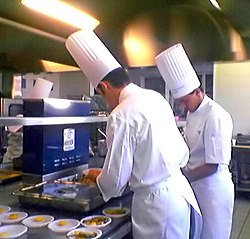
Sauciers-in-training

A saucier (French pronunciation: [sosje]) or sauté chef is a position in the classical brigade style kitchen. It can be translated into English as sauce chef. In addition to preparing sauces, the saucier prepares stews, hot hors d'œuvres, and sautés food to order. Although it is often considered the highest position of the station cooks, the saucier is typically still tertiary to the chef and sous-chef.[1][2]

Escoffier definition

[edit]

In Georges Auguste Escoffier's system of the classic kitchen brigade, outlined in his Guide Culinaire, the saucier is "responsible for all sautéed items and most sauces".[2][additional citation(s) needed]

See also

[edit]

References

[edit]
Revisions and contributorsEdit on WikipediaRead on Wikipedia
from Grokipedia
Saucier is an unincorporated community and census-designated place (CDP) in Harrison County, Mississippi, United States, situated approximately 20 miles (32 km) north of Gulfport along Mississippi Highway 15. It is part of the Gulfport–Biloxi Metropolitan Statistical Area and recorded a population of 1,077 at the 2020 United States census. The community derives its name from the Saucier family, early French settlers whose ancestor Jean Baptiste Saucier arrived on the Mississippi Gulf Coast in 1699 as part of Pierre Le Moyne d'Iberville's expedition to establish the French colony of Louisiana. Originally settled in the early 1800s amid the region's pine forests, Saucier emerged as a lumber town in the late 19th century with the arrival of the Gulf and Ship Island Railroad, which facilitated logging operations and early economic growth; the area was significantly impacted by Hurricane Katrina in 2005. Today, Saucier retains a rural-suburban character, blending agricultural heritage with modern residential and recreational development while facing pressures from regional urbanization. The local economy historically centered on timber but has diversified to include tourism, particularly golf, with two world-class courses: Fallen Oak Golf Course, a Tom Fazio-designed layout opened in 2006 and often ranked among the top public courses in the United States for its scenic hardwoods and challenging terrain, and Grand Bear Golf Club, a Jack Nicklaus Signature design from 1999 set within the De Soto National Forest. These facilities, both accessible to the public, draw visitors and contribute significantly to the area's appeal as a golf destination on the Mississippi Gulf Coast. Outdoor recreation is another hallmark, highlighted by the Tuxachanie Hiking Trail, an 11.9-mile path through the De Soto National Forest offering access to Airey Lake and diverse ecosystems. The community's planning efforts, as outlined in the 2006 Saucier Town Plan adopted by Harrison County, emphasize sustainable growth through compact, walkable development, projects, and preservation of its rural identity, including protections for natural features like the Wolf River watershed. Despite its small size, Saucier benefits from proximity to Gulfport-Biloxi amenities while maintaining a household income of around $50,720 and a median age of 41.4 as of 2023. Historical sites, such as remnants of early sawmills and family homesteads tied to the Saucier lineage, underscore its role as one of the Gulf Coast's enduring pioneer settlements.

Definition and Origins

Escoffier's Definition

Auguste Escoffier formalized the saucier position within the classical kitchen brigade in his seminal 1903 work Le Guide Culinaire, codifying it as a dedicated role responsible for the preparation of all sautéed items, most sauces, stocks, and related sautés. This specialization emerged from Escoffier's efforts to streamline professional kitchens for greater efficiency, drawing on his experiences at renowned establishments like the Savoy Hotel and the Ritz in Paris. By assigning these tasks to a single station, Escoffier elevated the saucier's status as a pivotal figure in achieving culinary precision and harmony. The term saucier derives from French, directly translating to "sauce chef" or "sauté chef," reflecting its core focus on liquid enhancements and quick-cooking techniques central to French . Escoffier positioned this as a highly skilled station in the brigade de cuisine, often second only to the and in prestige due to the technical demands involved. He regarded sauces as fundamental to French cooking, describing their preparation as the of the , with the saucier tasked as the expert custodian of this art. Initially, under Escoffier's delineation, the saucier's scope was limited to hot preparations, encompassing reductions, emulsions, and stocks used in warm applications, while excluding cold sauces and butters to maintain clear delineations within the . This focused remit underscored the role's emphasis on heat-based transformations, such as building complex flavor bases from and , ensuring no overlap with other stations like the entremetier for cold items. Such boundaries allowed for mastery in a niche that Escoffier deemed essential for elevating simple ingredients to refined dishes.

Historical Roots in French Cuisine

The role of the saucier emerged from the sophisticated culinary traditions of 18th- and 19th-century French kitchens, where the preparation of intricate sauces formed a cornerstone of , particularly in royal and aristocratic settings. During this period, chefs in noble households dedicated significant effort to crafting complex reductions and emulsions that elevated dishes for the elite, drawing on techniques refined over centuries but gaining prominence amid the opulence of pre-Revolutionary courts. Influenced by earlier innovators like , who introduced foundational sauce methods in the 17th century, these practices evolved into a specialized focus by the late as French gastronomy emphasized refinement and artistry. A pivotal figure in this development was , whose work in the early 19th century formalized the emphasis on elaborate sauces within professional cooking. Working in the service of diplomats and royalty, such as Charles-Maurice de Talleyrand, Carême specialized in creating layered sauce compositions that showcased technical mastery, often employing reductions and infusions to complement grand presentations. In his seminal five-volume treatise L'Art de la Cuisine Française (1833–1847), he codified four foundational "mother sauces"—velouté, béchamel, , and espagnole—providing a systematic framework that influenced subsequent generations of chefs and highlighted sauces as essential to French culinary identity. This informal specialization in sauce-making became a hallmark of practitioners, who operated as experts in royal kitchens, prioritizing flavor depth and balance for aristocratic banquets. The transition toward a more defined saucier role accelerated in the 19th century with the proliferation of professional restaurants in , spurred by the French Revolution's dismantling of aristocratic monopolies on . As former court chefs like those at establishments such as the Frères Provençaux adapted their skills to public venues, the demands of serving larger clientele amid urban growth and food industrialization necessitated greater division of labor, elevating sauce expertise as a critical, standalone proficiency in bustling commercial kitchens. This shift marked a departure from the arrangements of private households, fostering environments where preparation required dedicated attention to maintain consistency and innovation in a competitive culinary landscape. The standardization of the saucier position culminated in the late 19th century through the innovations of , who built upon Carême's foundations during his leadership at London's (1890–1899) and Paris's Ritz Hotel (from 1898). Escoffier refined kitchen organization into a hierarchical brigade system, designating the saucier as a key station responsible for sauces and related preparations, thereby formalizing the role to enhance efficiency in high-volume luxury settings. This structured approach transformed the informal sauce specialization of earlier eras into a professional cornerstone of modern .

Role in the Kitchen

Responsibilities and Duties

The saucier, as a key station chef in a professional brigade, is primarily responsible for preparing mother sauces such as béchamel and velouté, along with and gravies, all made from scratch through processes like and emulsions to ensure foundational flavor bases for multiple dishes. This involves simmering bones, , and aromatics to create robust , then transforming them into complex gravies and emulsions that maintain consistent texture and taste across service periods. Beyond sauces, the saucier's duties extend to sautéing proteins like meats, , and , as well as , to order during peak service, while also creating hot hors d'oeuvres such as grilled scallops and assembling stews or braises that integrate with the kitchen's overall menu. These tasks require precise timing to align with orders from the expediter, including techniques like flambéing or deglazing to enhance flavors without overcooking ingredients. In , the saucier times production to synchronize with service demands, constantly tasting sauces for balance in acidity, richness, and seasoning before collaborating with other stations—such as the garde-manger or rôtisseur—for final plating and presentation. This coordination occurs within the brigade system, where the saucier reports to the while contributing to organization and menu development for pairings. Essential equipment includes saucier pans with sloped sides for efficient , whisks for emulsifying, and high-control burners to manage heat precisely during or . Key challenges for the saucier involve maintaining consistency in high-volume settings, where emulsions like hollandaise risk breaking under fluctuating temperatures or rushed adjustments, demanding a refined and stamina amid the fast-paced demands of a busy . Adherence to protocols while multitasking further intensifies the role, often described as one of the most demanding stations due to its direct impact on dish quality.

Position in the Brigade System

In Escoffier's brigade de cuisine, the saucier occupies a key leadership role as a , reporting to the and often regarded as one of the most prestigious and demanding station heads due to the critical nature of their output. This placement underscores the saucier's status among the line positions, where it oversees junior staff such as commis cooks at the sauce station. The saucier reports directly to the for instructions on production needs and execution, while supplying essential sauces, stocks, and accompaniments to interdependent stations such as the grillardin (roast ) for meat dishes or the poissonnier ( ) for seafood preparations. During peak service periods, the saucier coordinates closely with these stations to synchronize timing, ensuring that sauces arrive hot and precisely balanced to elevate plated dishes without delaying the pass. As a core "line" position, the saucier bridges the preparatory phases of with real-time execution, maintaining high visibility and accountability during service when sauce quality can make or break a meal's success. In large, traditional brigades, the saucier role remains distinct and specialized; however, in smaller modern kitchens, it frequently merges with the sauté chef responsibilities to optimize staffing efficiency. In adaptations beyond classic French kitchens, such as American or fusion establishments, the saucier often leads efforts in sauce innovation, blending traditional techniques with global flavors to meet diverse menu demands.

Skills and Techniques

Sauce Preparation Methods

Sauce preparation begins with fundamental techniques that form the backbone of French culinary practice, as codified by Auguste Escoffier in Le Guide Culinaire. Building a roux involves cooking equal parts flour and fat—typically butter—over medium heat, stirring constantly to achieve the desired color and eliminate the raw flour taste; a white roux is cooked briefly for béchamel and velouté, while a brown roux requires longer cooking for espagnole. Clarifying stocks entails simmering bones and aromatics, skimming impurities to yield a clear liquid base free of foam and sediment, essential for velouté and espagnole to ensure transparency and purity. Creating liaisons, often a mixture of egg yolks and heavy cream, adds richness and smoothness without coagulation; the liaison is tempered by gradually incorporating hot sauce into it before returning to the pan off heat. The five mother sauces, as defined by Escoffier, serve as foundational elements from which hundreds of derivatives are made, each with distinct ingredients and processes emphasizing precision in heat and incorporation. Béchamel, a milk-based , starts with a of 2 ounces and 2 ounces ; warm 1 quart is whisked in gradually, then simmered on low heat for 10-15 minutes until thickened and the taste dissipates, seasoned simply with salt, , and . Velouté, a stock-based , uses a with 1 quart white stock (veal, chicken, or ), (1 ounce each , , ), and a of herbs; the mixture simmers for 1 hour, then strains through a fine mesh for clarity. Espagnole, the brown stock foundation for hearty reductions, begins with 8 ounces brown dissolved in 4 quarts brown stock, incorporating 1 pound and tomatoes; it simmers 2 hours, skims, reduces to 2 quarts, and strains. Hollandaise, an egg-emulsified , clarifies ½ cup by heating until frothy and separating solids; 2 egg yolks and 1 tablespoon lemon juice are whisked over a double boiler until ribboned, then is drizzled in slowly over 10-15 minutes, seasoned with and salt. , vegetable-forward, sweats 1.5 ounces each carrots and onions in 2 ounces with herbs, adds 1 ounce for , then 28 ounces crushed tomatoes and 1 cup stock; it simmers 90 minutes and strains for smoothness. Advanced techniques elevate these bases to refined finishes. Monte au beurre involves whisking cold diced into a hot, reduced off heat, incorporating up to equal parts butter for gloss and without separation, as seen in velouté derivatives. Straining through a or fine removes solids post-simmering, ensuring velvety texture in all mother sauces. Balancing acidity and flavor occurs via reductions, where liquids concentrate by evaporating 50-75% over low heat, adjusting with lemon or vinegar to harmonize richness. Common pitfalls in sauce preparation include in emulsions like hollandaise, caused by excessive heat; recovery involves whisking in 1 tablespoon boiling water drop-by-drop or starting with a fresh and gradually blending the broken mixture. Separation in reductions or -based sauces from overboiling can be fixed by off-heat incorporation of cold butter or while whisking vigorously. Lumpy in béchamel or velouté arises from uneven integration; prevent by sifting and adding hot liquid slowly, or blend lumps post-cooking with an immersion tool. Ingredient sourcing is paramount for authenticity and quality, prioritizing fresh, high-quality components such as bones roasted for brown in bases, which reduce equal parts espagnole and by half for concentrated . Unsalted butter, whole milk, and ripe tomatoes ensure purity, avoiding preservatives that alter flavor profiles.

Sautéing and Accompaniment Preparation

In the saucier station, sautéing involves high-heat cooking of proteins such as meats, , and , as well as , using minimal fat like or in a large pan to achieve a quick sear and develop flavorful through the . This technique requires precise timing to prevent overcooking, often starting with small, evenly cut ingredients like thinly sliced meats or diced such as onions and peppers, which are tossed or flipped once for even browning. Following the sear, the pan is deglazed with an acidic liquid like wine or stock to lift the browned bits () and incorporate them into a simple pan base, enhancing the dish's depth without relying on complex reductions. Beyond proteins, sauciers prepare accompaniments that complement main dishes, including small stews like beef or , which are simmered briefly to concentrate flavors and served as sides or garnishes. These may involve finely diced vegetables in a cut—uniform 2-3 mm cubes used for subtle flavor integration—or herb-infused butters, such as those compounded with or , to add freshness and richness to plates. Glazes made from reduced sugars and acids, or quick marinades for tenderizing proteins, further exemplify these elements, ensuring they harmonize with the overall meal presentation. Sauciers also handle hot hors d'oeuvres, which are small, warm appetizers prepared rapidly to align with service timing, such as sautéed slices seared for crisp exteriors or filled with seasoned mixtures and quickly pan-fried. Examples include grilled scallops briefly cooked in butter or miniature beef Wellingtons sautéed to medium-rare, emphasizing speed and portion control to maintain hot service temperatures. These items often integrate sauté elements with brief finishes, where pan juices are deglazed and lightly bound with a mother sauce like velouté for cohesion. Essential tools for these tasks include the sauté pan (or saucier pan), featuring sloped sides for easy tossing and reducing liquids, along with for handling hot items and long-handled spoons for deglazing. Safety protocols emphasize control, such as maintaining moderate flame heights to prevent flare-ups from fats, and using heat-resistant gloves during high-heat operations, all within the structured brigade system to minimize risks during multitasking.

Notable Figures

Pioneering Sauciers

Marie-Antoine Carême (1784–1833), often regarded as the precursor to the modern saucier, laid the groundwork for haute cuisine through his innovative sauce classifications and elaborate presentations while serving European royalty during the Napoleonic era. Working for figures such as diplomat Charles Maurice de Talleyrand-Périgord and Emperor Napoleon Bonaparte, Carême created menus emphasizing seasonal ingredients and precision, including a lavish wedding cake for Napoleon's 1810 marriage to Marie-Louise of Austria. He documented over 100 sauces in works like L'Art de la Cuisine Française au Dix-Neuvième Siècle, categorizing four foundational "grandes sauces"—béchamel, velouté, espagnole, and allemande—from which countless derivatives could be made, transforming sauces into structured elements of fine dining. Carême's pièces montées, towering edible sculptures of classical temples, pyramids, and ruins crafted from spun sugar, marzipan, and pastry, further elevated culinary artistry, reaching heights of up to four feet and symbolizing the fusion of architecture and gastronomy. Auguste Escoffier (1846–1935), who began his career as a saucier, formalized the role within professional kitchens and streamlined sauce preparation for broader application. Drawing from his experience at establishments like the Grand Hôtel in and London's , Escoffier integrated the saucier into his brigade de cuisine system, a hierarchical structure that assigned specialized duties to enhance efficiency and consistency. In Le Guide Culinaire (1903), he refined Carême's elaborate framework by reducing the complex array of over 100 sauces to five essential "mother sauces"—béchamel, velouté, espagnole, , and hollandaise—reclassifying as a velouté derivative and adding for versatility. This simplification made sauce-making more systematic and accessible, influencing menu innovations at high-profile venues where Escoffier oversaw operations. Charles Ranhofer (1836–1896), a at New York's restaurant from 1862 to 1896, adapted saucier techniques to American by blending European precision with local ingredients and preferences. Trained in and at III's court, Ranhofer introduced sophisticated French sauce methods to U.S. audiences through elaborate menus featuring items like , supported by a vast wine selection and seasonal adaptations. His 1894 tome The Epicurean, a 1,100-page compendium with 3,500 recipes, detailed analytical approaches to sauce preparation and variations, making French culinary standards practical for transatlantic contexts and setting benchmarks for establishments. The contributions of Carême, Escoffier, and Ranhofer shifted sauces from mere utilitarian accompaniments to central, artistic components of cuisine, standardizing techniques that permeated global and inspired enduring professional hierarchies. By codifying foundational recipes and integrating them into structured kitchen roles, they fostered a legacy of innovation that elevated French culinary influence worldwide.

Modern Sauciers

In contemporary kitchens, the role of the saucier has evolved from a rigidly defined station in Escoffier's system to a more integrated position, often embodied by executive chefs or specialists who innovate on sauce techniques while adapting to modern demands for lighter, more precise flavors. While traditional sauciers focused on classic mother and , today's practitioners emphasize extraction methods, emulsions, and global influences to create versatile accompaniments that enhance sustainability and health-conscious dining. This shift reflects broader trends in French and international , where sauces serve as the "" of a dish, providing emotional and textural depth without heavy reliance on or . Yannick Alléno, a three-Michelin-starred chef renowned for his work at in , exemplifies modern sauce innovation through techniques like extraction and cryo-concentration. In extraction, Alléno infuses ingredients such as celery root or fish bones at low temperatures (84–88°F) to draw out pure flavors, followed by cryo-concentration, where the liquid is frozen in a and slowly thawed to remove water, yielding intensely clear essences that can be repeated for amplified purity. These methods allow him to reinterpret classics, such as a modern poulette using fish carcasses and albumin finished with butter, elevating sauces as central elements in while avoiding thickeners for lighter profiles. Alléno's approach has influenced global culinary education, including a dedicated sauce-making course at Institut , underscoring his impact on contemporary technique. Arnaud Donckele, at the three--starred Plénitude in , builds on Alléno's foundations by treating sauces as dynamic narratives, employing cryo-extraction to craft light, floral broths, emulsions, and sabayons served tableside from carafes for interactive dining. His sauces, often vegetable-forward and precisely balanced, demonstrate how modern sauciers prioritize clarity and , as seen in his reinvention of emulsion-based derivatives that pair with or . Similarly, John Williams at The Ritz London revives opulent classics like sauce périgourdine, blending , , , and stock for luxurious depth, earning two stars in 2025 and signaling a resurgence of sauce-centric French cooking. These figures highlight the saucier's enduring prestige, adapted for today's emphasis on innovation and refinement.

References

Add your contribution
Related Hubs
User Avatar
No comments yet.