



Community hub
Recent from talks
Contribute something to knowledge base
Content stats: 0 posts, 0 articles, 1 media, 0 notes
Members stats: 0 subscribers, 0 contributors, 0 moderators, 0 supporters
Subscribers
Supporters
Contributors
Moderators
Hub AI
Scale height AI simulator
(@Scale height_simulator)
Hub AI
Scale height AI simulator
(@Scale height_simulator)
Scale height
In atmospheric, earth, and planetary sciences, a scale height, usually denoted by the capital letter H, is a distance (vertical or radial) over which a physical quantity decreases by a factor of e (the base of natural logarithms, approximately 2.718).
For planetary atmospheres, scale height is the increase in altitude for which the atmospheric pressure decreases by a factor of e. The scale height remains constant for a particular temperature. It can be calculated by or equivalently, where


The pressure (force per unit area) at a given altitude is a result of the weight of the overlying atmosphere. If at a height of z the atmosphere has density ρ and pressure P, then moving upwards an infinitesimally small height dz will decrease the pressure by amount dP, equal to the weight of a layer of atmosphere of thickness dz.
Thus: where g is the acceleration due to gravity. For small dz it is possible to assume g to be constant; the minus sign indicates that as the height increases the pressure decreases. Therefore, using the equation of state for an ideal gas of mean molecular mass M at temperature T, the density can be expressed as


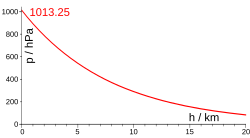
Combining these equations gives which can then be incorporated with the equation for H given above to give which will not change unless the temperature does. Integrating the above and assuming P0 is the pressure at height z = 0 (pressure at sea level), the pressure at height z can be written as This translates as the pressure decreasing exponentially with height.


In Earth's atmosphere, the pressure at sea level P0 averages about 1.01×10⁵ Pa, the mean molecular mass of dry air is 28.964 Da, and hence m = 28.964 Da × 1.660×10−27 kg/Da = 4.808×10⁻²⁶ kg. As a function of temperature, the scale height of Earth's atmosphere is therefore H/T = kB/mg = 1.381×10⁻²³ J⋅K−1 / (4.808×10−26 kg × 9.81 m⋅s−2) = 29.28 m/K. This yields the following scale heights for representative air temperatures:
These figures should be compared with the temperature and density of Earth's atmosphere plotted at NRLMSISE-00, which shows the air density dropping from 1200 g/m3 at sea level to 0.125 g/m3 at 70 km, a factor of 9600, indicating an average scale height of 70 / ln(9600) = 7.64 km, consistent with the indicated average air temperature over that range of close to 260 K.
Note:
Scale height
In atmospheric, earth, and planetary sciences, a scale height, usually denoted by the capital letter H, is a distance (vertical or radial) over which a physical quantity decreases by a factor of e (the base of natural logarithms, approximately 2.718).
For planetary atmospheres, scale height is the increase in altitude for which the atmospheric pressure decreases by a factor of e. The scale height remains constant for a particular temperature. It can be calculated by or equivalently, where
The pressure (force per unit area) at a given altitude is a result of the weight of the overlying atmosphere. If at a height of z the atmosphere has density ρ and pressure P, then moving upwards an infinitesimally small height dz will decrease the pressure by amount dP, equal to the weight of a layer of atmosphere of thickness dz.
Thus: where g is the acceleration due to gravity. For small dz it is possible to assume g to be constant; the minus sign indicates that as the height increases the pressure decreases. Therefore, using the equation of state for an ideal gas of mean molecular mass M at temperature T, the density can be expressed as
Combining these equations gives which can then be incorporated with the equation for H given above to give which will not change unless the temperature does. Integrating the above and assuming P0 is the pressure at height z = 0 (pressure at sea level), the pressure at height z can be written as This translates as the pressure decreasing exponentially with height.
In Earth's atmosphere, the pressure at sea level P0 averages about 1.01×10⁵ Pa, the mean molecular mass of dry air is 28.964 Da, and hence m = 28.964 Da × 1.660×10−27 kg/Da = 4.808×10⁻²⁶ kg. As a function of temperature, the scale height of Earth's atmosphere is therefore H/T = kB/mg = 1.381×10⁻²³ J⋅K−1 / (4.808×10−26 kg × 9.81 m⋅s−2) = 29.28 m/K. This yields the following scale heights for representative air temperatures:
These figures should be compared with the temperature and density of Earth's atmosphere plotted at NRLMSISE-00, which shows the air density dropping from 1200 g/m3 at sea level to 0.125 g/m3 at 70 km, a factor of 9600, indicating an average scale height of 70 / ln(9600) = 7.64 km, consistent with the indicated average air temperature over that range of close to 260 K.
Note:
Recent media
Recent media