
Hubbry Logo
Schelling's model of segregationSchelling's model of segregationMain
Open search
Schelling's model of segregation
Community hub
Schelling's model of segregation
logo
7 pages, 0 posts
0 subscribers
Be the first to start a discussion here.
Schelling's model of segregation
from Wikipedia

Schelling's model of segregation is an agent-based model developed by economist Thomas Schelling.[1][2] Schelling's model does not include outside factors that place pressure on agents to segregate such as Jim Crow laws in the United States, but Schelling's work does demonstrate that having people with "mild" in-group preference towards their own group could still lead to a highly segregated society via de facto segregation.[3][4][5]

Model

[edit]
Simulation of the model. Agents will move at each step until the fraction of neighbors that are from their own group is greater than or equal to . For equal sized populations, leads to the groups segregating themselves.

The original model is set in an grid. Agents are split into two groups and occupy the spaces of the grid and only one agent can occupy a space at a time. Agents desire a fraction of their neighborhood (in this case defined to be the eight adjacent agents around them) to be from the same group. Increasing corresponds to increasing the agent's intolerance of outsiders.

Each round consists of agents checking their neighborhood to see if the fraction of neighbors that matches their group—ignoring empty spaces—is greater than or equal . If then the agent will choose to relocate to a vacant spot where . This continues until every agent is satisfied. Every agent is not guaranteed to be satisfied and in these cases it is of interest to study the patterns (if any) of the agent dynamics.

While studying populations dynamics of two groups of equal size, Schelling found a threshold such that leads to a random population configuration and leads to a segregated population. The value of was approximately . This points to how individuals with even a small amount of in-group preference can form segregated societies. There are different parameterizations and variants of the model and a 'unified' approach is presented in [6] allowing the simulations to explore the thresholds for different segregation events to occur.

Physical model analogies

[edit]

There have been observations that the fundamental dynamics of the agents resemble the mechanics used in the Ising model of ferromagnetism.[7][8][9][10] This primarily relies on the similar nature in which each occupied grid location calculates an aggregate measure based upon the similarities of the adjacent grid cells. If each agent produces a satisfaction based upon their homophilic satisfaction threshold as then the summation of those values can provide an indication for the segregation of the state that is analogous to the clustering of the aligned spins in a magnetic material. If each cell is a member of a group , then the local homogeneity can be found via

where the 1-d position of can be translated into i,j coordinates of ni,nj. Then the state of whether the agent moves to a randomly empty grid cell position or 'remains' is defined by:

Agents that have their local homogeneity constraint satisfied 'remain' in that position between iterations. The total for the grid is plotted as an average over 500 simulations.

Each agent produces a binary value, so that for each grid configuration of agents of both groups, a vector can be produced of the remain due to satisfaction or not. The overall satisfaction from the remain states of all the agents can be computed;.
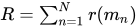
then provides a measure for the amount of homogeneity (segregation) on the grid and can be used with the maximum possible value (total sum of agents) as a 'density' of segregation over the simulation of movements as is performed in.[6][11] Following the approach of [9] can be interpreted as a macrostate whose density can be estimated by sampling via the Monte Carlo method the grid space from the random initialisations of the grid to produce a calculation of the entropy; This allows a trace of the entropy to be computed over the iterations of the simulation as is done with other physical systems.


Broader model considerations

[edit]

The canonical Schelling model does not consider variables which may affect the agent's ability to relocate positions in the grid. The work of Hatna and Benenson[3] investigates a model extension where the utility available to agents to move governs this action. It can explain some of the patterns seen where groups do not segregate due to the financial barrier homogeneous zones produce as a result of high demand. The consideration of the financial aspect is also investigated in two other papers, in 2012[12] and 2009.[13] The work of Mantzaris[10] further develops this concept of the importance of the monetary factor in the decision making, and uses it to extend the model with a dual dynamic where agents radiate their income store whenever a movement is made. This also provides a means to produce a more complete model where the trace of the entropy is non-decreasing and adds support that social systems obey the Second law of thermodynamics.[14]

Schelling's model has also been studied from a game-theoretic perspective: In Schelling games, agents strategically strive to maximize their utilities by relocating to a position with the highest fraction of neighboring agents from the same group.[15][16]

See also

[edit]

References

[edit]
Revisions and contributorsEdit on WikipediaRead on Wikipedia
from Grokipedia
Schelling's model of segregation is a spatial agent-based developed by economist Thomas C. Schelling to demonstrate how mild individual preferences for proximity to similar others—defined by traits such as , race, or —can spontaneously generate extensive residential segregation, even when no agent seeks total isolation from dissimilar types. Introduced in Schelling's 1969 paper "Models of Segregation" and elaborated in his 1971 work "Dynamic Models of Segregation," the framework employs simple rules: agents occupy positions on a line, circle, or grid and relocate to vacant spots if the local proportion of similar neighbors falls below a personal tolerance threshold, often set modestly above 20-50%. This local decision-making amplifies through chain reactions, producing clustered outcomes akin to observed urban patterns, with simulations revealing "tipping points" where minor demographic shifts trigger rapid homogenization. The model's counterintuitive insight—that aggregate segregation emerges from decentralized, non-malicious choices—has profoundly influenced fields like and , underscoring causal mechanisms of in social systems over exogenous forces like overt . Empirical studies corroborate tipping-like dynamics in real neighborhoods, where white population outflows accelerate beyond certain minority shares, aligning with the model's predictions despite debates over preference strength and institutional factors.

Origins and Formulation

Historical Context

, an economist and game theorist at , formulated his initial models of segregation in the late 1960s, a period marked by intense scrutiny of persistent racial residential patterns in the United States despite legal advancements in civil rights. The and the Fair Housing Act of 1968 aimed to prohibit discrimination in housing, yet urban areas exhibited enduring separation along racial lines, exemplified by phenomena such as from cities amid events like the 1965 and the 1967 Detroit uprising, which highlighted tensions over integration and neighborhood stability. Schelling's inquiry arose from observations that segregation often persisted without evidence of widespread individual desires for total isolation, challenging explanations reliant solely on institutionalized barriers or explicit . Schelling first outlined his ideas in a May 1969 RAND Corporation memorandum titled "Models of Segregation," later published in the American Economic Review that year, where he used simple spatial analogies—like checkers on a board—to illustrate how agents with even mild tolerances for dissimilar neighbors could produce clustered outcomes. This work built on his broader interest in how micro-level decisions aggregate into unintended macro phenomena, a theme central to his contributions in strategic analysis during the Cold War era, including nuclear deterrence models. The 1969 formulation emphasized bounded-neighborhood effects, reflecting contemporary concerns with urban dynamics where proximity influenced perceptions of compatibility. In 1971, Schelling expanded the framework in "Dynamic Models of Segregation," published in the Journal of Mathematical Sociology, introducing iterative processes that simulated relocation over time and quantified tipping points where small shifts in preference thresholds triggered rapid sorting. This development coincided with academic shifts toward computational and agent-based approaches to social phenomena, influenced by earlier spatial models like those of James Sakoda in the and , though Schelling's version gained prominence for its parsimony and applicability to real-world policy debates on housing integration. The model's historical significance lies in privileging individual agency and preference-driven causality over purely structural accounts, aligning with empirical patterns of self-selection observed in post-war and ethnic enclaves.

Initial Development and Publication

Thomas Schelling, an economist at Harvard University, developed the segregation model in the late 1960s as part of his broader exploration of how individual behaviors aggregate into unintended social patterns. Motivated by observations of persistent residential segregation in American cities despite stated preferences for integration, Schelling constructed simple abstract simulations to demonstrate emergent outcomes from local decision rules. He initially tested the model manually using physical aids such as checkerboards, coins, or graph paper to represent agents and neighborhoods, avoiding computational methods due to the era's technological limitations. These tabletop exercises revealed that even modest thresholds for neighborhood similarity—such as agents relocating if fewer than one-third of neighbors shared their type—could produce near-complete segregation from initially mixed configurations. The model received its initial formal publication in 1969 as a research memorandum titled "Models of Segregation" (RM-6694-PR), where Schelling outlined static and preliminary dynamic variants to illustrate tolerance distributions compatible with stable mixtures. This document emphasized the incompatibility of certain profiles with integrated equilibria, using linear and spatial arrangements to simulate based on neighborhood composition. Schelling expanded and refined the framework in a 1971 peer-reviewed article, "Dynamic Models of Segregation," published in the Journal of (Volume 1, Issue 2, pages 143–186). The 1971 paper introduced bounded-neighborhood dynamics, where agents evaluate satisfaction within defined radii and move sequentially to vacant sites, providing analytical and visual evidence of segregation's robustness across parameters like tolerance levels (e.g., 30–50% similarity thresholds yielding segregation indices near 0.75 or higher). This iteration formalized the tipping mechanism, showing how chain reactions of dissatisfaction amplify minor imbalances into polarized distributions.

Model Mechanics

Core Components

Schelling's model operates on a two-dimensional lattice, typically a finite grid such as a , where cells represent residential locations that can be occupied by agents or left vacant. Vacancy rates are commonly set at 25-30% to allow for mobility, with agents initially placed randomly on occupied cells to simulate diverse starting neighborhoods. Agents belong to one of two mutually exclusive groups, often denoted by symbols like stars and zeros or colors such as black and white, with group sizes either equal or imbalanced (e.g., 138 agents total on a 13x16 grid). Each agent possesses a tolerance threshold, defined as the minimum proportion of same-group neighbors required for satisfaction, such as 50% (at least 4 out of 8 neighbors) or lower values like one-third. Neighborhoods are local clusters centered on an agent's cell, usually comprising the eight immediately adjacent cells (a 3x3 excluding the center), though larger radii like 5x5 can be used. Satisfaction is assessed solely by the relative presence of same-group agents in this neighborhood, independent of absolute density or other factors. Dissatisfied agents—those with fewer same-group neighbors than their threshold—relocate to the nearest vacant cell where the neighborhood composition meets their tolerance requirement, without anticipating others' moves. Relocations occur sequentially (e.g., left-to-right or random order) in iterative rounds until equilibrium, where no agent wishes to move further. These elements—grid structure, grouped agents, vacancies, local neighborhoods, thresholds, and relocation rules—form the model's foundation, with parameters like threshold level, group ratio, vacancy percentage, and neighborhood size tunable to explore variations.

Agent Behaviors and Rules

In Schelling's model, agents represent individuals from two distinct demographic groups, such as differing ethnic or racial categories, positioned on a spatial structure like a linear array or two-dimensional grid with some vacant sites. Each agent evaluates satisfaction based on the composition of its local neighborhood, defined as proximate positions—typically the eight surrounding cells in grid-based variants or a fixed radius in linear setups. Satisfaction requires that the proportion of neighboring agents from the same group meets or exceeds a personal tolerance threshold, often set at 50% or lower (e.g., one-third) to reflect mild preferences for similarity rather than strict . Dissatisfied agents—those for whom the fraction of like-type neighbors falls below their threshold—initiate relocation by moving to the nearest available vacant position that restores satisfaction, without foresight into subsequent moves by others. This decision rule embodies a : agents act on current local conditions, prioritizing avoidance of excessive dissimilarity over . Tolerances may be uniform across all agents of a given type or heterogeneous, allowing for variations in individual preferences, but the core dynamic persists even under uniform mild thresholds, as agents' sequential actions amplify local imbalances. The process unfolds iteratively: in each round, dissatisfied agents are selected (e.g., in spatial order from left to right or randomly), assess their neighborhood anew after prior relocations, and move if still unhappy, potentially cascading dissatisfaction elsewhere. Empty sites facilitate mobility, serving as temporary buffers that agents occupy upon moving, with no return preference modeled. This rule set, derived from Schelling's formulation, underscores how self-interested local adjustments, absent coordination or malice, can propagate toward equilibrium states.

Simulation Process

The simulation process in Schelling's model begins with the initialization of a two-dimensional grid, such as a with fixed squares (e.g., 13 rows by 16 columns, totaling 208 positions), where agents of two distinct types—representing groups like "stars" and "zeros"—are randomly distributed, leaving approximately 25-30% of cells vacant to enable mobility. Each agent's neighborhood is defined by its eight surrounding cells, and satisfaction is determined by whether the proportion of similar-type neighbors meets or exceeds the agent's tolerance threshold, which Schelling varies across simulations (e.g., requiring at least 50% or as low as one-third similar neighbors for contentment). Agents with heterogeneous or insufficiently similar local compositions are deemed dissatisfied. Dissatisfied agents then relocate sequentially—often in a positional order from left to right or grouped by type—to the nearest vacant cell whose projected neighborhood composition satisfies their tolerance criterion, effectively prioritizing moves that restore individual contentment while altering the grid's overall distribution. This adjustment process iterates, with each move potentially rendering previously satisfied agents unhappy due to cascading effects on neighboring locales, until an equilibrium is reached where no further relocations occur or all agents meet their thresholds. Schelling conducted these simulations manually using physical tokens on a board, demonstrating how even modest tolerance levels (e.g., 33%) propel the system toward clustered homogeneity across the grid. Subsequent computational implementations often simplify the movement rule to random selection of vacant cells (without guaranteeing post-move satisfaction) and employ parallel updates for all unhappy agents per timestep, but these retain the core iterative logic of local evaluation and relocation to illustrate the model's dynamics. The process typically stabilizes after a finite number of iterations, yielding pronounced spatial segregation irrespective of initial randomness, as long as vacancies permit adjustment.

Key Findings

Emergence of Segregation

In Schelling's model, segregation emerges through iterative agent relocations triggered by local neighborhood dissatisfaction in an initially mixed population. Agents of two types occupy sites on a grid, with vacant positions available, and each agent moves to a random vacancy if the fraction of similar-type neighbors falls below a specified tolerance threshold FF. This process, repeated sequentially, transforms random or initial distributions into clustered patterns where large regions become predominantly homogeneous, despite no agent preferring total isolation from the other group. A critical tolerance threshold Fsegr1/3F_{\textrm{segr}} \approx 1/3 determines the outcome for equal group sizes: below this value, configurations stabilize in a random-like mixed state, while at or above it, the system converges to high segregation, with agents forming distinct enclaves. This bifurcation arises from chain reactions of moves that amplify minor imbalances; an agent's departure from a slightly heterogeneous area exacerbates dissatisfaction for remaining dissimilar neighbors, prompting further relocations that reinforce clustering elsewhere. Quantitative analyses confirm segregation for F5/240.208F \geq 5/24 \approx 0.208 under certain conditions, but the approximate 1/3 mark robustly predicts full spatial separation in standard setups with moderate vacancy rates. The illustrates a micro-macro disconnect, where mild individual preferences for similarity—far short of demanding majority status—generate unintended global outcomes via loops. Even tolerant agents (e.g., F=0.3F = 0.3 to 0.50.5) contribute to rapid homogenization, as vacated sites attract incoming similars, creating self-sustaining tipping dynamics that propagate across the grid. This sensitivity to thresholds underscores the model's insight into how local sorting behaviors can yield stable, large-scale segregation without centralized coordination.

Effects of Thresholds and Parameters

The tolerance threshold, defined as the minimum proportion of similar-type neighbors an agent requires to remain satisfied, determines the intensity of relocation incentives and thus the degree of segregation. In the standard setup with equal population fractions and Moore neighborhoods of eight adjacent cells, a critical threshold B\seg1/3B_{\seg} \approx 1/3 separates integration from segregation outcomes in randomly initialized grids; thresholds below this value stabilize mixed configurations, while those at or above it drive pervasive clustering even from mildly dissatisfied agents. Elevating the threshold beyond this critical point amplifies aggregation: for instance, requiring at least four similar neighbors (threshold of 0.5) yields compact mesoscale clusters with reduced perimeter complexity and higher seclusiveness, contrasting with sparser, less aggregated patterns at lower thresholds like three similar neighbors (0.375). Convergence speed and final cluster count also vary; stricter thresholds prolong simulations due to fewer viable moves but enhance overall homogeneity. Vacancy rates interact with thresholds to modulate these effects—for low thresholds, higher vacancies (up to 33%) boost cluster formation and number, whereas for intermediate thresholds, they reduce aggregation by fragmenting structures. Grid size inversely influences segregation scale: small grids (e.g., N=8N=8) achieve near-complete separation regardless of parameters, but larger ones (e.g., N=100N=100) confine patterns to local enclaves, diminishing global division. Unequal population ratios broaden the parameter space for partial integration; minority fractions as low as 0.05 shift the segregation threshold higher (e.g., to 0.25 proportion), enabling tolerant majorities to sustain mixed neighborhoods around minority pockets. Phase analysis reveals low thresholds inducing frozen disordered states with negligible mobility, intermediate values fostering active segregation into distinct clusters, and sufficiently high thresholds (e.g., ≥0.75) reverting to dynamic mixed equilibria. conditions prove robust, with both random and segregated starts converging to threshold-dependent persistent states.

Theoretical Implications

Micro-to-Macro Dynamics

Schelling's model demonstrates how decentralized, individual-level decisions based on local neighborhood composition generate unintended macro-scale segregation patterns. Agents evaluate satisfaction solely within their immediate vicinity—typically an 8-cell —and relocate if the proportion of similar agents falls below a personal tolerance threshold, often set between 20% and 50%. This local rule, applied iteratively without coordination, causes agents to cluster into homogeneous groups, even when initial distributions are randomly mixed and thresholds indicate only mild preferences for similarity. The causal mechanism operates through feedback loops: an agent's move to a marginally more compatible site displaces others, tipping adjacent neighborhoods toward dissatisfaction and prompting further relocations. Simulations reveal that once a critical density of similar agents forms in one area, it attracts more inflows while outflows from dissimilar zones accelerate, creating self-reinforcing spatial sorting. For instance, with a 30% tolerance threshold—meaning agents remain if at least 30% of neighbors are similar—complete segregation emerges across the grid, as local improvements propagate globally. This micro-to-macro transition underscores emergent phenomena where aggregate outcomes diverge from individual intents; Schelling observed that while no agent seeks total isolation, the system's dynamics produce it due to the absence of countervailing forces like global awareness or relocation costs. Empirical validations in agent-based simulations confirm robustness: varying grid sizes from 10x10 to 100x100 or initial mixing ratios yields similar segregation indices approaching 1.0, highlighting the model's sensitivity to thresholds rather than initial conditions.

Insights on Individual Preferences vs. Collective Outcomes

Schelling's model reveals a profound disconnect between individual-level preferences and aggregate societal outcomes, where agents exhibiting only mild intolerance for dissimilar neighbors—defined by a satisfaction threshold BaB_a as low as 30% similarity—nonetheless generate complete spatial segregation. In starting from randomly mixed populations, agents relocate solely to achieve local satisfaction, yet the process cascades into macro-level clustering, with neighborhoods becoming nearly 100% homogeneous despite no agent demanding total isolation. This underscores how decentralized, self-interested decisions amplify minor biases into systemic patterns, independent of centralized coordination. The threshold BaB_a represents the minimum proportion of similar neighbors required for an agent to remain content; empirical implementations show that values between 13\frac{1}{3} and 12\frac{1}{2} suffice to tip mixed configurations toward segregation, as dissatisfied agents' moves create vacancies that attract further relocations, accelerating imbalance. Schelling illustrated this in checkerboard setups where even a 50-50 initial mix devolves into polarized enclaves, highlighting the model's sensitivity to parameter choice: lowering BaB_a below a critical segregation threshold Bseg13B_{seg} \approx \frac{1}{3} preserves integration, but exceeding it triggers instability. Such dynamics imply that collective segregation arises not from extreme individual bigotry but from the multiplicative effects of interdependent choices in finite spaces. This micro-macro divergence challenges assumptions of equilibrium in diverse societies, as agents pursuing modest similarity may unwittingly endorse outcomes far more uniform than their preferences warrant, a Schelling termed "sorting" in Micromotives and Macrobehavior. The model's robustness across grid sizes and agent densities reinforces its insight into , where local adaptations propagate globally without foresight of the endpoint. Analyses confirm that these patterns persist under varied mobility rules, emphasizing causal realism in how preference enforcement, rather than malice, drives division.

Criticisms and Limitations

Assumptions and Simplifications

Schelling's model assumes a finite population of agents divided into two discrete groups, typically representing racial or ethnic categories, with each agent exhibiting a uniform preference for residing among neighbors of their own group. This binary categorization simplifies real-world diversity into just two types, ignoring intermediate or multiple identities, while the homogeneity of preferences within groups presumes no intra-group variation in tolerance levels. Agents are modeled as rational actors who evaluate satisfaction solely based on the local proportion of similar neighbors within a defined Moore neighborhood—typically an 8-cell vicinity excluding the agent's own cell—without considering global distribution, distance costs, or social networks beyond immediate adjacency. The model simplifies spatial structure to a toroidal or bounded grid of cells (e.g., N×NN \times N), where agents occupy cells and unoccupied "empty" cells serve as potential relocation sites, assuming frictionless movement with no transaction costs, , or preferences for specific locations beyond similarity thresholds. Updates occur sequentially or in rounds, with dissatisfied agents (those where the fraction of similar neighbors falls below a tolerance parameter BaB_a, often set around 1/3 to 2/3) randomly selecting an empty cell to move to, potentially displacing others indirectly through chain reactions, though without or . This ignores real-world factors like constraints, markets, , or in relocations. Further simplifications include perfect local information for agents, synchronous evaluation in some variants (leading to potential oscillations), and initial random dispersion of agents, which abstracts away historical clustering or policy interventions. The model posits that even mild thresholds (Ba1/3B_a \approx 1/3) suffice for segregation, but this rests on the assumption of iterative self-reinforcement without external shocks, feedback loops from macro outcomes, or heterogeneous agent capabilities, potentially overstating from micro-preferences alone. Empirical critiques note that such assumptions underplay institutional roles, like discriminatory lending, which Schelling acknowledged as complementary but not central to the model's illustrative purpose.

Challenges to Empirical Applicability

Critics argue that Schelling's model struggles with empirical due to the difficulty in measuring real-world tolerance thresholds for neighborhood composition, as surveys indicate preferences are often nuanced and context-specific rather than fitting discrete binary cutoffs. For instance, individuals may express mild dissatisfaction with minority presence in abstract scenarios but tolerate higher diversity when accounting for , amenities, or historical ties, which the model abstracts away. The omission of economic variables, such as prices and moving costs, limits the model's applicability, as empirical analyses of urban markets show that price signals and affordability constraints often override simple preference-driven relocation. In reality, agents face heterogeneous barriers to mobility, including transaction costs estimated at 5-10% of home values in U.S. data from the 1990s onward, which can stabilize mixed neighborhoods contrary to the model's predictions of rapid segregation. Direct tests of tipping behavior, central to the model's dynamics, yield mixed results; for example, analyses of mid-20th-century U.S. census data reveal limited evidence of sharp thresholds triggering mass exodus, with patterns more gradual and influenced by broader factors like school quality and crime rates rather than neighbor counts alone. Experimental analogs, such as classroom seating choices among students, provide partial support for preference-induced clustering under low-stakes conditions but fail to replicate residential-scale persistence, where integration endures in some cities despite reported mild biases. Moreover, the model's assumption of symmetric, self-interested agents ignores structural elements like and policy interventions, which econometric studies attribute to 20-30% of observed U.S. Black-white segregation gaps as of 2000, complicating attribution to preferences alone. Comprehensive reviews of post-1970 segregation research find few studies explicitly incorporating Schelling's framework into empirical models, highlighting a disconnect between its theoretical elegance and the multifaceted data on income-sorted or policy-driven clustering.

Extensions and Applications

Physical and Systems Analogies

Schelling's model exhibits parallels to physical processes of clustering and , where agents' preferences for similar neighbors drive spatial organization akin to energy minimization in particle systems. In a proposed physical analogue, agents are treated as particles seeking to maximize utility, which is mapped inversely to , with movements reducing overall system energy through local interactions. This leads to segregation as clusters form to minimize , similar to droplets coalescing into stable shapes like spheres or flat domains, stabilized by empty spaces acting as boundary layers. Unlike the , where spins flip to align with neighbors, Schelling agents retain their type and relocate, emphasizing diffusion-like dynamics over state changes. The model's dynamics resemble in physical systems, such as formation or binary alloy , where even weak attractive forces between like particles yield macroscopic segregation. These analogies highlight how mild thresholds for neighbor similarity trigger tipping points, analogous to critical temperatures in phase transitions, resulting in robust clustered states from initial random distributions. Empirical validations in physical simulations confirm that vacancy rates and preference parameters modulate cluster stability, mirroring Schelling's findings on tolerance levels around 30-50% for rapid segregation onset. In broader , Schelling's framework illustrates emergent order from decentralized rules, comparable to in bird models or traffic jam formation, where individual avoidance of dissimilarity amplifies global patterns without central coordination. This underscores causal mechanisms of in mixed states, propagating through iterative relocations until equilibrium clusters dominate, a process robust across lattice sizes from 10x10 to larger grids. Such analogies extend to non-physical domains like partitioning, but physical mappings provide rigorous quantitative insights via energy landscapes.

Modern Variations and Empirical Tests

Subsequent computational extensions have incorporated heterogeneous agent preferences, multi-group interactions, and network structures to address limitations in Schelling's binary, grid-based setup. For instance, a 2021 integrates urban venues—such as clubs or markets—that agents frequent based on cultural affinity, demonstrating that venue exclusivity amplifies global segregation by drawing similar agents into localized clusters, even with moderate thresholds around 50%. Similarly, extensions modeling social linkages as variable externalities show that interdependent preferences (e.g., benefits from similar neighbors' networks) sustain segregation patterns under diverse initial distributions, with simulations revealing tipping points at tolerance levels as low as 30-40% in non-spatial graphs. Other variations relax spatial assumptions by shifting to continuous or network topologies, incorporating resource constraints like environmental , where agents prioritize viability alongside similarity, yielding mixed equilibria rather than full segregation when thresholds exceed 20% of initial endowment. These models often scale to larger populations (e.g., N=10,000 agents) and reveal sensitivity to mobility costs, with higher costs (parameterized as 10-20% of ) preserving diversity by dampening relocation cascades. Direct empirical validations remain limited, as Schelling's stylized assumptions—such as perfect mobility and local tolerance without institutional barriers—diverge from real-world frictions like interventions or income constraints; bibliometric reviews of over 500 citations since 1971 identify fewer than 10% as explicit tests, highlighting the model's stronger role in interpretive frameworks than predictive falsification. Nonetheless, experiments provide partial support: a 2009 classroom seating study with 100+ participants and tolerance thresholds of 30-50% observed emergent clustering by traits like or in 70-80% of trials, mirroring simulations despite no enforced moves, though outcomes varied with group size imbalances (e.g., minorities at 20-30%). Field applications to data, such as U.S. tracts from 1970-2000, indirectly align with model predictions by linking mild preferences (inferred from surveys showing 40-60% tolerance) to observed segregation indices rising from 0.5 to 0.7 in mixed initial neighborhoods, but causal attribution is confounded by factors like , which extensions incorporating rules (e.g., proxies reducing minority access by 15-25%) better replicate. Overall, while variations enhance explanatory power for phenomena like venue-driven ethnic enclaves, underscores the need for hybrid models blending preferences with structural incentives to avoid overemphasizing micro-motives in macro-outcomes.

Reception and Impact

Academic Influence

Schelling's 1971 paper "Dynamic Models of Segregation," published in the Journal of Mathematical Sociology, has garnered extensive academic citations, exceeding 8,000 when combined with his related 1971 work on spatial segregation patterns. This influence spans , , , and , where the model serves as a foundational demonstration of how mild individual preferences for similar neighbors can yield macro-level segregation without requiring strong discriminatory intent. Bibliometric analyses highlight its role in advancing on residential segregation, prompting integrations with real-world data on neighborhood dynamics and policy interventions. The model's adoption in agent-based modeling (ABM) marked a pivotal shift, illustrating emergent phenomena from simple local rules and inspiring computational simulations across disciplines. Early theoretical focus evolved into widespread application by the , fueled by debates on urban inequality and , with annual citations rising steadily to reflect renewed interest in micro-motives driving social patterns. Extensions, such as those incorporating aging effects or venue-based interactions, build directly on its framework, underscoring its enduring analytical utility in explaining unintended collective outcomes. In and regional , the model informs analyses of tipping points in neighborhoods, where small shifts in composition trigger rapid homogenization, influencing studies on housing markets and locational choice. Its cross-disciplinary reach extends to physics analogies for phase transitions and variants testing segregation under evolving preferences, affirming its status as a benchmark for causal mechanisms in complex systems. Despite initial limited uptake, the paper's citation trajectory—sustained by reproducible simulations and adaptability—demonstrates robust academic impact, with over 50 years of derivative research validating its core insight on preference-driven sorting.

Debates in Policy and Society

Schelling's model has informed debates on the limitations of anti- policies in addressing residential segregation, particularly following the Fair Housing Act of 1968, which prohibited overt housing but failed to prevent persistent racial separation in U.S. cities. The model demonstrates that even mild individual preferences for neighborhood similarity—requiring as little as 30-50% similar neighbors for satisfaction—can drive self-reinforcing relocation patterns, leading to near-complete segregation regardless of initial integration levels. This dynamic explains why legal barriers to have not eradicated segregation, as evidenced by dissimilarity indices remaining above 50 for Black-White populations in many metropolitan areas as of , indicating high levels of spatial isolation. Proponents of the model's policy implications argue that preferences, rather than solely , sustain segregation, rendering coercive integration efforts—like busing or quota-based —temporarily effective but ultimately unstable, as dissatisfied residents relocate when thresholds are unmet. For instance, simulations incorporating regulatory constraints on mobility show reduced segregation under strict relocation policies, but real-world enforcement challenges limit such interventions. Critics, however, contend that the model overemphasizes voluntary preferences while underplaying structural factors like income disparities or historical , though empirical tests confirm preferences' independent role in post-Act patterns. In broader societal discussions, the model challenges assumptions that integration can be mandated without addressing underlying , influencing arguments for alternative strategies such as economic incentives to alter preferences or venue-based mixing to foster tolerance without residential upheaval. Academic analyses note that while the model highlights causal realism in preference-driven outcomes, mainstream policy discourse often prioritizes narratives, potentially overlooking data on self-sorting. Extensions incorporating selection further reveal how market choices amplify segregation, informing debates on whether exacerbates or merely reveals innate tendencies.

References

Add your contribution
Related Hubs
User Avatar
No comments yet.


