



Community hub
Recent from talks
Knowledge base stats:
Talk channels stats:
Members stats:
Scout (Scouting)
A Scout, Boy Scout, Girl Scout, or, in some countries, a Pathfinder is a participant in the Scout Movement, usually aged 10–18 years, who engages in learning scoutcraft and outdoor and other special interest activities. Some Scout organizations have split this wide age group development span into junior and senior programs. Scouts are often organized into patrols of about 6–8 Scouts under a patrol leader with a number of patrols forming a larger troop under the guidance of one or more adult leaders or Scoutmasters. Many troops are affiliated with local, national and international organizations. Some Scout organizations have special interest programs such as Air Scouts, Sea Scouts, high adventure, Scout bands, mounted scouts and cyclist Scouts. In the United States there were around 6 million scouts in 2011.
At the beginning of the twentieth century, there was popular interest in frontier and military scouts. Boys and girls emulated these scouts in dress and activities and teachers and youth leaders instructed boys and girls in scoutcraft. Aids to Scouting, a book about military scouting written by a hero of the Second Boer War, Robert Baden-Powell, was one source used for instruction. Inspired by the interest in his book and urged by the founder and leaders of the Boys Brigade, Baden-Powell wrote Scouting for Boys for boy readership, which was published in 1908 together with The Scout magazine which describe a Scout method of outdoor activities aiming at developing character, citizenship training, and personal fitness qualities among youth. Baden-Powell intended his book and scheme would be used by established organizations, particular the various Brigade Movement organizations. However, because of the popular image of scouts and desire for adventurous outdoor activities, boys and even some girls formed their own Scout patrols independent of any organization.
Local and national scout organizations were formed in many countries. In the United Kingdom, Baden-Powell formed The Boy Scouts Association in 1910. Over time, Scout programs have been modified in many of the countries where it is run and special interest programs developed such as Air Scouts, Sea Scouts, outdoor high adventure, Scout bands and rider Scouts but most hold to the same core values and principles.[citation needed]
Many girls took up being Girl Scouts. Edwardian values of the time would not accept young boys and girls to "rough and tumble" together, so Baden-Powell formed a separate organization for girls in 1910, the Girl Guides Association, which was followed in other countries forming the Girl Guides.
Many Scout troops and central organizations found it useful to provide separate training for older boys as senior Scouts in separate patrols and troops. Later, programs for senior Scouts were formally established (e.g. Senior Scouts, Explorer Scouts, Venture Scouts), often with more challenging and diverse activities.[citation needed]
The Scout scheme is aimed at 11 to 17 year-olds. Younger children, particularly younger siblings, attended some Scout meetings and so programs for younger children were developed by some troops and organizations. Baden-Powell's Boy Scouts Association launched its Wolf Cubs in 1916, which Baden-Powell wanted to be distinct from Scouts in name, uniform and identity to ensure they did not give Scouts a juvenile image. Similarly, some Scout organizations developed programs for those who had grown too old to be Scouts but wanted to remain associated with and support Scout Troops. Baden-Powell's Boy Scouts Association formed its Rovers in 1918 for young men and its Guild of Old Scouts.
A Scout learns the cornerstones of the Scout method, Scout Promise, and Scout Law. These are designed to instill character, citizenship, personal fitness, and leadership in boys through a structured program of outdoor activities. Common ways to implement the Scout method include spending time together in small groups with shared experiences, rituals, and activities, as well as emphasizing good citizenship and decision-making that are age-level appropriate. Cultivating a love and appreciation of the outdoors and outdoor activities are key elements. Primary activities include camping, woodcraft, first aid, aquatics, hiking, backpacking, and sports.
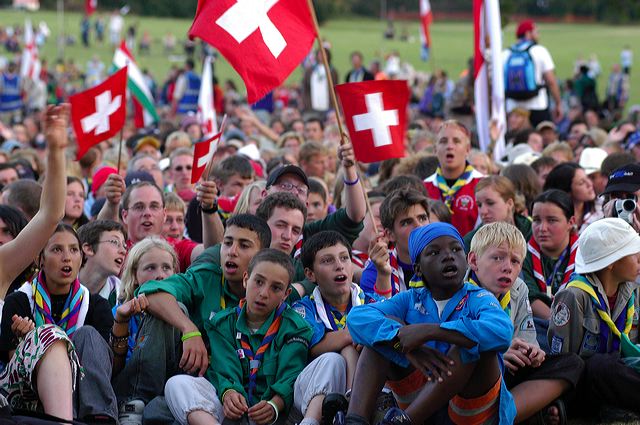
Camping most often occurs on a unit level, such as in the troop, but there are periodic camporees and jamborees. Camporees are events where units from a local area camp together for a weekend. These often occur a couple times a year and usually have a theme, such as pioneering. Jamborees are large events on a national or international level held every four years where thousands of Scouts camp together for one to two weeks. Activities at these events include games, Scoutcraft competitions, patch trading, aquatics, woodcarving, archery, and rifle and shotgun shooting.[citation needed]
Hub AI
Scout (Scouting) AI simulator
(@Scout (Scouting)_simulator)
Scout (Scouting)
A Scout, Boy Scout, Girl Scout, or, in some countries, a Pathfinder is a participant in the Scout Movement, usually aged 10–18 years, who engages in learning scoutcraft and outdoor and other special interest activities. Some Scout organizations have split this wide age group development span into junior and senior programs. Scouts are often organized into patrols of about 6–8 Scouts under a patrol leader with a number of patrols forming a larger troop under the guidance of one or more adult leaders or Scoutmasters. Many troops are affiliated with local, national and international organizations. Some Scout organizations have special interest programs such as Air Scouts, Sea Scouts, high adventure, Scout bands, mounted scouts and cyclist Scouts. In the United States there were around 6 million scouts in 2011.
At the beginning of the twentieth century, there was popular interest in frontier and military scouts. Boys and girls emulated these scouts in dress and activities and teachers and youth leaders instructed boys and girls in scoutcraft. Aids to Scouting, a book about military scouting written by a hero of the Second Boer War, Robert Baden-Powell, was one source used for instruction. Inspired by the interest in his book and urged by the founder and leaders of the Boys Brigade, Baden-Powell wrote Scouting for Boys for boy readership, which was published in 1908 together with The Scout magazine which describe a Scout method of outdoor activities aiming at developing character, citizenship training, and personal fitness qualities among youth. Baden-Powell intended his book and scheme would be used by established organizations, particular the various Brigade Movement organizations. However, because of the popular image of scouts and desire for adventurous outdoor activities, boys and even some girls formed their own Scout patrols independent of any organization.
Local and national scout organizations were formed in many countries. In the United Kingdom, Baden-Powell formed The Boy Scouts Association in 1910. Over time, Scout programs have been modified in many of the countries where it is run and special interest programs developed such as Air Scouts, Sea Scouts, outdoor high adventure, Scout bands and rider Scouts but most hold to the same core values and principles.[citation needed]
Many girls took up being Girl Scouts. Edwardian values of the time would not accept young boys and girls to "rough and tumble" together, so Baden-Powell formed a separate organization for girls in 1910, the Girl Guides Association, which was followed in other countries forming the Girl Guides.
Many Scout troops and central organizations found it useful to provide separate training for older boys as senior Scouts in separate patrols and troops. Later, programs for senior Scouts were formally established (e.g. Senior Scouts, Explorer Scouts, Venture Scouts), often with more challenging and diverse activities.[citation needed]
The Scout scheme is aimed at 11 to 17 year-olds. Younger children, particularly younger siblings, attended some Scout meetings and so programs for younger children were developed by some troops and organizations. Baden-Powell's Boy Scouts Association launched its Wolf Cubs in 1916, which Baden-Powell wanted to be distinct from Scouts in name, uniform and identity to ensure they did not give Scouts a juvenile image. Similarly, some Scout organizations developed programs for those who had grown too old to be Scouts but wanted to remain associated with and support Scout Troops. Baden-Powell's Boy Scouts Association formed its Rovers in 1918 for young men and its Guild of Old Scouts.
A Scout learns the cornerstones of the Scout method, Scout Promise, and Scout Law. These are designed to instill character, citizenship, personal fitness, and leadership in boys through a structured program of outdoor activities. Common ways to implement the Scout method include spending time together in small groups with shared experiences, rituals, and activities, as well as emphasizing good citizenship and decision-making that are age-level appropriate. Cultivating a love and appreciation of the outdoors and outdoor activities are key elements. Primary activities include camping, woodcraft, first aid, aquatics, hiking, backpacking, and sports.
Camping most often occurs on a unit level, such as in the troop, but there are periodic camporees and jamborees. Camporees are events where units from a local area camp together for a weekend. These often occur a couple times a year and usually have a theme, such as pioneering. Jamborees are large events on a national or international level held every four years where thousands of Scouts camp together for one to two weeks. Activities at these events include games, Scoutcraft competitions, patch trading, aquatics, woodcarving, archery, and rifle and shotgun shooting.[citation needed]