
Recent from talks
Second Jassy–Kishinev offensive
Knowledge base stats:
Talk channels stats:
Members stats:
Second Jassy–Kishinev offensive
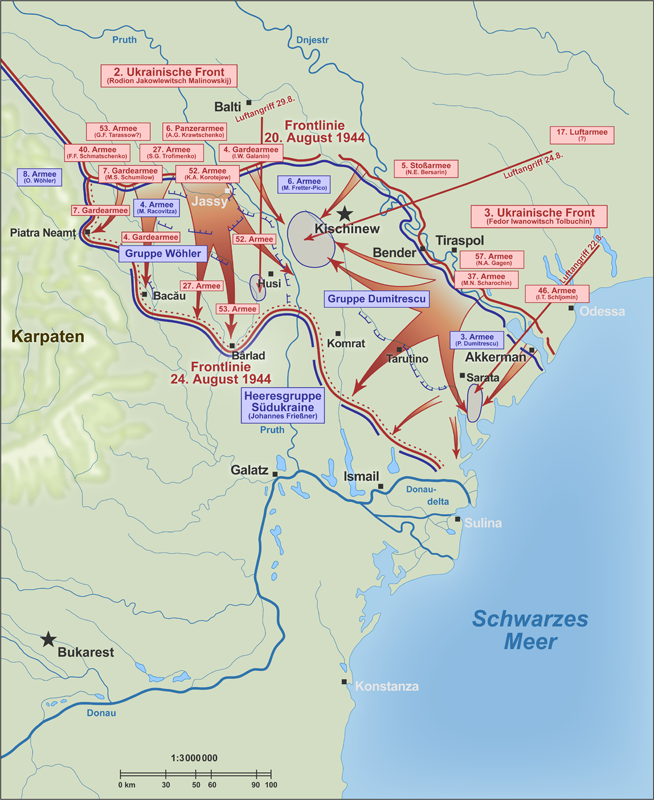
The second Jassy–Kishinev offensive, named after the two major cities, Jassy and Kishinev, in the staging area, was a Soviet offensive against Axis forces, which took place in Eastern Romania from 20 to 29 August 1944 during World War II. The 2nd and 3rd Ukrainian Fronts of the Red Army engaged Army Group South Ukraine, which consisted of combined German and Romanian formations, in an operation to reoccupy Bessarabia and destroy the Axis forces in the region, opening the way into Romania and the Balkans.
The offensive resulted in the encirclement and destruction of the German forces, allowing the Soviet Army to resume its strategic advance further into Eastern Europe. It also pressured Romania to switch allegiance from the Axis powers to the Allies. For the Germans, this was a massive defeat, which can be compared to the defeat at Stalingrad.
The Red Army had advanced past Romania's pre-war borders in the Uman–Botoșani offensive in early April. By late April, the German-Romanian allies managed to stabilize the frontline on the Carpathians-Târgu Frumos-lower Dniester alignment, and on May 6 the Stavka ordered the Soviet troops to switch to a defensive posture. Historian David Glantz however claims the Soviets made an unsuccessful attack in the same sector in an operation he refers to as the first Jassy–Kishinev offensive, from 8 April to 6 June 1944. In 1944, the Wehrmacht had been pressed back along its entire front line in the East. By May 1944, the South Ukraine Army Group (Heeresgruppe Südukraine) was pushed back towards the prewar Romanian frontier, with the German 6th Army managing to establish a line on the lower Dniester River after the conclusion of the Soviet Odessa Offensive. The line, however, was breached in two places, with the Red Army holding bridgeheads. After June, calm returned to the sector, allowing the rebuilding of the German formations.[citation needed]
Heeresgruppe Südukraine had been, until June 1944, one of the most powerful German formations in terms of armour. However, during the summer most of its armoured units were transferred to the Northern and Central fronts to stem Red Army advances in the Baltic states, Belarus, northern Ukraine, and Poland. On the eve of the offensive, the only armoured formations left were the 1st Romanian Armored Division (with the Tiger I tank),[self-published source?] and the German 13th Panzer and 10th Panzergrenadier Divisions.
Soviet deception operations prior to the attack worked well. The German command staff believed that the movement of Soviet forces along the front line was a result of a troop transfer to the north. Exact positions of Soviet formations were also not known until the final hours before the operation.
By contrast, the Romanians were aware of the imminent Soviet offensive and anticipated a rerun of Stalingrad, with major attacks against the 3rd and 4th Armies and an encirclement of the German 6th Army. Such concerns were dismissed by the German command as "alarmist". Marshal Ion Antonescu suggested a withdrawal of Axis forces to the fortified Carpathian–FNB (Focșani–Nămoloasa–Brăila)–Danube line, but Friessner, the commander of Army Group South Ukraine, was unwilling to consider such a move, having already been dismissed by Hitler from Army Group North for requesting permission to retreat.[citation needed]
Army Group South Ukraine – Generaloberst Johannes Friessner
The 1st Romanian Armored Division did not have all of its units immediately available for opposing the Soviet offensive. Some of its units were still in the interior as of 20 August. Therefore, an ad hoc organization of the Division's units which were actually available for opposing the Soviet offensive lists the Division's 80 front line tanks as follows (not including the Division's 12 armored cars):
Hub AI
Second Jassy–Kishinev offensive AI simulator
(@Second Jassy–Kishinev offensive_simulator)
Second Jassy–Kishinev offensive
The second Jassy–Kishinev offensive, named after the two major cities, Jassy and Kishinev, in the staging area, was a Soviet offensive against Axis forces, which took place in Eastern Romania from 20 to 29 August 1944 during World War II. The 2nd and 3rd Ukrainian Fronts of the Red Army engaged Army Group South Ukraine, which consisted of combined German and Romanian formations, in an operation to reoccupy Bessarabia and destroy the Axis forces in the region, opening the way into Romania and the Balkans.
The offensive resulted in the encirclement and destruction of the German forces, allowing the Soviet Army to resume its strategic advance further into Eastern Europe. It also pressured Romania to switch allegiance from the Axis powers to the Allies. For the Germans, this was a massive defeat, which can be compared to the defeat at Stalingrad.
The Red Army had advanced past Romania's pre-war borders in the Uman–Botoșani offensive in early April. By late April, the German-Romanian allies managed to stabilize the frontline on the Carpathians-Târgu Frumos-lower Dniester alignment, and on May 6 the Stavka ordered the Soviet troops to switch to a defensive posture. Historian David Glantz however claims the Soviets made an unsuccessful attack in the same sector in an operation he refers to as the first Jassy–Kishinev offensive, from 8 April to 6 June 1944. In 1944, the Wehrmacht had been pressed back along its entire front line in the East. By May 1944, the South Ukraine Army Group (Heeresgruppe Südukraine) was pushed back towards the prewar Romanian frontier, with the German 6th Army managing to establish a line on the lower Dniester River after the conclusion of the Soviet Odessa Offensive. The line, however, was breached in two places, with the Red Army holding bridgeheads. After June, calm returned to the sector, allowing the rebuilding of the German formations.[citation needed]
Heeresgruppe Südukraine had been, until June 1944, one of the most powerful German formations in terms of armour. However, during the summer most of its armoured units were transferred to the Northern and Central fronts to stem Red Army advances in the Baltic states, Belarus, northern Ukraine, and Poland. On the eve of the offensive, the only armoured formations left were the 1st Romanian Armored Division (with the Tiger I tank),[self-published source?] and the German 13th Panzer and 10th Panzergrenadier Divisions.
Soviet deception operations prior to the attack worked well. The German command staff believed that the movement of Soviet forces along the front line was a result of a troop transfer to the north. Exact positions of Soviet formations were also not known until the final hours before the operation.
By contrast, the Romanians were aware of the imminent Soviet offensive and anticipated a rerun of Stalingrad, with major attacks against the 3rd and 4th Armies and an encirclement of the German 6th Army. Such concerns were dismissed by the German command as "alarmist". Marshal Ion Antonescu suggested a withdrawal of Axis forces to the fortified Carpathian–FNB (Focșani–Nămoloasa–Brăila)–Danube line, but Friessner, the commander of Army Group South Ukraine, was unwilling to consider such a move, having already been dismissed by Hitler from Army Group North for requesting permission to retreat.[citation needed]
Army Group South Ukraine – Generaloberst Johannes Friessner
The 1st Romanian Armored Division did not have all of its units immediately available for opposing the Soviet offensive. Some of its units were still in the interior as of 20 August. Therefore, an ad hoc organization of the Division's units which were actually available for opposing the Soviet offensive lists the Division's 80 front line tanks as follows (not including the Division's 12 armored cars):
Recent media