
.jpg/250px-Sedum_dasyphyllum_(June_2010).jpg)


.jpg/2000px-Sedum_dasyphyllum_(June_2010).jpg)
Community hub
0 subscribers8 pages, 0 posts
Recent from talks
All channels
Be the first to start a discussion here.
Be the first to start a discussion here.
Be the first to start a discussion here.
Be the first to start a discussion here.
Contribute something
Welcome to the community hub built to collect knowledge and have discussions related to Sedum dasyphyllum.
Nothing was collected or created yet.
Sedum dasyphyllum
View on Wikipediafrom Wikipedia
| Sedum dasyphyllum | |
|---|---|
.jpg)
| |
| A Sedum dasyphyllum with flowers at a rural house in Southern Italy | |
Scientific classification 
| |
| Kingdom: | Plantae |
| Clade: | Tracheophytes |
| Clade: | Angiosperms |
| Clade: | Eudicots |
| Order: | Saxifragales |
| Family: | Crassulaceae |
| Genus: | Sedum |
| Species: | S. dasyphyllum
|
| Binomial name | |
| Sedum dasyphyllum | |
| Synonyms | |
|
Sedum burnatii | |

Sedum dasyphyllum,[1][2] also named Sedum burnatii and commonly known as Corsican stonecrop[3] or thick-leaved stonecrop,[4] is a low-growing succulent flowering plant of the genus Sedum in the family Crassulaceae.
Description
[edit]It is a small perennial plant with green-turquoise or gray-green opposite leaves and a creeping stem forming shrubs.[5] Its flowers are white and small with little black dots on the petals and green ovaries. The Sedum dasyphyllum, typical of the Mediterranean region, usually grows among the rocks, especially among the tuff walls of rural areas.
Gallery
[edit]-
 A shrub at Buffalo Botanical Garden
 -
 Detail of leaves
 -
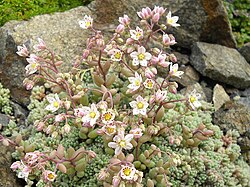 Flowers


_6.jpg)
Subspecies and varieties
[edit]- Sedum dasyphyllum subsp. dasyphyllum[6]
- Sedum dasyphyllum subsp. glanduliferum
- Sedum dasyphyllum subsp. granatense
- Sedum dasyphyllum var. microphyllum
References
[edit]- ^ Sedum dasyphyllum at desert-tropicals.com
- ^ (in French) Sedum dasyphyllum on tela-botanica.org
- ^ Nancy J. Ondra (15 April 2007). Foliage: Astonishing Color and Texture Beyond Flowers. Storey Publishing. p. 177. ISBN 978-1-58017-648-4. Retrieved 2 September 2012.
- ^ Thick-leaved Stonecrop page on maltawildplants.com
- ^ Sedum dasyphyllum on backyardgardner.com
- ^ (in French) Sedum dasyphyllum subsp. dasyphyllum on tela-botanica.org
External links
[edit]
Wikimedia Commons has media related to Sedum dasyphyllum.
 Data related to Sedum dasyphyllum at Wikispecies
- Sedum dasyphyllum: infos on backyardgardner.com

Sedum dasyphyllum
View on Grokipediafrom Grokipedia
Sedum dasyphyllum is a low-growing, evergreen succulent perennial subshrub in the family Crassulaceae, forming dense mats or cushions up to 15 cm tall with creeping, highly branched stems and tiny, fleshy, bluish-green to silvery-grey leaves that measure 2–7 mm long and often develop pink or purple tinges under stress.[1][2][3] First described by Carl Linnaeus in 1753, it is commonly known as Corsican stonecrop or thick-leaved stonecrop and produces clusters of small, star-shaped, creamy-white flowers on short stems during summer.[1][2]
Native to rocky habitats such as walls, dry grasslands, and colline to subalpine zones in central and southern Europe (including Austria, France, Italy, Spain, and Switzerland), southwest Turkey, and northwest Africa (Morocco, Algeria, and Tunisia), the species has been introduced to parts of northern Europe like Belgium, Denmark, Great Britain, and Ireland.[1][2] Its leaves are opposite or in whorls of three, ovoid to egg-shaped, strongly keeled, and glandular-hairy in the upper parts, contributing to its adaptation to temperate, drought-prone environments.[2][4] Valued ornamentally for ground cover and in green roofs due to its drought tolerance and cold hardiness to about -8°C, S. dasyphyllum also has ethnobotanical uses: its leaves and young stems are edible raw or cooked but may cause mild gastric upset from alkaloids like sedine and sedamine, while extracts exhibit anti-inflammatory, antiseptic, and antioxidant properties for treating wounds.[3][4]