Hubbry Logo
SenseoSenseoMain
Open search
Senseo
Community hub
Senseo
logo
8 pages, 0 posts
0 subscribers
Be the first to start a discussion here.
Senseo
Senseo
from Wikipedia
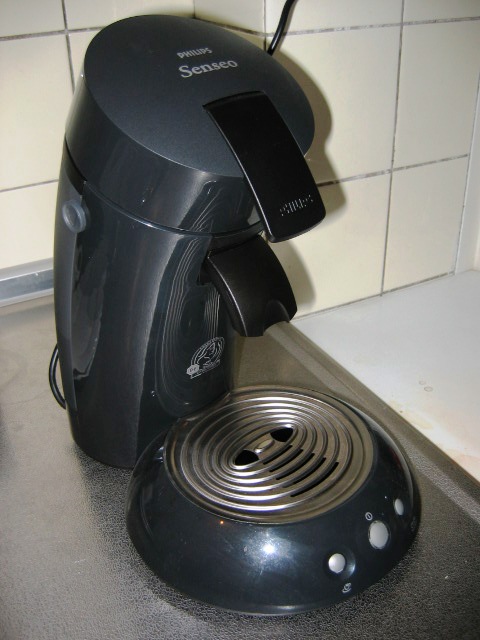
A Senseo coffee machine
Inside of a second generation Senseo coffee machine (click for legend)
Senseo coffee pods

Senseo is a registered trademark for a coffee brewing system from Dutch companies Philips and Douwe Egberts. The system is known for the coffee pods (called pads in some countries) it uses to brew the coffee.

History

[edit]

The system was first introduced in the Netherlands in February 2001, followed by Belgium and France, Germany/Austria/and Denmark, United Kingdom and United States, and Australia (in chronological order).[1] The Senseo was developed by WeLL Design. According to Philips, by 2005 ten million machines and four billion pads had been sold worldwide,[1] by and over 20 million machines by 2008.[2]

A new model of the Senseo machine, the Senseo New Generation, was launched in selected markets in 2007. This updated version allows the user to adjust the height of the mechanism to accommodate larger cups or mugs, has an indicator light function which shows when there is insufficient water for two cups (as opposed to the previous model which only showed whether there was sufficient water left for one cup), features a larger water reservoir and has an option which allows the user to adjust the amount of hot water used per cup.[3]

The Senseo Latte Select machine was introduced in 2008,[2] and features a separate milk reservoir. The machine utilizes the same coffee pods, and can produce three different variants of coffee with foam milk: Cappuccino, Café Latte and Latte macchiato. The three variants are not true brews though, as the machine cannot produce real espresso, but rather regular coffee, which is mixed with the foam milk. The machine can also produce regular coffee, and features three different strength settings.

In 2009 the Senseo Quadrante was introduced which features a new brick like design. The coffee pods are still the same, however the pod holder is designed differently. The Quadrante series also features a bigger water tank and allows the use of higher mugs through its three different mounting positions of the cup holder.

In November 2011 Sara Lee announced that they would discontinue selling the Senseo product line in North America.[4][5]

Senseo pods can still be used with compatible drip-coffee-makers, made by Hamilton Beach.

In January 2018, a North American electric compatible Senseo coffee maker once again became available to the public; primarily from online sources, such as "Daves Coffee Pods". The new Senseo Original XL HD7810/65 II Black USA Machine is an upgrade from prior models, and included the following features:

  • An XL 40 US fl oz (1,200 ml) water tank;
  • Intensity Select buttons which allow for a more or less intense tasting cup of coffee;
  • Senseo's "Coffee Boost Technology" which increased the number of water dispensing holes to 45, which the company claims will deliver a fuller extraction of the coffee.
  • Metal drip tray[6]

Aftermarket products

[edit]

Some aftermarket products allow consumers to use ground coffee in a Senseo coffee maker and avoid the higher cost of single-serve pods. The "Coffeeduck" is a durable filter that can be filled with coffee and placed in the Senseo machine to brew a cup of coffee (one Coffeeduck can be re-used thousands of times). There is also a device that allows one to make paper coffee pods with any chosen ground coffee.

Blends

[edit]

The main blends are mild, regular, mocca, dark roast and extra dark and there is also a decaffeinated variety. The blends differ, according to general taste, in different countries. The special blends, Colombia, Kenya and Brazil are blended from arabica coffees from selected plantations and are a little more expensive than the normal blends. There are also coffee pods with added flavors, called Vienna, Rio de Janeiro, Sevilla & Marrackech. More recent varieties launched in selected European markets include cappuccino, café choco and espresso. Douwe Egberts Senseo has launched a Hot Choco variety in Belgium and the Netherlands. Latest launches in Germany are the Guten Morgen breakfast blend and Caffé Crema, an Italian blend. In France, Maison du café Senseo has launched Noir Subtil.

Patent disputes

[edit]

A European patent application with the aim "to protect an assembly of pad holder and pad",[7] i.e. the Senseo coffee pods, was filed on September 30, 1998, by the Dutch firm "Sara Lee/DE N.V."[8] The European Patent Office granted EP 0904717  on July 11, 2001.[8] The European patent took force in a number of Contracting States of the European Patent Convention, including Belgium.

Dispute in Belgium

[edit]

On February 20, 2004, the Court of First Instance of Antwerp, Belgium, ruled in a lawsuit between three Belgian coffee vendors, N.V. Fort Koffiebranderij, S.A. Cafés Liégeois and N.V. Beyers Koffie, versus Philips and Douwe Egberts over the European patent, and decided that the other coffee vendors were allowed to produce and market coffee pods that fit the Senseo. The Senseo creators had used their patent to get an injunction against the marketing of coffee pods by other coffee brands, and those others replied by seeking a declaratory judgment of non-infringement. [citation needed]

One consideration the Belgian judge offered for the ruling is that coffee pods already existed. That ruling ended the Senseo coffee pod monopoly, and following that ruling, practically every coffee vendor in the Benelux countries started production of coffee pods. The Antwerp ruling affects the patents on the pods, but does not affect the patents on the Senseo machine itself.[9]

An appeal in court changed this patent matter, and the new judgement was that the other coffee makers were infringing on the European patent in Belgium.[10]

Revocation by the European Patent Office

[edit]

In the meantime, the European patent was opposed before the European Patent Office by a number of companies including Kraft Foods[8] and, on August 30, 2006, Sara Lee's EP 0904717  covering the Senseo pads was completely revoked on appeal by the European Patent Office.[7][11] Suzanne Rotteveel, spokeswoman for Sara Lee in the Netherlands, said:

We're very disappointed since we invested a lot of time, energy and money. It's disappointing when you are not able to regain a part of that investment. (...) what this ruling means is that we no longer have protection for our patent in Europe.[12]

See also

[edit]

References

[edit]
[edit]
Revisions and contributorsEdit on WikipediaRead on Wikipedia
from Grokipedia
Senseo is a pod-based system developed through a between the Dutch company and the roaster (part of , which was announced for acquisition by in August 2025), utilizing proprietary coffee pads to brew single servings of fresh with a characteristic crema layer in under a minute. Launched in the in 2001, the system was designed to offer a convenient alternative to traditional makers, combining ' expertise in appliance innovation with ' 250-year heritage in coffee roasting and blending. The Senseo machines feature a patented pressurized mechanism that extracts rich flavor from pre-measured, compostable coffee pads, available in various blends such as original, strong, and decaffeinated, while emphasizing ease of use with dishwasher-safe parts and automatic shut-off functions. In its early years, Senseo became one of Europe's most popular coffee systems, with over 30 million machines sold worldwide as of and expansions into models like the Senseo Original XL for larger brews along with partnerships allowing compatible third-party pods. In , sold its stake in the Senseo brand to Sara Lee (predecessor to ), but continues to manufacture the machines, maintaining the system's focus on quality, speed, and sustainability through compostable pads.

Introduction

Overview

Senseo is a single-serve pod brewing system co-developed by the Dutch electronics company and the producer , now known as Jacobs Douwe Egberts (JDE). This innovative platform combines proprietary machines with specially designed pods to deliver convenient, fresh preparation at home or in small offices. Unlike traditional makers or machines, Senseo emphasizes ease of use and speed, targeting consumers seeking a quick alternative to ground brewing methods without the need for filters or measuring. The system's basic operation involves inserting a pre-packaged pod into the machine, where hot water under mild extracts the to produce a crema-topped in under a minute. This pod-based approach ensures portion control and minimal cleanup, distinguishing Senseo from bulk brewing systems by focusing on individualized servings. The "Senseo" was originally registered jointly by and in 2001; following ' sale of its stake to Sara Lee (now JDE) in 2012, it is now owned by JDE, with continuing as the exclusive manufacturing partner. Senseo machines and pods are primarily available across , where the system originated and maintains strong , with more limited distribution in through select retailers and online channels. Launched in the in 2001, it quickly gained popularity for its accessibility in the European coffee culture.

Key Features

The Senseo coffee system emphasizes ease of use through its one-touch operation, enabling the preparation of one or two cups of in less than a minute without the need for grinding beans or measuring grounds, making it ideal for quick home brewing. This pod-based approach simplifies the process, as users simply insert a compatible pod and select the desired number of cups via intuitive controls. A standout feature is the patented brewing mechanism, with select models employing the Crema Plus system to generate a velvety crema layer on the surface of the , enhancing flavor and without requiring or additional additives. This innovation delivers a café-like quality in every cup, setting Senseo apart from traditional makers. Senseo machines are engineered with a compact footprint, fitting easily into small counter spaces, and entry-level models are affordably priced, typically ranging from $50 to $100, providing an accessible entry point for pod enthusiasts. In select models, users can customize their brew with adjustable spout heights to accommodate various cup sizes and water temperature settings for personalized strength and heat.

History

Development and Launch

The Senseo coffee brewing system originated from a between , a Dutch electronics company specializing in consumer appliances, and Sara Lee Corporation's Douwe Egberts division, a leading coffee producer, which began collaborating in the late to innovate single-serve for home use. This partnership combined ' expertise in small household appliances with Douwe Egberts' knowledge of and blending, aiming to create a convenient alternative to traditional drip methods. The concept was developed between and 2000, with a key for the coffee pod system filed in to protect the innovative pad design and brewing process. Senseo debuted in the on February 1, 2001, marking the first commercial launch of a pod-based targeted at everyday consumers seeking quick, crema-topped cups without the mess of ground filters. The initial was priced at approximately €70, including starter packs of pods, positioning it as an affordable upgrade for households over conventional brewing. Marketing emphasized ease of use, with one-touch operation for one or two cups, appealing to busy families and individuals who valued the ritual of café-style at home compared to time-intensive drip systems. The launch achieved rapid success in the , with strong initial sales reflecting consumer enthusiasm for the system's simplicity and consistent quality. Within the first few years, millions of units were sold across , underscoring the product's appeal in a mature market. However, early adoption faced hurdles, including restricted pod distribution primarily within , which limited for international users and third-party compatibility.

Expansion and Product Evolution

Following its initial launch in the Netherlands, Senseo expanded into Germany in 2002, the United Kingdom and France in 2003, and the North American market in 2004. By the mid-2000s, the system had entered more than a dozen countries, including Austria, Australia, Belgium, China, and Denmark, establishing a strong presence in Europe and beyond. In North America, however, sales faced challenges, leading Sara Lee to discontinue the product line effective March 31, 2012, though compatible pods remained available for existing machines. The brand was reintroduced to the U.S. market in 2018 with updated models available primarily through online channels. Sales grew rapidly in the early years, with 5.5 million machines and 3 billion pods sold across five European countries by . Worldwide, cumulative sales reached 10 million machines within the first three years of availability, reflecting strong consumer adoption of the pod-based brewing system. By 2012, over 33 million Senseo machines had been sold globally, supporting the production and consumption of billions of pods. As of 2023, the brand serves 15 million households and delivers approximately 38 million cups daily, underscoring its sustained scale under management. In 2021, Philips sold its domestic appliances business, including Senseo machine production, to Chinese investor Hillhouse Capital, which operates as Versuni and continues manufacturing the machines. Product evolution focused on enhancing functionality and user convenience. In 2007, the Senseo New Generation model was introduced in select markets, featuring an adjustable brewing volume mechanism for customizable cup sizes. The 2008 launch of the Latte Select added a dedicated milk reservoir and frothing capability, enabling preparation of milk-based drinks like lattes alongside standard coffee. The Quadrante model, introduced in 2009, increased water tank capacity to 1.2 liters to support brewing up to eight cups without frequent refills. Post-2018 updates, such as the Original XL HD7810/65, incorporated energy-saving features including a 30-minute auto shut-off to reduce power consumption. Pod production scaled significantly under oversight, reaching billions cumulatively by the early to meet global demand. Annual output supports high-volume consumption, with adaptations for regional preferences, such as compostable pads and recycling-ready packaging tailored for markets like the and to align with local regulations. In 2023, expansions into , , and further localized offerings to Eastern European tastes.

Technology

Brewing Mechanism

The brewing mechanism of Senseo machines employs a patented low-pressure system to extract from pods, producing a rich crema layer through controlled rather than high-pressure extraction. The process initiates when a pod is inserted into the designated holder within the chamber. from the , typically holding 0.7 to 1.4 liters depending on the model, is drawn into an internal where it is heated to a brewing temperature ranging from 72°C to 90°C. Once heated, a propels the through the pod at a mild of 1 bar, percolating through the ground to dissolve flavors and aromas in approximately 20 to 30 seconds for one cup or under 60 seconds for two cups. This low- approach, distinct from the 9-bar intensity of machines, yields a filter-style with balanced extraction focused on mild rather than concentrated shots. Following extraction, the passes through a patented crema modulator , which directs the liquid into a narrow channel (cross-section 0.01-0.09 cm², length at least 0.5 cm) to generate and draw in air, emulsifying the extract into micro-droplets for optimal crema formation. This air-coffee interaction creates a stable layer that enhances aroma retention, with the maximum in this phase reaching 2-5 bar to facilitate jet formation without compromising the overall mild profile. The water system incorporates a single for efficient heating and includes anti-scale measures in modern models, such as a descaling indicator to prevent buildup and maintain performance. Safety mechanisms prevent mishaps, including automatic shut-off after the brewing cycle or 30 minutes of inactivity, and overflow protection via sealed reservoir and chamber designs that halt pumping if levels exceed safe limits.

Pod Specifications

Senseo coffee pods, also known as pads, feature a flat, oval-shaped design measuring approximately 62 mm by 110 mm. Each pod contains 7 to 9 grams of finely ground , typically 100% or a blend of Arabica and Robusta beans. The pods are constructed using a non-woven made from all-natural fibers, which is oxygen-bleached without to ensure environmental safety. This biodegradable filter encases the coffee grounds and is topped with an aluminum foil seal to preserve freshness and aroma until . Official Senseo pods contain no plastic components, distinguishing them from some aftermarket alternatives. In terms of capacity, a single pod is designed to brew approximately 4 ounces (120 ml) of , while two pods together yield about 8 ounces (240 ml), compatible with the machine's 1-cup or 2-cup brewing trays. Only pods produced by licensed manufacturers, such as , are officially compatible to ensure optimal extraction and machine performance. Following EU regulations on packaging and waste, including updates to Directive 94/62/EC, Senseo transitioned to more recyclable outer packaging for pod packets starting in 2022, enhancing sustainability without altering the pod composition itself.

Products

Coffee Pods and Blends

Senseo offers a range of official coffee pods produced by Jacobs Douwe Egberts (JDE), focusing on diverse roasts and blends to suit various preferences. The core lineup includes the blend, a medium roast combining and Robusta beans for a balanced flavor with a delicate crema layer; the Strong blend, a dark roast emphasizing aromatic intensity; the Mild blend, featuring a light, soft taste; and Decaf, a caffeine-free option maintaining similar roast profiles. Flavored options extend to varieties like Mocca, which incorporates notes, and milk-based pods such as and for frothy specialty drinks. Regional variations adapt to local tastes, with stronger roasts like Intenso—dark and full-bodied—popular in for its espresso-like intensity. In the UK, milder options such as the House Blend prevail, offering smooth, rich 100% profiles. Limited editions, including seasonal blends and special releases like the Breakfast Blend with lighter, fruity notes, provide occasional variety. All Senseo pods are sourced and produced by JDE, utilizing blends of 100% beans for premium varieties like or mixes of Arabica and Robusta for fuller body, with beans carefully selected and roasted to ensure consistent aroma and foam. Pods are packaged in units ranging from 18 to 40 per box, designed for single-serve brewing. Innovations since 2020 include compostable pods featuring a plant-based , made primarily of grounds with and plant-derived materials, aligning with JDE's goals while preserving flavor. Caffeine content in standard pods averages 60-90 mg per serving, varying slightly by roast. These pods are widely available through supermarkets, JDE's online channels, and retailers across , with pricing typically ranging from €0.15 to €0.25 per pod depending on pack size and region.

Machine Models

Senseo offers a range of pod designed for use, with models varying in capacity, features, and target markets. The lineup includes entry-level options for basic and advanced models with enhanced controls for customized experiences. These are compatible with Senseo pods and emphasize ease of use, quick , and crema formation. The entry-level Senseo Original, part of the HD7810 series, features a 0.7-liter suitable for 1 or 2 cups at a time, making it ideal for small households or individuals. This model delivers in under a minute using a patented system and is priced around $70 in retail markets. It includes basic functions like auto shut-off after 30 minutes and dishwasher-safe parts for easy maintenance. For more advanced users, the Senseo Select (HD6564) provides aroma strength control via Duo Select settings, allowing adjustment for mild or strong , along with a 0.9-liter for up to 7 cups. This model incorporates Coffee Boost technology for even water dispersion and is available at approximately $90. It supports two cups simultaneously and features a descale indicator for longevity. The Senseo Maestro (CSA260 series) stands out with a touch display for intuitive operation and a 1.2-liter tank capacity, enabling up to 10 cups per fill. Priced around $120, it offers customizable intensity and includes energy-saving standby modes below 0.5W. This model is designed for frequent use, with a square form factor for compact placement. Notable discontinued models include the Quadrante, launched in 2009 with a 1.2-liter tank for 8 cups and Coffee Boost for optimal flavor extraction. The Latte Select, introduced in 2008, integrated a milk reservoir for frothed drinks like cappuccino, using the same pods as standard models while adding dual heating for coffee and milk. These were phased out to focus on core pod brewing innovations. As of 2025, Senseo offers energy-efficient models in , such as the Original ECO, featuring 35% recycled and 25% reduced power consumption. North American markets emphasize the Original XL variant of the HD7810 series, with its larger 1.2-liter tank for extended sessions. Accessories for Senseo machines include official descaling kits using citric acid-based solutions to remove and prolong machine life, recommended every 3-6 months depending on water hardness. Pod holders, available in 1-cup and 2-cup variants, are dishwasher-safe and essential for . Senseo provides a standard 2-year warranty on most models worldwide, covering manufacturing defects with proof of purchase.

Aftermarket Options

Third-Party Pods

Third-party coffee pods, also known as compatible or alternative pads, are unofficial products designed to work with Senseo machines, offering consumers options beyond the original Senseo pods. These pods typically adhere to the standard Senseo format, featuring a flat, round design with approximately 7 grams of ground sealed in biodegradable or compostable paper filters, ensuring they fit into the machine's pod holder without modification. Popular brands include Italian Coffee, which provides blends like Classico, Cremoso, and Vigoroso in packs of 18 to 180 pods, emphasizing rich, creamy flavors from Italian roasts; Gimoka, offering strong, mild, decaf, and classic varieties in 18- to 36-pod packs; and Meo (Cafés Méo), with options such as organic decaf, , and gastronomique blends in 36- to 270-pod quantities. Other notable producers are Petits Torrefacteurs for flavored pods like and hazelnut, Terramoka for organic single-origin s such as Ines and , and Café Michel for sustainable organic selections. These brands are widely available through European retailers and online platforms. Compatibility is generally reliable for most Senseo models, as these pods match the 70 mm diameter specification, allowing seamless insertion and brewing to produce a crema layer. Some, like those from Meo and Terramoka, utilize fully compostable materials to enhance environmental appeal. However, the crema quality can vary depending on the roast and grind, potentially resulting in a less consistent foam compared to official pods due to differences in sealing and coffee density. A key advantage of third-party pods is their lower cost, typically ranging from €0.10 to €0.15 per pod in bulk packs, making them more economical than official alternatives while providing a broader selection of flavors, including single-origin organics and flavored varieties not available in the standard Senseo lineup. For instance, packs from Italian Coffee or Gimoka often deliver robust, aromatic brews at scale, supporting diverse preferences from mild daily coffees to intense espressos. Non-standard seals in some pods may occasionally lead to minor brewing inconsistencies, such as uneven extraction, though most users experience no significant machine clogs. The availability of these pods has expanded consumer choice in , driven by affordability and variety.

Compatible Accessories

The Coffeeduck adapter is a refillable pod holder designed to enable Senseo machines to brew ground instead of pre-packaged pods, allowing users to fill it with 5-14 grams of loose coffee grounds and insert it into the standard pod slot for brewing. It preserves the machine's foam layer while being dishwasher-safe and durable for long-term use, with preparation taking approximately 20 seconds longer than using disposable pads. Compatible primarily with Senseo models such as HD7820 through HD7842, it functions as a 2-pod holder to support double shots or espresso-style brews. Reusable pods, often made from or , provide an alternative for filling with custom ground , promoting cost savings and reduced waste compared to single-use options. These pods are typically dishwasher-safe, include tamping tools for even packing, and claim to retain coffee oils for better flavor extraction while being free from BPA and other harmful materials. Eco-friendly assertions include preventing the disposal of up to 1,460 pods annually per user, equating to about 13 kg of waste reduction, with potential annual savings of around $420 for an individual. Compatibility extends to models like HD7801, HD6592, HD6553/70, and HD7865/60, where users fill, tamp, and brew as with standard pods. Third-party cleaning tools for Senseo machines include universal citric acid-based descalers, which remove buildup to maintain performance without damaging internal components. Products like multi-pack liquid descaling solutions are formulated for single-serve makers, including Senseo, and offer two uses per bottle for routine maintenance every 3-6 months depending on . Pod storage organizers, such as stackable holders or wall-mounted dispensers, help keep unused pods fresh and accessible, though specific Senseo-compatible versions are limited and often universal for pod systems. Mods from aftermarket sources include replacement larger water tanks, such as 1.2-liter XL reservoirs that fit models like HD7810 and HD6553 to reduce refills during multiple brews. Multi-brew adapters, similar to dual-pod holders in reusable designs, enable preparing two cups simultaneously on compatible Original series machines, often sourced from hobbyist adaptations. These accessories are widely available on platforms like Amazon and , with compatibility best verified against specific Senseo models such as the Original series for optimal performance. Prices range from $20-70 depending on material and type, and users report varying success based on and maintenance.

Patent Revocation in Europe

The (EPO) granted European Patent EP 0 904 717 on July 11, 2001, to Sara Lee/DE N.V. for a system comprising a coffee machine and sachets (pods) filled with extractable material, specifically covering the pod's sealing mechanism and the method central to the Senseo brewing process. This patent provided exclusive rights for the design and use of Senseo-compatible coffee pods across multiple European countries, enabling Sara Lee and to maintain a monopoly on pod production and sales following the Senseo's market launch in 2001. Oppositions against the patent were filed shortly after grant by several competitors, including and Minges Kaffee GmbH & Co. KG, challenging its validity on grounds of lack of novelty and inventive step. The EPO's Opposition Division reviewed the claims and, in an interlocutory decision dated February 21, 2005, maintained the patent in an amended form, narrowing the scope to specific pod holder and extraction features. However, Sara Lee/DE N.V. appealed this decision, while opponents sought full revocation, arguing that the claimed invention was obvious in light of , including filter paper sachets and extraction systems from the 1990s such as those disclosed in EP 0 331 894 (published 1989) and related technologies. On August 30, 2006, the EPO's Technical Board of Appeal (case T 0452/05) revoked the in its entirety, determining that the subject matter lacked an inventive step over the cited , as the combination of known pod sealing and low-pressure extraction elements did not involve a non-obvious technical advance. This revocation decision was final and not further appealed, effectively ending patent protection for the core Senseo pod design across by early 2007. The revocation dismantled the legal monopoly on Senseo pod specifications, immediately opening the European market to third-party generic pods compatible with Senseo machines and spurring competition from alternative suppliers. In response, joint owners and Sara Lee (later Jacobs Douwe Egberts for the pod side) pivoted to protection for the "Senseo" brand and specific pod features to safeguard market positioning and prevent consumer confusion with non-original products.

National Court Disputes

In 2001, Sara Lee/DE, in partnership with , filed lawsuits against several local competitors in , including NV Fort Koffiebranderij, SA Cafés Liégeois, and NV Beyers Koffiebranderij, alleging unauthorized production and distribution of coffee pods compatible with the Senseo system. The Court of First Instance in initially ruled in late 2003 that there was no infringement, allowing the competitors to continue operations. However, the Antwerp Court of Appeal overturned this decision in 2004, finding indirect infringement and issuing an that prohibited the , sale, and distribution of generic pods, thereby reinforcing Sara Lee/DE's market exclusivity in . The 2004 appellate ruling was upheld by the Belgian in 2005, which interpreted the scope to prevent competitors from supplying pods intended specifically for Senseo machines, effectively blocking generic entry and maintaining Sara Lee/DE's monopoly until the broader European revocation in 2006. In , the Federal Patent Court annulled the (EP 0 904 717) in 2005 for lack of inventive step. These rulings imposed significant consequences on competitors, including court-ordered injunctions, payments, and operational halts in the region, which delayed aftermarket innovation but ultimately spurred rapid generic pod development following the resolutions. As of 2025, no active national disputes persist, with legal efforts centered on protection to safeguard the Senseo brand identity.

Current Status

Market Presence

As of 2025, Senseo has sold millions of machines worldwide since its launch in 2001, reflecting sustained demand for its affordable single-serve brewing system. The brand benefits from established distribution networks and cultural affinity for home-brewed , with a strong concentration in . Senseo exhibits strong regional dominance in core European markets, particularly the and , where it ranks as the top pod-based coffee system due to widespread adoption and compatibility with local coffee preferences. In contrast, its footprint in the United States remains modest, primarily distributed through major retailers like and Amazon. The brand competes directly with premium capsule systems like from and pod-focused platforms like from , emphasizing cost-effectiveness and ease of use. Post-2020 developments have driven growth in sustainable options, including compostable eco-pods and the Senseo Original Plus Eco machine made from over 80% recycled plastic, aligning with rising environmental awareness among consumers. Partnerships with retailers such as have further bolstered availability and promoted these innovations across European stores. In its 2024 full-year results, reported organic sales growth of 5.3% overall, with the In-Home segment (including Senseo) increasing by 3.3%. Senseo primarily appeals to budget-conscious families seeking convenient, everyday solutions, highlighting the system's reliability and in a competitive landscape.

Environmental and Sustainability Aspects

Senseo pods, primarily composed of with a plant-based , generate that can be managed through industrial composting, certified to the NEN-EN 13432 standard, but in regions lacking composting facilities, they may end up landfilled or incinerated, contributing to environmental concerns. , the parent company, initiated a shift toward 100% compostable pods across starting in 2020 as part of its 2018 commitment to make all packaging recyclable or compostable by 2025, emphasizing responsibly sourced, Rainforest Alliance-certified to minimize overall ecological impact. Senseo machines incorporate recyclable components, with up to 25% of materials derived from recycled sources, supporting a circular that facilitates end-of-life . Energy consumption is optimized through features like automatic shut-off after , resulting in lower usage compared to traditional makers that brew full pots, though it exceeds that of manual methods such as a per cup; a typical brewing cycle uses minimal power for 1-2 cups. is another strength, with approximately 110 ml required per standard cup, reducing overall resource demands relative to larger-batch preparation. Environmental NGOs, including those cited in reports on single-serve coffee systems, have criticized Senseo pods for promoting single-use consumption that strains systems, even with compostable materials, as improper disposal leads to accumulation and potential ; water usage, while efficient at around 100 ml per cup, draws further scrutiny in contexts of global scarcity. These concerns highlight the need for expanded composting to realize the pods' potential. To address these issues, since 2010 Philips has integrated 160 grams of post-consumer recycled plastic—sourced from items like old vacuum cleaners—into each Senseo Original machine, accounting for 16% of its plastic weight and phasing out PVC in wiring. JDE Peet's has set ambitious carbon reduction targets, aiming for a 43.3% cut in absolute Scope 1 and 2 GHG emissions and 25% in Scope 3 emissions by 2030 from a 2020 baseline, with Senseo contributing through compostable innovations and low-impact production. Aftermarket reusable pods provide users an additional option to further minimize waste.

References

Add your contribution
Related Hubs
User Avatar
No comments yet.