Hubbry Logo
Sequential function chartSequential function chartMain
Open search
Sequential function chart
Community hub
Sequential function chart
logo
8 pages, 0 posts
0 subscribers
Be the first to start a discussion here.
Contribute something
Sequential function chart
from Wikipedia

Sequential function chart (SFC) is a visual programming language used for programmable logic controllers (PLCs). It is one of the five languages defined by IEC 61131-3 standard. The SFC standard is defined as Preparation of function charts for control systems, and was based on GRAFCET [fr] (itself based on binary Petri nets[1][2]).

It can be used to program processes that can be split into steps.

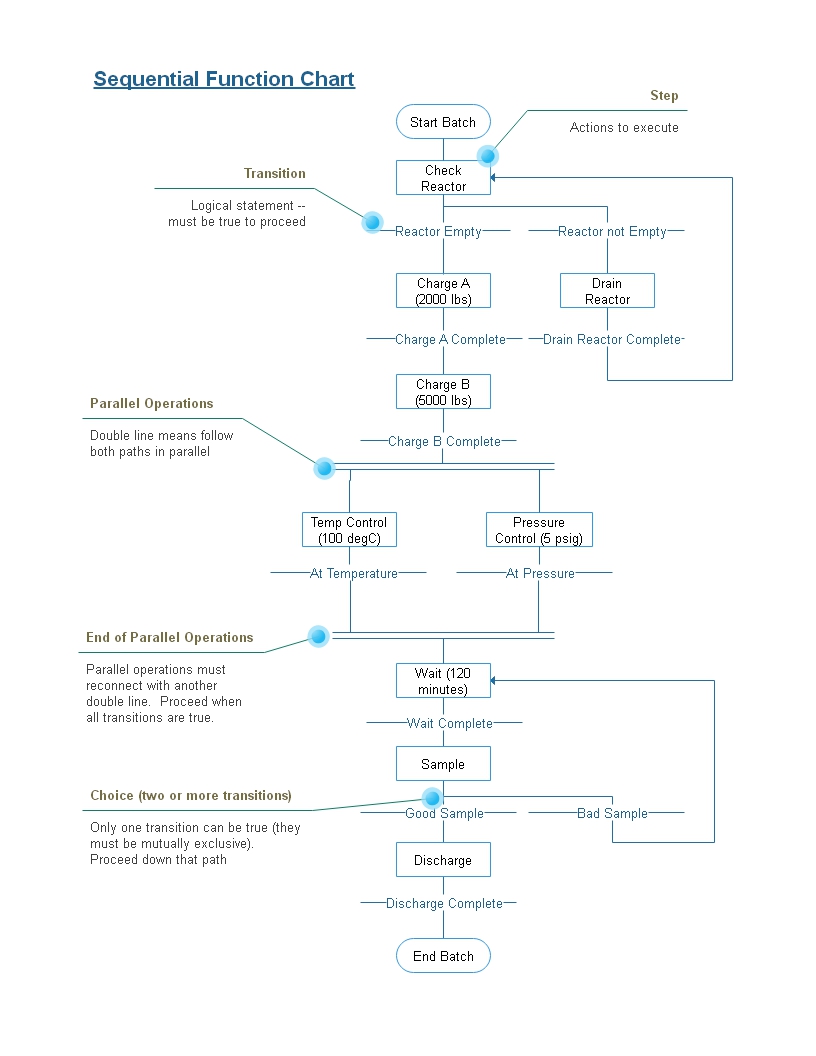
Basic Batch SFC, with important elements labeled

Main components of SFC are:

  • Steps with associated actions;
  • Transitions with associated logic conditions;
  • Directed links between steps and transitions.

Steps in an SFC diagram can be active or inactive. Actions are only executed for active steps. A step can be active for one of two motives:

  • It is an initial step as specified by the programmer.
  • It was activated during a scan cycle and not deactivated since.

Steps are activated when all steps above it are active and the connecting transition is superable (i.e. its associated condition is true). When a transition is passed, all steps above are deactivated at once and after all steps below are activated at once.

Actions associated with steps can be of several types, the most relevant ones being Continuous (N), Set (S), and Reset (R). Apart from the obvious meaning of Set and Reset, an N action ensures that its target variable is set to 1 as long as the step is active. An SFC rule states that if two steps have an N action on the same target, the variable must never be reset to 0. It is also possible to insert LD (Ladder Diagram) actions inside an SFC program (and this is the standard way, for instance, to work on integer variables).

SFC is an inherently parallel programming language in that multiple control flows — Program Organization Units (POUs) in the standard's parlance — can be active at once.

Non-standard extensions to the language include macroactions: i.e. actions inside a program unit that influence the state of another program unit. The most relevant such macroaction is "forcing", in which a POU can decide the active steps of another POU.[3]

See also

[edit]

References

[edit]
[edit]
Revisions and contributorsEdit on WikipediaRead on Wikipedia
from Grokipedia
A Sequential Function Chart (SFC) is a graphical programming language standardized in for programmable logic controllers (PLCs), designed to model and control sequential processes by representing them as a series of steps, transitions, and associated actions. It enables the visualization of complex control flows, such as those in or , by breaking down operations into discrete states where outputs are activated and conditions trigger progression. Originating from the French GRAFCET specification (IEC 60848) and Petri nets, SFC was adapted and formalized in the standard, first published in 1993, with the fourth edition released in May 2025, and revised in subsequent editions to promote in industrial automation programming. As one of five languages in the standard—alongside Ladder Diagram (LD), (FBD), Instruction List (IL), and (ST)—SFC serves primarily as a structuring tool for sequential and parallel execution, ensuring precise syntax and semantics without vendor-specific dialects. Key elements of an SFC include rectangular steps that denote active states with linked actions (e.g., turning on a motor), horizontal transitions evaluated as conditions to advance the sequence, and branching mechanisms for parallel or selective paths, such as simultaneous where multiple incoming transitions must synchronize. This structure facilitates efficient PLC scanning by activating only current steps, reducing computational overhead in real-time applications like assembly lines or chemical processes. SFCs are particularly valuable for documenting and maintaining control logic in team environments, as their flowchart-like representation enhances readability over purely textual or ladder-based methods, though they can be combined with other languages for hybrid programs. Widely adopted in industries requiring reliable sequential control, SFC supports features like step enabling, action qualifiers (e.g., time-limited or stored), and error handling to ensure robust operation.

Overview

Definition and Purpose

A (SFC) is a graphical standardized in for programmable logic controllers (PLCs), offering a visual method to represent the sequential behavior of control systems in industrial . It employs a structured set of graphical and equivalent textual elements to model the progression of operations over time, enabling engineers to depict how evolve through defined phases and conditions. This approach facilitates the organization of complex logic within programs and function blocks, particularly for machines and plants where orderly execution is critical. The primary purpose of SFC is to specify and manage the logical flow of activities in discrete or batch manufacturing processes, allowing for the of intricate control problems into manageable, sequential components. By providing a clear depiction of execution order, SFC simplifies the design, verification, and maintenance of systems, reducing errors in scenarios involving timed or conditional operations. It is especially valuable for applications requiring predictable behavior, such as assembly lines or chemical , where understanding the chronological sequence enhances system reliability and debuggability. At its core, SFC operates as an adapted form of state-transition diagrams tailored for industrial control, focusing on the temporal and conditional advancement of system states to ensure synchronized execution. This conceptualization builds upon earlier flowchart-like techniques, evolving to address the non-deterministic and parallel aspects inherent in modern tasks, thereby supporting more robust under the framework.

Relation to IEC 61131-3

IEC 61131-3 serves as the international standard for programming languages used in programmable controllers, first published by the (IEC) in 1993, with subsequent editions including the third in 2013 and the fourth in May 2025. This standard specifies the syntax and semantics of a unified suite of four programming languages to facilitate consistent implementation across programmable logic controllers (PLCs). Within , Sequential Function Chart (SFC) is defined as one of the three graphical programming languages, alongside Ladder Diagram (LD) and (FBD), complemented by the textual language (ST). SFC's graphical nature allows for visual representation of sequential control processes, distinguishing it from the more continuous or logic-oriented graphical languages like LD and FBD. By mandating precise syntax and semantics for SFC, ensures that programs developed in this language are portable across compliant PLC vendors and systems, reducing vendor-specific dependencies and enhancing in industrial . The standard requires SFC implementations to support hierarchical structures for decomposing complex control problems into sub-charts and parallel branches to enable simultaneous execution of multiple sequences, which is essential for modeling intricate processes like batch operations.

History

Origins in Grafcet

The Sequential Function Chart (SFC) traces its roots to Grafcet, a graphical formalism developed in France for specifying and analyzing sequential control systems in manufacturing processes. Grafcet, standing for GRAphe Fonctionnel de Commande Étape/Transition, was introduced in 1977 by a working group under the French Association for Economic and Technical Cybernetics (AFCET). This group, comprising around 40 researchers and industrial practitioners who had been convening since 1975, aimed to create a standardized method for describing logical automatisms in discrete event systems, particularly to facilitate the design of programmable logic controllers (PLCs) in industrial automation. A core innovation of Grafcet was its use of steps to represent operational states and transitions to denote conditions for moving between states, forming a that clearly delineates sequential behavior. This approach directly addressed the shortcomings of traditional relay-based diagrams, which, while effective for simple , struggled to intuitively model complex sequences, parallel branches, and state-dependent actions without becoming unwieldy. By emphasizing a structured, flowchart-like visualization, Grafcet enabled engineers to specify control logic more declaratively, reducing ambiguity in requirements capture and implementation for sequences like assembly lines or batch processes. During the 1980s, Grafcet gained international traction, particularly in , where it was implemented in automation systems, including PLC software from French and German vendors, promoting its use in sectors like automotive and chemical processing. Grafcet was formalized as the French standard NF C 03-190 in 1982 and later as the international IEC 60848 in 1988, solidifying its role in sequential control design. SFC emerged as the direct successor to Grafcet within the standard for PLC programming languages, adopted in 1993, incorporating Grafcet's foundational elements with minor adaptations for broader compliance and interoperability. Key changes included the standardization of action qualifiers—such as non-stored (N), set (S), and pulse (P)—to precisely define how actions associate with steps, ensuring consistent execution semantics across diverse PLC vendors while retaining Grafcet's graphical essence. These refinements made SFC more suitable for global industrial application without altering the core step-transition paradigm.

Standardization

The Sequential Function Chart (SFC) was formally incorporated into the international standard as part of its first edition, published in December 1993, which harmonized the graphical notation derived from Grafcet to support global interoperability in (PLC) programming languages. The second edition of , released in 2003, extended capabilities across the languages, including SFC, by adding new data types (such as WSTRING), references, namespaces, and additional standard function blocks to enhance modularity in sequential control applications. The third edition, published in 2013, introduced features such as classes, methods, and interfaces, further refined SFC's execution semantics and error-handling mechanisms while maintaining compatibility with prior versions, including updated definitions for program organization and fault-tolerant operations in industrial environments. The fourth edition, published in May 2025, includes enhancements such as support for strings and other updates to the syntax and semantics of the programming languages, ensuring continued relevance for modern industrial while preserving . Development of SFC within was led by the (IEC) Technical Committee 65 (TC 65) on Industrial-process measurement, control, and , specifically through its Subcommittee 65B, ensuring syntactic alignment with other standardized languages like Ladder Diagram and for consistent PLC implementation across vendors. Major vendors have adopted SFC in compliance with ; for instance, ' STEP 7 environment implements SFC via its GRAPH editor, supporting standard elements for sequential program structuring with extensions for advanced diagnostics. Similarly, Rockwell Automation's Studio 5000 integrates SFC for Logix controllers, providing -compliant routines for state-based control with features like concurrent branches and transition conditions.

Elements of SFC

Steps

In Sequential Function Charts (SFCs) standardized by , a step serves as the core state-holding element, depicted as a rectangular box that represents an active state during which associated actions are performed to control the process. Steps are categorized into three primary types to facilitate structured sequential control. The initial step, declared using the INITIAL_STEP keyword, acts as the of the SFC, becoming active immediately upon program initialization, with exactly one such step required per chart. Normal steps, defined with the STEP keyword, denote subsequent states in the sequence following the initial activation. Macro steps introduce by encapsulating a self-contained of steps and transitions, enabling modularity and reuse to simplify complex diagrams without invoking separate subprograms. Key properties of steps include their binary state—active when executing actions or inactive otherwise—and the ability to monitor duration since activation via an associated time variable. Enabling conditions for a step are established by the evaluation of incoming transitions, ensuring controlled progression through the chart. Per IEC 61131-3 visual notation, steps are rendered as solid rectangles, each optionally annotated with a unique name and sequential number for clarity and reference. This notation extends to parallel steps, which allow representation of concurrent operations through branching, supporting multifaceted process control.

Transitions

In Sequential Function Charts (SFC), transitions serve as the conditional links that connect steps, enabling the progression from one step to the next when specified criteria are met. A transition is graphically represented as a thin horizontal line intersecting the directed connection between steps, accompanied by a condition expression that evaluates to a Boolean value—true or false—to trigger the change. This mechanism ensures controlled flow through the sequence, where the preceding step remains active until the transition condition becomes true, at which point the subsequent step activates. The evaluation of a transition occurs continuously during the execution of the prior step, utilizing Boolean logic derived from input signals, timers, counters, or other variables. The condition is checked repeatedly in each scan cycle of the PLC program, and the transition is crossed only if the expression yields true, provided no prior transitions in a branch have already fired. In cases of simultaneous or alternative branches, transitions follow a left-to-right priority order to resolve conflicts, ensuring exclusive execution where only the first true condition activates the next step. This priority mechanism prevents ambiguous behavior in parallel structures. Special cases include unconditional transitions, which always evaluate to true and are denoted by the symbol "1" or the keyword TRUE, allowing immediate progression without additional logic. Jump transitions facilitate non-sequential flow by directing the execution to a non-adjacent step upon activation, often represented by an arrow symbol to avoid cluttered diagrams while maintaining the overall sequence integrity. These elements enhance the flexibility of SFC for complex control scenarios.

Actions and Other Components

In Sequential Function Charts (SFCs) as defined by , actions represent operations or code blocks executed in association with specific steps, enabling the implementation of control logic during step activation. These actions can be written in any of the standard languages, such as (ST) or Ladder Diagram (LD), and are linked to steps either graphically or textually to define behaviors like variable assignments, function calls, or output activations. Each action is qualified to specify its execution timing and persistence relative to the step's state, ensuring precise control over sequential operations. The primary action qualifiers include N (non-stored), which executes the action continuously only while the associated step is active; S (set), which activates the action upon step entry and maintains it until explicitly reset by an R-qualified action, even if the step deactivates; R (reset), which deactivates a previously set action overriding other qualifiers; and P (pulse), which executes the action for exactly one scan cycle immediately upon step activation. These qualifiers allow for flexible handling of transient and persistent tasks, such as initializing (P) or sustaining a motor run command (S) across multiple steps. Beyond basic actions, SFCs incorporate branches to manage parallelism and selection, where double horizontal lines denote divergence points for simultaneous sequence execution or conditional paths based on transition priorities, and convergence points to synchronize branches. Jumps facilitate loops and non-sequential flow by directing control to a labeled step via a double arrowhead, useful for repetitive processes like cycle resets. Stores maintain the activation history of steps through variables (e.g., step_name.X for active state) and time-tracking variables (e.g., step_name.T for elapsed time), preserving state for or conditional logic. Hierarchical elements extend SFC modularity, with macro steps serving as enclosures for sub-charts that encapsulate reusable sequences of steps, transitions, and actions, declared as actions within a parent step to promote . Emergency sections provide fault-handling mechanisms, typically implemented as dedicated branches or jumps triggered by error conditions to transition to safe states, isolating abnormal operations from the main sequence. Actions integrate seamlessly with other languages by referencing shared variables or function blocks, allowing, for instance, an SFC action in ST to invoke a Ladder Diagram routine for I/O control.

Syntax and Semantics

Basic Structure

A Sequential Function Chart (SFC) is structured as a graphical representation of sequential control processes, consisting of interconnected steps and transitions that define the progression of operations in programmable logic controllers (PLCs). The diagram typically begins with a single initial step, marked by double vertical lines, which becomes active upon program startup to establish the starting state of the system. From there, the flow proceeds through a series of steps connected by directed transitions, enabling both linear sequences—where operations follow a single path—and branched sequences that allow for alternative paths based on conditional evaluations. Transitions, depicted as horizontal lines between steps, evaluate Boolean conditions to determine whether to advance the control flow; when a transition condition is true and the preceding step is active, it deactivates the current step and activates the subsequent one(s). This mechanism supports complex decision-making, such as divergences where multiple branches may occur, with priority given to left-to-right evaluation among simultaneous options. For managing larger systems, SFCs employ hierarchical organization through macro steps—special symbols with double horizontal borders that encapsulate sub-charts starting and ending with defined steps—allowing nesting of simpler SFCs within actions to decompose intricate processes without overwhelming a single diagram. Single-page charts suffice for straightforward sequences, while macro steps facilitate modularity in extended applications. Entry and exit rules ensure well-defined chart boundaries: every SFC must include exactly one initial step to initiate execution, preventing at startup. Charts conclude with terminal steps, from which no further transitions emanate, or through loops that return control to prior steps via jumps or conditional reconvergences, enabling repetitive cycles as needed for ongoing processes. These rules maintain and prevent undefined states in the control logic. Drawing conventions standardize visualization for clarity and consistency, with the primary reading order proceeding from top to bottom and left to right across the . Parallel branches, representing simultaneous operations, are arranged in separate horizontal lanes delimited by double horizontal lines, allowing independent progression until at convergence points where transitions merge paths. Steps, serving as placeholders for actions or states, are rectangular boxes placed within these flows to denote operational phases.

Execution Model

In programmable logic controllers (PLCs) compliant with , Sequential Function Charts (SFCs) operate within the standard PLC scan cycle, where the SFC elements are evaluated repeatedly during each program execution cycle to manage sequential . During this cycle, transitions are evaluated in a predefined order—typically from top to bottom or according to the textual or network flow—once all preceding steps are active; if a transition's condition evaluates to true, it fires, deactivating the current step(s) and activating the subsequent step(s). This sequential evaluation ensures deterministic behavior, with all enabled transitions potentially clearing simultaneously based on the PLC's timing, preventing uncontrolled proliferation of active steps. Actions associated with steps are executed based on qualifiers that dictate their timing and relative to the step's state. The continuous qualifier (N) activates the action immediately upon step and executes it continuously throughout each scan cycle while the step remains active, ceasing execution upon deactivation. In contrast, the stored qualifier (S) latches the action on once the step activates, allowing it to even after step deactivation until explicitly reset by another action (e.g., via an R qualifier) or a reset mechanism, enabling of prior states across sequences. Other qualifiers, such as time-limited (L), impose duration constraints by deactivating the action after a specified TIME value, integrating timing directly into the execution semantics. Concurrency in SFCs is handled through simultaneous branches, where parallel sequences—delimited by double horizontal lines—execute independently and simultaneously once initiated by a divergence transition, with convergence requiring all active branches to reach their respective transitions before proceeding. Branch priorities are resolved using predefined rules, such as textual order (higher branches first) or explicit numbering, ensuring that only one path activates in selective divergences via mutually exclusive guards; this maintains controlled parallelism without asynchronous nondeterminism, akin to but distinct from Petri nets. Error handling and reset mechanisms in SFCs provide safeguards against faults, such as unreachable steps or token proliferation, by supporting step resets on detected errors like timeout violations monitored via qualifiers (e.g., ) or dedicated timeout transitions. A full SFC reset deactivates all active steps, clears associated actions (including stored ones), and restarts from the initial step, triggered either by stopping the PLC resource, user program intervention, or explicit error paths that route to a safe state, thereby ensuring operational integrity without halting the entire system.

Applications

In PLC Programming

In programmable logic controllers (PLCs), Sequential Function Charts (SFCs) are integrated as a core graphical programming language compliant with the standard, enabling the structured representation of sequential control processes. Tools such as facilitate SFC development by allowing users to create SFCs as Program Organization Units () through a dedicated dialog, where the implementation language is selected as SFC during POU addition. Similarly, Beckhoff's TwinCAT environment supports intuitive SFC creation via its editor, where elements like steps and transitions can be dragged and dropped from a toolbox into the diagram, streamlining the design of complex sequences. Once developed, these SFC diagrams are compiled by the PLC software into machine code executable on the controller hardware, ensuring efficient runtime performance. SFCs serve as modular within the overall PLC program structure, encapsulating sequential logic while invoking actions defined in other languages such as (ST) or Ladder Diagram (LD). This organization promotes reusability and maintainability, as actions associated with steps—such as variable assignments or function block calls—can be implemented externally and referenced within the SFC, allowing a hybrid approach to programming that combines graphical flow with detailed algorithmic code. For instance, an SFC POU might orchestrate a cycle by activating steps that trigger ST-based calculations for timing or control outputs. Debugging SFCs in PLC environments emphasizes real-time visibility into execution states, with features for online monitoring of active steps, pending transitions, and ongoing actions. In TwinCAT, for example, active steps are visually highlighted in blue during online mode, while transition conditions and action flags can be inspected cyclically to verify program flow and troubleshoot issues without halting the process. These capabilities align with requirements for structured program execution and support efficient iteration during development. Vendor implementations of SFC often extend the IEC standard for enhanced functionality, such as ABB's Automation Builder, which provides full support for SFC alongside the other four languages within a unified interface for configuration, programming, and maintenance. Automation Builder incorporates real-time extensions via integration, enabling synchronized monitoring and control in high-performance applications while maintaining core SFC semantics.

Industrial Examples

In batch mixing processes, such as chemical production, SFC is employed to orchestrate the sequential addition of ingredients, agitation, and discharge from a mixing tank. The process begins with a filling step where valves open to add predefined quantities of raw materials until a high-level is triggered, marking the transition to the stirring step. During stirring, a motor activates for a set duration via a , ensuring homogeneous mixing before transitioning to the emptying step, where pumps discharge the batch upon detection of a low-level . This structured approach using SFC in PLCs enables precise monitoring and fault recovery, such as halting on anomalies. Assembly line sequencing benefits from SFC's ability to handle operations, as seen in shop where multiple tasks occur concurrently. For instance, a transfers products into the painting area, applies coatings via sequential activation of guns, cleans the equipment, and moves items to ovens, while a simultaneous branch independently controls ventilation fans throughout. Transitions between steps rely on completion signals from arms or timers, with branches allowing independent quality checks, such as verifying thickness before advancing. This configuration in automotive lines, implemented via Logix 5000 controllers, supports synchronized movements without blocking the primary flow. In pharmaceutical packaging, hierarchical SFC structures manage complex sub-routines for tasks like blister filling, labeling, and sealing, ensuring compliance with regulatory standards. The top-level chart oversees the overall sequence, calling subordinate SFCs for specific operations—such as a labeling routine that activates printers upon product detection and transitions on verification scans—while integrating emergency stops that immediately route all branches to a safe state, disabling actuators like grippers and conveyors. Transitions incorporate pre-condition checks, including no active faults or emergency signals, to prevent errors in high-speed lines. Beckhoff TwinCAT implementations in packaging automation highlight this modularity, facilitating rapid reconfiguration for product changeovers in pharmaceutical settings. Integrating SFC with virtual commissioning tools in manufacturing, including automotive plants, has been shown to significantly reduce physical commissioning times; for example, a 2014 survey reported up to 75% reduction in real commissioning efforts for manufacturing systems through early simulation of sequential controls, minimizing on-site debugging for assembly processes.

Comparison with Other Languages

Versus Ladder Diagram

The Ladder Diagram (LD) is a graphical programming language derived from relay-based electrical control systems, featuring horizontal rungs connected between two vertical power rails to represent logic operations such as AND, OR, and NOT through contacts and coils. This structure makes LD particularly suited for mimicking electrical schematics and implementing discrete control logic, where inputs and outputs are directly tied to simple interlocking and on/off behaviors. However, LD's linear, scan-based execution model becomes cumbersome for modeling complex sequential processes, as it necessitates the use of auxiliary state variables, flags, and conditional branches to simulate steps and transitions, often leading to sprawling, hard-to-follow code. In comparison, the Sequential Function Chart (SFC) offers a structured visual flow that explicitly depicts multi-step operations through interconnected steps, transitions, and associated actions, providing an intuitive representation of program progression without relying on implicit in the core logic. This graphical approach in SFC facilitates easier comprehension and maintenance of sequential behaviors, contrasting LD's rung-by-rung enumeration. Both LD and SFC are defined as standard languages within the specification for programmable logic controllers (PLCs). SFC is ideally suited for state-based sequential control, such as machine cycles involving ordered phases like initialization, operation, and shutdown, where clear visibility into the current state and transition conditions is essential. Conversely, LD is preferred for straightforward applications like safety interlocks or basic relay replacements, where the electrical simplifies for personnel familiar with wiring diagrams. One key challenge in using LD for sequential tasks is the conversion from SFC equivalents, which typically expands the program into numerous additional rungs to handle state activation, transition evaluation, and output persistence, significantly increasing code size and complexity in elaborate cases. For instance, a simple SFC with multiple states may translate to dozens of LD rungs incorporating timers, comparators, and memory bits to replicate the flow.

Versus Function Block Diagram

Function Block Diagram (FBD) is a graphical programming language standardized in , consisting of interconnected blocks that represent functions and process signals in a data-flow manner, making it ideal for continuous control applications such as proportional-integral-derivative (PID) loops in process industries. In contrast, Sequential Function Chart (SFC) emphasizes discrete event sequencing through states and transitions, excelling in modeling step-by-step processes with branching and parallelism, while FBD is more effective for reusable function calls that operate independently of specific timing or sequence dependencies. Both languages can be integrated in hybrid applications within a single PLC project, such as embedding FBD modules as actions executed during particular SFC steps to manage in state-specific contexts. SFC's support for hierarchical structures allows it to organize complex sequences into nested levels, thereby reducing overall program sprawl compared to FBD's typically flat interconnections, which can become unwieldy for purely . As graphical languages defined in , SFC and FBD complement each other in modular PLC designs.

Advantages and Limitations

Benefits

Sequential Function Charts (SFCs) offer significant visual clarity in representing control sequences, resembling flowcharts that allow engineers and non-programmers to grasp complex processes intuitively without delving into textual code. This graphical nature facilitates easier understanding and maintenance of , as steps, transitions, and actions are explicitly depicted, making it accessible for multidisciplinary teams in industrial settings. The structured approach of SFCs inherently supports parallelism through simultaneous branches and hierarchy via macro steps, enabling the modeling of intricate state machines while minimizing errors in designing complex, multi-threaded processes. By separating states from transitions and actions, SFCs promote modular that enhances reliability in sequential control systems. As part of the standard, SFCs promote vendor-independent designs, facilitating portability of programs across different PLC manufacturers and collaboration among development teams, although actual interoperability can be limited by vendor-specific implementations. This standardization promotes reusability and reduces long-term maintenance costs in automation projects. SFCs improve debugging efficiency by enabling step-by-step and real-time monitoring of active states, transitions, and actions, which simplifies identifying issues and optimizes scan times compared to scanning entire programs in other languages. This visibility into the current system state accelerates in operational environments.

Drawbacks

Sequential function charts (SFCs) can become unwieldy when representing large-scale systems, as the graphical structure mixes sequence control with application logic, making maintenance and navigation challenging without . This limitation is particularly evident in complex involving numerous sequences, where the increasing size of the chart requires additional logic for , exacerbating readability issues. Furthermore, SFCs are not ideal for purely continuous control applications, such as steady-state regulation, where the discrete step-transition model does not align well with ongoing analog adjustments typically handled by diagrams or function block diagrams. The for SFCs is steeper compared to ladder diagrams, especially for programmers experienced in relay-based logic, as it demands a solid understanding of state machine concepts and graphical sequencing semantics. This requirement for additional training can hinder adoption in environments dominated by traditional electrical technicians, who may struggle with the indirect addressing and step manipulation inherent to SFCs. In terms of performance, SFCs introduce overhead for simple tasks due to the need for state tracking and function block execution, resulting in higher memory usage and potentially slower scan times compared to implementations. File-based SFC variants, in particular, demand more runtime resources than bit-based alternatives, which can impact efficiency in resource-constrained PLC environments. Vendor-specific extensions to the standard for SFCs often lead to portability issues, as implementations vary in syntax, semantics, and supported features across platforms, necessitating code rewrites when migrating between manufacturers. While the standard aims for , incomplete adherence by vendors limits seamless transfer of SFC programs, complicating multi-vendor deployments.

References

Add your contribution
Related Hubs
Contribute something
User Avatar
No comments yet.