


Community hub
Recent from talks
Contribute something
Nothing was collected or created yet.
Ishaaq bin Ahmed
View on Wikipedia
Ishaaq bin Ahmad bin Muhammad, more commonly known as Sheikh Ishaaq or Sheikh Isaaq (Somali: Sheekh Isxaaq) is a semi-legendary figure[3][4][5][6][7] who plays a prominent role in the oral traditions of the Somali Isaaq clan-family. According to these traditions, which were also preserved in several Arabic hagiologies,[8] he was an Islamic scholar of the Shafi’i school who crossed the sea from Arabia to the Horn of Africa. He is traditionally regarded as the Sayyid forefather of the Isaaq clan-family, whose territory in the Horn of Africa is wide and densely populated.[9][10][11][12]
Key Information


According to tradition, Sheikh Ishaaq traveled from Arabia to Somaliland in the 10th or 11th century, where he married two women; one from the local Dir clan and the other from the neighbouring Harari people.[13][14][15] He sired eight sons who are the common ancestors of the Isaaq clan-family. He is said to have settled in what is today the Erigavo District, and to have established his capital at Maydh.[16] He remained in Maydh until his death.[17]
The stories surrounding Sheikh Ishaaq have played an important role in establishing and reinforcing the Arab and Muslim identity of the Isaaq clan.[18] Scholar Christopher Ehret considers the founders of Somali clans like the Isaaq and the Darod to have been historical figures, but he regards the accounts surrounding them as legends.[19] While Sada Mire regards the foundation of Somali clan lineages by Arab progenitors as part of "the Somali Islamic myth of origin",[20] she does relate the legendary accounts surrounding them to historical migrations from South Arabia to Somalia.[21]
Biography
[edit]As a figure known only from oral tradition and hagiological accounts,[22] Ishaaq bin Ahmed's historicity is unclear, and there are varying views on the validity of the narratives about him. Christopher Ehret considers the founders of Somali clans like the Isaaq or the Darod to have been historical figures, but regards the accounts surrounding them as legends.[19] Mohamed Haji Mukhtar expresses skepticism that the population of two of the largest Somali clans (Isaaq and Darod) could descend from two Arab individuals (Ishaaq bin Ahmed and Abdirahman bin Isma'il al-Jabarti, respectively).[23] The pan-Islamic scholar Sharif Aydarus considers the accounts to be largely historical.[24][page needed]
Early life
[edit]According to tradition, after the death of Sheikh Ishaaq's grandfather he went on a series of migrations in order to study further and preach Islam. He first preached in Mecca and then travelled to Egypt, and hence to Eritrea and Zeila.[14] He then later settled in the area of Saba' in modern-day Yemen where he married the sister of the king of the Al Haqar clan.[25][26] Sheikh Ishaaq later settled in the Al-Jawf region in northern Yemen where he married once again and had a son, Mansur, who is the forefather of the Al Mansur clan in the Al-Jawf region. He then travelled to Yaba where he married and had a son, Yusuf, who is the forefather of the Al Yusuf clan based in Yaba and Ma'rib regions.[27][25][28]
Migrations
[edit]Traditional Arabic hagiologies of the Isaaq clan describe how Sheikh Isaaq first made a series of travels through Arabia, before sailing to the ancient Somali port of Zeila and continuing his travels through Somaliland and some regions of Ethiopia, finally settling in Maydh.[18]
While scholar Ioan Lewis considers these travel accounts to be a foundation myth, he does acknowledge that they likely reflect a historical settlement of Arabs in Somaliland.[18] Scholar Sada Mire also regards the narratives surrounding the founders of Somali clan lineages like Ishaaq bin Ahmed to be part of origin myths. In her view, these origin myths are meant to establish, through the link created between modern Somali clans and early Islamic figures like the prophet Muhammad or Ali ibn Abi Talib, a notion of 'divine kinship'.[29] Nevertheless, Mire also notes that while the Somali clan members she interviewed stated that Ishaaq bin Ahmed arrived in Somalia about 850 years ago, historical records do indicate that migrations from Hadhramaut and other parts of South Arabia to Somalia took place c. 1250.[21]
Arrival in the Horn of Africa
[edit]In accordance with tradition, Sheikh Ishaaq then continued his journey and migrated to Zeila, Somaliland and finally Harar in Ethiopia.[28] Several accounts indicate Shaykh Yusuf al Kownayn and Sheikh Isaaq were known to be contemporaries in Zeila and in contact at the same time.[30][31][32] According to a popular legend, Shaykh Yusuf al Kownayn, known locally as Aw-Barkhadle, upon meeting Sheikh Ishaaq prophesied that Sheikh Ishaaq would be blessed by Allah with many children while Shaykh Yusuf would not have descendants. According to the prophecy the descendants of Sheikh Ishaaq would also visit Aw-Barkhadle's grave and pay respect and perform siyaaro, or pilgrimage to his tomb.[33] Saints and Somalis: popular Islam in a clan-based society states:
Since, however, Aw Barkhadle’s precise connection with the rulers of Ifat is not widely known, he appears as an isolated figure, and in comparison with the million or so spears of the Isaaq lineage, a saint deprived of known issue. The striking difference between these two saints is explained in a popular legend, according to which, when Sheikh Isaaq and Aw Barkhadle met, the latter prophesied that Isaaq would be blessed by God with many children. He, however, would not have descendants, but Isaaq’s issue would pay him respect and siyaaro (voluntary offerings). So it is, one is told, that every year the Isaaq clansmen gather at Aw Barkhadle’s shrine to make offerings in his name.[34]
According to tradition, after studying and proselytizing in Harar he then undertook the pilgrimage to Makkah, came back to Somaliland and went along the shore eastward to the coastal town of Maydh in eastern Somaliland, where he converted the pagan peoples to Islam.[14] He later settled in the town aged 60,[35] where he married two women; one of the Magaadle Dir clan called Magaado, and a Harari woman called Hanifa, the daughter of a Harari emir, with descendants belonging to the Habar Magaadle or Habar Habusheed branches respectively.[14][15] He sired eight sons who are the common ancestors of the subclans of the Isaaq ethnic group. He remained in Maydh until his death.[36][37]
Lineage and descendants
[edit]
Arabic hagiologies trace Ishaaq bin Ahmed's lineage to Ali bin Abi Talib, the cousin and son-in-law of the Islamic prophet Muhammad. Scholar Ioan Lewis considers that, given the preponderance of names belonging to early Islamic Arabia rather than to medieval Somali-Arab culture, this lineage is unlikely to be genuine. According to Lewis, the genealogy is 'Arabicized' with the goal of enhancing the prestige of the Isaaq among the many ethnic groups in modern and contemporary Somalia.[18] Scholar Sada Mire regards the creation of lineages like this as part of what she terms "the Somali Islamic myth of origin".[20] The pan-Islamic scholar Sharif Aydarus considers the accounts to be largely historical, and agrees with the tradition of Ishaaq bin Ahmed's Arab origin.[24][page needed]
The Isaaq ethnic group are divided into two uterine divisions, as shown in the genealogy below. The first division is between those lineages descended from sons of Sheikh Ishaaq by a Harari woman – the Habr Habusheed – and those descended from sons of Sheikh Ishaaq by a Somali woman of the Magaadle sub-clan of the Dir – the Habr Magaadle. Indeed, most of the largest clans of the Isaaq ethnic group are in fact uterine alliances; hence the matronymic "Habr" which in archaic Somali means "mother".[38] This is illustrated in the following ethnic structure.[39]

A. Habr Magaadle
B. Habr Habuusheed
- Ahmed (Tol Je’lo)
- Muuse (Habr Je'lo)
- Ibrahiim (Sanbuur)
- Muhammad (‘Ibraan)

There is clear agreement on the clan and sub-clan structures that has not changed for a long time. The oldest recorded genealogy of a Somali in Western literature was by Sir Richard Burton in the mid–19th century regarding his Isaaq (Habr Yunis) host and the governor of Zeila, Sharmarke Ali Saleh.[40]
The following listing is taken from the World Bank's Conflict in Somaliland: Drivers and Dynamics from 2005 and the United Kingdom's Home Office publication, Somaliland Assessment 2001.[41][42]
- Isaaq
- Habr Awal
- Arap
- Ayub
- Garhajis
- Habr Je'lo
- Muuse Abokor
- Mohamed Abokor
- Samane Abokor
- Tol Je'lo
- Sanbuur
- Imraan
One tradition maintains that Sheikh Ishaaq had twin sons: Muhammad (Arap), and Ismail (Garhajis).[43] In addition, Sheikh Ishaaq had four additional sons in Yemen (Dir'an, Shareef, Yusuf and Mansur) whose descendants inhabit parts of northern Yemen, including the Khawlan district and the Ma'rib governorate.[28][44][27][45]
In one account, Sheikh Ishaaq's three eldest sons split their father's inheritance among themselves.[46] Isma’il receives his imama, a symbol of leadership; Abdel-Rahman receives the sheikh's wealth; and Ahmad inherits his sword.[46] The story is intended to depict the Garhajis' alleged proclivity for politics, the Habr Awal's mercantile prowess, and the Habr Je'lo's bellicosity.[46]
To strengthen these tribal stereotypes, historical anecdotes have been used: The Habar Yonis allegedly dominated positions as interpreters for the British during the colonial period, and thus acquired pretensions to intellectual and political superiority; Habr Awal dominance of the trade via Djibouti and Berbera is practically uncontested; and Habr Je’lo military prowess is cited in accounts of previous conflicts.[46]
Legacy
[edit]There are a number of existing hagiologies in Arabic which describe Sheikh Ishaaq's travels, works and life in Somaliland, as well as his movements in Arabia before his arrival.[47] Like other texts of this genre, they are strongly focused on narrating the holy man's pious deeds and the miracles he performed. Among these texts are:
- Manāqib al-shaykh Isḥāq (a text in the genre of manaqib or 'laudatory biography')[22]
- Nubdha ('genealogical account'), written by Ādam ibn Waʿays[22]
- Amjād ('praiseworthy qualities'), written by Ḥusayn ibn Aḥmad Darwīsh[22]
Sheikh Ishaaq's descendants would later go on to form two powerful sultanates that dominated the northern coastline of the Horn of Africa during the early modern era; the Isaaq sultanate and the Habr Yunis sultanate.[48][49][50]
Tomb
[edit]Sheikh Ishaaq's tomb is in Maydh, and is the scene of frequent pilgrimages.[47] Sheikh Ishaaq's mawlid (birthday) is also celebrated every Thursday with a public reading of his manaaqib (a collection of glorious deeds).[15] His siyaara or pilgrimage is performed annually both within Somaliland and in the diaspora particularly in the Middle East among Isaaq expatriates.[51] The tomb was kept by the family of Somali artist Abdullahi Qarshe.[52]
Murray in his book The Journal of the Royal Geographical Society notes that many men from the Isaaq clans would travel to Maydh to spend the last years of their lives in hopes of being buried near Sheikh Ishaaq.[53] The book states:[53]
The stranger is at once struck with the magnitude of the burial-ground at Meyet, which extends for fully a mile each way. Attachment to the memory of their forefather Isaakh yet induces many aged men of the western tribes to pass the close of their lives at Meyet, in order that their tombs may be found near that of their chief, and this will account for the unusual size of this cemetery. Many of the graves have head-stones of madrepore, on which is cut in relief the name of the tenant below, and of these many are to be found 250 years old.
References
[edit]- ^ محمد عزالدين الغرباني. العسجد المنظوم: كتاب عن سيرة الشريف إسحاق بن أحمد الهاشمي رحمه الله دفين قرية ميط بالصومال وجد قبيلة بني إسحاق شمال الصومال. archive.org.
- ^ محمد عزالدين الغرباني. العسجد المنظوم: كتاب عن سيرة الشريف إسحاق بن أحمد الهاشمي رحمه الله دفين قرية ميط بالصومال وجد قبيلة بني إسحاق شمال الصومال. archive.org.
- ^ Lewis, I. M. (March 1962). "Historical Aspects of Genealogies in Northern Somali Social Structure". The Journal of African History. 3 (1): 45. doi:10.1017/S0021853700002723. ISSN 1469-5138.
Thus it seems that the traditions surrounding the origins and advent from Arabia of Sheikhs Daarood and Isaaq have the character of myths rather than of history...
- ^ Loimeier, Roman (17 July 2013). Muslim Societies in Africa: A Historical Anthropology. Indiana University Press. p. 197. ISBN 978-0-253-02732-0.
Despite their clear Cushitic linguistic and ethnic identity, Somaal oral traditions claim Arab origin through two mystical clan ancestors, Shaykh Darood and Shaykh Isaaq, who allegedly arrived in the northern Horn in the tenth and thirteenth centuries, respectively, where they married local women ... [they] are presented as being of noble Qurayshī origin.
- ^ Abdullahi, Mohamed Diriye (30 October 2001). Culture and Customs of Somalia. Bloomsbury Publishing USA. p. 64. ISBN 978-0-313-07329-8.
Some of the early proselytizers were grafted both into the saintly pantheon and into the genealogical trees of Somali clans; these might be called genealogical saints; one of them is Sheikh Ishaaq, the mythical father of the Isaaq confederation, who probably was an early proselytizer who over the years became transmogrified into a genealogical father.
- ^ Lewis, I. M. (1994). Blood and Bone: The Call of Kinship in Somali Society. The Red Sea Press. p. 105. ISBN 978-0-932415-93-6.
[These examples illustrate] a process of myth-making in its early stages which has already proceeded much further amongst the Darood and Isaaq. Thus at the point where Somali trace descent from Arabia outside their own society, a strong mythical component enters into the genealogies which is not present at lower generational levels.
- ^ Diop, Samba; Diop, Papa Samba (1995). The Oral History and Literature of the Wolof People of Waalo, Northern Senegal: The Master of the Word (griot) in the Wolof Tradition. E. Mellen Press. p. 170. ISBN 978-0-7734-9031-4.
Lewis goes further by giving the example of a Sheikh named Isaaq (or rather his descendants) who "have arabicized their genealogy as a means of acquiring prestige"
- ^ Drozdík 2005. Some of these were published by Gori 2003.
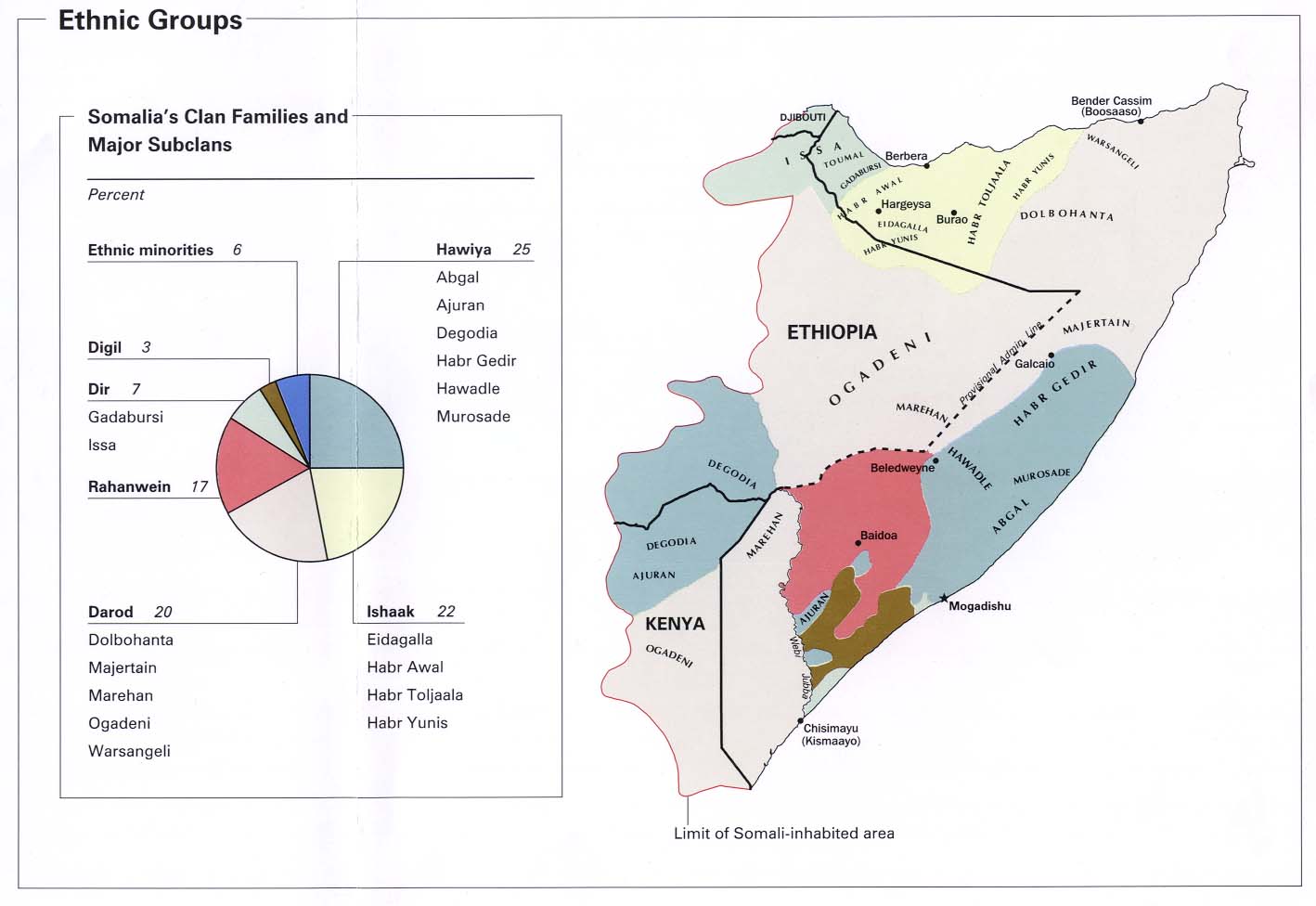
- ^ Ethnic Groups (Map). Somalia Summary Map. Central Intelligence Agency. 2002. Retrieved 30 July 2012. Perry–Castañeda Library Map Collection – N.B. Various authorities indicate that the Isaaq is among the largest east African clans who adopted the somali language [1], [2].
- ^ "Somalia – The great Somali migrations". Encyclopedia Britannica. Retrieved 24 March 2021.
- ^ Berns-McGown, Rima (1999). Muslims in the Diaspora: The Somali Communities of London and Toronto. Toronto: University of Toronto Press. pp. 27–28. ISBN 9780802082817.
- ^ Lewis, Ioan M., A Modern History of the Somali, fourth edition (Oxford: James Currey, 2002), pp. 22–23.
- ^ Nelson, Harold D. (1982). Somalia, a Country Study. U.S. Government Printing Office. p. 330.
- ^ a b c d Dierk Lange Ancient Kingdoms Of West Africa 1.
- ^ a b c I.M. Lewis, A Modern History of the Somali, fourth edition (Oxford: James Currey, 2002), pp. 31 & 42
- ^ Lewis, Ioan (1960). "The Somali Conquest of the Horn of Africa". Journal of African History. 1 (2): 213–230. doi:10.1017/S0021853700001808. JSTOR 180241. S2CID 162301641. p. 219.
- ^ Adam, Hussein M. (1980). Somalia and the World: Proceedings of the International Symposium Held in Mogadishu on the Tenth Anniversary of the Somali Revolution, October 15–21, 1979. Halgan.
- ^ a b c d Lewis, Ioan M. (1994). Blood and Bone: The Call of Kinship in Somali Society. Lawrencewill, NJ: The Red Sea Press. pp. 103–104. ISBN 0-932415-93-8.
- ^ a b Ehret, Christopher (1995). "The Eastern Horn of Africa, 1000 B.C. to 1400 A.D.: The Historical Roots". In Ahmed, Ali Jimale (ed.). The Invention of Somalia. Lawrenceville, NJ: Red Sea Press. pp. 233–256. ISBN 978-0-932415-99-8. p. 251.
- ^ a b Mire 2020, pp. 201, 205–206, cf. pp. 70–71, 154–155.
- ^ a b Mire 2020, p. 63.
- ^ a b c d Drozdík, Ladislav (2005). "Gori, Alessandro: St udi sulla letteratura agiografica islamica somala in lingua araba (Studies in Somalian Hagiographie Islamic Literature in the Arabic Language). Firenze, Universita di Firenze 2003. xii+ 430 pp. ISBN 88-901340-0-3; ISSN 1724-8213" (PDF). Asian and African Studies. 14 (1): 110.
- ^ Mukhtar, Mohamed Haji (1995). "Islam in Somali History: Fact and Fiction". In Ahmed, Ali Jimale (ed.). The Invention of Somalia. Lawrenceville, NJ: Red Sea Press. pp. 1–27. ISBN 978-0-932415-99-8. p. 15.
- ^ a b Sharif Aydarus al-Nadheeri (1955). بغية الآمال في تاريخ الصومال [The Attainment of Hopes regarding the History of Somalia] (in Arabic).
- ^ a b نور, مكتبة. "تحميل كتاب تحفة المشتاق لنسب السيد إسحاق لعبدالرحمن دبة pdf". www.noor-book.com (in Arabic). Retrieved 8 August 2021.
- ^ "Reer Shiekh Isaxaaq". Hoyga Qabaayilka Reer Sheekh Isaxaaq. Archived from the original on 9 November 2021. Retrieved 9 August 2021.
- ^ a b Zaylaʻī, ʻAbd al-Raḥmān Shaykh Maḥmūd; زيلعي، عبد الرحمن شيخ محمود. (2018). al-Ṣūmāl ʻurūbatuhā wa-ḥaḍāratuhā al-Islāmīyah = Somalia's Arabism and Islamic civilization (al-Ṭabʻah al-ūlá ed.). Dubayy. ISBN 978-9948-39-903-2. OCLC 1100055464.
{{cite book}}: CS1 maint: location missing publisher (link) - ^ a b c الاسحاقي الصومالي, عبدالرحمن. كتاب تحفة المشتاق لنسب السيد اسحاق.
- ^ Mire, Sada (2020). Divine Fertility: The Continuity in Transformation of an Ideology of Sacred Kinship in Northeast Africa. UCL Institute of Archaeology Publications. Vol. 69. New York: Routledge. ISBN 978-1-138-36850-7. p. 256.
- ^ Lewis, I. M. (1998). Saints and Somalis: Popular Islam in a Clan-based Society. The Red Sea Press. ISBN 9781569021033.
- ^ Andrzejewski, B. W. (1 January 1983). Islamic Literature of Somalia. African Studies Program, Indiana University. ISBN 9780941934473.
Shaykh Aw Barkhadle and Shaykh Isaaq belonged to the same time period.
- ^ Bader, Christian (2000). Mythes et légendes de la Corne de l'Afrique (in French). Karthala. p. 90. ISBN 9782845860698.
Translated from French to English: Then, at the age of 68 (Shaykh Isaaq), he took his pilgrim's staff and went to Harar, where the Sheikh 'Aw Barkhadle was then teaching.
- ^ Lewis, I. M. (1998). Saints and Somalis: Popular Islam in a Clan-based Society. The Red Sea Press. ISBN 978-1-56902-103-3.
- ^ Lewis, I. M. (1998). Saints and Somalis: popular Islam in a clan-based society. Red Sea Press. p. 94. ISBN 1569021031.
- ^ يحيى, بن نصر الله الهرري. مناقب الشيخ أبادر- متحف الشريف عبد الله في هرر.
- ^ Adam, Hussein M. (1980). Somalia and the World: Proceedings of the International Symposium Held in Mogadishu on the Tenth Anniversary of the Somali Revolution, October 15–21, 1979. Halgan.
- ^ Laurence, Margaret (1970). A Tree for Poverty: Somali Poetry and Prose. Hamilton: McMaster University. ISBN 978-1-55022-177-0.
- ^ Lewis, I. M. (1999). A Pastoral Democracy: A Study of Pastoralism and Politics Among the Northern Somali of the Horn of Africa. LIT Verlag Münster. ISBN 9783825830847.
- ^ I. M. Lewis, A pastoral democracy: a study of pastoralism and politics among the Northern Somali of the Horn of Africa, (LIT Verlag Münster: 1999), p. 157.
- ^ Burton. F., Richard (1856). First Footsteps in East Africa. p. 18.
- ^ Worldbank, Conflict in Somalia: Drivers and Dynamics, January 2005, Appendix 2, Lineage Charts, p. 55 Figure A-1
- ^ Country Information and Policy Unit, Home Office, Great Britain, Somalia Assessment 2001, Annex B: Somali Clan Structure Archived 16 July 2011 at the Wayback Machine, p. 43
- ^ Laurence, Margaret (1970). A Tree for Poverty: Somali Poetry and Prose. Hamilton: McMaster University. p. 145. ISBN 978-1-55022-177-0.
Then Magado, the wife of Ishaak had only two children, baby twin sons, and their names were Ahmed, nick-named Arap, and Ismail, nick-named Garaxijis .
- ^ MENAFN. "History of Sheikh Isaaq bin Mohammed (Al-Hashimi)". menafn.com. Retrieved 7 August 2021.
- ^ الغرباني, محمد بن أحمد. صورة لمخطوطة الغرباني التي تتحدث عن سيرة وحياة الشريف إسحاق بن أحمد الرضوي. pp. 95–96.
- ^ a b c d Dr. Ahmed Yusuf Farah, Matt Bryden. "Case Study of a Grassroots Peace Making Initiative". www.africa.upenn.edu. UNDP Emergencies Unit for Ethiopia. Retrieved 3 January 2022.
- ^ a b Roland Anthony Oliver, J. D. Fage, Journal of African history, Volume 3 (Cambridge University Press.: 1962), p.45
- ^ "Taariikhda Beerta Suldaan Cabdilaahi ee Hargeysa | Somalidiasporanews.com". Retrieved 9 January 2021.
- ^ Genealogies of the Somal. Eyre and Spottiswoode (London). 1896.
- ^ "Taariikhda Saldanada Reer Guuleed Ee Somaliland.Abwaan:Ibraahim-rashiid Cismaan Guure (aboor). | Togdheer News Network". Archived from the original on 11 January 2021. Retrieved 9 August 2021.
- ^ Reese, Scott S. (2018). "Claims to Community". Claims to Community: Mosques, Cemeteries and the Universe. Islam, Community and Authority in the Indian Ocean, 1839–1937. Edinburgh University Press. p. 69. ISBN 978-0-7486-9765-6. JSTOR 10.3366/j.ctt1tqxt7c.10. Retrieved 3 January 2022.
{{cite book}}:|work=ignored (help) - ^ Hassan, Mohamed-Rashid (4 November 2008). "Interview with the late Abdullahi Qarshe (1994) at the Residence of Obliqe Carton in Djibouti". Bildhaan. 2 (1): 65. ISSN 1528-6258.
- ^ a b Society, Royal Geographical (1849). The Journal of the Royal Geographical Society: JRGS. Murray. p. 64.
![[2]](http://www.lib.utexas.edu/maps/africa/somalia_ethnic_grps_2002.jpg)
Further reading
[edit]- Gori, Alessandro (2003). Studi sulla letteratura agiografica islamica somala in lingua araba. Firenze: Dipartimento di linguistica, Università di Firenze. ISBN 88-901340-0-3. OCLC 55104439.
Ishaaq bin Ahmed
View on GrokipediaBiography
Early Life and Origins
Sheikh Ishaaq bin Ahmed, traditionally regarded as the progenitor of the Isaaq clan, is described in Somali genealogical traditions as a Sayyid of Arab descent tracing his lineage to the Prophet Muhammad through his daughter Fatima and her husband Ali bin Abi Talib, belonging to the Banu Hashim branch of the Quraysh tribe.[1] These accounts position him within the Ashraf, or descendants of the Prophet, with his full paternal genealogy extending as Ishaaq bin Ahmed bin Muhammad bin al-Hussein bin Muhammad bin Abd al-Rahman bin al-Hassan bin al-Hussein bin Ali bin Abi Talib.[1] According to these traditions, Sheikh Ishaaq was born in Medina, in present-day Saudi Arabia, in 506 AH (approximately 1112 AD).[1] His father, Ahmed bin Muhammad bin al-Hussein, reportedly died shortly before or around his birth, prompting the family's migration to Yemen when Ishaaq was an infant.[1] His mother was Shariffa A’atika bint Ali bin Muhammad bin Ali, also of noble Hashimi ancestry.[1] Upbringing details remain sparse in the sources, but he is said to have grown up in Yemen's Saba region, where he spent approximately 15 years studying and preaching Islam after arriving there as a young child.[1] These narratives, drawn from oral Somali traditions, ancient manuscripts, and clan genealogical texts, portray Sheikh Ishaaq as an Islamic scholar who later journeyed to the Horn of Africa, though specific verifiable historical records of his early years are absent, reflecting the semi-legendary nature of such clan origin stories.[1] Some modern claims, including purported DNA analyses by Ashraf groups, have been invoked to affirm his Iraqi or Arabian roots, but these lack independent scholarly corroboration beyond traditional frameworks.[1]Migration and Settlement
According to Somali oral traditions and genealogical accounts, Sheikh Ishaaq bin Ahmed migrated from the Arabian Peninsula, departing Medina around 506 AH (1112 AD), and initially settled in Yemen's Hadhramaut region before moving to the Saba area for approximately 15 years.[1] He later performed the Hajj pilgrimage and resided in Al-Jouf, Yemen, prior to departing at age 57 for the Horn of Africa.[1] The traditional route continued via the port of Zeila (Zaila) in present-day Somaliland, where he briefly stayed, followed by travel inland to Harar in Ethiopia, and onward to Mait, a village associated with the Magaadle branch of the Dir clan in northeastern Somaliland.[1] [3] These accounts, drawn from Arabic hagiographies and clan genealogies such as the 1955 text Amjaad by Sheikh Husseen bin Ahmed Darwiish al-Isaaqi, place his arrival in the region during the 12th to 14th centuries, though precise dating remains inconsistent across sources.[3] [1] Upon settlement, Sheikh Ishaaq established himself in the coastal town of Maydh in the Sanaag region (modern-day Somaliland), intermarrying with local women from the Magaadle Dir to produce eight sons who became eponymous ancestors of the Isaaq sub-clans.[3] [1] His tomb in Maydh serves as a focal point for clan pilgrimage and reinforces these settlement narratives, though empirical verification beyond oral and textual traditions is limited.[3] From this base, Isaaq descendants expanded across northern Somalia's Awdal, Maroodi Jeex, Togdheer, Sahil, Sanaag, and Sool regions, as well as adjacent areas in Ethiopia, Djibouti, and Kenya.[3]Lineage and Descendants
Claimed Paternal Genealogy
Ishaaq bin Ahmed, traditionally identified as Sheikh Ishaaq, is claimed in Somali oral traditions and hagiographic accounts to descend paternally from Ali ibn Abi Talib, the cousin, son-in-law, and fourth caliph of the Prophet Muhammad, through the Banu Hashim branch of the Quraysh tribe.[1] This lineage positions him as a Sayyid, conferring religious prestige upon the Isaaq clan as Ashraf, or descendants of the Prophet via Ali's marriage to Fatima, the Prophet's daughter.[4] The immediate paternal chain is recited as Ishaaq bin Ahmed bin Muhammad bin Hussein al-Hashimi, originating from the Arabian Peninsula before migration to the Horn of Africa.[1] These genealogies emphasize a direct male-line transmission from Ali, bypassing maternal intermarriages common in broader Sayyid claims, though full nasab (genealogical trees) vary slightly across Isaaq sub-clans and lack independent corroboration beyond clan custodians.[4][1] Such claims, while central to Isaaq identity and reinforced in religious texts like Arabic hagiologies, serve to underscore Islamic scholarly heritage and noble descent, often paralleling similar assertions by other Somali clans like the Darod. Empirical verification remains elusive, relying on unverified oral chains preserved by religious lineages rather than contemporary records from the 11th-13th centuries when Ishaaq is said to have lived.[1][4]Marriages and Immediate Family
According to Somali genealogical traditions documented in regional historical accounts, Sheikh Ishaaq bin Ahmed contracted four marriages during his travels, primarily in Yemen and the Horn of Africa, with offspring forming branches of descent outside the core Isaaq clan in Somaliland. His first wife was the sister of the ruler of Saba in Yemen, who bore two sons, Dara’an and Sharif; the latter's descendants are associated with the Al-Karab lineage in Yemen.[1] His second marriage, to the daughter of his uncle Tahir in the Al-Jawf region of Yemen, produced one son, Mansour, regarded as the forefather of the Al Mansur branch.[1] The third marriage was to a woman from the Habuushed tribe in Harar, Ethiopia, yielding four sons who became ancestors of Habar Magaadle sub-clans: Ahmad (founder of Tol Je’lo), Musa (Habar Je’lo), Ibrahim (Sanbur), and Muhammad (Cimraan).[1] The fourth and final marriage occurred in Somaliland to a local woman of the Magadleh Dir clan from the Mait area, who bore four additional sons: Ayub, Ismail (progenitor of Garhajis), Arap, and Abdalrahman (founder of Awal).[1] These eight sons from the latter two wives are traditionally viewed as the immediate progenitors of the major Isaaq clan divisions, though accounts vary and rely on oral genealogies rather than contemporaneous records.[1] No daughters are prominently recorded in these traditions, and the familial narratives emphasize patrilineal descent aligned with Somali clan structures. These claims stem from pre-modern genealogical texts and oral histories preserved within Isaaq communities, which prioritize symbolic ancestry over empirical verification.[1]Sub-Clan Foundations
The sub-clans of the Isaaq clan-family trace their foundations to the sons of Ishaaq bin Ahmed, organized traditionally into uterine divisions reflecting the ethnic origins of their mothers, a structure emphasizing matrilineal alliances in Somali genealogy known as habar (meaning "mother" in archaic Somali).[3] This division separates lineages from Ishaaq's marriage to a woman from the Harari Habuushed tribe in Harar (eastern Ethiopia) and those from his union with a woman of the Magaadle Dir clan near Mait in Somaliland.[1] The Habr Habuusheed division descends from the former, comprising smaller lineages such as Tol Je’leh (from son Ahmad), Habar Je’lo (from son Musa), Sanbur (from son Ibrahim), and Cimraan (from son Muhammad), with burials indicating early settlements in areas like Gammaanso between Dayaha and Erigavo.[1] The more prominent Habr Magaadle division, founded by sons from the Magaadle Dir wife, includes major sub-clans such as Ayub (from son Ayub), Garhajis (from son Ismail, buried at Karin), Habar Awal (from son Abdalrahman, or Awal), Arap (from son Arap, buried at Daalo), Habar Yunis, and Habar Je’lo (overlapping with Habr Habuusheed in some accounts).[3][1] These foundations are rooted in oral traditions dating to Ishaaq's 13th- or 14th-century settlement in Maydh, Somaliland, where intermarriages facilitated clan expansion across northwestern Somalia, Djibouti, and eastern Ethiopia.[3] Sub-clan territories solidified through pastoral migrations and alliances, with Habar Awal establishing strongholds in coastal and western regions like Berbera, while Habar Je’lo and Habar Yunis dominated interior highlands.[3] This genealogical framework, preserved in Somali poetic and oral histories, underscores patrilineal descent from Ishaaq but incorporates uterine ties for cohesion, though empirical verification remains limited to traditional accounts rather than contemporary records.[1] Variations exist across recitations, with some emphasizing six principal sons overall, reflecting adaptive clan narratives amid nomadic dispersal.[3]Legacy
Religious and Cultural Impact
Sheikh Ishaaq bin Ahmed is traditionally regarded as an Islamic scholar who contributed to the spread of Islam among local populations in the Horn of Africa, particularly through his settlement in the coastal town of Maydh, where oral accounts credit him with converting pagan communities to the faith.[1] His purported descent from the Prophet Muhammad via Fatima, conferring Sharif status, has elevated his figure in Isaaq religious narratives, fostering a sense of spiritual lineage that underscores adherence to Shafi'i jurisprudence and broader Sunni practices.[5] The tomb of Sheikh Ishaaq in Maydh serves as a focal point for religious veneration, attracting frequent pilgrimages known as siyaara, where devotees perform rituals seeking barakah (blessings). These gatherings reinforce communal piety and Islamic identity among the Isaaq, with annual observances drawing participants from Somaliland and the diaspora, particularly in the Middle East. Additionally, his mawlid—commemorating his birth—is observed weekly on Thursdays through public recitations of manaqib, collections detailing his virtuous deeds, which sustain hagiographic traditions amid Somalia's historical Sufi-influenced devotional culture.[3][6] Culturally, Sheikh Ishaaq's legacy manifests in the Isaaq clan's oral genealogies and poetry, which invoke his travels from Arabia to legitimize Arab-Muslim heritage, enhancing clan prestige and social cohesion in Somaliland society. These narratives, preserved in Arabic hagiologies and recited in gatherings, have shaped identity formation, distinguishing Isaaq traditions from neighboring groups while promoting values of scholarship and migration as cultural ideals. However, such accounts rely on unverified oral transmission, with their enduring influence stemming from their role in unifying descendants rather than empirical historicity.[1][6]Tomb and Associated Traditions
The tomb of Sheikh Ishaaq bin Ahmed is located in Maydh, a coastal town in the Sanaag region of Somaliland, where he is said to have spent his final years and passed away.[7] The structure features a domed mausoleum, characteristic of historical Somali-Islamic architectural sites, and serves as a focal point for Isaaq clan reverence.[8] Associated traditions include frequent pilgrimages (ziyarat or siyaaro) to the site by Isaaq descendants, who pay respects to Sheikh Ishaaq as their eponymous ancestor.[3] These visits often involve prayers and reflections on lineage ties, reinforcing communal identity within the clan. Additionally, Sheikh Ishaaq's mawlid, or birthday commemoration, is observed every Thursday through public dhikr gatherings at the tomb, drawing participants for religious recitations and supplications.[3] Some oral accounts claim the mausoleum also houses the graves of certain sons, such as Abdirahman (founder of the Awal sub-clan) and Muse (Habar Jeclo), though variant traditions place other sons' burials at sites like Daalo or Karin, reflecting inconsistencies in genealogical narratives preserved through clan lore.[1] These practices underscore the tomb's role in sustaining Isaaq cultural and spiritual heritage, with preservation efforts noted for maintaining the site's historical integrity amid regional challenges.Historical Debates
Authenticity of Descent Claims
The descent claims of Ishaaq bin Ahmed trace his lineage to Ahmed bin Muhammad al-Hashimi, purportedly linking through Fatima and Ali to the Prophet Muhammad, with traditions placing his arrival in the Horn of Africa around the 12th to 14th century CE.[1] These genealogies, preserved in oral traditions and some Somali texts, position Ishaaq as a Sharif (descendant of the Prophet), conferring religious prestige upon the Isaaq clan-family.[5] However, anthropologists such as I. M. Lewis describe such claims as notional, serving to integrate Islamic identity with indigenous kinship structures rather than reflecting verifiable historical migration or paternity.[9] No contemporary written records from Arab or Somali sources corroborate Ishaaq's existence, migration from Samarra or Yemen, or specific descent from named Hashimite figures.[10] Northern Somali genealogies, including those of the Isaaq, often exhibit telescoping—where intermediate generations are omitted or fabricated to bridge eponymous ancestors to distant Islamic progenitors—functioning more as charters for alliance and authority than literal histories.[2] The Isaaq are frequently classified within the Dir clan-family, an indigenous Somali group with pre-Islamic roots, suggesting the Sheikh Ishaaq narrative may represent a later assimilation of a holy man into local lineages or a unifying myth for diverse sub-clans.[11] Genetic analyses undermine paternal Arab descent. Y-chromosome studies of Somalis, including Isaaq samples, predominantly show haplogroups E-V32 (a subclade of E-M78, autochthonous to Northeast Africa) and T-M184, both lacking signatures of recent Arabian Peninsula input like J1-M267 subclades common in Semitic-speaking Arabs. A 2020 HLA genome-wide study of ethnic Somalis confirmed an East African genetic profile with minimal Middle Eastern admixture beyond ancient Eurasian backflow, inconsistent with a 12th-century founding father of Arab origin.[12] These findings align with broader patterns where Somali clan claims to Arab ancestry—prevalent across groups like Dir, Hawiye, and Darod—elevate status via prophetic ties but contradict empirical patrilineal continuity.[13]Oral Tradition Versus Empirical Evidence
Somali oral traditions, preserved through abtirsi (genealogical recitations) and poetry, portray Ishaaq bin Ahmed as a historical Arab sheikh who migrated from the Arabian Peninsula—possibly Hadhramaut or Samarra—to the Horn of Africa between the 10th and 12th centuries, intermarrying with local clans like the Dir and founding the Isaaq confederation as a patrilineal descent group.[1] These accounts emphasize his religious scholarship and Hashimi lineage tracing to the Prophet Muhammad, serving to legitimize clan identity, territorial claims, and Islamic piety within a segmentary lineage system where genealogies function as social charters rather than literal histories.[2] Such traditions, transmitted verbatim across generations for political and ritual purposes, exhibit internal consistency within Isaaq subgroups but vary in details like exact migration routes or birthplaces, reflecting adaptive memorization rather than fixed documentation.[14] Empirical evidence for Ishaaq's existence or the described migration remains absent, with no contemporary Arabic, Somali, or regional records from the 11th-12th centuries corroborating a figure of his stature; the earliest printed biographies, such as the Amjaad by Sheikh Husseen bin Ahmed al-Isaaqi, date to the 19th-20th centuries and derive from oral sources without independent verification. Archaeological findings in Somaliland yield no artifacts or inscriptions linked to an Arabian founder in that era, while the region's medieval trade networks, though connecting Yemen and the Horn, show cultural diffusion rather than mass settlement or clan foundation by individuals. Genetic analyses further challenge patrilineal Arab descent: Y-chromosome studies of Isaaq samples predominantly reveal E-V32 and related E1b1b subclades, autochthonous to Cushitic-speaking Northeast Africans and predating putative Arab influxes, with minimal J1 haplogroup frequencies (under 10%) inconsistent with a bottleneck founder event from a single migrant.[15] Autosomal DNA profiles of Somalis, including Isaaq, indicate 70-80% Cushitic ancestry with low-level West Eurasian admixture from historical contacts, not a discrete Arabian progenitor signature.[13] This discrepancy underscores oral genealogies' role as ideological constructs in Somali society, where claims of saintly or prophetic descent enhanced cohesion and prestige amid Islamization (post-7th century) and competition with neighboring groups, often prioritizing symbolic unity over biological fidelity—a pattern critiqued in anthropological analyses as "mythico-historical" rather than evidentiary.[16] While oral traditions provide cultural continuity and self-reported coherence, their divergence from genetic and archival voids suggests Ishaaq bin Ahmed functions more as an eponymous ancestor or composite legend than a verifiable historical actor, akin to origin myths in other pastoralist societies lacking pre-colonial literacy. Peer-reviewed genomic surveys reinforce this, showing clan endogamy preserves haplogroup distributions but traces no amplified paternal lineage from medieval Arabia, implying endogenous diversification of proto-Isaaq groups with later Arabo-Islamic veneer.[17]References
- https://handwiki.org/wiki/Biography:Ishaaq_bin_Ahmed