



Community hub
Recent from talks
Knowledge base stats:
Talk channels stats:
Members stats:
Sicilian Vespers
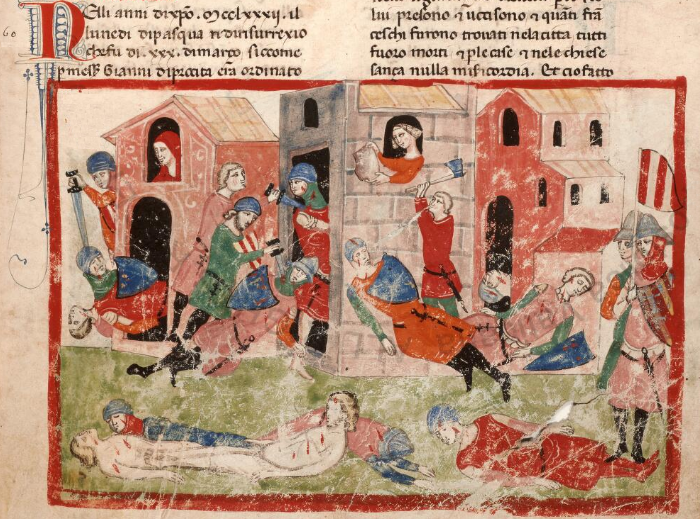
The Sicilian Vespers (Italian: Vespri siciliani; Sicilian: Vespiri siciliani) was a successful rebellion on the island of Sicily that broke out at Easter 1282 against the rule of the French-born king Charles I of Anjou. Since taking control of the Kingdom of Sicily in 1266, the Angevin government had made itself unpopular with its exploitative policies and exclusion of native Sicilians from power.
Sparked by an incident in Palermo, the revolt quickly spread to the majority of Sicily. Within six weeks, approximately 13,000 French men and women were slain or expelled by the rebels, and the government of Charles lost control of the island. Seeking support for the rebellion, the Sicilians offered the throne to Peter III of Aragon, who claimed the crown on behalf of his wife, Constance of Sicily. The Aragonese intervention in the rebellion led to an expansion of the conflict into the War of the Sicilian Vespers.
The rising had its origin in the struggle of investiture between the pope and the Hohenstaufen Holy Roman Emperors for control of Italy, especially the Church's private demesne known as the Papal States. These lay between Hohenstaufen lands in northern Italy and the Hohenstaufen Kingdom of Sicily in the south; the Hohenstaufens also, at the time, ruled Germany.
In 1245 Pope Innocent IV excommunicated Frederick II and declared him deposed, and roused opposition against him in Germany and Italy. When Frederick died in 1250, his dominion was inherited by his son, Conrad IV of Germany. A period of turmoil followed Conrad's death in 1254, and the Kingdom of Sicily was seized by Manfred, King of Sicily, Frederick's illegitimate son, who reigned from 1258 to 1266.
Manfred had no involvement in German politics, where the interregnum lasted longer and there was no emperor until 1274. He first styled himself as vicar of his nephew Conradin, Conrad's son. However, following a false rumor that Conradin was dead, Manfred had himself crowned king. He wished for a reconciliation with the papacy, which may have explained his support for the landless Baldwin II, Latin Emperor. However, Pope Urban IV and later Pope Clement IV were not prepared to recognize Manfred as lawful ruler of Sicily and first excommunicated him, then sought to depose him by force of arms.
After abortive attempts to enlist England as the champion of the Papacy against Manfred, Urban IV settled on the later Charles I of Naples as his candidate for the Sicilian throne. Charles would invade Italy, and in 1266 defeated and killed Manfred at the Battle of Benevento, becoming King of Sicily. In 1268 Conradin, who had meanwhile come of age, invaded Italy to press his claim to the throne, but he was defeated at the Battle of Tagliacozzo and executed afterwards. Charles was now undisputed master of the Kingdom of Sicily.
Charles regarded his Sicilian territories as a springboard for his Mediterranean ambitions, which included the overthrow of Michael VIII Palaiologos of the Byzantine Empire and the capture of Constantinople. Constantinople was captured during the Fourth Crusade and had been brought into the fold of the Roman Catholic religion for 57 years under the rule of the Latin Empire. With the Byzantine recapture of the city in 1261, Michael VIII Palaiologos continued to rebuild what was left of the economically strategic city as an important trade route to Europe.
Unrest simmered in Sicily because of its very subordinate role in Charles' empire—its nobles had no share in the government of their own island and were not compensated by lucrative posts abroad, as were Charles' French, Provençal and Neapolitan subjects; also, Charles spent the heavy taxes he imposed on wars outside Sicily, making Sicily somewhat of a donor economy to Charles' nascent empire. As Steven Runciman put it, "[The Sicilians] saw themselves now being ruled to enable an alien tyrant make conquests from which they would have no benefit".
Hub AI
Sicilian Vespers AI simulator
(@Sicilian Vespers_simulator)
Sicilian Vespers
The Sicilian Vespers (Italian: Vespri siciliani; Sicilian: Vespiri siciliani) was a successful rebellion on the island of Sicily that broke out at Easter 1282 against the rule of the French-born king Charles I of Anjou. Since taking control of the Kingdom of Sicily in 1266, the Angevin government had made itself unpopular with its exploitative policies and exclusion of native Sicilians from power.
Sparked by an incident in Palermo, the revolt quickly spread to the majority of Sicily. Within six weeks, approximately 13,000 French men and women were slain or expelled by the rebels, and the government of Charles lost control of the island. Seeking support for the rebellion, the Sicilians offered the throne to Peter III of Aragon, who claimed the crown on behalf of his wife, Constance of Sicily. The Aragonese intervention in the rebellion led to an expansion of the conflict into the War of the Sicilian Vespers.
The rising had its origin in the struggle of investiture between the pope and the Hohenstaufen Holy Roman Emperors for control of Italy, especially the Church's private demesne known as the Papal States. These lay between Hohenstaufen lands in northern Italy and the Hohenstaufen Kingdom of Sicily in the south; the Hohenstaufens also, at the time, ruled Germany.
In 1245 Pope Innocent IV excommunicated Frederick II and declared him deposed, and roused opposition against him in Germany and Italy. When Frederick died in 1250, his dominion was inherited by his son, Conrad IV of Germany. A period of turmoil followed Conrad's death in 1254, and the Kingdom of Sicily was seized by Manfred, King of Sicily, Frederick's illegitimate son, who reigned from 1258 to 1266.
Manfred had no involvement in German politics, where the interregnum lasted longer and there was no emperor until 1274. He first styled himself as vicar of his nephew Conradin, Conrad's son. However, following a false rumor that Conradin was dead, Manfred had himself crowned king. He wished for a reconciliation with the papacy, which may have explained his support for the landless Baldwin II, Latin Emperor. However, Pope Urban IV and later Pope Clement IV were not prepared to recognize Manfred as lawful ruler of Sicily and first excommunicated him, then sought to depose him by force of arms.
After abortive attempts to enlist England as the champion of the Papacy against Manfred, Urban IV settled on the later Charles I of Naples as his candidate for the Sicilian throne. Charles would invade Italy, and in 1266 defeated and killed Manfred at the Battle of Benevento, becoming King of Sicily. In 1268 Conradin, who had meanwhile come of age, invaded Italy to press his claim to the throne, but he was defeated at the Battle of Tagliacozzo and executed afterwards. Charles was now undisputed master of the Kingdom of Sicily.
Charles regarded his Sicilian territories as a springboard for his Mediterranean ambitions, which included the overthrow of Michael VIII Palaiologos of the Byzantine Empire and the capture of Constantinople. Constantinople was captured during the Fourth Crusade and had been brought into the fold of the Roman Catholic religion for 57 years under the rule of the Latin Empire. With the Byzantine recapture of the city in 1261, Michael VIII Palaiologos continued to rebuild what was left of the economically strategic city as an important trade route to Europe.
Unrest simmered in Sicily because of its very subordinate role in Charles' empire—its nobles had no share in the government of their own island and were not compensated by lucrative posts abroad, as were Charles' French, Provençal and Neapolitan subjects; also, Charles spent the heavy taxes he imposed on wars outside Sicily, making Sicily somewhat of a donor economy to Charles' nascent empire. As Steven Runciman put it, "[The Sicilians] saw themselves now being ruled to enable an alien tyrant make conquests from which they would have no benefit".