Hubbry Logo
Siege of GythiumSiege of GythiumMain
Open search
Siege of Gythium
Community hub
Siege of Gythium
logo
8 pages, 0 posts
0 subscribers
Be the first to start a discussion here.
Siege of Gythium
Siege of Gythium
from Wikipedia
Siege of Gythium
Part of War against Nabis

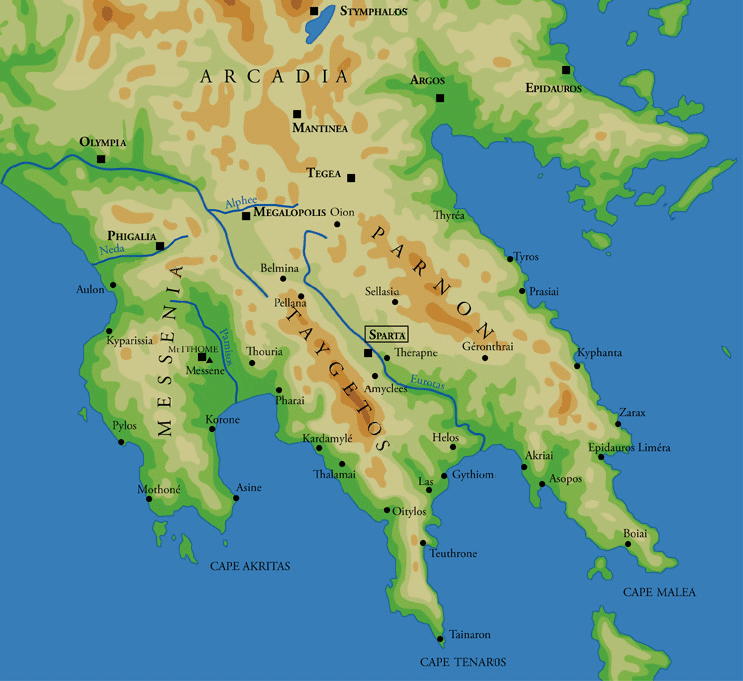
A map of the southern Peloponnese.
Date195 BC
Location
Result Allied Victory
Belligerents
Roman Republic
Achaean League
Rhodes
Pergamum
Macedon
Sparta
Commanders and leaders
Titus Quinctius Flamininus
Eumenes II of Pergamum
Dexagoridas 
Gorgopas
Strength
About 50,000 men

The siege of Gythium was fought in 195 BC between Sparta and the coalition of Rome, Rhodes, the Achaean League, and Pergamum. As the port of Gythium was an important Spartan base, the allies decided to capture it before they advanced inland to Sparta. The Romans and the Achaeans were joined outside the city by the Pergamese and Rhodian fleets. The Spartans held out, but one of the joint commanders, Dexagoridas, decided to surrender the city to the Roman legate. When Gorgopas, the other commander, found out, he killed Dexagoridas and took sole command of the city. After Dexagoridas' murder, the Spartans held out more vigorously. However, Titus Quinctius Flamininus of the allied forces arrived with 4,000 more men and the Spartans decided to surrender the city on the condition that the garrison could leave unharmed. The result of this siege forced Nabis, the tyrant of Sparta, to abandon the surrounding land and withdraw to the city of Sparta. Later that year, Sparta capitulated to the allies.

Prelude

[edit]

The Macedonians had been defeated in the Second Macedonian War in 197 BC which left the Spartans in control of Argos. This Spartan gain was a setback for the Achaean League who had been trying to incorporate Sparta into their league for many years. The Romans had won the Second Macedonian War and it left them in control of Greek affairs. However, they decided not to occupy Greece but to garrison some cities for five years.[1] The tyrant of Sparta, Nabis, who had declared himself king, was troubling the Achaean League and was also threatening to destroy the peace in Greece.

In 195 BC, Flamininus summoned his army in Greece and that of his allies at Plataea in Boeotia. He then marched from Plataea to Argos where he was joined by 10,000 Achean infantry and 1,000 cavalry.[2] After a few brief skirmishes, the allies decided to abandon the siege and they pitched in Tegea.[3] They then advanced upon Caryae where they were joined by 1,500 Macedonians and 400 Thessalian cavalry.[3]

Nabis also made his own preparations. Nabis had always been on good terms with Cretan leaders and he requested 1,000 of their best soldiers who were hand picked to assist him. As well as the Cretans, he hired 3,000 mercenaries and 10,000 citizens.[4] The Romans and their allies then advanced upon Sellasia not far north of Sparta. The Romans were defeated in a small battle and they retreated.[4] The Romans then won another battle against the Spartans and forced them to retreat into the city.[5]

Siege

[edit]

Some coastal cities surrendered to the Romans which allowed them to have a base in the coastal regions of Laconia.[5] Gythium was a large city and had been made by the Spartans as their main port and naval arsenal. The Romans advanced upon the city and they were joined there by the combined Rhodian and Pergamese fleets. The sailors from the Roman, Pergamese, and Rhodian fleets built siege engines which had devastating effects on the walls.[5] One of the city's joint commanders, Dexagoridas, offered to surrender the city to the Roman legate in charge of the fleet while Flamininus was gone.[5] When the other commander Gorgopas found out, he murdered Dexagoridas.[5]

Macedonia and the Aegean world.

Now with the city under Gorgopas' command the defenders became reinvigorated. The siege was proving more difficult until Flamininus arrived with 4,000 Roman soldiers.[6] With the arrival of the new soldiers, the allied soldiers were encouraged and began bombarding the city again with their siege engines while the Rhodian and Pergamese fleet continued to put pressure on the Spartans from the sea. The Spartans knew that they did not have much of a chance of withstanding the renewed allied assault and Gorgopas decided to surrender the city to the Romans under the condition that the garrison was allowed to leave the city unharmed.[6]

Aftermath

[edit]

When Nabis found out that Gythium had fallen to the allies he decided to abandon the remaining Laconian countryside that he controlled. Nabis sent envoys to Flamininus who offered Nabis a parley.[6] The Romans attacked Sparta when the parley ended but the Spartans withstood the initial allied assaults. Nabis, however, seeing that the situation was hopeless, agreed to surrender the city to the Romans.[7] The Romans forced Nabis to abandon Argos and most of the coastal cities of Laconia.[8] The Romans formed all the cities that had broken off from Sparta on the Laconian coast into the Union of Free Laconians.[9] However, the Romans didn't strip Nabis of his powers because they wanted a state in the Peloponnese to counter the growing Achaean League.[10] Nabis attacked Gythium two or three years later only to retreat after being unable to capture the city but in 192 BC he was assassinated by the Aetolians before he had a chance to attempt another attack on the city. In 189 BC, the Spartans, having been deprived of a port, attacked and captured the city of Las. The Acheans, threatened by the attack, demanded the surrender of those responsible for the attack and when that was refused they captured the city.[11][10]

Notes

[edit]

References

[edit]
Revisions and contributorsEdit on WikipediaRead on Wikipedia
from Grokipedia
The Siege of Gythium was a pivotal engagement in 195 BC during the Roman-Spartan War (also known as the Laconian War or ), in which a coalition of Roman and Greek forces captured the strategically vital Spartan port city and naval arsenal of Gythium from the tyrant Nabis, marking a significant blow to Sparta's maritime capabilities. The conflict arose from Nabis's aggressive expansionism and alliances with Rome's enemies, prompting the , fresh from victories in the Second Macedonian War, to intervene alongside Hellenistic allies to curb Spartan influence in the . The Roman commander was the consul Titus Quinctius Flamininus, who coordinated the land operations, while his brother Lucius Quinctius led the naval assault with a combined fleet comprising approximately 40 Roman quinqueremes, 18 Rhodian vessels, and additional ships from Pergamum, totaling around 68 warships under the overall command of allied leaders including of Pergamum. On the Spartan side, Gythium was defended by co-commanders Dexagoridas and Gorgopas, with a bolstered by local inhabitants and recent settlers loyal to Nabis, though exact numbers remain unspecified in ancient accounts. The siege commenced with a combined land and sea blockade, as the coalition forces approached Gythium—Sparta's primary harbor, located southeast of the city of Sparta itself—and established siege works to isolate the port. Flamininus reinforced the operation by dispatching 4,000 troops to support his brother, enabling assaults using siege engines such as battering rams and undermining techniques that caused sections of the harbor walls and a defensive tower to collapse. Initial skirmishes saw Spartan defenders repel advances, but internal discord emerged when Dexagoridas attempted to negotiate surrender; Gorgopas responded by slaying him and rallying the garrison to continue resistance. Despite fierce fighting, including the use of Roman siege machinery to breach fortifications, the defenders held until additional reinforcements arrived, after which Gorgopas capitulated on terms allowing the garrison safe passage to Sparta. The fall of Gythium deprived Nabis of his naval base and fleet, severely hampering Sparta's ability to project power and paving the way for the subsequent coalition advance on Sparta itself, which ultimately forced Nabis to sue for peace. This victory underscored Rome's growing dominance in Greek affairs and the effectiveness of combined Roman engineering and allied naval support in Hellenistic warfare.

Background

The War against Nabis

Nabis seized power in Sparta around 207 BC, shortly after the death of the previous tyrant Machanidas at the Battle of Mantinea, establishing himself as ruler through a coup that ended the brief regency for the young . His regime was characterized by tyrannical oppression, including the execution of political rivals and the use of terror to consolidate control, as ancient historians like and described him as a bloodthirsty despot who undermined traditions. During the Second Macedonian War, Nabis allied with , receiving the city of Argos in 197 BC as a result. After Philip's defeat, he formed an alliance with the , which provided mutual support against common enemies, and he engaged in from ports, dispatching ships that disrupted maritime routes and captured Roman citizens, exacerbating tensions in the Aegean. These actions, including raids around Cape Malea, not only enriched his treasury but also threatened the economic stability of Greek city-states reliant on sea commerce. The Roman intervention against Nabis stemmed from the aftermath of the Second Macedonian War, concluded in 197 BC with ' victory over V at the , which removed Macedonian influence from . In 196 BC, at the , Flamininus proclaimed the freedom of the Greek states, obligating powers like to respect the autonomy of coastal territories, yet Nabis violated these peace terms by retaining control over seized towns such as Gythium, a vital Spartan port essential for naval operations. Prior to this, Nabis had expanded Spartan influence through conquests, including an attack on around 201 BC where he seized territory by force, and the occupation of Argos in 197 BC, which he fortified against rivals following V's withdrawal. These aggressions, combined with his piracy, prompted Roman accusations of tyranny and instability, leading to a formal declaration of war against Nabis in the spring of 195 BC by the . To prosecute the war, assembled a coalition that included the , led by the , who contributed significant infantry forces motivated by Nabis' encroachments on Peloponnesian territories. joined for naval support, deploying ships to counter Nabis' piracy and secure trade lanes, while King of Pergamum provided a fleet of warships and auxiliary troops to bolster the allied armada. Flamininus coordinated these allies at a conference in , initiating joint movements toward Spartan-held areas, with initial advances targeting Nabis' coastal strongholds to isolate his regime. This multinational effort reflected 's strategy of leveraging Greek grievances to enforce its post-war order in the region.

Strategic Importance of Gythium

Gythium served as Sparta's primary deep-water port on the , providing essential access to maritime trade, supplies, and naval operations in the southern . Located approximately 45 kilometers southeast of at the western edge of the gulf, it functioned as the chief maritime outlet for Laconia, enabling the transport of goods and reinforcements across the Aegean while shielding the region from naval threats. Its strategic position made it indispensable for sustaining Sparta's economy and military logistics, particularly under Nabis' rule, where it supported the importation of mercenaries and export of piratical gains. Economically and militarily, Gythium held critical significance as Nabis exploited the port for operations around Cape Malea, generating revenue and disrupting Roman shipping in violation of prior treaties. Nabis had fortified it as a naval arsenal, using it to import foreign mercenaries and maintain his fleet, which bolstered his control over coastal territories seized after the Second Macedonian War. Capturing Gythium would sever Sparta's sea routes, isolating the city from external reinforcements, food supplies, and trade, thereby weakening Nabis without requiring an immediate assault on the heavily fortified inland capital. In the historical context of the war, Roman concerns over Nabis' expansion along the Peloponnesian coast intensified following his violations of the Roman settlement proclaimed at the in 196 BC by retaining control over coastal territories such as Argos (the earlier seizure of in 201 BC had violated a prior with in 205 BC). The allied coalition, led by , prioritized Gythium as the initial target to exploit its role in Nabis' illicit activities and to strategically encircle by controlling both land approaches and the gulf. Gythium's vulnerabilities further enhanced its appeal as a target, featuring a relatively modest compared to Sparta's defenses and its exposure to simultaneous land and sea assaults. Populated by a mix of Lacedaemonians and maritime , the port exhibited potential for rapid capitulation due to divided loyalties among residents wary of Nabis' tyrannical policies, which alienated traditional Spartan elites in favor of helot supporters.

Forces Involved

Allied Coalition

The allied coalition besieging Gythium in 195 BC comprised Roman, Achaean, Rhodian, Pergamene, Macedonian, and Thessalian forces, united against the Spartan tyrant Nabis to curb his expansionism and piracy in the Aegean. This multinational effort leveraged complementary strengths in land , naval , and engineering, enabling a coordinated on Sparta's vital port. Roman forces, initially absent due to Titus Quinctius Flamininus's diplomatic engagements in central Greece, relied on allied contingents for the opening phase of the siege. Lucius Quinctius, Flamininus's brother, commanded the Roman fleet of 40 warships that arrived first to support the blockade. Flamininus later reinforced the land assault with approximately 4,000 picked , bolstering the coalition's heavy troop capability and providing disciplined legionaries for direct assaults on the fortifications. The contributed the largest land contingent, with 10,000 infantry and 1,000 cavalry under the command of Aristaenus, encamping near Cleonae before joining the Romans. These hoplites and light troops formed the core of the land-based attacks, driven by Nabis's recent seizure of Argos and incursions into Messenian territories allied to the League, which threatened Achaean security in the . The Rhodian fleet, numbering 18 decked warships, established a tight naval of Gythium's harbor to cut off Spartan resupply and reinforcements. Renowned for their maritime prowess and experience in countering —Nabis's privateers had disrupted Rhodian routes—the Rhodians also deployed expertise in constructing siege engines, including and protective sheds, to target the seaward walls. King of Pergamum provided a naval squadron of 10 decked warships, 30 despatch-boats, and smaller vessels, integrating seamlessly with the Roman and Rhodian fleets for combined operations. His contingent included skilled engineers and specialists who contributed catapults and other machinery essential for breaching the town's defenses, reflecting Pergamum's reputation for Hellenistic military innovation. Additional support came from 1,500 Macedonian infantry sent by King Philip V and 400 Thessalian cavalry, further strengthening the land forces. This integration of diverse forces—Roman discipline, Achaean numbers, Rhodian seamanship, and Pergamene technology—proved decisive in isolating and overwhelming the defenders.

Spartan Defenders

The garrison at Gythium consisted primarily of local Laconian troops and mercenaries, including and Peloponnesian auxiliaries; ancient accounts do not specify the exact number. Notably, it lacked the elite Spartan citizen-soldiers, underscoring tyrant Nabis' heavy dependence on hired forces to bolster his . These troops were a mix of citizens and resident aliens, thoroughly equipped with arms and defensive apparatus, but their composition reflected the broader decline of traditional Spartan military institutions under Nabis' rule. Leadership of the defenders was divided between Dexagoridas, the initial commander, and his deputy Gorgopas, creating immediate tensions within the command structure. Dexagoridas, perceiving the garrison's low morale and the futility of prolonged resistance against the allied coalition, secretly negotiated with the Roman legate Quinctius Flamininus to surrender the city, but Gorgopas assassinated him upon discovering the plot and seized full control to enforce a policy of defiance. This internal conflict highlighted the fragility of Nabis' authority, as the deputy's drastic action aimed to prevent collapse but ultimately isolated the defenders further. The defenses of Gythium were robust, featuring fortified walls on both landward and seaward approaches, along with watchtowers and harbor chains to impede naval assaults; however, preparations were hampered by limited stockpiling of and other supplies, as Nabis diverted resources to protect itself. No reinforcements arrived from the Spartan capital during the siege, with Nabis prioritizing the defense of his stronghold amid the broader campaign. Overall, the garrison's internal dynamics were plagued by disloyalty and division, exacerbated by Nabis' tyrannical reputation, which eroded allegiance among the mercenaries and locals alike and contributed to the rapid unraveling of resistance.

The Siege

Initial Assaults

In 195 BC, allied forces under Lucius Quinctius, including the Achaean League, Pergamene troops, and a Rhodian fleet of eighteen decked ships, approached Gythium, the principal Spartan naval base, to initiate the siege as part of the broader coalition effort against the Spartan tyrant Nabis. The attackers quickly established a naval blockade to prevent any escape or reinforcement by sea, effectively isolating the port city. The first engagements erupted in skirmishes along the city walls, where allied troops deployed siege ladders and battering in an attempt to scale and breach the defenses. These assaults were met with fierce Spartan resistance orchestrated by the garrison commander Gorgopas, whose archers rained arrows on the climbers while sorties from disrupted the attackers' formations and forced temporary retreats. Despite the intensity of these clashes, the Spartans held firm, repelling multiple waves over the initial days of . The attackers employed naval battering and undermining techniques, causing sections of the harbor walls and a tower to collapse. Complementing the land operations, the Rhodian squadron bombarded the harbor defenses, targeting Spartan supply vessels and sinking several to cripple resupply efforts. Meanwhile, Pergamene engineers, leveraging a large contingent of seamen for labor, constructed protective earthworks and towers to shield advancing troops and consolidate the besiegers' positions around the perimeter. To bolster and deter any internal dissent, Gorgopas publicly executed Dexagoridas, a subordinate who had secretly negotiated surrender terms with the attackers, framing the act as a necessary measure against . Spartan forces responded with limited counterattacks sallying from the gates, which inflicted casualties but failed to break the , allowing the defenders to maintain control of Gythium for several days amid the ongoing stalemate.

Arrival of Flamininus and Turning Point

Titus Quinctius Flamininus, the Roman proconsul, had initially delayed his direct involvement in the campaign against Nabis due to ongoing consultations with the Roman Senate regarding the legitimacy of escalating the conflict beyond the original mandate against Philip V of Macedon. This hesitation stemmed from concerns over whether the war against the Spartan tyrant constituted a separate undertaking, prompting Flamininus to await formal authorization while the allied forces under his brother Lucius Quinctius commenced the siege of Gythium. By mid-siege, following Senate approval, Flamininus marched overland from Tegea with approximately 4,000 select Roman legionaries, reinforcing the beleaguered coalition after their initial assaults had made limited progress against the fortified port. Upon arrival, Flamininus promptly shifted tactics by integrating his disciplined Roman infantry into the , tightening the to prevent resupply and suppress Spartan sorties more effectively than the allied contingents had managed alone. The siege intensified with the use of Roman siege engines, including undermining the walls and causing a defensive tower to collapse, increasing pressure on the defenders. The Roman troops' superior allowed them to repel several desperate Spartan attempts to break out, using maniples to form flexible lines that countered the defenders' formations. Flamininus' presence profoundly demoralized the Spartan defenders, whose resolve was already strained by the ongoing blockade and recent defeats. The Roman commander's reputation, bolstered by his victory at Cynoscephalae two years prior, loomed large, evoking fears of inevitable subjugation among troops familiar with Roman prowess against Macedonian forces. This psychological edge, combined with the tactical reinforcements, transformed the siege from a protracted stalemate into a pivotal moment favoring the allies.

Surrender and Capture

As the siege progressed, the pressure from the combined assaults mounted on the Spartan defenders. Flamininus offered the garrison safe passage out of the city to avoid further bloodshed, but the Spartan Gorgopas initially refused, having previously executed his co-commander Dexagoridas for proposing surrender. However, facing growing reluctance among his troops to continue fighting the Romans, Gorgopas encountered internal dissent verging on , as many soldiers expressed unwillingness to die for a hopeless cause. After prolonged resistance, Gorgopas surrendered on negotiated terms allowing the garrison safe passage to . The terms permitted the Spartan garrison to evacuate intact with their arms, withdrawing to without pursuit, while the city itself was handed over to the allies without destruction or plunder. No major breach of the walls proved necessary, as the defenders yielded to the combined threat of land and sea forces rather than risk annihilation. Specific casualty figures are not recorded in ancient accounts. Upon surrender, the allied coalition—comprising Romans, Achaeans, Rhodians, and Pergamenes—entered Gythium under strict orders from Flamininus to maintain and prevent . They promptly secured the vital harbor, warehouses stocked with supplies, and fortifications, ensuring the port's utility for subsequent operations against Nabis.

Aftermath

Immediate Consequences

Following the fall of Gythium, Nabis rapidly abandoned his remaining coastal defenses, withdrawing his forces inland to fortify as the primary line of resistance against the advancing . Alarmed by the loss of his key seaport, which severed his naval capabilities and access to Cretan reinforcements, Nabis immediately sued for peace by sending his son-in-law, , to negotiate with ; these overtures led to negotiations that resulted in a , halting further military advance on . The immediate territorial losses for Nabis were substantial, as the compelled him to recognize the loss of Gythium and other coastal territories to the , with Gythium occupied by Achaean forces, along with relinquishing control over Argos, as well as the Laconian coastal towns and other ports in the maritime districts. These concessions dismantled Nabis' hold on the Peloponnesian coastline, isolating economically and militarily while strengthening the Achaean position in the region. For the allied coalition, the capture of Gythium secured essential supply lines from the sea, preventing any potential Spartan counteroffensives via naval support and markedly boosting morale across the contingents. Flamininus capitalized on this success to rally additional allies, emphasizing Nabis' vulnerability to consolidate broader opposition and accelerate the campaign against Spartan tyranny. Internally, descended into heightened unrest triggered by the assassination of Dexagoridas, the garrison commander at Gythium, who had attempted to surrender the city but was slain by his subordinate Gorgopas in a bid to prolong the defense. This act of betrayal exacerbated divisions within the Spartan leadership and populace, leading Nabis to execute approximately 80 suspected traitors upon his return to the capital in an effort to quell dissent and maintain control amid the encroaching threat.

Long-term Impact on Sparta

The concluded in 195 BC severely curtailed Nabis' power, requiring him to relinquish all territories beyond Laconia, including the surrender of Argos to the , the dismantlement of his fleet, and the prohibition on rebuilding coastal fortifications, while also imposing a financial on . Enforcement of these terms proved lax, as the allied coalition prioritized broader stability in over strict oversight, allowing Nabis a precarious hold on his reduced domain. This agreement marked a pivotal erosion of Spartan , confining Nabis to the heartland and stripping the city-state of its maritime and expansionist capabilities. The treaty granted autonomy to the Laconian coastal towns (perioikoi communities), freeing them from Spartan control and placing some under protection; these later formed the Koinon of Free Laconians in 21 BC, which further fragmented Sparta's traditional territorial control and economic base. By granting these towns independence, the arrangement not only weakened the Spartan heartland but also integrated peripheral regions into the Hellenistic league system, diminishing Nabis' influence over his former subjects. Nabis' subsequent actions hastened his downfall; shortly after the treaty, he briefly regained control of Argos in 195 BC through treachery during a local festival, exploiting internal divisions to seize the city and provoke renewed conflict with the . This violation escalated tensions, culminating in his assassination in 192 BC by Aetolian agents who infiltrated under the guise of mercenaries, ending his tyrannical rule and plunging the city into further instability under Achaean oversight. The siege exemplified ' policy of portraying Rome as the liberator of Greece from "tyrants" like Nabis, fostering client relationships among Greek states that advanced Roman dominance without immediate annexation, setting the stage for the of 146 BC when resistance to Roman influence led to the league's dissolution. In historiography, and frame the victory as a triumph over Nabis' perceived barbarity, such as his use of devices and reliance, though modern scholarship critiques this narrative for underemphasizing the strategic role of Rhodian naval blockades in isolating Gythium.

References

Add your contribution
Related Hubs
User Avatar
No comments yet.