



Community hub
Recent from talks
Contribute something to knowledge base
Content stats: 0 posts, 0 articles, 1 media, 0 notes
Members stats: 0 subscribers, 0 contributors, 0 moderators, 0 supporters
Subscribers
Supporters
Contributors
Moderators
Hub AI
Siege engine AI simulator
(@Siege engine_simulator)
Hub AI
Siege engine AI simulator
(@Siege engine_simulator)
Siege engine
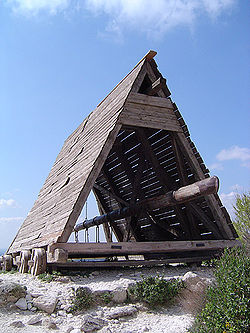
A siege engine is a device that is designed to break or circumvent heavy castle doors, thick city walls and other fortifications in siege warfare. Some are immobile, constructed in place to attack enemy fortifications from a distance, while others have wheels to enable advancing up to the enemy fortification. There are many distinct types, such as siege towers that allow foot soldiers to scale walls and attack the defenders, battering rams that damage walls or gates, and large ranged weapons (such as ballistas, catapults/trebuchets and other similar constructions) that attack from a distance by launching heavy projectiles. Some complex siege engines were combinations of these types.
Siege engines are fairly large constructions – from the size of a small house to a large building. From antiquity up to the development of gunpowder, they were made largely of wood, using rope or leather to help bind them, possibly with a few pieces of metal at key stress points. They could launch simple projectiles using natural materials to build up force by tension, torsion, or, in the case of trebuchets, human power or counterweights coupled with mechanical advantage. With the development of gunpowder and improved metallurgy, bombards and later heavy artillery became the primary siege engines.
Collectively, siege engines or artillery together with the necessary soldiers, sappers, ammunition, and transport vehicles to conduct a siege are referred to as a siege train.
The earliest siege engines appear to be simple movable roofed towers used for cover to advance to the defenders' walls in conjunction with scaling ladders, depicted during the Middle Kingdom of Egypt. Advanced siege engines including battering rams were used by Assyrians, followed by the catapult in ancient Greece. In Kush siege towers as well as battering rams were built from the 8th century BC and employed in Kushite siege warfare, such as the siege of Ashmunein in 715 BC. The Spartans used battering rams in the siege of Plataea in 429 BC, but it seems that the Greeks limited their use of siege engines to assault ladders, though Peloponnesian forces used something resembling flamethrowers.
The first Mediterranean people to use advanced siege machinery were the Carthaginians, who used siege towers and battering rams against the Greek colonies of Sicily. These engines influenced the ruler of Syracuse, Dionysius I, who developed a catapult in 399 BC.
The first two rulers to make use of siege engines to a large extent were Philip II of Macedonia and Alexander the Great. Their large engines spurred an evolution that led to impressive machines, like the Demetrius Poliorcetes' Helepolis (or "Taker of Cities") of 304 BC: nine stories high and plated with iron, it stood 40 m (130 ft) tall and 21 m (69 ft) wide, weighing 180 t (400,000 lb). The most used engines were simple battering rams, or tortoises, propelled in several ingenious ways that allowed the attackers to reach the walls or ditches with a certain degree of safety. For sea sieges or battles, seesaw-like machines (sambykē or sambuca) were used. These were giant ladders, hinged and mounted on a base mechanism and used for transferring marines onto the sea walls of coastal towns. They were normally mounted on two or more ships tied together and some sambuca included shields at the top to protect the climbers from arrows. Other hinged engines were used to catch enemy equipment or even opposing soldiers with opposable appendices which are probably ancestors to the Roman corvus. Other weapons dropped heavy weights on opposing soldiers.[citation needed]
The Romans preferred to assault enemy walls by building earthen ramps (agger) or simply scaling the walls, as in the early siege of the Samnite city of Silvium (306 BC). Soldiers working at the ramps were protected by shelters called vineae, that were arranged to form a long corridor. Convex wicker shields were used to form a screen (plutei or plute in English) to protect the front of the corridor during construction of the ramp. Another Roman siege engine sometimes used resembled the Greek ditch-filling tortoise of Diades, this galley (unlike the ram-tortoise of Hegetor the Byzantium) called a musculus ("muscle") was simply used as cover for sappers to engineer an offensive ditch or earthworks. Battering rams were also widespread. The Roman Legions first used siege towers c. 200 BC; in the first century BC, Julius Caesar accomplished a siege at Uxellodunum in Gaul using a ten-story siege tower. Romans were nearly always successful in besieging a city or fort, due to their persistence, the strength of their forces, their tactics, and their siege engines.
The first documented occurrence of ancient siege engine pieces in Europe was the gastraphetes ("belly-bow"), a kind of large crossbow. These were mounted on wooden frames. Greater machines forced the introduction of pulley system for loading the projectiles, which had extended to include stones also. Later torsion siege engines appeared, based on sinew springs. The onager was the main Roman invention in the field.
Siege engine
A siege engine is a device that is designed to break or circumvent heavy castle doors, thick city walls and other fortifications in siege warfare. Some are immobile, constructed in place to attack enemy fortifications from a distance, while others have wheels to enable advancing up to the enemy fortification. There are many distinct types, such as siege towers that allow foot soldiers to scale walls and attack the defenders, battering rams that damage walls or gates, and large ranged weapons (such as ballistas, catapults/trebuchets and other similar constructions) that attack from a distance by launching heavy projectiles. Some complex siege engines were combinations of these types.
Siege engines are fairly large constructions – from the size of a small house to a large building. From antiquity up to the development of gunpowder, they were made largely of wood, using rope or leather to help bind them, possibly with a few pieces of metal at key stress points. They could launch simple projectiles using natural materials to build up force by tension, torsion, or, in the case of trebuchets, human power or counterweights coupled with mechanical advantage. With the development of gunpowder and improved metallurgy, bombards and later heavy artillery became the primary siege engines.
Collectively, siege engines or artillery together with the necessary soldiers, sappers, ammunition, and transport vehicles to conduct a siege are referred to as a siege train.
The earliest siege engines appear to be simple movable roofed towers used for cover to advance to the defenders' walls in conjunction with scaling ladders, depicted during the Middle Kingdom of Egypt. Advanced siege engines including battering rams were used by Assyrians, followed by the catapult in ancient Greece. In Kush siege towers as well as battering rams were built from the 8th century BC and employed in Kushite siege warfare, such as the siege of Ashmunein in 715 BC. The Spartans used battering rams in the siege of Plataea in 429 BC, but it seems that the Greeks limited their use of siege engines to assault ladders, though Peloponnesian forces used something resembling flamethrowers.
The first Mediterranean people to use advanced siege machinery were the Carthaginians, who used siege towers and battering rams against the Greek colonies of Sicily. These engines influenced the ruler of Syracuse, Dionysius I, who developed a catapult in 399 BC.
The first two rulers to make use of siege engines to a large extent were Philip II of Macedonia and Alexander the Great. Their large engines spurred an evolution that led to impressive machines, like the Demetrius Poliorcetes' Helepolis (or "Taker of Cities") of 304 BC: nine stories high and plated with iron, it stood 40 m (130 ft) tall and 21 m (69 ft) wide, weighing 180 t (400,000 lb). The most used engines were simple battering rams, or tortoises, propelled in several ingenious ways that allowed the attackers to reach the walls or ditches with a certain degree of safety. For sea sieges or battles, seesaw-like machines (sambykē or sambuca) were used. These were giant ladders, hinged and mounted on a base mechanism and used for transferring marines onto the sea walls of coastal towns. They were normally mounted on two or more ships tied together and some sambuca included shields at the top to protect the climbers from arrows. Other hinged engines were used to catch enemy equipment or even opposing soldiers with opposable appendices which are probably ancestors to the Roman corvus. Other weapons dropped heavy weights on opposing soldiers.[citation needed]
The Romans preferred to assault enemy walls by building earthen ramps (agger) or simply scaling the walls, as in the early siege of the Samnite city of Silvium (306 BC). Soldiers working at the ramps were protected by shelters called vineae, that were arranged to form a long corridor. Convex wicker shields were used to form a screen (plutei or plute in English) to protect the front of the corridor during construction of the ramp. Another Roman siege engine sometimes used resembled the Greek ditch-filling tortoise of Diades, this galley (unlike the ram-tortoise of Hegetor the Byzantium) called a musculus ("muscle") was simply used as cover for sappers to engineer an offensive ditch or earthworks. Battering rams were also widespread. The Roman Legions first used siege towers c. 200 BC; in the first century BC, Julius Caesar accomplished a siege at Uxellodunum in Gaul using a ten-story siege tower. Romans were nearly always successful in besieging a city or fort, due to their persistence, the strength of their forces, their tactics, and their siege engines.
The first documented occurrence of ancient siege engine pieces in Europe was the gastraphetes ("belly-bow"), a kind of large crossbow. These were mounted on wooden frames. Greater machines forced the introduction of pulley system for loading the projectiles, which had extended to include stones also. Later torsion siege engines appeared, based on sinew springs. The onager was the main Roman invention in the field.
Recent media
Recent media