Hubbry Logo
logo
Siege engine
Community hub

Siege engine

logo
0 subscribers
Read side by side
from Wikipedia
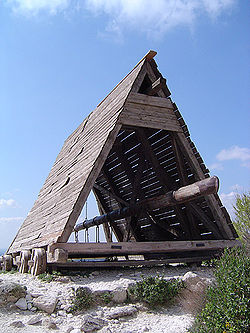
Replica battering ram at Château des Baux, France

A siege engine is a device that is designed to break or circumvent heavy castle doors, thick city walls and other fortifications in siege warfare. Some are immobile, constructed in place to attack enemy fortifications from a distance, while others have wheels to enable advancing up to the enemy fortification. There are many distinct types, such as siege towers that allow foot soldiers to scale walls and attack the defenders, battering rams that damage walls or gates, and large ranged weapons (such as ballistas, catapults/trebuchets and other similar constructions) that attack from a distance by launching heavy projectiles. Some complex siege engines were combinations of these types.

Siege engines are fairly large constructions – from the size of a small house to a large building. From antiquity up to the development of gunpowder, they were made largely of wood, using rope or leather to help bind them, possibly with a few pieces of metal at key stress points. They could launch simple projectiles using natural materials to build up force by tension, torsion, or, in the case of trebuchets, human power or counterweights coupled with mechanical advantage. With the development of gunpowder and improved metallurgy, bombards and later heavy artillery became the primary siege engines.

Collectively, siege engines or artillery together with the necessary soldiers, sappers, ammunition, and transport vehicles to conduct a siege are referred to as a siege train.[1]

Antiquity

[edit]

Ancient Assyria through the Roman Empire

[edit]
Siege engine in Assyrian relief of attack on an enemy town during the reign of Tiglath-Pileser III 743–720 BC from his palace at Kalhu (Nimrud)

The earliest siege engines appear to be simple movable roofed towers used for cover to advance to the defenders' walls in conjunction with scaling ladders, depicted during the Middle Kingdom of Egypt.[2] Advanced siege engines including battering rams were used by Assyrians, followed by the catapult in ancient Greece. In Kush siege towers as well as battering rams were built from the 8th century BC and employed in Kushite siege warfare, such as the siege of Ashmunein in 715 BC.[3][2] The Spartans used battering rams in the siege of Plataea in 429 BC, but it seems that the Greeks limited their use of siege engines to assault ladders, though Peloponnesian forces used something resembling flamethrowers.

The first Mediterranean people to use advanced siege machinery were the Carthaginians, who used siege towers and battering rams against the Greek colonies of Sicily. These engines influenced the ruler of Syracuse, Dionysius I, who developed a catapult in 399 BC.[4]

The first two rulers to make use of siege engines to a large extent were Philip II of Macedonia and Alexander the Great. Their large engines spurred an evolution that led to impressive machines, like the Demetrius Poliorcetes' Helepolis (or "Taker of Cities") of 304 BC: nine stories high and plated with iron, it stood 40 m (130 ft) tall and 21 m (69 ft) wide, weighing 180 t (400,000 lb). The most used engines were simple battering rams, or tortoises, propelled in several ingenious ways that allowed the attackers to reach the walls or ditches with a certain degree of safety. For sea sieges or battles, seesaw-like machines (sambykē or sambuca) were used. These were giant ladders, hinged and mounted on a base mechanism and used for transferring marines onto the sea walls of coastal towns. They were normally mounted on two or more ships tied together and some sambuca included shields at the top to protect the climbers from arrows. Other hinged engines were used to catch enemy equipment or even opposing soldiers with opposable appendices which are probably ancestors to the Roman corvus. Other weapons dropped heavy weights on opposing soldiers.[citation needed]

Roman siege engines.

The Romans preferred to assault enemy walls by building earthen ramps (agger) or simply scaling the walls, as in the early siege of the Samnite city of Silvium (306 BC). Soldiers working at the ramps were protected by shelters called vineae, that were arranged to form a long corridor. Convex wicker shields were used to form a screen (plutei or plute in English)[5] to protect the front of the corridor during construction of the ramp.[6] Another Roman siege engine sometimes used resembled the Greek ditch-filling tortoise of Diades, this galley (unlike the ram-tortoise of Hegetor the Byzantium) called a musculus ("muscle") was simply used as cover for sappers to engineer an offensive ditch or earthworks. Battering rams were also widespread. The Roman Legions first used siege towers c. 200 BC; in the first century BC, Julius Caesar accomplished a siege at Uxellodunum in Gaul using a ten-story siege tower.[6] Romans were nearly always successful in besieging a city or fort, due to their persistence, the strength of their forces, their tactics, and their siege engines.[6]

The first documented occurrence of ancient siege engine pieces in Europe was the gastraphetes ("belly-bow"), a kind of large crossbow. These were mounted on wooden frames. Greater machines forced the introduction of pulley system for loading the projectiles, which had extended to include stones also. Later torsion siege engines appeared, based on sinew springs. The onager was the main Roman invention in the field.

Ancient China

[edit]
Modern reconstruction of a cloud ladder

The earliest documented occurrence of ancient siege-artillery pieces in China was the levered principled traction catapult and an 8 ft (2.4 m) high siege crossbow from the Mozi (Mo Jing), a Mohist text written at about the 4th – 3rd century BC by followers of Mozi who founded the Mohist school of thought during the late Spring and Autumn period and the early Warring States period. Much of what we now know of the siege technology of the time comes from Books 14 and 15 (Chapters 52 to 71) on Siege Warfare from the Mo Jing. Recorded and preserved on bamboo strips, much of the text is now extremely corrupted. However, despite the heavy fragmentation, Mohist diligence and attention to details which set Mo Jing apart from other works ensured that the highly descriptive details of the workings of mechanical devices like Cloud Ladders, Rotating Arcuballistas and Levered Catapults, records of siege techniques and usage of siege weaponry can still be found today.[7]

Elephant

[edit]

Indian, Sri Lankan, Chinese and Southeast Asian kingdoms and empires used war elephants as battering rams.

Middle Ages

[edit]
The medieval Mons Meg with its 20" (50 cm) cannonballs

Medieval designs include a large number of catapults such as the mangonel, onager, the ballista, the traction trebuchet (first designed in China in the 3rd century BC and brought over to Europe in the 4th century AD), and the counterweight trebuchet (first described by Mardi bin Ali al-Tarsusi in the 12th century, though of unknown origin). These machines used mechanical energy to fling large projectiles to batter down stone walls. Also used were the battering ram and the siege tower, a wooden tower on wheels that allowed attackers to climb up and over castle walls, while protected somewhat from enemy arrows.

A typical military confrontation in medieval times was for one side to lay siege to an opponent's castle. When properly defended, they had the choice whether to assault the castle directly or to starve the people out by blocking food deliveries, or to employ war machines specifically designed to destroy or circumvent castle defenses. Defending soldiers also used trebuchets and catapults as a defensive advantage.

Other tactics included setting fires against castle walls in an effort to decompose the cement that held together the individual stones so they could be readily knocked over. Another indirect means was the practice of mining, whereby tunnels were dug under the walls to weaken the foundations and destroy them. A third tactic was the catapulting of diseased animals or human corpses over the walls in order to promote disease which would force the defenders to surrender, an early form of biological warfare.

Modern era

[edit]
One of the super-heavy Karl-Gerät siege mortars used by the German army in World War II
A German Big Bertha howitzer being readied for firing

With the advent of gunpowder, firearms such as the arquebus and cannon—eventually the petard, mortar and artillery—were developed. These weapons proved so effective that fortifications, such as city walls, had to be low and thick, as exemplified by the designs of Vauban.

The development of specialized siege artillery, as distinct from field artillery, culminated during World War I and World War II. During the First World War, huge siege guns such as Big Bertha were designed to see use against the modern fortresses of the day. The apex of siege artillery was reached with the German Schwerer Gustav gun, a huge 80 cm (31 in) caliber railway gun, built during early World War II. Schwerer Gustav was initially intended to be used for breaching the French Maginot Line of fortifications, but was not finished in time and (as a sign of the times) the Maginot Line was circumvented by rapid mechanized forces instead of breached in a head-on assault. The long time it took to deploy and move the modern siege guns made them vulnerable to air attack and it also made them unsuited to the rapid troop movements of modern warfare.

See also

[edit]

References

[edit]

Sources

[edit]
  • Campbell, Duncan B. (2003). Greek and Roman Siege Machinery 399 BC – AD 363. Osprey Publishing.
  • Liang, Jieming (2006). Chinese Siege Warfare: Mechanical Artillery & Siege Weapons of Antiquity. Leong Kit Meng. ISBN 981-05-5380-3.
[edit]
Revisions and contributorsEdit on WikipediaRead on Wikipedia
from Grokipedia
A siege engine is a large mechanical device used in military warfare to breach, undermine, or circumvent fortified defenses such as walls, gates, or towers during a siege, typically by launching projectiles, ramming structures, or facilitating direct assault by troops.[1] These engines were essential tools for attackers aiming to overcome the protective barriers of cities, castles, or strongholds that symbolized political and military power.[2] The development of siege engines traces back to ancient civilizations, with early examples appearing among the Assyrians as far back as the 9th century BC, including rudimentary siege towers equipped with rams for breaching walls.[1] In ancient Greece, innovations by figures such as Dionysius I of Syracuse in the 4th century BC standardized torsion-based machines, while the Romans professionalized their use, equipping legions with up to 60 engines per unit under Augustus.[1] The Byzantine Empire advanced defensive and offensive capabilities, notably with the invention of Greek fire in 674 AD by Kallinikos, a flammable liquid projected from siphons to incinerate enemy ships and fortifications during the Siege of Constantinople.[1] During the medieval period from the 5th to 15th centuries, siege engines reached their peak in Europe, the Middle East, and Asia, playing pivotal roles in conflicts like the Crusades, where they enabled the penetration of heavily fortified holy sites, though their dominance waned with the introduction of gunpowder-based artillery around the mid-14th century.[2][3] Siege engines encompassed a variety of designs tailored to specific tactical needs, broadly categorized into projectile launchers for bombardment and direct assault devices for close-quarters breaching.[1] Key types included:
  • Trebuchets, counterweight-powered machines that hurled stones weighing up to 1 tonne over walls to demolish structures or terrorize defenders, first notably used in England at the Siege of Dover in 1216–1217.[3]
  • Ballistae, torsion-driven catapults resembling oversized crossbows that fired large bolts or arrows to target defenders or weaken fortifications from afar.[4]
  • Mangonels, traction or torsion catapults that launched stones, flaming projectiles, or even diseased materials to cause injury, fear, and structural damage during prolonged bombardments.[3]
  • Battering rams, heavy suspended or wheeled beams tipped with metal heads, swung or pushed against gates and walls to splinter them, often protected by overhead covers to shield operators from counterattacks.[4]
  • Siege towers, multi-story wooden structures on wheels that allowed troops to approach and scale high walls under cover, as seen in Assyrian reliefs from 865–860 BC depicting early versions.[1]
These engines required substantial engineering expertise, timber resources, and manpower to construct and operate, often deciding the outcome of sieges that could last months, such as the six-month Siege of Kenilworth in 1266.[3]

Overview

Definition and Purpose

A siege engine is a mechanical device or structure engineered to assault fortifications, such as city walls, gates, and defensive towers, during military sieges. These apparatuses, ranging from simple battering rams to complex projectile launchers, leverage principles of physics including leverage, torsion, and gravity to deliver destructive force against entrenched positions.[2] The primary purpose of siege engines is to neutralize the inherent advantages of defensive fortifications, including their elevated height, substantial thickness, and protective barriers, which otherwise grant defenders a significant edge in asymmetric warfare. By enabling attackers to breach, undermine, or scale these obstacles, siege engines facilitate direct assaults that bypass prolonged blockades, reducing reliance on attrition tactics like starvation while minimizing casualties from defensive fire. For instance, catapults and similar devices could hurl heavy projectiles to dismantle walls or demoralize garrisons.[2] Sieges themselves trace their origins to urban warfare in the ancient Near East around 3000 BCE, when Mesopotamian city-states began fortifying settlements with mud-brick walls, prompting attackers to employ rudimentary breaching methods amid the tension between encirclement for starvation and risky direct assaults. Mechanical siege engines emerged later as an evolution of these tactics, with early examples like battering rams appearing by the 9th century BCE among the Assyrians, transforming sieges from endurance contests into engineered offensives.[5] In contrast to field artillery, which consists of mobile cannons designed for rapid deployment against maneuvering troops in open battles, siege engines are specialized for static targets, often being larger, less portable, and optimized for sustained bombardment of fixed defenses rather than dynamic field engagements. This distinction became more pronounced with the advent of gunpowder in the 14th century, when early cannons adapted siege roles before lighter variants enabled field use.[6]

Classification by Power Source

Siege engines have historically been classified by their primary power sources, which determine the mechanism for propelling projectiles or applying force during assaults on fortifications. This taxonomy highlights the progression from simple human or animal exertion to sophisticated mechanical systems, and eventually to chemical propulsion.[1] Early mechanical engines occasionally relied on tension, where elastic materials such as composite bows or springs are stretched linearly and then released to launch projectiles. Though less common for large-scale siege use, early handheld devices like the Greek gastraphetes exemplified this type, influencing later designs.[1] The dominant mechanism in antiquity was torsion, employing twisted skeins of fiber—often hair, sinew, or silk—to store and release energy through rotational force. Ballistae, developed by the ancient Greeks and refined by the Romans, exemplify this type; they used twisted animal sinew to power arms that fired bolts or stones over distances up to 500 meters. The onager, a Roman innovation, utilized this power source via a single arm with a sling to hurl rocks or incendiary devices, serving as a precursor to later catapults. Springalds, medieval torsion engines popular in 12th- and 13th-century Europe, combined elements of torsion with bow-like arms powered by skeins, firing large bolts from wheeled or fixed mounts.[7][1][8] Counterweight systems marked a significant advancement, harnessing gravity through a pivoting lever where a heavy counterbalance on one end propelled a projectile arm on the other. Trebuchets, dominant in the Middle Ages, embodied this design, capable of launching massive stones over walls with greater range and accuracy than tension or torsion devices.[1] The advent of gunpowder in the 14th century introduced chemical propulsion, fundamentally altering siege warfare by powering cannons that fired explosive shells or solid shot. Early examples appeared during the Siege of Algeciras (1343–1344), where primitive cannons defended against attackers, gradually supplanting mechanical engines by the late 15th century in Europe as bombards and later standardized artillery proved more destructive.[6][1] Hybrid types occasionally blended these mechanisms, such as devices incorporating both torsion skeins and tensioned bows for enhanced projectile velocity, though pure forms predominated. The evolution of power sources shifted from reliance on human or animal labor in antiquity—evident in traction trebuchets pulled by crews—to mechanical leverage in medieval times, improving efficiency and range while reducing manpower needs.[8][1] Non-mechanical "engines" represent primitive classifiers, utilizing living assets or direct physical force rather than stored energy. Battering rams, propelled by teams of soldiers or draft animals, directly assaulted gates and walls, often sheltered within mobile tortoises for protection. War elephants, employed by ancient Indians and Assyrians, functioned as living battering rams or elevated platforms, their immense strength (up to 4 tons per animal) enabling them to demolish palisades or carry archers over defenses, as described in Buddhist texts and historical accounts.[7][9][1]

Mechanics

Design Principles

Siege engines operate on fundamental engineering principles that maximize mechanical advantage while ensuring operational reliability. Central to their design is the use of leverage, which amplifies force through pivoting arms or beams to propel projectiles over distances, often achieving ranges exceeding 200 meters depending on the mechanism.[10] Projectile motion governs the trajectory, following parabolic paths influenced by launch angle, initial velocity, and environmental factors like wind, with optimal angles around 38-45 degrees for maximum range.[10] Structural integrity is paramount to withstand the recoil forces generated during firing, requiring robust frameworks that distribute stress and prevent catastrophic failure under repeated loads.[11] Key components include sturdy frames forming the base and support structure, typically constructed to house the power mechanism and pivot points; projectiles such as stones, arrows, or incendiary devices like pots of flaming pitch; and aiming mechanisms, often adjustable slings or cradles that allow fine-tuning of release angle without repositioning the entire engine.[12] These elements work in concert across tension, torsion, or gravity-based power sources to deliver payloads with controlled accuracy.[2] Materials selection emphasizes durability and availability, with wood serving as the primary material for frames due to its strength-to-weight ratio and ease of shaping into beams and supports.[13] Sinew or rope provides elastic tension in torsion systems, while stone or metal counterweights enable gravitational force in later designs; over time, iron reinforcements appeared in frames and fittings to enhance resistance to wear and impact, particularly in high-stress components.[2][13] The physics of siege engines revolves around energy transfer, converting stored potential energy into the kinetic energy of the projectile. For gravity-powered systems, the potential energy of a falling counterweight, given by $ E_p = m g h $ where $ m $ is the counterweight mass, $ g $ is gravitational acceleration (approximately 9.8 m/s²), and $ h $ is the drop height, is transformed into kinetic energy as the arm pivots (assuming ideal conditions with ~60% efficiency due to friction and other losses). This kinetic energy propels the projectile, expressed as $ E_k = \frac{1}{2} M v^2 $, where $ M $ is the projectile mass and $ v $ is its launch velocity; the derivation assumes conservation of energy (neglecting friction losses), so $ m g h \approx \frac{1}{2} M v^2 $, solving for $ v = \sqrt{\frac{2 m g h}{M}} $ to determine achievable speeds, often 30-50 m/s for effective range.[10][14] In torsion or tension systems, elastic potential energy from twisted sinew or ropes similarly converts to kinetic form upon release.[13] Designs incorporate safety features and mobility considerations to facilitate deployment in field conditions, often featuring modular construction for disassembly into transportable sections using oxen or human labor.[2] Large engines require substantial crews for assembly, loading, and firing, typically 20-140 personnel for major trebuchets to manage counterweights and maintain stability during operation.[15]

Construction and Operation

Siege engines were typically constructed using readily available natural materials, with wood forming the primary structural component due to its strength and workability. Hardwoods such as oak, ash, or maple were sourced for frames and arms, often cut green and debarked on-site to facilitate transport and assembly during campaigns. For torsion-based engines like ballistae, animal sinew or hair was twisted into skeins to create the elastic power source, while counterweight trebuchets relied on timber reinforcements and pouches filled with sand or stone for ballast. Assembly began with erecting the base frame using mortise-and-tenon joints secured by wooden pegs or wedges, followed by mounting the throwing arm or torsion springs; for example, in reconstructions of Roman scorpions, the frame was laminated from multiple wood layers and fitted with metal pins and washers for durability.[16][17] Tensioning mechanisms varied by engine type but emphasized precise winding to store energy. In torsion engines, skeins were threaded through frame holes and twisted using levers or winches, with adjustments made via rebates or washers to ensure even tension—often tuned by ear for uniform pitch. For trebuchets, the counterweight box was attached to the short arm of the throwing beam after raising it with shear legs or pulleys, a process that could take hours for large models requiring teams of workers. Full assembly of a half-scale trebuchet, for instance, involved raising bents sequentially like a barn frame and adding struts for stability, typically completed in four hours with modern aids but far longer historically without them. Logistical challenges included on-site building to avoid transport issues, as engines were often too bulky for long marches and assembled near the siege site from prefabricated parts.[16][17] Operation followed a standardized sequence adapted to the engine's design, prioritizing safety and coordination among crew members. Loading involved placing the projectile—such as a stone, bolt, or arrow—into a sling or groove, with the arm or slider drawn back using a windlass to engage the tension. Aiming relied on trial shots or rudimentary sights, adjusting the frame's elevation with props or guy lines; for ballistae, the slider was cranked back to compress the skeins before locking the trigger. Firing released the mechanism, propelling the payload via torsion twist or counterweight drop, with reloading cycles taking seconds to minutes for smaller field variants and up to 30-60 minutes for large siege-scale machines requiring multiple winches and counterweight repositioning. Reloading trebuchets, for example, entailed latching the arm down and repositioning the counterweight, a process repeated after each shot to maintain rhythm.[16][17][18] Crew roles were specialized to handle the engine's complexity, with a master engineer overseeing design and adjustments while carpenters managed fabrication and repairs. Loaders and haulers—often 5-50 personnel for large trebuchets—handled projectiles and tensioning, guided by a commander who directed aiming and firing to avoid mishaps like misfires from uneven skeins. In torsion engines, operators included those winding the winch and triggering the release, with legionary crews in ancient contexts performing dual roles in maintenance and combat positioning. Logistical demands strained resources, as crews balanced operation with transporting materials like spare timber or sinew during extended sieges.[16][17] Maintenance addressed wear from repeated use and environmental factors, with regular inspections essential to prevent failures. Weather degradation, such as moisture warping wooden frames or loosening sinew skeins, necessitated on-site repairs like replacing broken arms or re-twisting cords; for instance, torsion springs required periodic tightening and protection under covers during rain. Scaling affected durability—small field engines needed less upkeep than massive siege variants, which could require full disassembly for peg replacement after 6-20 shots. Crews performed repairs during lulls, using spare parts stockpiled for longevity, though misalignment from battle damage often demanded complete rebuilds.[16][17] Efficiency metrics highlighted practical limits, with ranges typically spanning 50-400 meters based on design and payload. Torsion ballistae achieved effective ranges up to 300 meters for arrow payloads of around 1-5 kilograms, though accuracy diminished beyond 200 meters due to wind and sighting challenges. Trebuchets excelled in payload capacity, hurling 50-150 kilogram stones over 250-300 meters, with larger models like the Warwolf variant managing 136 kilograms at similar distances; however, reload times and crew coordination influenced sustained fire rates.[17][12] These figures established scale for breaching fortifications, prioritizing destructive impact over precision.[12]

Historical Development

Ancient World

The earliest known siege engines emerged in the Neo-Assyrian Empire during the 9th century BCE, where battering rams and siege towers were employed to breach fortified cities. Assyrian reliefs from the palace of Ashurnasirpal II (r. 883–859 BCE) depict massive battering rams with reinforced metal heads, often protected by wheeled towers that allowed soldiers to approach walls under cover while ramming gates or undermining foundations.[19] These innovations marked a shift from simple scaling ladders to coordinated mechanical assaults, enabling the Assyrians to conquer numerous Levantine and Mesopotamian strongholds through systematic engineering.[20] Advancements in the Greco-Persian and Roman worlds introduced torsion-based artillery, harnessing twisted sinew or rope to propel projectiles with greater force and accuracy. In 399 BCE, Dionysius I of Syracuse commissioned the development of the first torsion catapults, known as gastraphetes (belly-bows), which evolved into larger field pieces capable of launching bolts or stones over distances exceeding 300 meters.[21] This technology spread through Hellenistic engineers and was refined by the Romans into the ballista, a two-armed torsion engine firing bolts for anti-personnel roles, and the onager, a single-armed variant for stone-throwing. Roman legions integrated these into standardized siege trains, as exemplified during Julius Caesar's Siege of Alesia in 52 BCE, where over 20 ballistae mounted on towers supported contravallation walls, suppressing Gallic sallies and facilitating the encirclement of Vercingetorix's forces.[22] Torsion power, referenced in broader classifications, relied on elastic tension from organic materials, providing a mechanical advantage over earlier tension-based designs.[23] In ancient China, siege warfare emphasized manpower-driven devices, with the traction trebuchet appearing by the 5th century BCE during the Warring States period. This rotating-beam engine, powered by crews pulling ropes to hurl stones up to 100 kilograms, offered a counter to fortified walls without relying on complex torsion mechanisms, as documented in texts like the Mozi military treatise.[24] Complementing these were large mounted crossbows, or nu, scaled for siege use to deliver volleys of bolts against defenders, with designs incorporating multiple prods for enhanced range and penetration.[25] Tactics such as Tian Dan's deployment of fire oxen in 279 BCE during the siege of Jimo—where incendiary-laden cattle were driven into Yan forces—exemplified ancient Chinese traditions of using animals in psychological and disruptive roles against besiegers.[26] War elephants served as living siege engines in South Asian and Mediterranean campaigns, combining brute force with terror tactics from the 4th century BCE onward. During Alexander the Great's Battle of the Hydaspes in 326 BCE against King Porus, Indian elephants charged Macedonian phalanxes, using their tusks and mass to ram formations and create breaches, while their unfamiliar sight induced panic among troops unaccustomed to such beasts.[27] Carthaginians under Hannibal later employed similar tactics in the Second Punic War (218–201 BCE), deploying elephants to shatter Roman lines at Trebia and Lake Trasimene through ramming charges that disrupted infantry cohesion and morale.[28] Their primary impact stemmed from psychological disruption, often routing enemies before direct combat escalated. Despite these innovations, ancient siege engines faced significant limitations, particularly their reliance on wooden frames that were highly susceptible to fire attacks from defenders using flaming arrows or boiling substances. Regional variations further constrained adoption; for instance, Chinese engineers favored traction and tension systems over torsion artillery, which did not appear in East Asia until much later due to differences in material availability and tactical priorities.[29] These vulnerabilities often prolonged sieges, as engines required constant maintenance and protection against countermeasures.[30]

Middle Ages

In Europe, the Normans advanced siege tactics in the 11th century by employing sapper mines to undermine fortress walls and mantlets—large, wheeled shields—to shield advancing infantry and engineers from defensive fire. These methods proved effective during the post-1066 conquest of England, where mining collapsed key defenses at sites like Rochester Castle, allowing rapid breaches without prolonged bombardment.[31] The introduction of more powerful trebuchets further transformed European sieges, with traction models in use during the 12th century and counterweight variants appearing later in the century. At the Siege of Lisbon in 1147, Crusader forces deployed two traction trebuchets that launched stones at a rate of one every 15 seconds, delivering relentless pressure on the city's walls and contributing to its fall after four months.[32] Islamic engineers in the Abbasid Caliphate of the 8th century refined ancient torsion engines, particularly the mangonel, by optimizing arm length and tension for improved projectile accuracy and velocity in defending vast territories. These enhancements influenced Byzantine and later Arab designs, enabling effective counter-siege operations across the caliphate. During the Crusades, counterweight trebuchet technology proliferated through cultural exchange; at the Siege of Acre in 1191, Crusaders operated 11 machines, including the massive "Bad Neighbour," to hurl stones over 100 meters and weaken the Mamluk tower, while defenders reciprocated with similar engines.[33] In parallel, Asian innovations emphasized explosive integration with mechanical launchers. The Song Dynasty's 1044 military compendium, Wujing Zongyao, detailed trebuchets modified to propel thunderclap bombs—early gunpowder-filled shells that detonated on impact, shattering walls and demoralizing garrisons during defenses against Jurchen invasions.[34] The Mongols under Kublai Khan adapted these and Persian techniques in the 13th century, enlisting Chinese engineers to construct oversized counterweight trebuchets for sieges like Xiangyang (1268–1273), where sustained barrages over 200 meters broke a years-long stalemate and paved the way for conquering southern China.[35] Medieval siege engines evolved to larger scales, with counterweight trebuchets achieving ranges up to 300 meters to outdistance archer fire, though effective impacts often occurred within 100 meters for precision targeting.[36] They integrated seamlessly with infantry tactics, bombarding walls to suppress defenders and create breaches for coordinated assaults by sappers, ram teams, and scaling ladders.[37] The utility of these mechanical engines waned in the late Middle Ages due to advanced concentric fortifications, which featured multiple wall layers that complicated mining efforts, and aggressive knightly sorties from sally ports that destroyed vulnerable machines before they could be fully deployed.[3]

Early Modern and Gunpowder Era

The introduction of gunpowder-based cannons marked a pivotal shift in siege warfare during the Early Modern period, transitioning from mechanical devices like trebuchets to explosive propulsion systems. In 1453, Ottoman forces under Sultan Mehmed II employed massive bombards, including the enormous Urban cannon capable of firing 600-pound stone balls, to breach the formidable walls of Constantinople, ultimately leading to the city's fall after a 53-day siege. These weapons, cast in bronze and requiring teams of oxen for transport, demonstrated gunpowder's destructive potential against stone fortifications. By the mid-15th century, European armies adopted similar technology, with cast-iron cannons emerging as a cheaper alternative to bronze; for instance, England produced iron guns at the Weald foundries by the 1540s.[38][39] Gunpowder also revolutionized underground tactics, particularly through sapping and mining operations that undermined defensive walls. During the 1547 Siege of Cambrai, French forces used gunpowder charges in sapper tunnels to collapse sections of the city's ramparts, combining explosive demolition with artillery barrages for breaching. Defenders countered with their own mines, listening for digging sounds and detonating charges to flood or collapse attacker tunnels, a practice refined throughout the 16th century. Petards—small, bell-shaped gunpowder bombs affixed to gates or barricades—further aided breaching efforts; these devices, often hand-placed by elite engineers, could shatter wooden barriers or iron reinforcements, as seen in various Italian Wars campaigns where they complemented cannon fire.[40][41] In colonial contexts, European powers adapted gunpowder siege engines to new environments, enhancing conquests in the Americas and Asia. Spanish conquistadors in the 16th century deployed lightweight bronze cannons during sieges of indigenous strongholds, such as the 1521 assault on Tenochtitlan, where artillery from brigantines bombarded Aztec causeways and temples, facilitating Hernán Cortés's victory despite numerical inferiority. In India, Mughal forces innovated with rocket artillery by the 18th century, employing iron-cased rockets with ranges up to 1.5 km in sieges like the 1761 Third Battle of Panipat, where salvos disrupted enemy formations and fortifications, influencing later Mysorean adaptations under Hyder Ali.[42][43][44] Defensive engineering evolved rapidly to counter these advances, leading to the widespread adoption of bastion fortresses known as the trace italienne. Developed in 16th-century Italy amid conflicts with France and the Holy Roman Empire, this angular design featured low, sloped earthen ramparts and protruding bastions that allowed enfilading fire from cannons, deflecting direct assaults and minimizing blind spots. Engineers like Michelangelo and Baldassare Peruzzi contributed to early prototypes, such as those at Florence in the 1520s, which prioritized gunpowder resistance over medieval high walls. Siege guns of this era achieved effective ranges up to 2 km, as with 24-pounder culverins used in European campaigns, compelling attackers to approach methodically under prolonged bombardment.[45][46] The Thirty Years' War (1618–1648) exemplified the integration of cannon barrages and mining tactics in prolonged sieges, reshaping Central European warfare. At the 1631 Siege of Magdeburg, Imperial forces under Tilly combined heavy artillery to pulverize walls with counter-mines that detected and neutralized Swedish sappers, though the city ultimately fell to storming after mines failed to fully breach defenses. Swedish engineers, influenced by Dutch innovations, employed parallel trenches and petards at the 1636 Siege of Hanau, coordinating cannon fire with underground explosions to force capitulation without total destruction. These operations highlighted gunpowder's role in attritional sieges, where combined tactics often decided outcomes amid the war's devastation.[47][41]

19th Century to Present

In the 19th century, siege warfare underwent significant industrialization, with innovations in rifled artillery enhancing range and accuracy. Rifled siege guns and mortars, such as the French 6.5-inch (165-mm) cast-iron models, demonstrated superior destructive power during the Crimean War (1853–1856), where they outranged smoothbore counterparts and facilitated assaults on fortified positions like Sevastopol.[48] These advancements were enabled by steam-powered manufacturing, which allowed for mass production of standardized components, transforming artillery from artisanal craft to industrial output and enabling larger-scale deployments in conflicts.[49] During World War I, heavy siege artillery epitomized the era's mechanized escalation, with Germany's 420-mm "Big Bertha" howitzer playing a pivotal role in breaching Belgian and French forts in 1914, its massive shells capable of penetrating reinforced concrete from over 9 miles away.[50] Trench warfare sieges, such as the Battle of Verdun (February–December 1916), relied on prolonged artillery barrages to attrit entrenched positions, resulting in over 700,000 casualties amid a static frontline that immobilized traditional mobility.[51] In World War II, Nazi Germany pursued supergun technology with the V-3 cannon, a multi-chambered 140-meter-long weapon intended for sustained bombardment of London from occupied France in 1944, though Allied bombing prevented its operational use and highlighted the vulnerabilities of fixed siege installations.[52] Post-1945, siege engines evolved into missile systems, redefining remote bombardment capabilities. Iraq's Al-Hussein variants of Scud missiles, with ranges extended to 400 miles, were launched against coalition targets during the Gulf War (1991), serving as modern equivalents to siege artillery by targeting urban and military infrastructure from afar, though their inaccuracy limited strategic impact.[53] In urban sieges like Sarajevo (1992–1996), Bosnian Serb forces employed artillery and snipers to isolate the city, but NATO's 1995 intervention introduced precision-guided munitions, such as laser-guided bombs, which minimized collateral damage in airstrikes supporting the siege's resolution.[54] Contemporary sieges incorporate cyber and electronic warfare, as seen in Russia's 2022 invasion of Ukraine, where cyberattacks targeted critical infrastructure in besieged cities like Mariupol, disrupting communications and logistics to complement kinetic operations.[55] These tactics must adhere to international humanitarian law under the Geneva Conventions, which prohibit starvation of civilians as a method of warfare and require parties to allow humanitarian relief passage during sieges, with violations constituting war crimes.[56] Traditional siege engines have declined with the ascendancy of air power and mobile infantry, which prioritize rapid maneuver over prolonged encirclement, rendering static artillery obsolete in conventional conflicts since the mid-20th century.[57] However, asymmetric warfare has spurred a resurgence, with non-state actors adapting improvised explosives and drones for urban sieges, as in prolonged insurgencies where weaker forces exploit terrain to negate technological superiority.[58]

Cultural and Tactical Impact

Role in Warfare

Siege engines served critical tactical roles in warfare by enabling direct assaults on fortifications through breaching mechanisms, such as battering rams that targeted gates and walls, or siege towers that allowed infantry to scale defenses and engage in close combat.[37] These devices facilitated assaults where traditional field maneuvers were ineffective against stone walls, contrasting with blockade strategies that used catapults and trebuchets to bombard supplies and structures from afar, gradually weakening the defenders' resolve.[37] Additionally, siege engines contributed to psychological warfare by instilling fear through relentless bombardment and the launch of incendiary projectiles or even severed heads, often prompting surrenders before a full-scale assault could occur.[37] Strategically, the deployment of siege engines shifted warfare dynamics by prolonging engagements and emphasizing attrition over decisive field battles; in medieval Europe, sieges outnumbered pitched battles, with many conflicts—such as those during the Crusades—relying on engines to force capitulations without direct confrontation.[37] This approach altered military doctrines, evolving from ancient Roman tactics like the testudo formation, where shielded infantry advanced under cover of portable screens to approach walls safely during sieges, to more integrated systems in the early modern period. By the 17th century, engineers like Sébastien Le Prestre de Vauban formalized siege manuals that coordinated artillery with infantry and cavalry advances, standardizing operations to capture fortresses in approximately 48 days through systematic approaches like parallel trenches.[59] Defenders developed countermeasures to counter these engines, including moats to hinder rams and towers, angled bastion walls to deflect projectiles, and scorched-earth tactics where surrounding lands were burned to deny attackers forage and prolong the siege's burden.[60] This created an ongoing arms race between offensive engines and defensive innovations, as seen in the transition to gunpowder artillery like cannons, which accelerated breaches but demanded even more robust fortifications.[37] Economically, siege engines imposed high costs, requiring vast resources for construction and maintenance—often limited by feudal service terms of around 40 days—which could equate to the upkeep of large contingents of troops and strain royal treasuries.[37]

Evolution and Legacy

The principles of leverage, torsion, and counterweight systems developed in ancient and medieval siege engines have influenced modern artillery and engineering practices. For instance, the trebuchet's mechanism for converting gravitational potential energy into kinetic force for projectile launch has informed the design of contemporary systems, such as conceptual space launchers like SpinLaunch, which use centrifugal acceleration to achieve high velocities with reduced fuel needs.[61][62] Ottoman engineers further advanced this legacy through innovations in gunpowder artillery during the 15th century, exemplified by the massive bronze cannons like the Great Bombard used in the 1453 siege of Constantinople, which integrated siege engine mobility with explosive propulsion to breach fortifications and influenced subsequent European cannon designs.[63] Culturally, siege engines have permeated literature since antiquity, as in medieval chronicles and illuminated manuscripts, such as those depicting Crusader sieges at Acre, trebuchets and battering rams appear as heroic emblems of conquest, often allegorizing spiritual battles in art like church frescoes. Modern media continues this tradition, with films like Troy (2004) dramatizing ancient engines to evoke themes of destruction and hubris, reinforcing their symbolic role in narratives of siege as a metaphor for societal collapse.[2][64] Historically, siege engines facilitated empire-building by enabling systematic territorial expansion, as Roman legions used ballistae and other early artillery to dismantle fortifications during campaigns that expanded the empire's size from 200 BCE to 100 CE, underscoring lessons in engineering's role in imperial dominance. These tools also sparked ethical debates on civilian targeting; ancient tacticians like Aeneas (c. 350 BCE) treated sieges as inevitable civilian ordeals, while Roman practices often involved indiscriminate bombardment, raising enduring questions about proportionality in warfare that prefigured modern international humanitarian law.[65][64] Addressing gaps in Western-centric histories, non-Western innovations like Ottoman siege engineering—blending Islamic mechanical traditions with gunpowder—highlight underrepresented contributions to global military evolution, such as mobile cannon platforms that outpaced European designs until the 16th century; similarly, Chinese engineers developed traction trebuchets that influenced East Asian siege tactics from the Warring States period onward. In 21st-century contexts, urban warfare in Gaza draws analogies to historical sieges, where encirclement and attrition tactics mirror medieval isolation strategies, though modern precision munitions replace engines like trebuchets in targeting fortified urban zones (as of 2023).[63][66] Looking ahead, siege tactics see revival in hybrid warfare, as seen in Russia's 2014–present operations in Ukraine, which combine encirclement with cyber and artillery assaults akin to historical engine barrages, potentially escalating in future urban conflicts (as of November 2025). Preservation efforts sustain this legacy through museum replicas, such as the 22-tonne trebuchet at Warwick Castle—Britain's largest working model, operational since 2005—which demonstrates medieval mechanics to educate on engineering heritage.[67][68]

References

User Avatar
No comments yet.