



Community hub
Recent from talks
Contribute something
Nothing was collected or created yet.
Sigma-additive set function
View on Wikipedia | This article needs additional citations for verification. (April 2024) |
In mathematics, an additive set function is a function mapping sets to numbers, with the property that its value on a union of two disjoint sets equals the sum of its values on these sets, namely, If this additivity property holds for any two sets, then it also holds for any finite number of sets, namely, the function value on the union of k disjoint sets (where k is a finite number) equals the sum of its values on the sets. Therefore, an additive set function is also called a finitely additive set function (the terms are equivalent). However, a finitely additive set function might not have the additivity property for a union of an infinite number of sets. A σ-additive set function is a function that has the additivity property even for countably infinite many sets, that is,



Additivity and sigma-additivity are particularly important properties of measures. They are abstractions of how intuitive properties of size (length, area, volume) of a set sum when considering multiple objects. Additivity is a weaker condition than σ-additivity; that is, σ-additivity implies additivity.
The term modular set function is equivalent to additive set function; see modularity below.
Additive (or finitely additive) set functions
[edit]Let be a set function defined on an algebra of sets with values in (see the extended real number line). The function is called additive or finitely additive, if whenever and are disjoint sets in then A consequence of this is that an additive function cannot take both and as values, for the expression is undefined.


![{\displaystyle [-\infty ,\infty ]}](https://wikimedia.org/api/rest_v1/media/math/render/svg/e13233867b861889693a36843d98e51d90d38f9f)





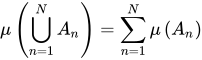
One can prove by mathematical induction that an additive function satisfies for any disjoint sets in


σ-additive set functions
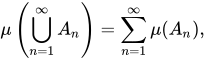
[edit]Suppose that is a σ-algebra. If for every sequence of pairwise disjoint sets in holds then is said to be countably additive or 𝜎-additive. Every 𝜎-additive function is additive but not vice versa, as shown below.

τ-additive set functions
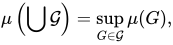
[edit]Suppose that in addition to a sigma algebra we have a topology If for every directed family of measurable open sets we say that is -additive. In particular, if is inner regular (with respect to compact sets) then it is -additive.[1]



Properties
[edit]Useful properties of an additive set function include the following.
Value of empty set
[edit]Either or assigns to all sets in its domain, or assigns to all sets in its domain. Proof: additivity implies that for every set (it's possible in the edge case of an empty domain that the only choice for is the empty set itself, but that still works). If then this equality can be satisfied only by plus or minus infinity.


Monotonicity
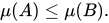
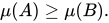
[edit]If is non-negative and then That is, is a monotone set function. Similarly, If is non-positive and then

Modularity
[edit]A set function on a family of sets is called a modular set function and a valuation if whenever and are elements of then The above property is called modularity and the argument below proves that additivity implies modularity.



Given and Proof: write and and where all sets in the union are disjoint. Additivity implies that both sides of the equality equal





However, the related properties of submodularity and subadditivity are not equivalent to each other.
Note that modularity has a different and unrelated meaning in the context of complex functions; see modular form.
Set difference
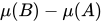
[edit]If and is defined, then

Examples
[edit]An example of a 𝜎-additive function is the function defined over the power set of the real numbers, such that

If is a sequence of disjoint sets of real numbers, then either none of the sets contains 0, or precisely one of them does. In either case, the equality holds.

See measure and signed measure for more examples of 𝜎-additive functions.
A charge is defined to be a finitely additive set function that maps to [2] (Cf. ba space for information about bounded charges, where we say a charge is bounded to mean its range is a bounded subset of R.)


An additive function which is not σ-additive
[edit]An example of an additive function which is not σ-additive is obtained by considering , defined over the Lebesgue sets of the real numbers by the formula where denotes the Lebesgue measure and the Banach limit. It satisfies and if then




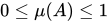


One can check that this function is additive by using the linearity of the limit. That this function is not σ-additive follows by considering the sequence of disjoint sets for The union of these sets is the positive reals, and applied to the union is then one, while applied to any of the individual sets is zero, so the sum of is also zero, which proves the counterexample.



Generalizations
[edit]One may define additive functions with values in any additive monoid (for example any group or more commonly a vector space). For sigma-additivity, one needs in addition that the concept of limit of a sequence be defined on that set. For example, spectral measures are sigma-additive functions with values in a Banach algebra. Another example, also from quantum mechanics, is the positive operator-valued measure.
See also
[edit]- Additive map – Z-module homomorphism
- Hahn–Kolmogorov theorem – Theorem extending pre-measures to measures
- Measure (mathematics) – Generalization of mass, length, area and volume
- σ-finite measure – Concept in measure theory
- Signed measure – Generalized notion of measure in mathematics
- Submodular set function – Set-to-real map with diminishing returns
- Subadditive set function
- τ-additivity
- ba space – The set of bounded charges on a given sigma-algebra
This article incorporates material from additive on PlanetMath, which is licensed under the Creative Commons Attribution/Share-Alike License.
References
[edit]Sigma-additive set function
View on GrokipediaDefinitions
Finitely additive set functions
A set function defined on an algebra of sets is finitely additive if and whenever and are disjoint sets in the domain, with the sum defined in the extended real numbers.[5] This property extends by induction to any finite collection of pairwise disjoint sets: for and pairwise disjoint in the domain with also in the domain, .[5] The domain of such a function must be a ring or algebra of sets, which is closed under finite unions and intersections (and complements in the case of an algebra), ensuring that finite disjoint unions remain within the collection.[5] While may take values in the extended real line , it cannot assign both and to sets in a way that leads to indeterminate forms like , as this would violate the additivity condition for defined sums.[5] Finitely additive set functions played an early role in integration theory, as seen in the development of Jordan content for measuring lengths, areas, and volumes, which satisfied finite additivity but not countable additivity prior to Lebesgue's advancements.[6] This finite additivity serves as a foundational property, with countable additivity representing a stronger extension for infinite disjoint unions.[5]Countably additive set functions
A countably additive set function, also known as a sigma-additive set function, is a function defined on a -algebra of subsets of a set , such that for any countable collection of pairwise disjoint sets , This property extends the notion of additivity to infinite disjoint unions, allowing the function to handle countable decompositions consistently.[1][7] Every countably additive set function is finitely additive, as the countable additivity condition specializes to the finite case by taking all but finitely many to be empty. The domain must be a -algebra, which is closed under countable unions (and thus ensures that ), distinguishing it from merely additive functions defined on algebras that may not support such operations.[1][7] The equality in countable additivity can be expressed through limits of finite approximations: for pairwise disjoint , where the finite unions and partial sums are well-defined via finite additivity. This formulation emphasizes the sequential buildup of the infinite union.[1][7] When takes values in the real numbers , the series must converge absolutely to ensure the additivity holds independently of the ordering of the terms, preventing issues with conditional convergence in the context of disjoint unions. For non-negative set functions, convergence is guaranteed by monotonicity of partial sums.[7]Completely additive set functions
In a topological measure space , where denotes the topology and is a -algebra containing the Borel -algebra generated by , a set function is -additive (also known as completely additive in some contexts) if, for any directed family of open measurable sets with union , it satisfies .[8] This condition generalizes countable additivity by requiring the measure to preserve suprema over arbitrary directed sets, typically indexed by nets or filters, rather than restricting to countable collections.[9] The domain consists of measurable sets within such topological spaces, often focusing on Borel or completion-regular measures where inner approximations by closed or compact sets are feasible.[9] A key relation exists between -additivity and regularity: inner regular measures, which can approximate any measurable set from below by compact subsets (i.e., ), are -additive on Hausdorff spaces.[9] Conversely, in complete locally determined spaces, -additivity implies inner regularity with respect to closed sets.[8] This equivalence underscores -additivity's role in ensuring measures align with the topology beyond countable operations, particularly for uncountable unions that cannot be reduced to countable subfamilies without loss of information.[9] In contexts like capacities and fuzzy measures, -additivity extends standard Lebesgue theory by handling non-additive set functions in topological settings, such as Choquet capacities on non-Hausdorff spaces where outer regularity predominates.[10] For instance, in fuzzy measure theory, -additive monotone measures provide a framework for aggregating uncountable directed families in decision-making models beyond classical probability spaces.[10] Countably additive measures satisfy -additivity as a special case when the directed family is countable.Properties
Value of the empty set
A key property of sigma-additive set functions, also known as countably additive functions, is that they assign the value zero to the empty set in all non-trivial cases. Consider a sigma-additive function defined on a -algebra over a set . The empty set can be expressed as the countable union , where each term is and the sets are pairwise disjoint. By the definition of countable additivity, Let . If is finite and nonzero, the equation becomes . For , the right side diverges to , yielding , a contradiction. For , the right side diverges to , yielding , again a contradiction. Thus, unless takes infinite values everywhere, rendering it trivial.[12] In the trivial case where , consider any nonempty set . Then , and by additivity (which follows from countable additivity), By induction, must be on every nonempty set, and similarly . An analogous argument holds if , leading to . Such functions are excluded in standard treatments of measures to ensure meaningful applications, as they violate the usual requirement that signed measures take at most one of .[12] This property extends to finitely additive set functions as well, where implies or the infinite triviality, since countable additivity implies finite additivity.[12] The condition thus normalizes non-trivial sigma-additive functions, providing a foundational normalization that underpins further properties like monotonicity in measure theory.[12]Monotonicity
A sigma-additive set function , also known as a countably additive measure, that is non-negative satisfies the monotonicity property: if , then .[13][1] To prove this, note that where and are disjoint. By countable additivity, . Since is non-negative, , so .[13] This property extends to signed measures. For a signed measure , the total variation is itself a non-negative countably additive measure, and thus implies .[13] Monotonicity further implies countable subadditivity for non-negative countably additive functions: for any countable collection of sets , . This follows by applying monotonicity to the union contained in the disjointified version and using additivity on the latter.[1]Modularity and set operations
A sigma-additive set function , being finitely additive, satisfies the modular property: for any sets in the domain with also in the domain, .[1][14] This holds even when and are not disjoint, extending the basic additivity axiom beyond disjoint unions. To see this, decompose the union as , where denotes disjoint union; by finite additivity, . Similarly, , so . Subtracting these equations yields , or equivalently, .[14][1] From modularity, the measure of the intersection follows as , provided is in the domain. For the set difference, if and is non-negative (hence monotone), then , so .[1][14] Sigma-additivity further implies continuity properties. For an increasing sequence of sets (i.e., and ), . Similarly, for a decreasing sequence with , . These follow from countable additivity applied to the disjoint differences (with ) for the increasing case, and to the complements relative to for the decreasing case.[1]Examples
Additive but not countably additive functions
A prominent example of a finitely additive set function that fails to be countably additive is constructed using a free ultrafilter on the natural numbers . Define by if and otherwise. This is finitely additive because ultrafilters are closed under finite intersections and their complements, ensuring that for disjoint finite collections with union , exactly one (if any) belongs to , so .[15] However, is not countably additive: each singleton has since free ultrafilters contain no finite sets, so , but and .[15] Another example arises on . Using the Hahn-Banach theorem, there exist finitely additive, translation-invariant extensions of the Lebesgue measure defined on the power set .[16] These agree with on Lebesgue measurable sets and satisfy , but . Such are not countably additive: if they were, they would contradict the Vitali construction, which shows no countably additive, translation-invariant probability measure on all subsets of exists. Specifically, a Vitali set can be partitioned into countably many disjoint rational translates , whose union covers up to measure zero; countable additivity and invariance would imply , but each , so countably many copies sum to , impossible unless , but then the covering would have measure 0, contradicting .[16] These examples illustrate functions that satisfy finite additivity on full power sets but violate countable additivity on countable disjoint unions, underscoring the necessity of restricting domains to sigma-algebras for measures in standard analysis. Such finitely additive measures appear in non-standard analysis, where internal finitely additive set functions on hyperfinite sets are transferred via the Loeb construction to yield countably additive standard measures on the standard part.[17] The failure stems from the underlying limit structures—ultrafilter membership or the non-commutativity of the extension with countable operations—not preserving the additivity for infinite sums, as finite approximations suffice for additivity but countable operations disrupt the invariance or 0-1 valuation.Countably additive functions
A canonical example of a countably additive set function is the Dirac measure , defined on the power set of a set for a fixed point by if and otherwise.[1] This measure satisfies countable additivity because, for any countable collection of pairwise disjoint subsets of , the point belongs to at most one , so , which equals 1 if is in the union and 0 otherwise.[1] The Dirac measure models point masses and arises in applications such as distribution theory and stochastic processes.[1] Another fundamental example is the Lebesgue measure , defined on the Borel -algebra of , which assigns to each Borel set its geometric volume in a translation-invariant manner, with .[18] Lebesgue measure is countably additive: for any countable collection of pairwise disjoint Borel sets , This property holds by the Carathéodory extension theorem, which constructs from the outer measure on rectangles and ensures additivity on the generated -algebra.[18][1] To illustrate for disjoint open intervals on , suppose for are pairwise disjoint; then , as the Lebesgue outer measure of the union equals the infimum of sums of lengths of covering intervals, which aligns exactly with the disjoint sum due to non-overlap, and inner approximations via compact subintervals confirm equality.[18] Lebesgue measure underpins integration theory and analysis on Euclidean spaces.[1] The counting measure on the power set of a countable set provides a discrete example, where (the cardinality of ) if is finite and otherwise.[1] It is countably additive because, for pairwise disjoint subsets of , the cardinality of the union is the sum of the cardinalities (finite or infinite), as disjointness prevents overlap in enumeration.[1] This measure is useful in combinatorics and for studying infinite sets in measure-theoretic contexts.[1] More generally, probability measures are non-negative countably additive set functions on a -algebra over normalized so that .[1] Examples include scaled versions of the Dirac measure (Dirac probability at ) and Lebesgue measure restricted to the unit interval (uniform distribution).[1] These functions form the foundation of probability theory, modeling uncertainty and random phenomena.[1]Applications
Relation to measure theory
In measure theory, a measure is formally defined as a non-negative countably additive set function defined on a -algebra over a set , satisfying and for any countable collection of pairwise disjoint sets .[4] This definition ensures that measures extend the intuitive notion of length, area, or volume to abstract settings while preserving additivity over countable disjoint unions.[1] The requirement of -additivity, rather than mere finite additivity, is crucial for handling limits and infinite processes inherent in modern analysis.[19] Sigma-additive set functions underpin Lebesgue integration, where the integral of a non-negative measurable function is constructed as the supremum of integrals of simple functions approximating from below.[19] Sigma-additivity guarantees that this integral respects limits of increasing sequences of functions, enabling the interchange of integration and limits via the monotone convergence theorem, which fails under finite additivity alone.[1] This framework allows integration over sets of arbitrary (possibly uncountable) cardinality, resolving limitations of the Riemann integral. In probability theory, sigma-additive functions normalized so that define probability measures on a sample space, forming the third axiom in Kolmogorov's axiomatic system, which ensures continuity from below and above for probabilities of nested events.[20] The development of sigma-additive measures addressed foundational gaps in early 20th-century analysis, particularly the need to rigorously measure uncountable point sets beyond Jordan content. Henri Lebesgue introduced the core ideas in his 1902 thesis, defining measurable sets and integrals via approximations that implicitly rely on countable additivity.[19] Constantin Carathéodory provided a more abstract axiomatization in 1914, using outer measures to generate sigma-algebras and ensuring countable additivity through a splitting criterion for measurability.[21] Today, these functions form the bedrock of spaces for , consisting of equivalence classes of measurable functions with , which are complete normed spaces essential for functional analysis, partial differential equations, and harmonic analysis.[1] Monotonicity of measures, a consequence of sigma-additivity for non-negative functions, further supports inequalities in these spaces.[4]Extension theorems
Carathéodory's extension theorem provides a fundamental method for constructing sigma-additive measures from premeasures defined on semi-rings. Specifically, if is a sigma-additive set function on a semi-ring of subsets of a set , and is countably subadditive, i.e., for every and every countable cover of , , then there exists a unique extension of to a sigma-additive measure on the sigma-algebra generated by .[22] This theorem, originally established by Constantin Carathéodory, relies on defining an outer measure and identifying measurable sets via the Carathéodory criterion to achieve the extension.[22] The Hahn-Kolmogorov extension theorem addresses the extension of finitely additive functions, particularly signed ones, to sigma-additive measures. It states that if is a finitely additive signed set function on an algebra of subsets of , and there exists a positive finitely additive set function on such that for all , then extends to a sigma-additive signed measure on the sigma-algebra generated by . The proof employs Zorn's lemma to construct maximal extensions, thereby requiring the axiom of choice.[23] This result, independently developed by Hans Hahn and Andrey Kolmogorov, targets countably additive functions as the extended form. Key conditions ensure the well-behaved nature of these extensions. Sigma-finiteness of the bounding function (i.e., with for each ) guarantees uniqueness of the extension and avoids pathological non-measurable sets like Vitali sets, which demonstrate the incompleteness of measures without additional assumptions.[1] Similarly, finite additivity bounded above prevents the emergence of such sets by ensuring the extension remains sigma-finite.[1] A prominent example is the construction of Lebesgue measure on the real line. The length function , defined as for intervals , forms a sigma-additive premeasure on the semi-ring of half-open intervals, which is countably subadditive. Carathéodory's theorem extends uniquely to a sigma-additive measure on the Borel sigma-algebra generated by these intervals.[22] However, limitations arise in the absence of suitable conditions or foundational axioms. Finitely additive functions without a dominating positive function may not extend to sigma-additive ones on the full sigma-algebra, as the Hahn-Kolmogorov theorem's existence relies on the axiom of choice; without it, only trivial or incomplete extensions may exist, highlighting the role of AC in avoiding measure-theoretic pathologies.[24]Generalizations
Signed measures
A signed measure on a measurable space is a function that is countably additive, satisfies , takes values in the extended real numbers, attains at most one of the values or , and is not identically or .[25] Unlike positive measures, signed measures can assign both positive and negative values to sets, allowing them to model phenomena with cancellations or opposing contributions.[25] For disjoint sets , countable additivity requires , where the sum converges in .[25] The total variation of a signed measure quantifies its overall "size," defined for each as where the supremum is over all finite partitions of into measurable sets.[25] This total variation is itself a positive measure on , and it inherits countable additivity from .[25] If takes only finite values, then , making a finite signed measure.[25] Every signed measure admits a Jordan decomposition , where and are unique positive measures on that are mutually singular, meaning there exist disjoint sets with such that and for all .[25] The sets and arise from a Hahn decomposition of , partitioning it into a positive set where is non-negative and a negative set where it is non-positive.[25] Moreover, the total variation satisfies .[25] Signed measures exhibit monotonicity: if , then , and the countable additivity of implies that of .[25] They are not necessarily positive, but their variation controls boundedness, with for all .[25] In applications, signed measures arise in the Riesz–Markov–Kakutani representation theorem, which identifies continuous linear functionals on the space of continuous functions over a locally compact Hausdorff space with integration against regular signed Borel measures.[26] This correspondence extends the representation of positive functionals to signed ones, enabling the study of duality in function spaces via measure-theoretic tools.[26]Topological variants
In topological measure theory, regular measures provide a refinement of sigma-additive set functions by incorporating the underlying topology. A Borel measure on a topological space is outer regular if for every Borel set , , and inner regular if . A measure is regular if it satisfies both properties simultaneously, and such measures are sigma-additive on the Borel sigma-algebra by construction.[1] These properties ensure better interaction with the topology, allowing approximation of measurable sets by open or compact subsets while preserving the sigma-additivity axiom.[2] In locally compact Hausdorff spaces, regular measures—often termed Radon measures—are necessarily tau-additive, meaning for any directed family of Borel sets ordered by inclusion. This tau-additivity strengthens sigma-additivity by aligning it with the directed structure of the topology, and it follows directly from the inner regularity, which permits approximation via increasing unions of compact sets. Completion regularity in product spaces further connects these concepts, ensuring tau-additive measures maintain regularity properties across topological products.[27] A prominent example of a topological variant is the Haar measure on a locally compact group , defined as a left-invariant (i.e., for all and Borel sets ) Radon measure on the Borel sigma-algebra of . It is sigma-additive, locally finite, and unique up to positive scalar multiples, facilitating invariant integration over the group.[28] In potential theory, capacities generalize sigma-additive measures but are typically only finitely subadditive; however, sigma-additive variants arise when capacities derive from underlying Radon measures, such as Newtonian or Greenian capacities defined via equilibrium potentials on compact sets. These maintain sigma-additivity on the relevant sigma-algebra while capturing subadditive behaviors for non-disjoint unions. Modern applications in Choquet theory extend this to non-additive set functions (capacities) that approximate sigma-additive measures through integral representations over extremal additive components, enabling probabilistic interpretations and regularization in spaces without full additivity.[29]References
- https://arxiv.org/pdf/2504.04390