



Community hub
Recent from talks
Contribute something
Nothing was collected or created yet.
Signal averaging
View on Wikipedia |
Signal averaging is a signal processing technique applied in the time domain, intended to increase the strength of a signal relative to noise that is obscuring it. By averaging a set of replicate measurements, the signal-to-noise ratio (SNR) will be increased, ideally in proportion to the square root of the number of measurements.
Deriving the SNR for averaged signals
[edit]Assumed that
- Signal is uncorrelated to noise, and noise is uncorrelated : .
- Signal power is constant in the replicate measurements.
- Noise is random, with a mean of zero and constant variance in the replicate measurements: and .
- We (canonically) define Signal-to-Noise ratio as .


![{\displaystyle E[z(t)z(t-\tau )]=0=E[z(t)s(t-\tau )]\forall t,\tau }](https://wikimedia.org/api/rest_v1/media/math/render/svg/eeea997f7a3e3526978cb81699ebe33e42bd93a6)
![{\displaystyle P_{signal}=E[s^{2}]}](https://wikimedia.org/api/rest_v1/media/math/render/svg/34332bbec8a13bfb85ef61c9e4f6f2a2b58b5fae)
![{\displaystyle E[z]=0=\mu }](https://wikimedia.org/api/rest_v1/media/math/render/svg/8b3b9f74d6434306bd6b57c40639b50024a19534)
![{\displaystyle 0<E[\left(z-\mu \right)^{2}]=E[z^{2}]=P_{noise}=\sigma ^{2}}](https://wikimedia.org/api/rest_v1/media/math/render/svg/780964440bcf4ff0015d980b8b744a2208b848be)
![{\displaystyle SNR={\frac {P_{signal}}{P_{noise}}}={\frac {E[s^{2}]}{\sigma ^{2}}}}](https://wikimedia.org/api/rest_v1/media/math/render/svg/2526da1a49a6a9e5a90893a7113299b2d7ce5269)
Noise power for sampled signals
[edit]Assuming we sample the noise, we get a per-sample variance of
.
![{\displaystyle \mathrm {Var} (z)=E[z^{2}]=\sigma ^{2}}](https://wikimedia.org/api/rest_v1/media/math/render/svg/7f16b4daf3d63aac073cc99d89c1230ab366321f)
Averaging a random variable leads to the following variance:
.

Since noise variance is constant :

,

demonstrating that averaging realizations of the same, uncorrelated noise reduces noise power by a factor of , and reduces noise level by a factor of .


Signal power for sampled signals
[edit]Considering vectors of signal samples of length :


,
![{\displaystyle V_{i}=\left[s_{i,1},\ldots ,s_{i,T}\right],\quad s_{i,k}\in \mathbb {K} ^{T}}](https://wikimedia.org/api/rest_v1/media/math/render/svg/d407877d4bed3a8686d56ecba813a1cd8d4ccf1c)
the power of such a vector simply is

.

Again, averaging the vectors , yields the following averaged vector

.
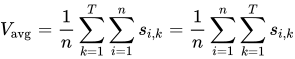
In the case where , we see that reaches a maximum of


.

In this case, the ratio of signal to noise also reaches a maximum,
.

This is the oversampling case, where the observed signal is correlated (because oversampling implies that the signal observations are strongly correlated).
Time-locked signals
[edit]Averaging is applied to enhance a time-locked signal component in noisy measurements; time-locking implies that the signal is observation-periodic, so we end up in the maximum case above.
Averaging odd and even trials
[edit]A specific way of obtaining replicates is to average all the odd and even trials in separate buffers. This has the advantage of allowing for comparison of even and odd results from interleaved trials. An average of odd and even averages generates the completed averaged result, while the difference between the odd and even averages, divided by two, constitutes an estimate of the noise.
Algorithmic implementation
[edit]The following is a MATLAB simulation of the averaging process:
N=1000;   % signal length
even=zeros(N,1);  % even buffer
odd=even;         % odd buffer
actual_noise=even;% keep track of noise level
x=sin(linspace(0,4*pi,N))'; % tracked signal
for ii=1:256 % number of replicates
    n = randn(N,1); % random noise
    actual_noise = actual_noise+n;

    if (mod(ii,2))
        even = even+n+x;
    else
        odd=odd+n+x;
    end
end

even_avg = even/(ii/2); % even buffer average
odd_avg = odd/(ii/2);   % odd buffer average
act_avg = actual_noise/ii; % actual noise level

db(rms(act_avg))
db(rms((even_avg-odd_avg)/2))
plot((odd_avg+even_avg));
hold on;
plot((even_avg-odd_avg)/2)
The averaging process above, and in general, results in an estimate of the signal. When compared with the raw trace, the averaged noise component is reduced with every averaged trial. When averaging real signals, the underlying component may not always be as clear, resulting in repeated averages in a search for consistent components in two or three replicates. It is unlikely that two or more consistent results will be produced by chance alone.
Correlated noise
[edit]Signal averaging typically relies heavily on the assumption that the noise component of a signal is random, having zero mean, and being unrelated to the signal. However, there are instances in which the noise is not uncorrelated. A common example of correlated noise is quantization noise (e.g. the noise created when converting from an analog to a digital signal).
References
[edit]Signal averaging
View on GrokipediaIntroduction
Definition and Motivation
Signal averaging is a signal processing technique that enhances the detectability of a deterministic signal embedded in noise by arithmetically averaging multiple independent measurements of the same signal.[4] This method relies on the principle that the underlying signal remains consistent across repetitions, while random noise varies unpredictably, allowing the noise to diminish through summation.[2] It is particularly effective for repetitive or time-locked signals, such as evoked responses in biomedical applications.[4] The primary motivation for signal averaging is to improve the signal-to-noise ratio (SNR) in scenarios where the desired signal is weak and obscured by substantial background noise, without the need for specialized hardware beyond standard acquisition systems.[5] Intuitively, each averaging iteration reinforces the coherent signal components, which add constructively, while uncorrelated noise terms cancel out on average, leading to a progressive reduction in noise variance.[2] This makes it a cost-effective approach for extracting low-amplitude signals in fields like electroencephalography, where direct measurement is challenging due to inherent physiological noise.[6] Effective signal averaging requires certain prerequisites, including a stationary signal that does not vary systematically across trials and additive noise that is random, zero-mean, and uncorrelated between measurements.[2] These assumptions ensure that the averaging process isolates the true signal without introducing distortions. The technique originated in the context of evoked potential analysis in electroencephalography (EEG), pioneered by George D. Dawson, who in 1954 introduced a summation method to detect small brain responses to stimuli amid large irregular backgrounds.[6]Applications
Signal averaging is widely applied in biomedical engineering to extract weak physiological signals from noisy recordings. In electroencephalography (EEG), it is used to isolate evoked potentials, such as auditory or visual responses, by time-locking multiple trials to stimuli and averaging them, thereby enhancing the signal-to-noise ratio (SNR) of brain activity patterns buried in background neural noise.[7] Similarly, in electrocardiography (ECG), signal averaging detects low-amplitude late potentials at the end of the QRS complex, which indicate delayed ventricular depolarization and risk of arrhythmias, enabling non-invasive assessment of myocardial substrate for reentrant ventricular tachycardia.[8] In physics and engineering, signal averaging improves the detection of faint signals in high-noise environments. Nuclear magnetic resonance (NMR) spectroscopy employs it to boost sensitivity for low-abundance nuclei like ¹³C, where multiple scans are accumulated to reduce thermal noise and achieve higher spectral resolution for molecular structure analysis. In seismology, it enhances weak earthquake signals by stacking repeated recordings from similar events, suppressing random seismic noise and revealing subtle ground motions for improved event detection and characterization.[10] In audio and communications, signal averaging serves as a noise reduction technique. For speech processing, it averages multiple utterances or segments to attenuate uncorrelated noise, improving clarity in environments like teleconferencing or hearing aids, where it helps recover intelligible speech from additive background interference. In radar systems, pulse integration— a form of coherent signal averaging—accumulates returns from multiple transmissions to increase detection range and reliability of targets amid clutter and thermal noise.[11] As of 2025, emerging applications integrate signal averaging with machine learning for adaptive processing in real-time systems. In wearable health devices, ML algorithms enhance EEG averaging by dynamically weighting trials based on noise estimates, improving seizure detection accuracy from continuous biosignals.[12] A representative example is in clinical EEG for diagnosing neurological disorders, where averaging 100-500 stimulus-locked trials can improve SNR by approximately 20-27 dB, allowing visualization of event-related potentials essential for identifying conditions like multiple sclerosis or epilepsy.[13]Theoretical Foundations
Signal and Noise Models
In signal averaging, the underlying signal is modeled as a deterministic, time-invariant waveform that repeats identically across independent trials, exhibiting no variability between repetitions.[5][14] This assumption holds in applications such as evoked potential recordings, where the signal is triggered by repeatable stimuli, ensuring phase coherence across trials. The noise component is characterized as additive, zero-mean random noise superimposed on the signal in the -th trial, where . This noise is assumed to be stationary with constant variance and uncorrelated across trials, satisfying for , and uncorrelated with the signal itself.[5][14] These properties allow the noise to cancel out through summation, as its expected value remains zero while its fluctuations diminish. The averaged output signal is given by where the signal term persists unchanged at , and the noise term has a reduced variance of due to the independence of the noise instances.[5][14] For discrete-time implementations, common in digital signal processing, the models extend to sampled versions and at a sampling rate , with the noise often further assumed to be white (uncorrelated across samples) to ensure independence in the discrete domain.[5] The averaging formula becomes preserving the signal while attenuating the noise variance by . A critical assumption underpinning these models is that the noise is ergodic, meaning ensemble averages equal time averages, and remains uncorrelated across trials; deviations from these conditions, such as correlated artifacts, can compromise the efficacy of averaging.[5][14]Derivation of SNR Improvement
The signal-to-noise ratio (SNR) is defined as , where is the signal power and is the noise power.[15] In signal averaging, consider a deterministic signal corrupted by additive uncorrelated noise with zero mean and variance . The signal power remains unchanged after averaging independent realizations because the signal adds coherently: the averaged signal is , so . The noise power reduces due to the law of large numbers for uncorrelated noise. The variance of the sum of independent noise terms is , and dividing by for the average yields a variance of , so . The improvement in the linear power SNR is thus , leading to a decibel improvement of . Equivalently, considering the amplitude-based perspective, the ratio simplifies step-by-step as follows: This shows that the amplitude SNR improves by a factor of , consistent with the power SNR gain of (since squaring the amplitude ratio yields ).[16] For continuous-time signals, power is computed via integrals over the signal duration, such as for a period , with the averaging derivation holding analogously as the noise variance scales by . For discrete-time sampled signals with samples, power is estimated as , and the noise power reduction follows the same factor upon averaging across trials, assuming uncorrelated noise samples.[16] Graphically, plotting SNR in dB versus the number of averages on a logarithmic scale yields a straight line with slope 10 (since ), illustrating the linear increase in dB with .Practical Techniques
Time-Locked Averaging
Time-locked averaging is a fundamental technique in signal processing where signals are aligned to a specific reference event, known as the trigger or lock point, to enable coherent summation and extraction of transient responses embedded in noise. This method segments continuous data into epochs, each beginning at the trigger onset, such as a stimulus presentation, ensuring that the underlying signal component adds constructively across trials while uncorrelated noise diminishes. Pioneered by George Duncan Dawson in the early 1950s, this approach revolutionized the study of evoked potentials by allowing the detection of weak, time-synchronized neural responses that were previously obscured by ongoing brain activity.[17] The process involves extracting epochs from each trial , spanning from (the lock point) to a duration , where the recorded signal is modeled as the sum of the true signal and noise . The averaged signal is then computed as , with time referenced relative to the trigger, enhancing the signal-to-noise ratio (SNR) for components phase-locked to the event. Alignment relies on precise triggers, such as visual flashes or auditory tones delivered via controlled experimental setups, to minimize timing errors; in cases of minor jitter (variability in event latency), techniques like epoch windowing to exclude edges or interpolation-based realignment can be applied to preserve coherence.[18][19] This technique is particularly advantageous for isolating transient events, such as evoked responses, where the signal is consistently timed to the stimulus, leading to substantial SNR improvements—often by a factor of for trials under ideal conditions—specifically for phase-locked components. In electroencephalography (EEG), time-locked averaging to stimulus onset reveals event-related potentials (ERPs), like the P300 wave, which reflect cognitive processes hidden within broadband neural noise. However, the method assumes consistent signal latency across trials; misalignments from jitter introduce phase shifts that smear the average waveform, thereby reducing peak amplitudes and effective SNR, with the degree of reduction depending on the jitter magnitude and the signal's temporal precision.[20][18][21]Averaging Odd and Even Trials
Averaging odd and even trials serves as a validation technique in signal averaging to confirm the reliability of the extracted evoked response by assessing consistency between independent subsets of data, thereby detecting potential artifacts, systematic biases, or non-stationary effects that could compromise the overall average.[22] This method is particularly valuable in applications like evoked potential recordings, where random noise is assumed but correlated noise or outliers might mimic a true signal.[23] By splitting trials post-time-locking, researchers can verify that the averaged waveform reflects a genuine evoked response rather than experimental confounds.[24] The procedure involves dividing the total set of N trials into two subsets: odd-numbered trials (1, 3, 5, ...) to form the average y_odd(t) and even-numbered trials (2, 4, 6, ...) to form y_even(t).[22] These sub-averages are computed separately after aligning trials to the stimulus onset, then compared through correlation analysis or subtraction. The Pearson correlation coefficient between y_odd(t) and y_even(t) quantifies similarity, with values exceeding 0.9 typically indicating excellent internal consistency and reliability of the evoked signal.[24] Alternatively, a difference waveform d(t) = y_odd(t) - y_even(t) can be generated; for valid results, its amplitude should remain near zero across the time window of interest, suggesting minimal discrepancies due to noise or biases.[23] This interleaved splitting helps mitigate effects like subject fatigue, as odd and even trials are temporally intermixed.[22] Interpretation of the results hinges on the degree of similarity: high correlation or low-amplitude d(t) confirms the presence of a true, reproducible signal, supporting the assumptions of signal averaging.[24] Discrepancies, such as correlation below 0.8 or prominent peaks in d(t), may signal issues like correlated noise, outliers from movement artifacts, or non-stationarity in the neural response, prompting rejection or further investigation of the dataset.[23] In practice, at least 40-50 trials per subset are often required to achieve satisfactory reliability, depending on the signal-to-noise ratio.[23] In evoked potential studies, this technique is routinely applied to ensure clinical reliability; for instance, sessions with low odd-even correlations are rejected to avoid misinterpretation of waveforms in diagnosing neurological conditions.[22] The International Society for Clinical Electrophysiology of Vision recommends overlaying odd and even sub-averages during recording to monitor reproducibility in real-time, facilitating immediate adjustments like additional trials if inconsistencies arise.[22] This approach extends to more robust validation by generalizing to k-fold splitting, where trials are divided into multiple subsets for cross-validation, enhancing detection of variability in larger datasets.[25]Implementation and Limitations
Algorithmic Implementation
The basic algorithm for signal averaging begins by extracting epochs from the continuous signal using time-locking to a reference event, such as a stimulus onset. An accumulator array is initialized to zeros with length equal to the number of samples per epoch. For each of the epochs, the epoch data is added to the accumulator. The final average is obtained by dividing the accumulator by , yielding the discrete-time average signal for , where denotes the -th sample of the -th epoch.[26] A simple pseudocode implementation is as follows:# Assume epochs is a 2D array of shape (N, M), with N trials and M samples per epoch
initialize accumulator = zeros(M)
for i = 1 to N:
epoch = epochs[i] # Extract i-th epoch (time-locked)
accumulator += epoch
average = accumulator / N
# Assume epochs is a 2D array of shape (N, M), with N trials and M samples per epoch
initialize accumulator = zeros(M)
for i = 1 to N:
    epoch = epochs[i]  # Extract i-th epoch (time-locked)
    accumulator += epoch
average = accumulator / N
np.mean(epochs, axis=0) computes the average along the trial dimension in a single call, or MATLAB's mean(epochs, 1) for row-wise averaging.
To optimize efficiency, especially for large datasets (e.g., trials and samples), employ vectorized array operations to eliminate explicit loops, and pre-allocate the accumulator array to avoid dynamic resizing during summation. Such practices minimize memory overhead and leverage optimized BLAS libraries underlying NumPy and MATLAB for faster computation.[26]
Prior to averaging, baseline correction is applied to each epoch by subtracting the mean value computed over a pre-event baseline period (e.g., -100 ms to 0 ms relative to the trigger) from all samples in that epoch, thereby removing slow drifts unrelated to the signal of interest.[27]
Outlier rejection precedes averaging to exclude contaminated epochs; a common method uses amplitude thresholds (e.g., ±40 μV) or joint probability metrics, rejecting segments where activity exceeds 3 standard deviations from the mean for single electrodes or electrode groups.[28]
The overall computational complexity of the algorithm is , arising from the summation over epochs each of length , making it feasible for real-time applications when remains modest (e.g., below 100).[26]