Hubbry Logo
SkvaderSkvaderMain
Open search
Skvader
Community hub
Skvader
logo
8 pages, 0 posts
0 subscribers
Be the first to start a discussion here.
Skvader
Skvader
from Wikipedia
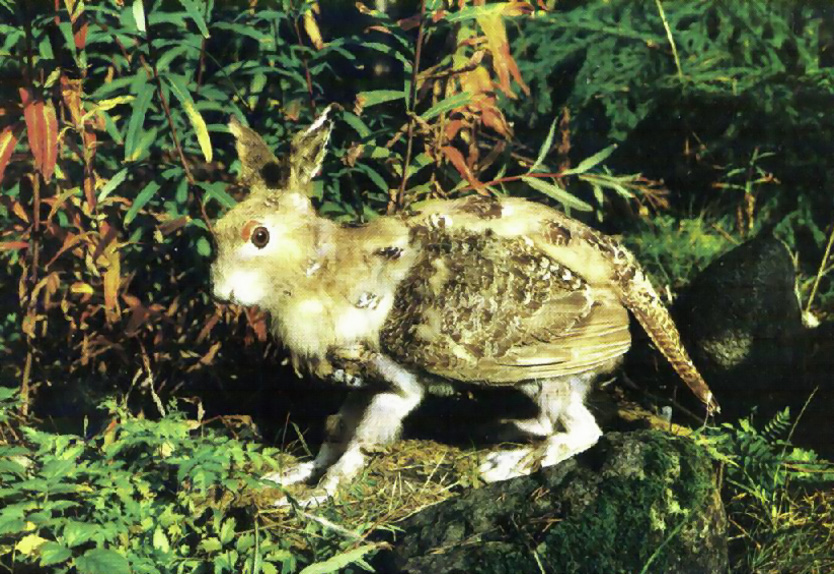
Rudolf Granberg's prepared skvader

The skvader (pronounced [ˈskvɑ̌ːdɛr]) is a Swedish fictional creature that was constructed in 1918 by the taxidermist Rudolf Granberg and is permanently displayed at the museum at Norra Berget in Sundsvall. It has the head, forequarters and hindlegs of a European hare (Lepus europaeus), and the back, wings and tail of a female wood grouse (Tetrao urogallus). It was later jokingly given the Latin name Tetrao lepus pseudo-hybridus rarissimus L.[1]

The term has taken on a general meaning of two disparate elements put together, often conveying a sense of a less fortunate such combination.

Name

[edit]

The name is a combination of two words, explained by the Svenska Akademiens ordbok (Dictionary of the Swedish Academy) as being from the "prefix skva- from skvattra (quack or chirp), and the suffix -der from tjäder (wood grouse)".

Origins

[edit]

The skvader originates from a tall tale hunting story told by a man named Håkan Dahlmark during a dinner at a restaurant in Sundsvall in the beginning of the 20th century. To the amusement of the other guests, Dahlmark claimed that he in 1874 had shot such an animal during a hunt north of Sundsvall. On his birthday in 1907, his housekeeper jokingly presented him with a painting of the animal, made by her nephew and shortly before his death in 1912, Dahlmark donated the painting to a local museum. During an exhibition in Örnsköldsvik in 1916 the manager of the museum became acquainted with the taxidermist Rudolf Granberg. He then mentioned the hunting story and the painting and asked Granberg if he could re-construct the animal. In 1918 Granberg had completed the skvader and it has since then been a very popular exhibition item at the museum, which also has the painting on display.[2]

Similar creatures

[edit]
Wolpertinger edited from a drawing of a hare by Albrecht Dürer.

A strikingly similar creature called the "rabbit-bird" was described by Pliny the Elder in Natural History. This creature had the body of a bird with a rabbit's head and was said to have inhabited the Alps.[3]

Other similar creatures include the Bavarian wolpertinger, the Austrian raurakl, the Thuringian Forest's rasselbock, the Palatinate's Elwedritsche, and the American jackalope.

Symbolism

[edit]
A road sign on the approach to the museum warns drivers for skvaders on the road.

The skvader has since then often been seen as an unofficial symbol of Sundsvall and when the province Medelpad was to be given a provincial animal (in addition to the provincial flower) in 1987, many locals voted for the skvader. The final choice was a kind of compromise, the mountain hare, which is the front-end of the skvader.

Other uses

[edit]
A typical skvader bus

The term skvader can be used colloquially in Swedish to mean 'a combination of contradicting elements'.[4]

Skvader also became the nickname in the 1950s and 1960s for a bruck, a combination of bus and truck (lorry in British English) with the front-end of a bus taking passengers and the back-end as an open loading bay. The skvader was used on small bus routes in Norrland and to deliver milk from small farmers to the nearest dairy.

"Skvaderns" is also a herbal liqueur made with herbs from the forest Lunde Skog, the place Skvaderns first were shot at.[5][6]

References

[edit]
[edit]
Revisions and contributorsEdit on WikipediaRead on Wikipedia
from Grokipedia
The Skvader is a fictional Swedish creature portrayed as a mythical hybrid of a and a wood grouse, constructed as a specimen in by the taxidermist Rudolf Granberg and permanently displayed at the Norra Berget open-air museum in , . It combines the head, forequarters, and hind legs of a (Lepus timidus) with the back, wings, and tail of a female wood grouse (also known as capercaillie, Tetrao urogallus), creating the appearance of a winged . The legend of the Skvader originated from a reportedly told by Swedish hunter Håkan Dahlmark during a dinner in the early 1900s, who claimed to have shot a bizarre animal near around 1874, which was illustrated in local newspapers and inspired Granberg's creation decades later. Granberg, a local taxidermist, assembled the specimen as a novelty , drawing from the earlier to craft what became a beloved in the Medelpad province. The term "skvader" itself derives from Swedish , colloquially meaning "a bad compromise" or "a bungled job," reflecting the creature's chimeric nature. Since its debut, the Skvader has been a centerpiece of the Norra Berget museum, which opened in 1944 and preserves regional through artifacts and exhibits, attracting visitors interested in Swedish . A bronze statue of the creature was erected in a park in 1994, further cementing its status as an unofficial symbol of the area, often compared to similar hoaxes like the American . The original specimen remains on view, highlighting themes of , , and regional identity in Swedish .

Description

Physical Appearance

The Skvader is a taxidermied hybrid specimen constructed from the head, forequarters, and hindlegs of a (Lepus europaeus), seamlessly integrated with the back, wings, and tail sourced from a female wood grouse (Tetrao urogallus), commonly known as the capercaillie. This combination creates a chimeric form that blends and avian features, with the hare's sleek fur covering the frontal sections and the grouse's feathers adorning the posterior and appendages. The result is a mounted creature that evokes a mythical winged , preserved through traditional techniques using the actual skins of these animals to achieve a lifelike yet fantastical appearance. In terms of overall size and proportions, the Skvader approximates the dimensions of an adult , measuring roughly 50-70 cm in length, with the addition of the grouse's wings extending its silhouette to suggest flight capability without altering the core quadrupedal stance. The hare-derived elements provide a grounded, agile base, while the avian contributions—particularly the broad wings and fan-like tail—impart an otherworldly elevation, emphasizing the hybrid's folklore-inspired design over realistic anatomy. This balanced scaling ensures the specimen retains the compact, earthy form of its mammalian component while incorporating bird-like extensions for visual drama. The Skvader has been humorously classified under the pseudo-scientific Latin binomial Tetrao lepus pseudo-hybridus rarissimus L., reflecting its fabricated nature as a rare pseudo-hybrid. This nomenclature playfully merges the genera of its constituent species (Tetrao for the grouse and Lepus for the hare), underscoring the creature's status as an artistic invention rather than a natural taxon. The mounted specimen, which appears as a poised winged hare ready for imagined flight, is currently displayed at the Norra Berget museum in Sundsvall, Sweden.

Name and Etymology

The term skvader (pronounced [ˈskvɑ̌ːdɛr] in Swedish) primarily denotes a fictional hybrid creature originating from Swedish , specifically the taxidermy specimen created in 1918 and displayed at the Norra Berget museum in , . This usage ties directly to the creature's depiction as a mismatched amalgamation of a hare's forebody and hind legs with a wood grouse's (tjäder) back, wings, and tail, embodying an improbable biological fusion. Etymologically, skvader is a portmanteau derived from the dialectal prefix skva-, linked to verbs such as skväda (to splash or spill haphazardly) or related forms like skvalta (to splash about), combined with -der from tjäder (wood grouse). This construction evokes the notion of a haphazard or splash-like mixing of elements, mirroring the creature's incongruous hybrid form. The first syllable may also allude to the supposed vocalization of the animal, akin to splashing sounds in dialectal contexts. In broader Swedish usage, skvader has evolved into a colloquialism for any ill-matched or contradictory combination, such as incompatible ideas, objects, or compromises, humorously extending from the creature's mismatched anatomy. This semantic shift underscores how the term captures the essence of discordance in everyday language.

Origins and Creation

The Founding Tale

The Skvader's legendary origins trace back to a tall tale recounted by Swedish timber rafting inspector Håkan Dahlmark, who claimed to have encountered the creature during a hunt in 1874 north of Sundsvall, specifically in the Lunde forest near Timrå. According to Dahlmark's narrative, while pursuing game with a borrowed Belgian double-barreled shotgun, he spotted a peculiar animal that combined the body of a hare with the wings and tail of a wood grouse (Tetrao urogallus), weighing approximately 10-15 kilograms and exceeding one meter in length. The creature, which he later dubbed the "Skvader," adopted a defensive posture but evaded full capture when Dahlmark fired upon it, fleeing into the underbrush and leaving only a fleeting glimpse of its hybrid form. Dahlmark first shared this embellished hunting yarn with dinner companions at a restaurant in in the early , much to their amusement, positioning the 1874 incident as a whimsical encounter with a shy, winged -like being that blended agility with avian features. The story gained a tangible artifact in 1907 when Dahlmark's housekeeper, Lova Lindahl, commissioned her nephew, artist Halvar Frisendahl, to create a of the imagined creature as a birthday gift; the artwork depicted the Skvader based on market-bought models of a and wood , complete with an inscription noting the 1874 hunt in Lunde skog. The tale's dissemination culminated shortly before Dahlmark's death in , when he donated the Frisendahl to a local museum in , solidifying the Skvader as a piece of regional without any verifiable evidence of the creature's existence. Historians and folklorists have since classified the account as pure fiction, a product of Dahlmark's inventive storytelling during social gatherings, with no biological or eyewitness corroboration beyond the itself.

Construction Process

In 1916, Carl Erik Hammarberg, the director of the Norra Berget in , encountered Swedish taxidermist Rudolf Granberg and commissioned him to fabricate a physical specimen of the Skvader as a tribute to the fictional tale recounted by hunter Håkan Dahlmark. Granberg drew inspiration from a 1907 of the creature, created by Dahlmark's housekeeper's nephew and later donated to the in 1912, to guide the hybrid's form. Granberg employed conventional methods to construct the piece, sewing together the preserved skin of a (Lepus europaeus) for the anterior body, head, and forelimbs with the skin of a wood grouse ( urogallus, known locally as tjäder) for the posterior body, tail, and wings to evoke the mythical flying hare. He assigned it the mock scientific name Lepor tetrao pseudohybridus rarrisimus. The assembly was mounted on an artificial frame without involving any live animals, resulting in a purely fabricated artifact intended as an elaborate . The project was completed in 1918, after which Granberg donated the finished Skvader to the Norra Berget museum, where it was explicitly labeled as a fictional creation and displayed as a lighthearted curiosity to engage visitors with Swedish folklore traditions.

Cultural Significance

Symbolism and Local Role

The Skvader serves as an unofficial mascot for the city of in Sweden's province, embodying local humor, eccentricity, and a tradition of whimsical hoaxes. Created in 1918 as a hybrid, it has endured as a of creative invention within Swedish cultural narratives, highlighting the region's playful approach to and regional identity. In an unofficial 1987 to select a provincial animal for —alongside the existing provincial flower—many residents voted for the Skvader, reflecting its deep ties to local pride and affection. However, the mountain (Lepus timidus) was ultimately chosen as a more conventional representative of the area's natural , though the Skvader's popularity underscored its role as a cherished, if unofficial, emblem. The creature's hybrid form has inspired interpretations as a for mismatched or contradictory elements in and , aligning with its colloquial use in Swedish to denote "a bad " or an awkward fusion of incompatible parts. This symbolism ties into broader themes of imagination triumphing over strict reality, reinforcing the Skvader's place in Sundsvall's lore as a fun, non-serious icon that fosters community amusement and regional distinctiveness since the early . A erected in a Sundsvall park in further cements its status in local tourism and cultural displays.

Modern Interpretations and Uses

In contemporary Swedish culture, the term "skvader" has evolved beyond its original folklore roots to describe hybrid or contradictory combinations in everyday language. For instance, it is colloquially applied to "skvaderbussar," a type of bus-truck hybrid vehicle prevalent in the Norrland region, particularly in areas like Östersund during the 1950s and 1960s. These vehicles, which combined bus passenger compartments with truck cargo capabilities, were practical adaptations for rural transport needs in northern Sweden. The usage reflects the creature's enduring connotation as an improbable fusion, often implying a suboptimal compromise. Commercially, the Skvader has inspired regional products that leverage its mythical allure for branding. A notable example is Skvaderns Örtlikör, an herbal produced by Sankta Annas Bränneri in , featuring a 35% alcohol content derived from and berries sourced from Lunde Skog forest—the legendary site of the creature's first "sighting." Launched as a tribute to the Skvader, the liqueur ties into local to promote regional identity, though production details remain centered on traditional methods without extensive disclosure. The original 1918 taxidermy specimen continues to serve as a key , preserved unchanged in a permanent exhibit at Norra Berget in since the museum's establishment in 1944. Housed in the Crafts and Maritime Museum, it draws tourists as a whimsical emblem of folklore, complementing the site's 19th-century farmhouses, , and nature trails to enhance visitor experiences focused on regional history and curiosity. In recent decades, the Skvader has seen sporadic media coverage and creative reinterpretations that sustain its cultural footprint. Artistic projects, such as Spanish muralist Dulk's 2019 street art depiction in —blending the creature with elements reminiscent of the German —have introduced it to broader audiences through urban installations. Additionally, the Skvaderboden, a combined and at Norra Berget with ongoing exhibitions and Skvader-themed merchandise, fosters public engagement as of 2025. While digital recreations remain limited, these modern adaptations highlight the creature's role as a lighthearted symbol in Swedish heritage tourism and design.

Comparisons to Similar Creatures

European Fictional Hybrids

The , a Swedish combining a and a , shares its fictional hybrid nature with several other European creations rooted in and prankster craftsmanship, particularly in German-speaking regions where taxidermists crafted chimeric mounts to amuse or deceive locals and tourists. These often blend mammalian and avian elements, reflecting a continental tradition of whimsical fabrication that emerged prominently in the 19th and early 20th centuries, emphasizing mismatched anatomies for humorous effect. One of the most iconic parallels is the from , a taxidermied hybrid typically featuring a or body augmented with deer antlers, wings (often from pheasants or ), fangs, and sometimes a squirrel-like or . Originating as a 19th-century by Bavarian taxidermists, these mounts were sold to visitors as rare alpine wildlife, capitalizing on the region's hunting culture and tourist trade; specimens remain on display at institutions like the German Hunting and Fisheries Museum in . Unlike the Skvader's streamlined hare-grouse fusion, the Wolpertinger's design allows for greater variability, incorporating up to five animal parts to evoke absurd, localized myths of crossbred forest dwellers. In , the represents a regional variant of this , constructed on a base with added deer antlers, a tail, and occasionally wings, creating a rattling ("rassel") effect in tales due to its supposed noisy movements. These pieces, akin to the , date to the 19th-20th centuries and served as curios for regional enthusiasts, highlighting Thuringia's forested landscapes and distinct from Bavarian models by prioritizing squirrel elements over fangs or beaks. The 's design underscores the adaptive, prank-driven evolution of these hybrids across German states, where local fauna inspired unique combinations. Austria's Raurakl embodies a similar Alpine flavor, depicted as a -bird hybrid frequently incorporating duck wings, deer antlers, and waterfowl features, often mounted as hoaxes inspired by of elusive mountain creatures. Emerging alongside the in the , the Raurakl was crafted to mimic rare sightings in Austrian woodlands, blending hare agility with avian adaptations for a more aquatic twist compared to the Skvader's terrestrial elements. This variant illustrates the cross-border diffusion of the tradition within the German-speaking , where taxidermists tailored features to regional ecosystems. Further west in the Palatinate region, the Elwedritsche (or Elwetritsch), a chicken-like creature with stag antlers, a long beak, scales instead of feathers, serpentine tails, and rooster spurs, forming a bird-dominant hybrid that emphasizes mismatched avian-fae themes in hoax mounts. Like its counterparts, it arose from 19th-century taxidermy pranks, with organized "hunts" as social jests, distinguishing itself through woodcock influences that evoke the area's marshy habitats and folklore of goblin-crossed fowl. The Elwedritsche's composition parallels the Skvader in avian-mammal incongruity but leans toward poultry absurdity over hunting prey. These modern European hybrids trace conceptual roots to ancient precedents, such as Pliny the Elder's 1st-century AD description in Natural History of the lagopus, a ptarmigan bird with feet "tufted like a hare's," interpreted in later Renaissance illustrations as a more explicit rabbit-bird hybrid and serving as an early literary precursor to the taxidermy hoaxes of later centuries.

Global Counterparts

The most prominent global counterpart to the Skvader is the jackalope, a mythical creature from North American folklore depicted as a jackrabbit fused with antelope or pronghorn horns. This hoax originated in the 1930s when brothers Douglas and Ralph Herrick, amateur taxidermists in Douglas, Wyoming, grafted pronghorn antlers onto a jackrabbit carcass, creating the first physical specimen. The jackalope quickly gained popularity through sales to local hotels and curio shops, as well as mass-produced postcards that spread its legend across the American West. The jackalope's creation reflects broader influences from 19th-century American sideshow culture, where fabricated "gaffs" captivated audiences seeking marvels and oddities. A seminal example is P.T. Barnum's 1842 exhibition of the , a stitched-together monkey-fish hybrid that exemplified the era's deceptive attractions and inspired subsequent hoaxes. In contrast to the Skvader's avian hybrid, the jackalope emphasizes features without avian or aquatic elements, aligning more with terrestrial tall tales than European museum curiosities. Similar hybrid concepts appear in worldwide, such as the horned rabbit in Huichol mythology of indigenous Mexican communities, where a rabbit-like figure is said to share antlers with deer in ancient oral traditions. These examples underscore a recurring motif of lagomorph-ungulate fusions, yet the Skvader stands apart through its specific early 20th-century European origins as a one-off exhibit in 1918, rather than widespread commercial or indigenous narrative proliferation.

References

Add your contribution
Related Hubs
User Avatar
No comments yet.