Hubbry Logo
Slope deflection methodSlope deflection methodMain
Open search
Slope deflection method
Community hub
Slope deflection method
logo
7 pages, 0 posts
0 subscribers
Be the first to start a discussion here.
Slope deflection method
from Wikipedia

The slope deflection method is a structural analysis method for beams and frames introduced in 1914 by George A. Maney.[1] The slope deflection method was widely used for more than a decade until the moment distribution method was developed. In the book, "The Theory and Practice of Modern Framed Structures", written by J.B Johnson, C.W. Bryan and F.E. Turneaure, it is stated that this method was first developed "by Professor Otto Mohr in Germany, and later developed independently by Professor G.A. Maney". According to this book, professor Otto Mohr introduced this method for the first time in his book, "Evaluation of Trusses with Rigid Node Connections" or "Die Berechnung der Fachwerke mit Starren Knotenverbindungen".

Introduction

[edit]

By forming slope deflection equations and applying joint and shear equilibrium conditions, the rotation angles (or the slope angles) are calculated. Substituting them back into the slope deflection equations, member end moments are readily determined. Deformation of member is due to the bending moment.

Slope deflection equations

[edit]

The slope deflection equations can also be written using the stiffness factor and the chord rotation :

Derivation of slope deflection equations

[edit]

When a simple beam of length and flexural rigidity is loaded at each end with clockwise moments and , member end rotations occur in the same direction. These rotation angles can be calculated using the unit force method or Darcy's Law.

Rearranging these equations, the slope deflection equations are derived.

Equilibrium conditions

[edit]

Joint equilibrium

[edit]

Joint equilibrium conditions imply that each joint with a degree of freedom should have no unbalanced moments i.e. be in equilibrium. Therefore,

Here, are the member end moments, are the fixed end moments, and are the external moments directly applied at the joint.

Shear equilibrium

[edit]

When there are chord rotations in a frame, additional equilibrium conditions, namely the shear equilibrium conditions need to be taken into account.

Example

[edit]
Example

The statically indeterminate beam shown in the figure is to be analysed.

  • Members AB, BC, CD have the same length .
  • Flexural rigidities are EI, 2EI, EI respectively.
  • Concentrated load of magnitude acts at a distance from the support A.
  • Uniform load of intensity acts on BC.
  • Member CD is loaded at its midspan with a concentrated load of magnitude .

In the following calculations, clockwise moments and rotations are positive.

Degrees of freedom

[edit]

Rotation angles , , , of joints A, B, C, respectively are taken as the unknowns. There are no chord rotations due to other causes including support settlement.

Fixed end moments

[edit]

Fixed end moments are:

Slope deflection equations

[edit]

The slope deflection equations are constructed as follows:

Joint equilibrium equations

[edit]

Joints A, B, C should suffice the equilibrium condition. Therefore

Rotation angles

[edit]

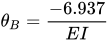
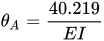
The rotation angles are calculated from simultaneous equations above.
Member end moments

[edit]

Substitution of these values back into the slope deflection equations yields the member end moments (in kNm):


See also

[edit]

Notes

[edit]

References

[edit]
Revisions and contributorsEdit on WikipediaRead on Wikipedia
from Grokipedia
The slope deflection method is a classical displacement-based technique in used to analyze beams and frames by relating the end moments of members to the rotations (slopes) and relative lateral displacements (deflections) at their joints, enabling the determination of internal forces, shears, and reactions through equilibrium equations. Introduced in 1915 by American engineer George A. Maney, the method derives its core equations from the elastic curve theory, assuming small deformations, linear elastic material behavior, and negligible axial and shear deformations while focusing on effects. Key principles include formulating slope-deflection equations for each member—such as MAB=2EIL(2θA+θB3ψ)+MABFM_{AB} = \frac{2EI}{L} (2\theta_A + \theta_B - 3\psi) + M_{AB}^F, where EE is the modulus of elasticity, II is the , LL is the member length, θ\theta represents rotations, ψ\psi is the chord rotation due to displacement, and MFM^F is the fixed-end moment—and solving a system of simultaneous equations from moment equilibrium, with additional considerations for support settlements and sway in frames. This approach is advantageous for hand calculations in structures with low to moderate indeterminacy, providing detailed insights into moment distribution, though it becomes cumbersome for highly complex systems and has largely been supplanted by matrix stiffness methods in .

Introduction

Historical Background

The slope deflection method was introduced by George A. Maney in 1915 through his publication Studies in Engineering, issued by the . This work presented the foundational equations for relating end moments in beams to rotations and displacements at the joints, establishing it as a displacement-based approach for analyzing structures. Prior to the mid-20th century advent of digital computers, the method gained traction for manual analysis of indeterminate beams and rigid frames, particularly in and design where exact solutions were essential for economy and safety. It addressed the limitations of earlier methods by directly incorporating joint rotations, making it suitable for hand calculations in practice. By the 1930s, growing demands for efficient analysis of multi-story frames under lateral loads—such as wind and seismic forces, heightened after events like the —spurred adaptations of the method, including its use by the San Francisco Bureau of Building Inspection in 1930. During the and 1940s, it evolved from purely manual techniques into a foundational precursor for advanced displacement methods, paving the way for matrix-based formulations that would dominate post-war . Subsequent publications significantly popularized the approach, including the 1918 bulletin Analysis of Statically Indeterminate Structures by the Slope Deflection Method by W. M. Wilson, F. E. Richart, and Camillo Weiss, published as Bulletin No. 108 by the Engineering Experiment Station, which provided detailed derivations, examples, and applications to complex frames. These works solidified its role in engineering curricula and professional practice until computational tools supplanted manual methods.

Method Overview

The deflection method is a displacement-based approach in used to determine the end moments and rotations in beams and frames that possess redundant supports, thereby enabling the analysis of structures. Introduced by George A. Maney in , it treats rotations and relative displacements as the primary unknowns, relating these to member end actions through compatibility conditions. This method is particularly effective for plane frames, continuous beams, and multi-story structures subjected to transverse loads, as it focuses on flexural deformations while neglecting axial and shear effects. It is not applicable to structures dominated by axial loads, such as trusses, due to these simplifying assumptions. At a high level, the procedure begins with calculating the fixed-end actions for each member assuming no joint displacements, followed by applying slope deflection relations to express end moments in terms of unknown rotations and translations. Equilibrium is then enforced at each by summing moments to zero, yielding a system of simultaneous equations that are solved for the unknown displacements. Once displacements are obtained, the end moments and shears can be computed to complete the analysis. In contrast to force methods, such as the flexibility or consistent deformation approach, which select redundant forces as unknowns and enforce compatibility through superposition, the slope deflection method prioritizes displacement unknowns and satisfies equilibrium directly via joint balances. This displacement-centric framework makes it more straightforward for computer implementation and suitable for structures with moderate degrees of indeterminacy, though it requires solving linear equations rather than iterative corrections.

Theoretical Basis

Assumptions and Sign Conventions

The slope deflection method relies on a set of foundational assumptions to model the behavior of statically indeterminate beams and frames accurately. The material is assumed to exhibit linear elastic behavior, with stresses proportional to strains and full recovery upon load removal. Deformations are small, allowing the neglect of higher-order geometric nonlinearities and ensuring that the slope of the deflected shape remains nearly equal to the rotation. The method applies to plane frame analysis, where out-of-plane actions such as torsion or lateral-torsional buckling are disregarded. Each structural member is presumed to have a constant cross-section and uniform modulus of elasticity EE, resulting in constant flexural rigidity EIEI along its length. Joints are treated as rigid, meaning no relative rotation occurs between connected members at the joints. Additionally, axial deformations and shear deformations are neglected, focusing exclusively on flexural (bending) effects in line with Euler-Bernoulli beam theory. These assumptions impose inherent limitations on the method's scope. It is unsuitable for plastic analysis, as the linear elastic framework does not account for yielding or post-yield behavior in materials. Similarly, the small deformation assumption renders it inappropriate for problems involving large deflections, where second-order effects like P-Δ interactions dominate. The neglect of axial and shear effects further restricts its use to slender members where bending governs the response. To ensure consistent application, the slope deflection method employs standardized sign conventions based on local member coordinates. Moments are positive if they act on the member end, promoting tension on the bottom for horizontal members. Rotations, or slopes, at the member ends (denoted θA\theta_A and θB\theta_B) are positive when relative to the member's original position. The chord ψ\psi, which accounts for relative displacements, is defined as the relative lateral (or vertical for beams) displacement Δ\Delta between ends divided by the member length LL, or ψ=Δ/L\psi = \Delta / L, with the sign chosen such that positive ψ\psi corresponds to of the chord. Subscripts distinguish near-end (e.g., MABM_{AB}) and far-end (e.g., MBAM_{BA}) actions, with all quantities resolved in the local aligned with the member. Effective use of the method requires prerequisite knowledge of fundamental concepts in . Familiarity with Euler-Bernoulli beam theory is essential, as it underpins the flexural focus and moment-curvature relationships. Understanding static indeterminacy—such as identifying and compatibility conditions in beams and frames—is critical for setting up the necessary equilibrium equations. Proficiency in interpreting shear and moment diagrams also aids in verifying results and appreciating how end rotations and displacements influence internal forces.

Derivation of Slope Deflection Equations

The derivation of the slope deflection equations originates from the theory of beam bending, specifically the elastic curve equation EId2ydx2=M(x)EI \frac{d^2 y}{dx^2} = M(x), where EE is the modulus of elasticity, II is the moment of inertia of the cross-section, yy is the transverse deflection, and M(x)M(x) is the internal bending moment distribution along the beam length. This equation relates the curvature of the deflected beam to the applied moments and can be solved through double integration or equivalent geometric methods like the moment-area theorem to express end moments in terms of end rotations and displacements. The approach assumes small deformations and linear elastic behavior, with constant EIEI. Consider a prismatic beam member AB of length LL, with ends A and B subjected to end moments MABM_{AB} and MBAM_{BA}, respectively, and no transverse loading initially. The moment distribution along the beam is linear: M(x)=MAB(1xL)+MBA(xL)M(x) = M_{AB} \left(1 - \frac{x}{L}\right) + M_{BA} \left(\frac{x}{L}\right), where xx is measured from end A. To find the relationship between these moments and the end rotations θA\theta_A and θB\theta_B (the changes in of the beam tangents at A and B relative to the chord connecting the ends), the moment-area method is applied, which states that the change in slope between two points is the area of the M/EIM/EI diagram between them, and the tangential deviation is the first moment of that area. Using the , the relative rotation between ends A and B is θBθA=1EI0LM(x)dx=L(2MAB+MBA)6EI\theta_B - \theta_A = \frac{1}{EI} \int_0^L M(x) \, dx = \frac{L (2M_{AB} + M_{BA})}{6 EI}, no, correction: actually θBθA=L(MAB+MBA)2EI\theta_B - \theta_A = \frac{L (M_{AB} + M_{BA})}{2 EI}, representing the total area under the M/EIM/EI diagram. The tangential deviation of end B relative to the tangent at A is tB/A=1EI0LM(x)xdxt_{B/A} = \frac{1}{EI} \int_0^L M(x) x \, dx, wait, standard for t_{B/A} (deviation at B from tangent at A) is the first moment about A: but from integration, tB/A=L2(MAB+2MBA)6EIt_{B/A} = \frac{L^2 (M_{AB} + 2 M_{BA})}{6 EI}? Wait, from earlier calc, it's \frac{L^2 (2 M_{AB} + M_{BA})}{6 EI}. From the elastic curve integration, the deviation tB/A=y(L)LθA=L2(2MAB+MBA)6EIt_{B/A} = y(L) - L \theta_A = \frac{L^2 (2 M_{AB} + M_{BA})}{6 EI}. For consistency with the chord rotation ψ\psi (defined as the rotation of the chord AB due to relative transverse displacement δ\delta of end B with respect to A, where ψ=δ/L\psi = \delta / L), the deviation relates to tB/A=L(ψθA)t_{B/A} = L (\psi - \theta_A). Solving these equations simultaneously yields the moment-rotation relations for the unloaded case. Rearranging the solved system gives: MAB=2EIL(2θA+θB3ψ)M_{AB} = \frac{2EI}{L} (2\theta_A + \theta_B - 3\psi) MBA=2EIL(θA+2θB3ψ)M_{BA} = \frac{2EI}{L} ( \theta_A + 2\theta_B - 3\psi ) These equations show that the moment at the near end (e.g., MABM_{AB} at A) depends on a stiffness coefficient of 4EI/L4EI/L for the local rotation θA\theta_A and 2EI/L2EI/L for the far-end rotation θB\theta_B, with an additional sway term 6EI/L2δ-6EI/L^2 \cdot \delta arising from the 3ψ-3\psi contribution, which accounts for relative joint displacements in frames. The factor 4EI/L4EI/L represents the rotational stiffness at the near end when the far end is fixed (θB=ψ=0\theta_B = \psi = 0), while 2EI/L2EI/L is the carry-over factor to the far end. For beams with transverse loads, the principle of superposition is applied: the total end moments are the sum of the above expressions and the fixed-end moments MFABM_{FAB} and MFBAM_{FBA} computed for the member as if both ends were fixed against rotation and displacement. Thus, the complete slope deflection equations become: MAB=2EIL(2θA+θB3ψ)+MFABM_{AB} = \frac{2EI}{L} (2\theta_A + \theta_B - 3\psi) + M_{FAB} MBA=2EIL(θA+2θB3ψ)+MFBAM_{BA} = \frac{2EI}{L} (\theta_A + 2\theta_B - 3\psi) + M_{FBA} This formulation, introduced by George A. Maney in 1915, enables the analysis of indeterminate structures by relating member end actions directly to joint degrees of freedom.

Key Equations and Components

Slope Deflection Equations

The slope deflection equations express the end moments in a beam member in terms of the rotations at the ends, the relative displacement between the ends, and the fixed-end moments due to applied loads. For a prismatic member with constant flexural rigidity EIEI and length LL, the moment at end A of member AB, denoted MABM_{AB}, is given by MAB=EIL(4θA+2θB6ψ)+FEMABM_{AB} = \frac{EI}{L} (4 \theta_A + 2 \theta_B - 6 \psi) + FEM_{AB} where θA\theta_A and θB\theta_B are the rotations (slopes) at ends A and B, respectively (positive in the clockwise direction), ψ\psi is the chord rotation due to relative transverse displacement Δ\Delta between the ends (ψ=Δ/L\psi = \Delta / L, positive clockwise), and FEMABFEM_{AB} is the fixed-end moment at A due to loads assuming fixed ends. The symmetric equation for the moment at end B, MBAM_{BA}, is MBA=EIL(2θA+4θB6ψ)+FEMBA.M_{BA} = \frac{EI}{L} (2 \theta_A + 4 \theta_B - 6 \psi) + FEM_{BA}. These equations were introduced by George A. Maney in as a practical tool for indeterminate analysis. In these equations, the terms 4EILθA\frac{4EI}{L} \theta_A and 2EILθB\frac{2EI}{L} \theta_B in MABM_{AB} (and analogously for MBAM_{BA}) represent the rotational stiffness contributions: the 4EI/L4EI/L reflects the at the near end against rotation when the far end is fixed, while 2EI/L2EI/L is the carry-over to the far end due to rotation at the near end. The term 6EILψ-6 \frac{EI}{L} \psi corrects for the effect of relative end displacement, equivalent to an imposed rotation along the member's chord that induces additional moments. The FEMFEM terms account for moments arising solely from transverse or axial loads on the member, independent of joint displacements, and are precomputed based on load type and position. For non-prismatic members where II varies along the length, the equations are extended by replacing the fixed coefficients 4 and 2 with member-specific KK and carry-over factor COFCOF (typically K4EIavg/LK \approx 4EI_{avg}/L and COF0.5COF \approx 0.5 for slight variations), derived from elastic curve integration or tabulated for common shapes like tapered or haunched beams; fixed-end moments also require specialized tables.

Fixed-End Moments and Shears

Fixed-end moments (FEMs) represent the moments induced at the ends of a beam member that is completely restrained against both and vertical when subjected to transverse loads. These moments arise solely from the applied loading and are essential components in the slope deflection method, where they account for the effects of loads on fixed-end conditions before incorporating displacements. The corresponding fixed-end shears are the vertical reactions at the restrained ends required to maintain equilibrium under the same loading. The formulas for fixed-end moments are derived from the integration of the for beam deflection or through standard solutions in . For a distributed load ww acting over the full span length LL, the fixed-end moments are MABf=wL212M_{AB}^f = -\frac{wL^2}{12} at end A and MBAf=wL212M_{BA}^f = \frac{wL^2}{12} at end B, following the convention where positive moments produce at the near end. For a concentrated point load PP applied at the midspan, the fixed-end moments are MABf=PL8M_{AB}^f = -\frac{PL}{8} and MBAf=PL8M_{BA}^f = \frac{PL}{8}. For other common loadings, such as triangular distributed loads, the fixed-end moments differ due to . The following table summarizes fixed-end moments for selected load cases, assuming a beam of length LL with ends A (left) and B (right), and positive moments at the left end or counterclockwise at the right end:
Load TypeDescriptionMABfM_{AB}^fMBAfM_{BA}^f
Uniform distributedww constant over LLwL212-\frac{wL^2}{12}wL212\frac{wL^2}{12}
Point load at midspanPP at L/2L/2 from APL8-\frac{PL}{8}PL8\frac{PL}{8}
Triangular distributedIncreasing from 0 at A to ww at BwL230-\frac{wL^2}{30}wL220\frac{wL^2}{20}
For complex or arbitrary loadings, fixed-end moments can be obtained by direct integration of the load function into the beam's governing or by the principle of superposition, combining moments from multiple simpler load cases. Fixed-end shears are computed using static equilibrium equations for the restrained beam: the sum of vertical forces equals the total applied load, and the sum of moments about either end equals zero. For symmetric loading cases, such as a uniform distributed load, the fixed-end shears satisfy VA=VBV_A = -V_B, with magnitudes determined by half the total load adjusted for moment equilibrium; specifically, VA=VB=wL2|V_A| = |V_B| = \frac{wL}{2}. In the slope deflection method, these fixed-end shears, along with the FEMs, are added as constant terms to the expressions relating end moments and shears to joint rotations and displacements.

Analysis Procedure

Identifying Degrees of Freedom

In the slope deflection method, (DOF) refer to the independent displacements at the of a , specifically the unknown joint rotations (denoted as θ) at free ends of members and the sway displacement (denoted as ψ or Δ) for lateral translations in . These DOF represent the kinematic unknowns that must be determined to analyze indeterminate beams and frames. The process for identifying DOF begins by considering the total possible displacements at each in a plane frame, where each joint can have up to two DOF: one rotational (θ) and one translational (Δ, often in the horizontal direction for sway). Restrained DOF are then subtracted based on support conditions—for instance, a fixed support eliminates both θ and Δ at that joint, while a pinned support eliminates Δ but allows θ. This counting yields the kinematic indeterminacy, which equals the number of unknown displacements and thus the number of equilibrium equations required in the . Examples illustrate this process clearly. A single-span beam with both ends fixed has 0 DOF, making it statically determinate as no rotations or translations are possible. A two-span continuous beam with fixed end supports and an intermediate has 1 DOF, corresponding to the single unknown rotation at that . In contrast, a simple portal frame with fixed bases and a horizontal beam typically has 3 DOF: rotations at the two beam-column plus one sway displacement for the frame's lateral . Kinematic indeterminacy, defined by the number of DOF, differs from static indeterminacy, which measures the excess of unknown forces or reactions beyond those solvable by static equilibrium alone. In the slope deflection method, the identified DOF directly determine the size of the to solve, ensuring compatibility of deformations across members.

Establishing and Solving Equilibrium Equations

In the slope deflection method, equilibrium equations are established at each to relate the end moments of connected members, ensuring the sum of moments equals zero for rigid joints under rotational equilibrium. For a A connected to members AB and AD, this yields an such as MAB+MAD=0M_{AB} + M_{AD} = 0, where MABM_{AB} and MADM_{AD} are the end moments expressed using the slope deflection equations that incorporate joint rotations θA\theta_A and θB\theta_B, θD\theta_D. Known rotations or support conditions are directly substituted into these moment expressions; for instance, a fixed support imposes θ=0\theta = 0 at that end, simplifying the coefficients in the equilibrium without altering the summation form. For frames prone to sway, additional equilibrium equations account for lateral displacement, introducing an unknown sway angle ψ\psi or displacement Δ\Delta that couples with the rotational unknowns. Horizontal force equilibrium (H=0\sum H = 0) or moment equilibrium about a base (M=0\sum M = 0) is applied across the frame, relating shears derived from member end moments to external loads; for example, in a portal frame, VAB+VCD=PV_{AB} + V_{CD} = P (where PP is the horizontal load), with shears expressed as V=Mnear+MfarL+FEM termsLV = \frac{M_{near} + M_{far}}{L} + \frac{FEM \ terms}{L}, incorporating ψ\psi. The resulting —one per , including sway—is solved for the unknown rotations and displacements. For systems with one or two , direct substitution or elimination yields the solutions; for instance, substituting joint equilibrium into sway conditions solves for θB\theta_B and Δ\Delta simultaneously. In multi-degree-of-freedom cases, the equations are assembled in matrix form as [K]{θ}={Mf}[K] \{\theta\} = \{M_f\}, where [K][K] is the with coefficients like 4EI/L4EI/L on diagonals and 2EI/L2EI/L off-diagonals, and {Mf}\{M_f\} includes fixed-end moments adjusted for known conditions; the solution {θ}=[K]1{Mf}\{\theta\} = [K]^{-1} \{M_f\} is obtained via inversion or . For small systems, direct methods suffice without , though convergence checks via residual moments may verify accuracy in hand calculations.

Applications and Examples

Advantages, Limitations, and Modern Use

The slope deflection method offers several advantages in , particularly for its intuitive approach to hand calculations in beams and frames. It directly yields end moments and joint rotations as primary unknowns, facilitating a clear understanding of stiffness interactions between members. This displacement-based method is efficient for small-to-medium structures with up to 5-10 , where the number of simultaneous equations remains manageable without computational aids. Despite these strengths, the method has notable limitations that restrict its practicality in complex scenarios. It becomes tedious for large structures due to the in the number of unknown displacements and equilibrium equations required. The approach assumes linear elastic behavior, making it unsuitable for nonlinear materials, geometric instabilities, or conditions. Additionally, fixed-end moments must be calculated manually for each load case, increasing effort for multiple loading configurations. In modern , the slope deflection method primarily serves as a pedagogical tool in , where it helps students grasp fundamental concepts of indeterminate through manual computations of continuous beams and rigid frames. It forms the conceptual basis for the matrix method implemented in software like SAP2000 and ETABS, which extend its principles to handle larger systems via automated matrix inversion. While largely replaced by finite element methods in the post-1970s era due to advances in computing, it remains relevant for occasional manual use in preliminary design of simple indeterminate beams and for verifying software outputs in academic or small-scale applications.

Illustrative Example: Continuous Beam

Consider a propped beam AB of span L, fixed at end A and simply supported at end B, subjected to a uniform distributed load of intensity w throughout the span. The flexural rigidity EI is constant. This configuration serves as an illustrative example of the slope deflection method applied to an indeterminate beam, which is a fundamental component in the analysis of continuous beams with multiple spans. The are identified as the θ_B at the simply supported end B, with θ_A = 0 at the fixed end A and no chord ψ due to level supports. The fixed-end moments for the span AB, assuming both ends fixed against , are MABf=wL212M_{AB}^f = -\frac{w L^2}{12} MBAf=wL212M_{BA}^f = \frac{w L^2}{12} These values represent the moments induced by the load w if the ends were fixed, and can be derived by integrating the load to find the end moments for a fixed-fixed beam, yielding the symmetric ± w L^2 /12 distribution. The slope deflection equations for the end moments are MAB=MABf+2EIL(2θA+θB3ψ)M_{AB} = M_{AB}^f + \frac{2 EI}{L} (2 \theta_A + \theta_B - 3 \psi ) MBA=MBAf+2EIL(2θB+θA3ψ)M_{BA} = M_{BA}^f + \frac{2 EI}{L} (2 \theta_B + \theta_A - 3 \psi ) With θ_A = 0 and ψ = 0, these simplify to MAB=wL212+2EILθBM_{AB} = -\frac{w L^2}{12} + \frac{2 EI}{L} \theta_B MBA=wL212+4EILθBM_{BA} = \frac{w L^2}{12} + \frac{4 EI}{L} \theta_B At the simply supported end B, the equilibrium condition requires M_{BA} = 0, as the support provides no moment resistance. Substituting into the equation for M_{BA}: wL212+4EILθB=0\frac{w L^2}{12} + \frac{4 EI}{L} \theta_B = 0 Solving for θ_B: 4EILθB=wL212\frac{4 EI}{L} \theta_B = -\frac{w L^2}{12} θB=wL212L4EI=wL348EI\theta_B = -\frac{w L^2}{12} \cdot \frac{L}{4 EI} = -\frac{w L^3}{48 EI} The final moment at the fixed end A is then MAB=wL212+2EIL(wL348EI)=wL2122wL248=wL212wL224=2wL224wL224=3wL224=wL28M_{AB} = -\frac{w L^2}{12} + \frac{2 EI}{L} \left( -\frac{w L^3}{48 EI} \right ) = -\frac{w L^2}{12} - \frac{2 w L^2}{48} = -\frac{w L^2}{12} - \frac{w L^2}{24} = -\frac{2 w L^2}{24} - \frac{w L^2}{24} = -\frac{3 w L^2}{24} = -\frac{w L^2}{8} The end shears are determined from vertical equilibrium and moment balance. Taking moments about B: MAB+VAL=wL22M_{AB} + V_A L = \frac{w L^2}{2} wL28+VAL=wL22-\frac{w L^2}{8} + V_A L = \frac{w L^2}{2} VAL=wL22+wL28=5wL28V_A L = \frac{w L^2}{2} + \frac{w L^2}{8} = \frac{5 w L^2}{8} VA=5wL8V_A = \frac{5 w L}{8} From overall vertical equilibrium V_A + V_B = w L, it follows that V_B = w L - V_A = w L - 5 w L /8 = 3 w L /8. Note that the convention here has V_A and V_B as upward reactions; these values are consistent with standard results for this configuration, where the fixed end reaction is 5 w L /8 and the simple end is 3 w L /8. These results match the known closed-form solution for a fixed-pinned beam under uniform load, confirming the method's accuracy. In a full continuous beam with an additional span BC, the equilibrium at B would be extended to M_{BA} + M_{BC} = 0, incorporating the contributions from the adjacent span using similar slope deflection equations or modified forms if C is pinned.

Comparisons with Other Methods

Moment Distribution Method

The is an iterative relaxation technique for the analysis of beams and frames, developed by Hardy Cross and published in 1930. It approximates the redistribution of moments in a by successively balancing unbalanced moments at each , starting from an initial assumption of fixed ends, until equilibrium is achieved within a desired tolerance./01%3A_Chapters/1.12%3A_Moment_Distribution_Method_of_Analysis_of_Structures) This approach revolutionized manual structural analysis prior to widespread computer use, as it simplifies computations for complex frames without requiring the solution of large systems of equations. The process begins with calculating the fixed-end moments (FEMs) for each member under applied loads, assuming all joints are initially clamped against rotation./01%3A_Chapters/1.12%3A_Moment_Distribution_Method_of_Analysis_of_Structures) At each joint, the distribution factors are determined as the ratio of a member's relative stiffness to the sum of relative stiffnesses of all members meeting at that joint, where the relative stiffness k=4EILk = \frac{4EI}{L} for prismatic members with the far end fixed, EE being the modulus of elasticity, II the moment of inertia, and LL the member length./01%3A_Chapters/1.12%3A_Moment_Distribution_Method_of_Analysis_of_Structures) The unbalanced moment at the joint—equal to the negative sum of moments from connected members—is then distributed to each member proportionally according to its distribution factor, with the distributed moment applied in the opposite direction to the unbalance./01%3A_Chapters/1.12%3A_Moment_Distribution_Method_of_Analysis_of_Structures) Half of each distributed moment is carried over to the far end of the respective member as a carry-over moment, using a carry-over factor of 12\frac{1}{2} for members without relative lateral displacement./01%3A_Chapters/1.12%3A_Moment_Distribution_Method_of_Analysis_of_Structures) This cycle of distribution and carry-over is repeated across all joints in a systematic order until the unbalanced moments become negligible, typically after a few iterations for convergent structures. Compared to the slope deflection method, the moment distribution method offers advantages in simplicity for hand calculations, particularly for multi-bay frames with numerous joints, as it replaces the need to formulate and solve simultaneous equilibrium equations with a straightforward iterative process. Both are displacement-based approaches that ultimately derive moments from joint rotations and deflections, but moment distribution avoids direct linear system solving by incrementally relaxing constraints, making it more efficient for moderate-sized indeterminate structures where iteration converges rapidly, whereas slope deflection excels in cases with few degrees of freedom due to its direct algebraic resolution./01%3A_Chapters/1.12%3A_Moment_Distribution_Method_of_Analysis_of_Structures)

Matrix Stiffness Method

The matrix stiffness method represents a computational of the slope deflection principles, transforming the of indeterminate structures into a systematic matrix-based framework suitable for large-scale applications. In this method, the vector of end moments {M} across the structure is expressed in relation to the vector of joint rotations and displacements {θ} via the global [K], according to the equation {M} = [K]{θ} + {FEM}, where {FEM} denotes the vector of fixed-end moments arising from distributed loads on members. The global matrix [K] is assembled by superimposing the contributions from each member's local , which encodes the structure's resistance to deformation. The direct connection to slope deflection is evident in the local member formulation, where the rotational behavior of a beam element without translation is captured by a 2×2 derived from the slope deflection coefficients. For a prismatic beam of L and EI, the end moments are related to rotations as follows: [MijMji]=[4EIL2EIL2EIL4EIL][θiθj]\begin{bmatrix} M_{ij} \\ M_{ji} \end{bmatrix} = \begin{bmatrix} \frac{4EI}{L} & \frac{2EI}{L} \\ \frac{2EI}{L} & \frac{4EI}{L} \end{bmatrix} \begin{bmatrix} \theta_i \\ \theta_j \end{bmatrix} This matrix directly embodies the slope deflection terms for rotations at ends i and j, excluding fixed-end and sway effects. To accommodate sway degrees of freedom in non-sway-prevented beams or axial deformations in frames, the member stiffness matrix expands to 3×3 (incorporating chord rotation ψ) or 6×6 for plane frame elements, which include three degrees of freedom per joint: translations in x and y directions plus . For frames, each member contributes a 12×12 , accounting for per end (three translations and three s). These local matrices are transformed to global coordinates using matrices and assembled into the overall [K], enabling equilibrium solution via {θ} = [K]^{-1}({M} - {FEM}). This approach provides key advantages in scalability, allowing analysis of intricate three-dimensional structures through software implementation, and supports extensions to nonlinear problems via tangent stiffness matrices that update iteratively for material or geometric nonlinearities. As a direct evolution of slope deflection for plane frames, it automates joint equilibrium enforcement and serves as the cornerstone of modern finite element analysis in structural engineering. Compared to the manual slope deflection method, which is specialized for small systems requiring hand calculations of rotations and moments member-by-member, the matrix stiffness method automates assembly and solution processes, expanding applicability to highly indeterminate and complex configurations while maintaining the core displacement-based philosophy.

References

Add your contribution
Related Hubs
User Avatar
No comments yet.