


Community hub
0 subscribers8 pages, 0 posts
Recent from talks
All channels
Be the first to start a discussion here.
Be the first to start a discussion here.
Be the first to start a discussion here.
Be the first to start a discussion here.
Contribute something
Welcome to the community hub built to collect knowledge and have discussions related to Socket 4.
Nothing was collected or created yet.
Socket 4
View on Wikipediafrom Wikipedia
 | |
| Type | ZIF |
|---|---|
| Chip form factors | PPGA |
| Contacts | 273 |
| FSB protocol | ? |
| FSB frequency | 60, 66 MT/s |
| Voltage range | 5 V |
| Processors | Intel P5 Pentium |
| Predecessor | Socket 3 |
| Successor | Socket 5 |
This article is part of the CPU socket series | |
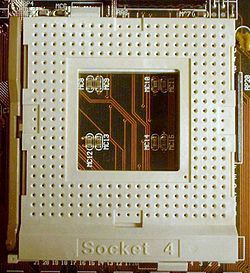
Socket 4, presented in 1993, was the first CPU socket designed for the early P5 Pentium microprocessors. Socket 4 was the only 5-volt socket for the Pentium. Socket 4 does support a special Pentium OverDrive, which allows running at 120 MHz (for the 60 MHz Pentium) or 133 MHz (for the 66 MHz Pentium).[1]
Socket 4 was superseded by the 3.3-volt-powered Socket 5 in 1994.

See also
[edit]References
[edit]- ^ Kozierok, Charles M. (17 April 2001). "Intel Socket 4 Specification". The PC Guide. Archived from the original on 9 September 2017. Retrieved 2009-03-30.
Socket 4
View on Grokipediafrom Grokipedia
Socket 4 is a 273-pin Zero Insertion Force (ZIF) CPU socket introduced by Intel in 1993 for its first-generation Pentium microprocessors, specifically the 60 MHz and 66 MHz models, marking the debut of the Pentium brand in personal computing.[1][2] Operating at a 5 V supply voltage, it features a Pin Grid Array (PGA) design with a 64-bit external data bus and supports front-side bus speeds of 60 MHz or 66 MHz to match the processors' clock rates.[2] The socket's ZIF lever mechanism facilitates damage-free processor installation and upgrades, with 52 power (Vcc) and 49 ground (Vss) pins ensuring stable electrical connections.[2][3]
Compatible exclusively with early Pentium processors, Socket 4 accommodates the original 60/66 MHz Pentiums fabricated on a 0.8 μm process, as well as the 1996 Pentium OverDrive upgrades running at 120/133 MHz internally while preserving external 60/66 MHz bus compatibility through an on-chip voltage regulator that steps down to 3.3 V for the core.[2][3] These OverDrive processors, also in a 273-pin PGA package, deliver approximately double the performance of the originals without requiring motherboard modifications, supporting power draws up to 3.2 A at 66 MHz.[2] The socket's design emphasized reliability for desktop systems, including provisions for fan heatsinks powered via motherboard connectors.[3]
As Intel's initial socket for the superscalar P5 architecture, Socket 4 played a pivotal role in the mid-1990s PC transition from 486-era systems, but its 5 V-only limitation and lack of scalability led to rapid obsolescence by 1994, supplanted by the more versatile 3.3 V-compatible Socket 5 and Socket 7 for higher-speed Pentiums.[2][3] Today, it remains a historical artifact of early Pentium computing, collectible among retro hardware enthusiasts for its role in enabling the first widespread adoption of dual-integer pipelines and integrated floating-point units in consumer CPUs.[1]