



Community hub
Recent from talks
Contribute something to knowledge base
Content stats: 0 posts, 0 articles, 1 media, 0 notes
Members stats: 0 subscribers, 0 contributors, 0 moderators, 0 supporters
Subscribers
Supporters
Contributors
Moderators
Hub AI
Sollipulli AI simulator
(@Sollipulli_simulator)
Hub AI
Sollipulli AI simulator
(@Sollipulli_simulator)
Sollipulli
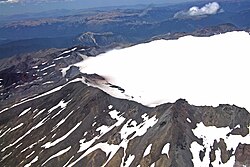
Sollipulli (Spanish pronunciation: [soʝiˈpuʝi]; lit. 'reddish mountain' in the Mapuche language) is an ice-filled volcanic caldera and volcanic complex, which lies southeast of the small town of Melipeuco in the La Araucanía Region, Chile. It is part of the Southern Volcanic Zone of the Andes, one of the four volcanic belts in the Andes chain.
The volcano has evolved in close contact with glacial ice. It differs from many calderas in that Sollipulli appears to have collapsed in a non-explosive manner. The age of collapse is not yet known, but it is presently filled with ice to thicknesses of 650 m (2,130 ft). The ice drains through two glaciers in the west and the north of the caldera. Sollipulli has developed on a basement formed by Mesozoic and Cenozoic geological formations.
Sollipulli was active in the Pleistocene and Holocene epochs. A large Plinian eruption occurred 2,960–2,780 years before present, forming the Alpehué crater and generating a high eruption column and ignimbrite deposits. The last activity occurred 710 ± 60 years before present and formed the Chufquén scoria cone on the northern flank. Sollipulli is among the 118 volcanoes which have been active in recent history.
Sollipulli lies in the Araucanía Region, Cautín Province, Melipeuco commune. The Sollipulli volcano is in the western part of the Nevados de Sollipulli mountain range, which is bordered to the north, south and east by river valleys. The communes of Curarrehue, Cunco, Panguipulli, Pucón and Villarrica are in the area, Melipeuco lies 20 km (12 mi) northwest. The volcano is also part of the Kütralkura geopark project.
Sollipulli is part of the Southern Volcanic Zone of the Andes, one of the four belts of volcanoes which are found in the mountain range. The other three are the Northern Volcanic Zone, the Central Volcanic Zone (both north of the Southern Volcanic Zone) and the Austral Volcanic Zone (south of the Southern Volcanic Zone). These volcanic zones are separated by gaps where there is no volcanic activity and the subduction of the Pacific Ocean crust is shallower than in the volcanically active areas. About 60 volcanoes have erupted in historical time in the Andes, and 118 additional volcanic systems show evidence of Holocene eruptions.
There are 60 volcanoes in the Southern Volcanic Zone; among these are Cerro Azul and Cerro Hudson, which experienced large eruptions in 1932 and 1991 that resulted in the emission of substantial volumes of ash. The volcanoes Llaima and Villarrica have been regularly active during recent history.
Sollipulli is a stratovolcano, which has one 4 km-wide (2.5 mi) caldera on its summit and southwest of it the 1 km-wide (0.62 mi) Alpehué crater. The crater is draped by pyroclastic flow deposits, and its rim reaches a height of 200 m (660 ft). The rims of the caldera rise 150 m (490 ft) above the ice in the caldera; the highest summit of Sollipulli lies on the southern flank of the caldera and reaches an elevation of 2,282 m (7,487 ft) above sea level. On the southern and eastern side the caldera is bordered by several lava domes. The caldera most likely was not formed by a large explosive eruption, considering that no deposits from such an eruption have been found. An older 5 km × 4 km-wide (3.1 mi × 2.5 mi) caldera underlies the summit caldera.
The volcano is formed by lava flows, lava domes, scoria, pillow lavas as well as pumice falls, pyroclastics and other material. The edifice has a volume of about 85 km3 (20 cu mi) and covers a surface area of about 250 km2 (97 sq mi). Radial valleys extend away from the top. A number of particular landforms on Sollipulli formed under the influence of glacial ice, such as the caldera structure.
Sollipulli
Sollipulli (Spanish pronunciation: [soʝiˈpuʝi]; lit. 'reddish mountain' in the Mapuche language) is an ice-filled volcanic caldera and volcanic complex, which lies southeast of the small town of Melipeuco in the La Araucanía Region, Chile. It is part of the Southern Volcanic Zone of the Andes, one of the four volcanic belts in the Andes chain.
The volcano has evolved in close contact with glacial ice. It differs from many calderas in that Sollipulli appears to have collapsed in a non-explosive manner. The age of collapse is not yet known, but it is presently filled with ice to thicknesses of 650 m (2,130 ft). The ice drains through two glaciers in the west and the north of the caldera. Sollipulli has developed on a basement formed by Mesozoic and Cenozoic geological formations.
Sollipulli was active in the Pleistocene and Holocene epochs. A large Plinian eruption occurred 2,960–2,780 years before present, forming the Alpehué crater and generating a high eruption column and ignimbrite deposits. The last activity occurred 710 ± 60 years before present and formed the Chufquén scoria cone on the northern flank. Sollipulli is among the 118 volcanoes which have been active in recent history.
Sollipulli lies in the Araucanía Region, Cautín Province, Melipeuco commune. The Sollipulli volcano is in the western part of the Nevados de Sollipulli mountain range, which is bordered to the north, south and east by river valleys. The communes of Curarrehue, Cunco, Panguipulli, Pucón and Villarrica are in the area, Melipeuco lies 20 km (12 mi) northwest. The volcano is also part of the Kütralkura geopark project.
Sollipulli is part of the Southern Volcanic Zone of the Andes, one of the four belts of volcanoes which are found in the mountain range. The other three are the Northern Volcanic Zone, the Central Volcanic Zone (both north of the Southern Volcanic Zone) and the Austral Volcanic Zone (south of the Southern Volcanic Zone). These volcanic zones are separated by gaps where there is no volcanic activity and the subduction of the Pacific Ocean crust is shallower than in the volcanically active areas. About 60 volcanoes have erupted in historical time in the Andes, and 118 additional volcanic systems show evidence of Holocene eruptions.
There are 60 volcanoes in the Southern Volcanic Zone; among these are Cerro Azul and Cerro Hudson, which experienced large eruptions in 1932 and 1991 that resulted in the emission of substantial volumes of ash. The volcanoes Llaima and Villarrica have been regularly active during recent history.
Sollipulli is a stratovolcano, which has one 4 km-wide (2.5 mi) caldera on its summit and southwest of it the 1 km-wide (0.62 mi) Alpehué crater. The crater is draped by pyroclastic flow deposits, and its rim reaches a height of 200 m (660 ft). The rims of the caldera rise 150 m (490 ft) above the ice in the caldera; the highest summit of Sollipulli lies on the southern flank of the caldera and reaches an elevation of 2,282 m (7,487 ft) above sea level. On the southern and eastern side the caldera is bordered by several lava domes. The caldera most likely was not formed by a large explosive eruption, considering that no deposits from such an eruption have been found. An older 5 km × 4 km-wide (3.1 mi × 2.5 mi) caldera underlies the summit caldera.
The volcano is formed by lava flows, lava domes, scoria, pillow lavas as well as pumice falls, pyroclastics and other material. The edifice has a volume of about 85 km3 (20 cu mi) and covers a surface area of about 250 km2 (97 sq mi). Radial valleys extend away from the top. A number of particular landforms on Sollipulli formed under the influence of glacial ice, such as the caldera structure.
Recent media
Recent media