Hubbry Logo
Eruption columnEruption columnMain
Open search
Eruption column
Community hub
Eruption column
logo
8 pages, 0 posts
0 subscribers
Be the first to start a discussion here.
Eruption column
Eruption column
from Wikipedia
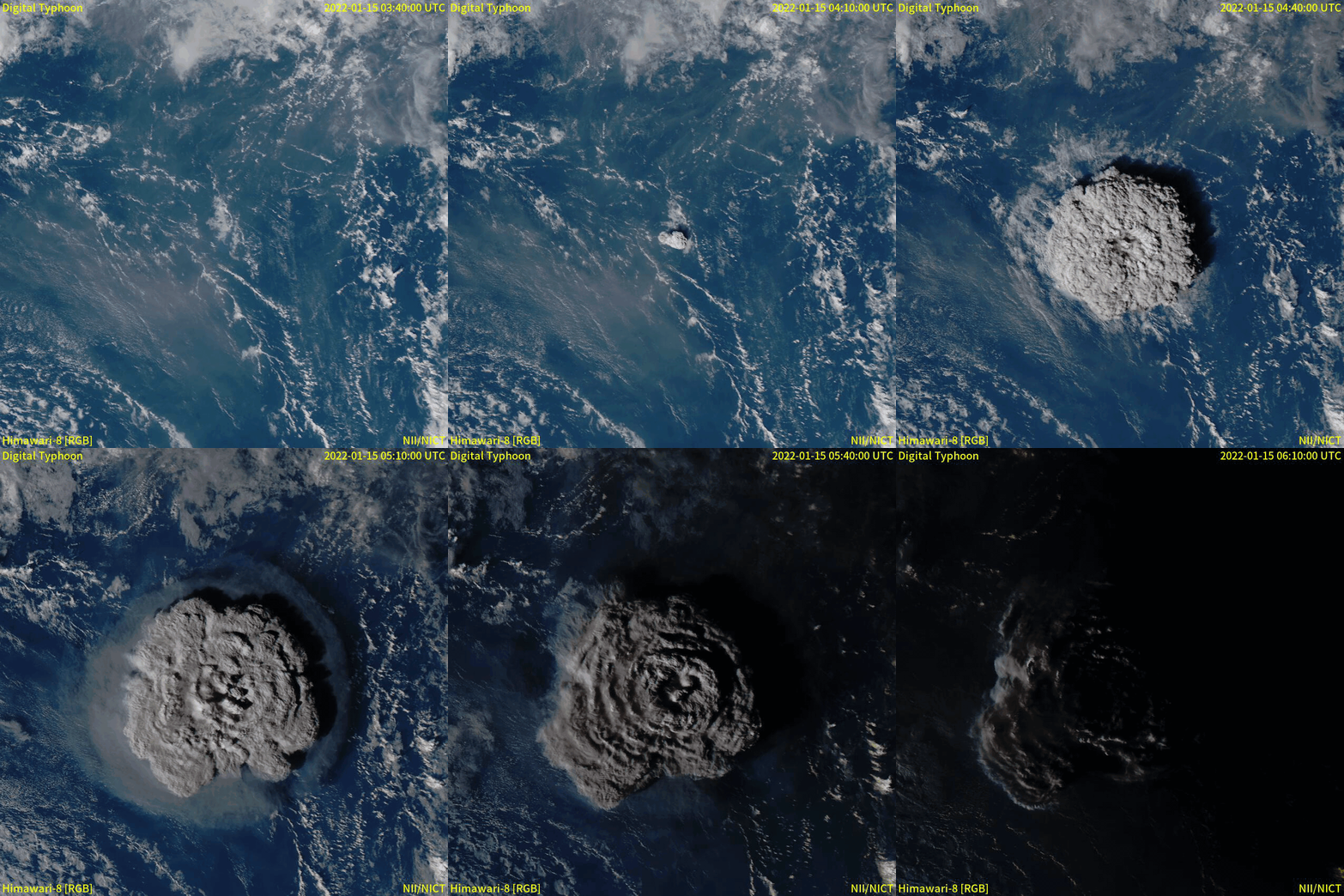
Satellite animation of the initial eruption column and shockwave from Hunga Tonga–Hunga Haʻapai on 15 January 2022

An eruption column or eruption plume is a cloud of super-heated ash and tephra suspended in gases emitted during an explosive volcanic eruption. The volcanic materials form a vertical column or plume that may rise many kilometers into the air above the vent of the volcano. In the most explosive eruptions, the eruption column may rise over 40 km (25 mi), penetrating the stratosphere. Injection of aerosols into the stratosphere by volcanoes is a major cause of short-term climate change.

A common occurrence in explosive eruptions is column collapse when the eruption column is or becomes too dense to be lifted high into the sky by air convection, and instead falls down the slopes of the volcano to form pyroclastic flows or surges (although the latter is less dense). On some occasions, if the material is not dense enough to fall, it may create pyrocumulonimbus clouds.

Formation

[edit]
Eruption column over Mount Pinatubo in the Philippines, 1991

Eruption columns form in explosive volcanic activity, when the high concentration of volatile materials in the rising magma causes it to be disrupted into fine volcanic ash and coarser tephra. The ash and tephra are ejected at speeds of several hundred metres per second, and can rise rapidly to heights of several kilometres, lifted by enormous convection currents.

Eruption columns may be transient, if formed by a discrete explosion, or sustained, if produced by a continuous eruption or closely spaced discrete explosions.

Structure

[edit]

The solid and liquid materials in an eruption column are lifted by processes that vary as the material ascends:[1]

  • At the base of the column, material is violently forced upward out of the crater by the pressure of rapidly expanding gases, mainly steam. The gases expand because the pressure of rock above it rapidly reduces as it approaches the surface. This region is called the gas thrust region and typically reaches to only one or two kilometers above the vent.
  • The convective thrust region covers most of the height of the column. The gas thrust region is very turbulent and surrounding air becomes mixed into it and heated. The air expands, reducing its density and rising. The rising air carries all the solid and liquid material from the eruption entrained in it upwards.
  • As the column rises into less dense surrounding air, it will eventually reach an altitude where the hot, rising air is of the same density as the surrounding cold air. In this neutral buoyancy region, the erupted material will then no longer rise through convection, but solely through any upward momentum which it has. This is called the umbrella region, and is usually marked by the column spreading out sideways. The eruptive material and the surrounding cold air has the same density at the base of the umbrella region, and the top is marked by the maximum height which momentum carries the material upward. Because the speeds are very low or negligible in this region it is often distorted by stratospheric winds.

Column heights

[edit]
Eruption column rising over Redoubt Volcano, Alaska, on 21 April 1990, which reached a height of about 9 km (5.6 mi)[2]

The column will stop rising once it attains an altitude where it is more dense than the surrounding air. Several factors control the height that an eruption column can reach.

Intrinsic factors include the diameter of the erupting vent, the gas content of the magma, and the velocity at which it is ejected. Extrinsic factors can be important, with winds sometimes limiting the height of the column, and the local thermal temperature gradient also playing a role. The atmospheric temperature in the troposphere normally decreases by about 6-7 K/km, but small changes in this gradient can have a large effect on the final column height. Theoretically, the maximum achievable column height is thought to be about 55 km (34 mi). In practice, column heights ranging from about 2–45 km (1.2–28.0 mi) are seen.

Eruption columns with heights of over 20–40 km (12–25 mi) break through the tropopause and inject particulates into the stratosphere. Ashes and aerosols in the troposphere are quickly removed by precipitation, but material injected into the stratosphere is much more slowly dispersed, in the absence of weather systems. Substantial amounts of stratospheric injection can have global effects: after Mount Pinatubo erupted in 1991, global temperatures dropped by about 0.5 °C (0.90 °F). The largest eruptions are thought to cause temperature drops down to several degrees, and are potentially the cause of some of the known mass extinctions.

Eruption column heights are a useful way of measuring eruption intensity since for a given atmospheric temperature, the column height is proportional to the fourth root of the mass eruption rate. Consequently, given similar conditions, to double the column height requires an eruption ejecting 16 times as much material per second. The column height of eruptions which have not been observed can be estimated by mapping the maximum distance that pyroclasts of different sizes are carried from the vent—the higher the column the further ejected material of a particular mass (and therefore size) can be carried.

The approximate maximum height of an eruption column is given by the equation.

H = k(MΔT)1/4

Where:

k is a constant that depends on various properties, such as atmospheric conditions.
M is the mass eruption rate.
ΔT is the difference in temperature between the erupting magma and the surrounding atmosphere.

Hazards

[edit]

Column collapse

[edit]
The eruption column produced by the 1980 eruption of Mount St. Helens as seen from the village of Toledo, Washington, which is 56 km (35 mi) away. The cloud was roughly 64 km (40 mi) wide and 24 km; 79,000 ft (15 mi) high.

Eruption columns may become so laden with dense material that they are too heavy to be supported by convection currents. This can suddenly happen if, for example, the rate at which magma is erupted increases to a point where insufficient air is entrained to support it, or if the magma density suddenly increases as denser magma from lower regions in a stratified magma chamber is tapped.

If it does happen, then material reaching the bottom of the convective thrust region can no longer be adequately supported by convection and will fall under gravity, forming a pyroclastic flow or surge which can travel down the slopes of a volcano at speeds of over 100–200 km/h (62–124 mph). Column collapse is one of the most common and dangerous volcanic hazards in column-creating eruptions.

Aircraft

[edit]

Several eruptions have seriously endangered aircraft which have encountered or passed by the eruption column. In two separate incidents in 1982, airliners flew into the upper reaches of an eruption column blasted off by Mount Galunggung, and the ash severely damaged both aircraft. Particular hazards were the ingestion of ash stopping the engines, the sandblasting of the cockpit windows rendering them largely opaque and the contamination of fuel through the ingestion of ash through pressurisation ducts. The damage to engines is a particular problem since temperatures inside a gas turbine are sufficiently high that volcanic ash is melted in the combustion chamber, and forms a glass coating on components farther downstream of it, for example on turbine blades.

In the case of British Airways Flight 9, the aircraft lost power on all four engines, and in the other, nineteen days later, three of the four engines failed on a Singapore Airlines 747. In both cases, engines were successfully restarted, but the aircraft were forced to make emergency landings in Jakarta.

Similar damage to aircraft occurred due to an eruption column over Redoubt volcano in Alaska in 1989. Following the eruption of Mount Pinatubo in 1991, aircraft were diverted to avoid the eruption column, but nonetheless, fine ash dispersing over a wide area in Southeast Asia caused damage to 16 aircraft, some as far as 1,000 km (620 mi) from the volcano.

Eruption columns are not usually visible on weather radar and may be obscured by ordinary clouds or night.[3] Because of the risks posed to aviation by eruption columns, there is a network of nine Volcanic Ash Advisory Centers around the world which continuously monitor for eruption columns using data from satellites, ground reports, pilot reports and meteorological models.[4]

See also

[edit]

References

[edit]

Further reading

[edit]
[edit]
Revisions and contributorsEdit on WikipediaRead on Wikipedia
from Grokipedia
An eruption column, also known as an eruption plume, is the ascending vertical column of hot volcanic gases, ash, and other particles that rises directly above a volcanic vent during an . This structure forms a gas-solid dispersion driven by the rapid expansion of magmatic gases and entrained air, propelling material high into the atmosphere. Eruption columns are characteristic of highly volcanic events, such as Vulcanian or Plinian eruptions, and can reach heights from several kilometers to over 40 km, injecting aerosols into the . The formation of an eruption column begins at the vent, where high-pressure gases accelerate the mixture of fragments and air to velocities exceeding 100 m/s, creating a buoyant plume that rises through thermal convection. Structurally, it consists of three main s: a lower gas-thrust region powered by initial gas expansion, a central convective thrust region sustained by , and an upper umbrella region where the plume spreads laterally due to atmospheric winds, forming a mushroom-shaped . The dynamics are governed by factors like exit velocity, gas content (typically requiring at least 2-5% volatiles by mass), vent geometry, and atmospheric conditions, with models showing that column stability depends on the balance between upward and gravitational settling. Eruption column heights vary widely based on eruption intensity, measured by the Volcanic Explosivity Index (VEI), where heights correlate with volume and mass eruption rate—low-end columns may reach 2-10 km, while extreme Plinian events exceed 25-40 km. For instance, the 1980 eruption produced a column oscillating up to 31 km, the 1991 Pinatubo eruption reached about 40 km, and the 2022 Hunga Tonga-Hunga Ha'apai eruption attained an exceptional height of approximately 58 km. Theoretical maximum heights approach 50-55 km, limited by atmospheric density gradients, though typical practical observations rarely surpass 45 km due to partial collapses. Eruption columns pose significant hazards, including widespread ash fallout that can disrupt , , and over thousands of kilometers, as particles drift in and may circumnavigate the globe. If the column collapses—often due to insufficient —it generates pyroclastic flows and surges, high-velocity avalanches of hot gas and debris that devastate areas within tens of kilometers of the vent, as seen in the 79 AD Vesuvius eruption that buried Pompeii. Additionally, stratospheric injection of from tall columns can cause by forming aerosols that reflect sunlight, altering climate for years.

Fundamentals

Definition and Types

An eruption column is the ascending vertical plume of superheated volcanic gases, , and pyroclastic fragments () ejected directly above a volcanic vent during an . This phenomenon arises from the rapid decompression and expansion of volatile-rich , propelling the mixture into the atmosphere as a buoyant, gas-thrust column. Eruption columns are categorized by eruption style, which influences their height, duration, and composition. Strombolian columns, associated with low-viscosity basaltic , are intermittent and low-energy, typically reaching heights under 2 km and consisting of gas bursts ejecting lapilli and bombs. Vulcanian columns form from more viscous, gas-pressurized in a blocked conduit, producing short-lived, explosive ejections with heights of 1–10 km and dense loads. Plinian columns, driven by highly silicic, gas-saturated , are sustained and reach altitudes over 25 km—sometimes up to 45 km—due to efficient and minimal particle fallout. Sub-Plinian variants represent intermediate cases, with unsteady columns of 10–25 km height and reduced mass eruption rates compared to full Plinian events. Notable examples illustrate these types. The May 18, 1980, of generated a column up to 31 km in height, sustained for over nine hours and dispersing across multiple states. In contrast, the May 8, 1902, of featured a column that rapidly collapsed, triggering devastating pyroclastic flows (nuées ardentes) that destroyed Saint-Pierre and killed nearly 30,000 people. Eruption columns should be distinguished from related features such as lava fountains, which involve non-explosive, ballistic trajectories of molten basaltic lava rising only hundreds of meters without forming a dispersed plume, and eruption clouds, which describe the radial spreading at the column's apex or the atmospheric dispersal following partial .

Formation Processes

The formation of an eruption column is driven primarily by the rapid exsolution of magmatic volatiles, such as water (H₂O) and (CO₂), during magma ascent through the volcanic conduit. As surrounding pressure decreases, these dissolved gases form bubbles that expand dramatically, generating within the . This exceeds the tensile strength of the , leading to explosive fragmentation into pyroclasts and a gas-particle mixture that is ejected from the vent. The process unfolds in distinct stages, beginning with initial high-velocity jetting of the fragmented mixture due to decompression in the conduit. In this basal phase, the jet is momentum-dominated, with particles and gas accelerating outward under the force of expanding volatiles. As the jet rises, it entrains surrounding atmospheric air through turbulent mixing at its margins, which cools the mixture and imparts to sustain upward propagation into a convective column. Magma properties play a critical role in determining the intensity of fragmentation and the resulting column dynamics. High viscosity, often associated with elevated silica content, inhibits bubble escape and enhances overpressure buildup, favoring explosive behavior; for instance, high-silica rhyolite magmas, with their low crystallinity and substantial volatile content (typically 4-6 wt% H₂O), produce sustained fragmentation that supports tall, Plinian-style columns. Conversely, higher crystallinity reduces mobility and explosivity, while lower volatile content limits gas expansion. Vent geometry further modulates the exit velocity, as narrow conduits constrain flow and accelerate the mixture to higher speeds compared to broader craters, which allow greater dispersion and reduced momentum. Plinian eruptions, for example, rely on sustained high exit velocities exceeding 100 m/s from such configurations.

Physical Properties

Internal Structure

The internal structure of an established eruption column is characterized by distinct zonal divisions that reflect the interplay of momentum, buoyancy, and entrainment processes. At the center lies a high-temperature core composed primarily of undiluted magmatic gas and coarse tephra particles, with temperatures reaching up to approximately 1000°C near the base. This core is surrounded by a turbulent mixing zone where the erupted material interacts with entrained ambient air through shear instabilities, leading to rapid dilution and velocity gradients. Further outward, an outer cooled sheath forms, consisting of cooler, particle-laden gas that has undergone significant mixing and heat loss, acting as a boundary layer with the surrounding atmosphere. Particle distribution within the column varies radially, with coarser concentrated near the axis due to higher velocities and less dispersion in the core, while finer particles are preferentially carried outward into the mixing zone and sheath by turbulent eddies. Gas composition similarly transitions from predominantly magmatic (rich in volatiles like H₂O, CO₂, and SO₂) in the central core to increasingly atmospheric (dominated by N₂ and O₂) with radial distance and height, as entrainment dilutes the original mixture. This forms following volatile exsolution in the during ascent. Thermal gradients in the column begin with rapid adiabatic expansion and cooling during initial ascent, where gas temperatures drop due to decompression, followed by additional losses through radiative to the surroundings and convective exchange in the mixing zone. Observational evidence from infrared imaging reveals pronounced temperature decreases, with basal column temperatures around 800°C cooling to below 100°C at higher altitudes, as captured in thermal profiles of plumes like those at Sabancaya Volcano. Density contrasts drive the column's , with the hot central core exhibiting bulk below 1 kg/m³—owing to elevated temperatures and low gas —compared to ambient atmospheric air at approximately 1.2 kg/m³, while the outer sheath approaches atmospheric through entrainment.

Height Determination

The of an eruption column is fundamentally determined by the balance between the provided by the hot, low-density volcanic material and the opposing forces of and atmospheric drag. This buoyant rise occurs as the plume entrains ambient air, cooling and diluting until its matches that of the surrounding atmosphere at the neutral level, marking the maximum . Key influencing factors include the eruption (typically in kg/s), exit of the erupted material, and in the atmosphere. Higher increases the and , enabling taller columns, while elevated exit temperatures enhance through greater contrasts with ambient air. can bend or truncate the plume, reducing its effective height by increasing drag and lateral spreading. Empirical models, such as Wilson's equation, provide practical estimates of plume height based on these parameters: H(MΔT)1/4H \propto (M \Delta T)^{1/4}, where HH is the height, MM is the mass eruption rate, ΔT=TeTa\Delta T = T_e - T_a is the temperature difference between exit TeT_e and ambient TaT_a, derived from integral plume theory and calibrated against observed eruptions to predict maximum heights. A notable case is the , where a mass flux of approximately 10810^8 kg/s propelled the column to about 40 km, injecting material deep into the . In contrast, low-flux events with rates below 10610^6 kg/s typically produce columns under 10 km, remaining confined to the . Atmospheric effects become critical when column heights exceed 20 km, surpassing the and enabling stratospheric injection that can lead to global climate impacts through scattering of sunlight.

Dynamics

Buoyancy and Stability

The of an eruption column arises from the Archimedean , which dictates that the upward buoyant equals the weight of the displaced ambient air volume. This drives the column's ascent because the average of the column ρc\rho_c is lower than that of the surrounding atmosphere ρa\rho_a, primarily due to elevated temperatures and volatile content that reduce the mixture's . The resulting net upward acceleration is proportional to the difference Δρ=ρaρc\Delta \rho = \rho_a - \rho_c, enabling the column to rise through gravitational stratification. Under the Boussinesq approximation, which assumes small variations relative to the ambient fluid, the vertical rise velocity ww of the buoyant column scales with height zz as w(gΔρρz)1/2w \propto \left( g \frac{\Delta \rho}{\rho} z \right)^{1/2}, where gg is and ρ\rho is the reference . This scaling captures the initial buoyancy-dominated phase where momentum from the source transitions to thermal driving, before significant entrainment alters the dynamics. Stability at the column base requires avoiding density inversions that could trigger Rayleigh-Taylor instability, wherein a denser overlying layer accelerates into a lighter underlying one, potentially disrupting coherent ascent; sustained columns remain stable when initial input surpasses dilution from turbulent entrainment of ambient air. Crosswinds interact with the rising column by inducing bending and distortion, yet the buoyant core maintains upward motion until reaching altitudes of approximately 20-30 km, where cumulative entrainment reduces excess . At the level—where the column's density matches the ambient air—the vertical converts to radial spreading, forming the umbrella region as the plume intrudes horizontally and expands laterally.

Collapse Mechanisms

Eruption column collapse occurs when the upward momentum of the plume is insufficient to overcome gravitational forces, primarily triggered by excessive mass loading due to high eruption rates exceeding 10910^9 kg/s, which limits air entrainment and prevents the column from achieving buoyancy. These rates overwhelm the mixing process, causing the dense mixture to spread laterally rather than rise further. Additionally, atmospheric inversion layers can act as a density barrier, halting plume ascent by inhibiting vertical mixing in stable conditions and promoting destabilization. Collapse manifests in two main forms: partial and total. In partial collapse, only a portion of the column, often influenced by topography or asymmetric venting, destabilizes, generating directed blasts that channel material in specific directions. Total collapse involves the entire column failing, producing radial pyroclastic flows that spread outward symmetrically from the vent. The distinction depends on the balance between source conditions and ambient atmosphere, with partial regimes common in laterally confined settings. Upon collapse, the material accelerates rapidly under , forming currents with initial speeds of 100-300 m/s as the dense, hot mixture overrides cooler air. This acceleration is driven by the contrast and , leading to turbulent flows that propagate horizontally. Collapse occurs below the neutral buoyancy level, where plume models such as Morton-Taylor equate column to ambient air . Representative examples illustrate these mechanisms. The 1980 eruption featured a partial column collapse following sector failure, producing a directed blast that traveled over 25 km at speeds up to 300 m/s. In contrast, the 1883 eruption involved total column collapse, generating radial pyroclastic flows that swept across the island and into the sea, depositing over extensive areas.

Hazards

Ground-Based Risks

Eruption columns pose significant ground-based risks primarily through the fallout of , which consists of , lapilli, and larger fragments ejected into the atmosphere and subsequently deposited on the ground. Tephra fallout patterns are influenced by the column's height, wind direction, and atmospheric conditions, leading to widespread ash deposition that can extend hundreds of kilometers from the vent. For instance, ash accumulations exceeding 0.5 meters in thickness have caused structural collapses of roofs and buildings, resulting in fatalities and infrastructure damage, as observed in historical events like the 1980 eruption where over 500 million tons of ash blanketed areas up to 1,300 km away. Pyroclastic density currents (PDCs) represent another major hazard, originating from the partial or total collapse of eruption columns, which generate hot, fast-moving avalanches of gas, ash, and rock fragments. These currents can travel distances of 10 to 100 kilometers from the volcano at speeds up to 700 km/h and temperatures ranging from 100°C to 700°C, capable of burying communities and causing immediate death by thermal burns, impact, or suffocation. A seminal example is the 79 AD eruption of , where PDCs devastated Pompeii and , preserving the cities under meters of pyroclastic material and killing an estimated 2,000 people. Eruption columns can also trigger lahars—volcanically induced mudflows—when heavy rainfall from the column's interaction with the atmosphere mixes with loose ash and debris, or when ash remobilizes with existing water bodies. These s form rapidly flowing slurries that follow river valleys, reaching speeds of 50-100 km/h and depositing sediments up to several meters thick, which can destroy bridges, homes, and agricultural lands. The 1985 eruption in exemplified this risk, where a triggered by column-related melting and ash fall killed over 23,000 people in . Vulnerability to these ground-based risks is heightened in areas with high near volcanic vents, where urban expansion into hazard zones amplifies exposure. Historical data indicate that approximately 100,000 fatalities occurred from volcanic eruptions in the alone, with a significant portion attributable to fallout, PDCs, and lahars associated with tall eruption columns. Factors such as socioeconomic conditions, lack of early warning systems, and proximity to drainages further exacerbate these threats, particularly in developing regions. Mitigation strategies focus on scaling evacuation zones and measures to the anticipated column height and associated hazards. For example, a column reaching 30 km may necessitate evacuation radii up to 50 km to account for PDC runout and fallout, incorporating real-time monitoring of plume dynamics to inform decisions. Effective measures include reinforced building codes for ash loads, early warning networks, and on sheltering during fallout events, as implemented by agencies like the USGS in high-risk areas.

Aviation and Atmospheric Impacts

Eruption columns pose significant hazards to aviation primarily through the dispersal of fine particles, which can be ingested into engines. When ash enters jet engines, the particles melt at temperatures exceeding 1100°C—well below the operating temperatures of modern cores, which reach 1200–2000°C—forming a glassy coating on turbine blades and vanes that disrupts and leads to surging, power loss, or complete . Additionally, ash clouds drastically reduce visibility to near zero, complicating navigation and increasing the risk of mid-air collisions or . These risks are exacerbated by the abrasiveness of , which can sandblast windshields, pit leading edges of wings, and clog pitot tubes and air data systems, potentially rendering instruments unreliable. Historical eruptions have demonstrated the severe disruptions caused by eruption columns to . The 1980 eruption of in Washington, , produced ash clouds that contaminated runways and reduced visibility, leading to the closure of airports in for up to two weeks and widespread flight cancellations across the Pacific Northwest. Similarly, the 2010 eruption of in generated a persistent plume that closed much of European airspace for six days from April 15 to 20, canceling over 100,000 flights and stranding millions of passengers, with economic losses estimated in billions of euros for the industry. These incidents underscored the need for robust ash detection and avoidance protocols, as even brief encounters can necessitate emergency diversions and extensive post-flight maintenance. Beyond immediate aviation threats, tall eruption columns exceeding 15 km in height can inject (SO₂) and ash directly into the , where they form aerosols that persist for months to years and influence global climate. For instance, the in the lofted approximately 20 million tons of SO₂ into the via a column reaching 40 km, resulting in a global temperature drop of about 0.5°C from 1991 to 1993 due to increased reflection of solar radiation. Such injections alter patterns, potentially exacerbating and , though the cooling effect is temporary and regionally variable. Ash from eruption columns disperses over thousands of kilometers, often entrained in jet streams at altitudes of 10–15 km, enabling rapid transcontinental transport that amplifies aviation risks far from the source volcano. Volcanic Ash Advisory Centers (VAACs), operated by meteorological agencies worldwide, monitor these patterns using , ground-based sensors, and dispersion models to forecast plume trajectories and issue advisories. In response, the (ICAO) has established quantitative thresholds for ash concentrations—such as probabilities exceeding 0.2 mg/m³, 2.0 mg/m³, 5.0 mg/m³, or 10.0 mg/m³—to define hazard zones and guide no-fly decisions, moving away from zero-tolerance policies toward risk-based assessments that consider concentrations relative to background levels. These measures, informed by post-eruption analyses, help minimize disruptions while prioritizing flight safety.

Observation and Modeling

Measurement Techniques

Ground-based measurement techniques provide critical real-time data on eruption column dynamics. systems, such as ground-based X-band s, are deployed to measure velocity profiles within volcanic plumes, enabling estimation of mass eruption rates and column height by tracking particle fallout and internal flow structures. For instance, during eruptions like that of Mount Spurr in 1992, detected ash particles and column heights exceeding 10 km, validating plume buoyancy models. Seismometers complement by detecting eruption onset through ground vibrations caused by explosive events, with sensors capturing long-period signals indicative of movement and column formation. These instruments, often networked around volcanic centers, allow for early warning by identifying precursory tremors up to hours before plume ejection. Remote sensing techniques offer broad-scale monitoring of eruption columns from afar. Satellites equipped with the (MODIS) detect thermal anomalies in plumes, quantifying hot spots and estimating eruption intensity through radiance measurements in bands, as demonstrated during the 2010 eruption where anomalies revealed plume temperatures up to 500 K. The Cloud-Aerosol with Orthogonal Polarization () uses to profile ash layers, retrieving extinction coefficients and depolarization ratios to distinguish volcanic aerosols from other particles, with observations showing ash layers extending 10-15 km in the 2010 event. Aircraft-based sampling, involving specialized flights into plumes, directly measures gas and particle composition using electrochemical sensors and spectrometers, revealing SO2 concentrations and ash mineralogy that inform column chemistry, as in samples from Kanaga Volcano in 2015 yielding mantle-derived CO2 signatures. In-situ measurements penetrate the column for detailed vertical profiles. Balloon sondes, launched from ground stations, ascend to altitudes up to 20 km to record temperature gradients, particle size distributions (typically 0.1-10 μm), and aerosol concentrations within plumes, as seen in post-eruption profiles from the 2018 Ambae event where sondes captured enhanced particle loading between 16 and 24 km. These lightweight instruments, often equipped with optical particle counters, validate data by providing ground-truth measurements of plume and microphysics. Such sampling has confirmed internal structures like particle clustering in buoyant columns. Historical reconstruction of eruption columns relies on proxy records preserved in geological archives. stratigraphy examines layered ash deposits to infer past column heights and eruption styles, with thickness variations and grain size grading indicating plume dispersal, as in sequences from the 1912 eruption revealing columns over 30 km tall. records of (SO2 oxidation products) provide timelines of stratospheric injections, with spikes in and Antarctic cores documenting events like the 1257 through elevated non-sea-salt levels exceeding 100 ppb. These methods reconstruct eruption magnitudes retrospectively, linking past columns to climatic impacts. Advances since 2000 have enhanced integration of these techniques through Volcanic Ash Advisory Centers (VAACs), which synthesize multi-sensor data from radars, satellites, and sondes to issue real-time plume forecasts. Established under the International Airways Volcano Watch, the nine global VAACs process inputs like MODIS imagery and profiles to track ash dispersion, as during the 2010 crisis where combined data improved aviation alerts by reducing false positives in plume extent estimates. This networked approach has increased detection accuracy for sub-Plinian columns, supporting hazard mitigation worldwide.

Computational Models

One-dimensional (1D) integral models simulate eruption column dynamics by solving the conservation equations for , , and along the plume centerline, enabling predictions of column height as a function of mass eruption rate (). These models treat the plume as a series of cross-sections, incorporating ambient and particle settling to estimate rise and spreading. A representative example is the PLUME-MoM model, which uses the method of moments to handle distributions and integrates these equations in a steady-state framework. Entrainment of surrounding air is a critical process in these models, parameterized by an entrainment rate α0.1\alpha \approx 0.1, which governs plume expansion. The mass flux MM evolves according to the equation dMdz=2αρaρcMr,\frac{dM}{dz} = 2 \alpha \sqrt{\frac{\rho_a}{\rho_c}} \frac{M}{r},
Add your contribution
Related Hubs
User Avatar
No comments yet.