Hubbry Logo
Solution architectureSolution architectureMain
Open search
Solution architecture
Community hub
Solution architecture
logo
8 pages, 0 posts
0 subscribers
Be the first to start a discussion here.
Solution architecture
from Wikipedia
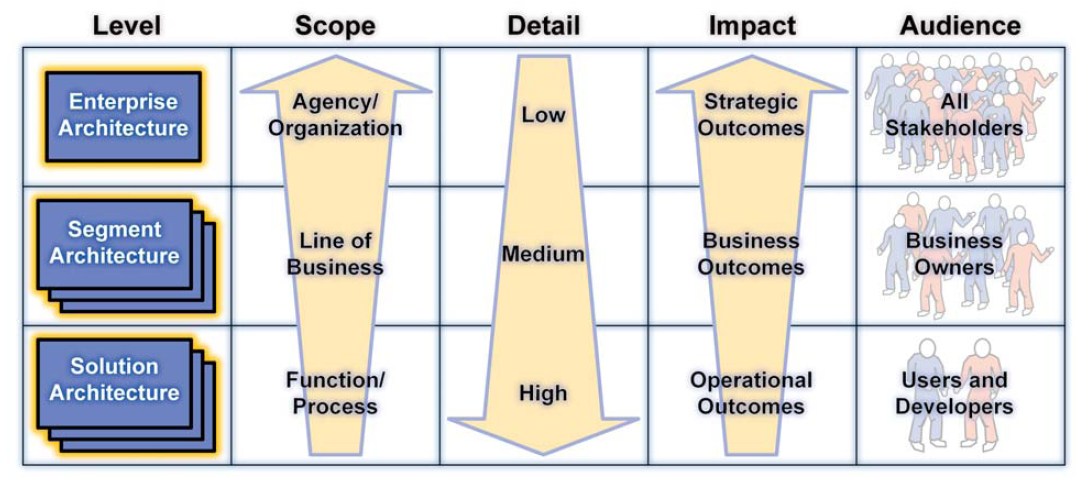
Sketch of architecture types

Solution architecture is a term used in information technology with various definitions, such as "a description of a discrete and focused business operation or activity and how IS/IT supports that operation".[1]

Definitions

[edit]

The Open Group's definition of solution architecture, as provided above, is accompanied by the following three from Scaled Agile, Gartner and Greefhorst/Proper. The Open Group does not recognize the role "solution architect" in its TOGAF skills framework; on the other hand, Glassdoor advertised 55,000 Solution Architect roles in August 2020.[2]

  • Scaled agile (2020): Solution Architect/Engineering is responsible for defining and communicating a shared technical and architectural vision across a "Solution Train" to help ensure the system or Solution under development is fit for its intended purpose.[3]
  • Gartner (2013): A solution architecture (SA) is an architectural description of a specific solution. SAs combine guidance from different enterprise architecture viewpoints (business, information and technical), as well as from the enterprise solution architecture (ESA).[4]
  • Greefhorst and Proper (2013): An architecture of a solution, where a solution is a system that offers a coherent set of functionalities to its environment. As such, it concerns those properties of a solution that are necessary and sufficient to meet its essential requirements[5]

A typical property of solution architecture, in contrast to other types of Enterprise Architecture, is that it often seeks to define a solution within the context of a project or initiative.[6] This close association to actual projects and initiatives means that solution architecture is the means to execute or realise a technology strategy.

Coverage

[edit]

According to Forrester Research, solution architecture is one of the key components by which Enterprise Architecture delivers value to the organization. It entails artifacts such as a solution business context, a solution vision and requirements, solution options (e.g. through RFIs, RFPs or prototype development) and an agreed optimal solution with build and implementation plans ("road-map").[7]

Since The Open Group does not recognize a unique Solution Architect role, a relevant link for these mentioned artifacts can be to the Business and Systems Analyst roles. The Open Group's definition of solution architecture is broader than Forrester's (see aforementioned definition).

According to a 2013 paper published by the Federation of Enterprise Architecture Professional Organizations, solution architecture includes business architecture, information architecture, application architecture, and technology architecture operating at a tactical level and focusing on the scope and span of a selected business problem. In contrast, enterprise architecture, which also includes the aforementioned four types of architecture, operates at the strategic level and its scope and span is the enterprise rather than a specific business problem.[8][9]

See also

[edit]

References

[edit]

Further reading

[edit]
Revisions and contributorsEdit on WikipediaRead on Wikipedia
from Grokipedia
Solution architecture is the practice of designing, describing, and managing the engineering of IT solutions to address specific problems and requirements. It provides a structured architectural description of a particular solution, integrating guidance from viewpoints including , information, and technical perspectives. This discipline ensures that solutions are aligned with broader organizational strategies while delivering targeted functionality to meet immediate needs. The role of a solution architect is pivotal in bridging business and technical domains, acting as a technical leader who translates stakeholder requirements into feasible designs. Solution architects lead the overall technical vision for projects, overseeing the design, implementation, deployment, and adoption of solutions to ensure they are secure, scalable, and reliable. They collaborate with to incorporate organizational standards, while focusing on project-specific details that differentiate solution architecture from the more holistic, strategic scope of enterprise architecture. Key aspects of solution architecture include defining core elements such as business vision, processes, people, , and technology strategy to create a comprehensive blueprint. This systematic approach identifies dependencies, mitigates risks, and optimizes resource use, ultimately enabling organizations to achieve business goals efficiently. By emphasizing alignment with enterprise-wide principles, solution architecture supports agile development and innovation in complex IT environments.

Overview

Definition

Solution architecture is the practice of defining, designing, and managing the development of targeted technological solutions to address discrete problems or opportunities, bridging the gap between requirements and technical implementations. This discipline involves creating architectural descriptions that outline how specific systems, applications, or processes will function to meet defined objectives, often incorporating elements such as software components, hardware, , and flows. Unlike broader frameworks, solution architecture focuses on solution-specific scopes, such as individual projects or systems, rather than enterprise-wide strategies that encompass the entire organizational IT landscape. In relation to , solution architecture operates as a tactical , applying enterprise guidelines to particular initiatives while ensuring alignment with overarching IT strategies. For instance, in upgrading an platform, a solution architecture might delineate high-level components including a user-facing frontend layer for interface interactions, a backend layer handling and inventory management, and integration layers connecting to gateways and services, all visualized through diagrams to illustrate data flows and dependencies.

Scope and Importance

Solution architecture encompasses the design and planning activities that span from initial requirements gathering through to the deployment of specific IT solutions, focusing on project-specific initiatives rather than ongoing operational . This scope involves creating detailed blueprints that address both functional needs and non-functional requirements, such as to handle growing workloads, to protect and systems, and to ensure reliable operation under varying conditions. Unlike , which operates at a broader organizational level, solution architecture is typically bounded by the lifecycle of individual projects, integrating guidance from various enterprise viewpoints to ensure coherence with the existing IT landscape. The importance of solution architecture lies in its ability to drive substantial business value by mitigating implementation risks, optimizing resource costs, and aligning technical solutions with strategic organizational objectives. Industry analyses indicate that IT project failure rates remain high; for example, the Standish Group's CHAOS Report (as of 2020) revealed that only 31% of projects succeed fully, while 50% face challenges like budget overruns or scope creep, and 19% fail outright. Structured architectural design, including solution architecture, helps reduce these risks as part of broader project management practices. As a critical bridge between stakeholders and IT teams, solution architecture translates abstract business requirements into actionable technical specifications, fostering in dynamic environments such as adoption. This translation ensures that solutions not only meet immediate needs but also support scalability and rapid adaptation, enabling organizations to respond to market changes more effectively. practices, which encompass solution architecture, have been associated with higher C-suite engagement among digital leaders (as of 2018). Key metrics of success for well-architected solutions include reductions in time-to-market and improvements in (ROI), as these directly correlate with enhanced business performance. High-performing organizations prioritize time-to-market as the primary IT indicator, achieving faster delivery through optimized designs that minimize rework and integration issues.

Historical Development

Origins in IT

The foundational concepts underlying solution architecture trace back to the and 1970s, when advancements in and during the mainframe computing era laid the groundwork for modular and reliable IT solutions. Mainframe systems, exemplified by IBM's System/360 introduced in , required rigorous approaches to designing large-scale, reliable software for and transaction handling in enterprise environments. This period saw the development of principles, formalized by the 1966 structured program theorem, which demonstrated that any could be implemented using only sequence, selection, and , thereby reducing complexity in program design and laying groundwork for modular system architectures. The distinct practice of solution architecture emerged in the late 1980s and early 1990s, as businesses recognized the need for specialists to design IT solutions tailored to specific problems, building on frameworks that emphasized systematic documentation and alignment of IT with business needs. A pivotal contribution was John Zachman's 1987 framework, published in the Systems Journal, which proposed a 6x6 matrix for classifying architectural artifacts across perspectives (from planner to user) and interrogatives (what, how, where, who, when, why), providing a structured for information . This framework marked a shift from ad-hoc to disciplined architectural practices, influencing how solutions were conceptualized in complex IT environments. The served as a catalyst for solution architecture, driven by the principle of (SoC) in object-oriented design and the transition to client-server computing paradigms. SoC, articulated by in his 1974 essay on scientific thought in computing, advocated decomposing systems into distinct layers to manage complexity, a concept that gained prominence in object-oriented methodologies during the , enabling modular and reusable components. The rise of client-server architectures necessitated solutions that integrated distributed components, addressing scalability needs in networked environments. Key early influences included pioneer Edward Yourdon's work on structured design, detailed in his 1979 book co-authored with Larry Constantine, which introduced metrics like cohesion and to evaluate module independence and interdependence, foundational to architectural decision-making. These principles were adopted in large-scale projects within defense and finance sectors, where mainframe-based systems demanded fault-tolerant, maintainable designs; for instance, U.S. Department of Defense initiatives in the 1970s applied structured techniques to mission-critical software. Pre-2000 examples include IBM's component-based architectures, such as the System Object Model (SOM) released in 1990, which facilitated object-oriented development of reusable components for distributed systems like enterprise applications.

Modern Evolution

In the early 2000s, solution architecture began integrating with (SOA), which emphasized the creation of reusable services through standardized interfaces, particularly driven by the adoption of web services and XML technologies. This shift, prominent between 2001 and 2005, allowed for greater and in enterprise systems, moving away from tightly coupled monolithic designs toward loosely coupled components that could be orchestrated across distributed environments. By the 2010s, solution architecture incorporated paradigms, influenced by the public launch of (AWS) in 2006, which by 2010 had popularized hybrid cloud models combining on-premises infrastructure with public cloud resources for scalability and flexibility. Concurrently, architectures gained traction following Netflix's adoption around 2011, enabling independent deployment of small, focused services to handle massive scale, as seen in their transition from a to over 700 supporting billions of daily API calls. practices also emerged as a key methodology in this era, promoting , , and collaboration between development and operations teams to accelerate delivery in cloud-native environments. Entering the 2020s, solution architecture has increasingly emphasized the integration of (AI) and (ML) components, including the rapid adoption of generative AI since 2023 for applications in automated , predictive modeling, and intelligent automation within solution designs. has further evolved architectures by distributing processing closer to data sources, reducing latency and bandwidth demands in IoT and real-time applications. Sustainability considerations have also risen, with green architecture principles gaining prominence post-2022 through EU regulations like the Corporate Sustainability Reporting Directive (CSRD), which mandate lifecycle assessments and energy-efficient designs to minimize environmental impact. These updates align with agile methodologies and continuous integration/continuous delivery () pipelines, enabling faster iterations in dynamic digital ecosystems. Influential frameworks such as (TOGAF) have adapted to these changes, with version 10.0 released in April 2022 incorporating modular structures and guidance for , agile practices, and like and AI. This evolution ensures solution architectures remain aligned with business strategies in rapidly changing technological landscapes.

Core Concepts

Key Components

Solution architecture is built upon a set of core structural elements that provide a comprehensive framework for designing systems that meet specific business objectives. These elements typically include business architecture, which focuses on mapping organizational requirements, processes, and capabilities to the proposed solution, ensuring alignment between strategic goals and implementation. Data architecture addresses the management of data assets, including storage mechanisms, data flows, governance policies, and integration across sources to support decision-making and operations. Application architecture defines the software components, layers, and interactions, such as modular services or microservices, to handle business logic efficiently while minimizing redundancy in the application portfolio. Technology architecture encompasses the selection and configuration of infrastructure, including hardware, networks, and cloud services, to underpin the solution's performance and deployment. Together, these elements form the foundational layers that bridge business needs with technical delivery. Integration aspects are critical for enabling seamless communication among components in a solution architecture. APIs serve as the primary interfaces for exposing and consuming services, allowing applications to exchange and functionality securely across distributed systems. , such as message brokers like Azure Service Bus or workflow orchestrators like Azure Logic Apps, facilitates asynchronous communication, decoupling components and handling events or transformations without tight coupling. standards, including RESTful services for stateless, resource-based interactions, ensure compatibility and efficiency in hybrid or multi-vendor environments. These integration mechanisms support patterns like API-first design and event-driven architectures, promoting and . Non-functional components address the quality attributes that determine a solution's robustness beyond core functionality. Security models are integrated to protect data and systems from threats through continuous authentication and least-privilege access. Scalability patterns include horizontal scaling, which adds instances to distribute load across multiple servers, and vertical scaling, which enhances individual resources like CPU or memory, chosen based on workload demands to handle growth without downtime. Reliability mechanisms, such as fault tolerance via redundancy and automated failover, ensure high availability by mitigating failures, often targeting metrics like service level objectives (SLOs) for uptime exceeding 99.9%. These components are embedded across the architecture to meet performance, resilience, and compliance requirements. Visual representations are essential artifacts in solution architecture for communicating complex designs to stakeholders. Solution blueprints provide high-level overviews of the entire system, illustrating relationships between structural elements, integrations, and non-functional provisions in a simplified, layered diagram. UML diagrams, such as component or sequence diagrams, offer detailed software-level views, focusing on class interactions, interfaces, and behavioral flows within application layers. models extend this by providing enterprise-wide notations across business, application, and technology layers, using standardized viewpoints like motivation or realization to create coherent, stakeholder-specific visuals that support transformation roadmaps. These artifacts, often created with tools like or draw.io, facilitate analysis, validation, and iteration during the design phase.

Fundamental Principles

Solution architecture is grounded in core principles that ensure robust, adaptable designs capable of meeting organizational needs. Modularity involves decomposing complex systems into independent, reusable units that can be developed, tested, and maintained separately, thereby enhancing overall system flexibility and reducing integration risks. Interoperability emphasizes the ability of components to communicate and function seamlessly across diverse systems and platforms, often achieved through standardized interfaces and protocols to facilitate data exchange without proprietary dependencies. Alignment requires a tight integration between technical solutions and business objectives, ensuring that architectural decisions directly support strategic goals such as operational efficiency and scalability. Quality attributes form a critical foundation for evaluating architectural effectiveness, with a strong emphasis on maintainability, extensibility, and cost-efficiency. Maintainability prioritizes designs that allow for straightforward updates and repairs, minimizing downtime and long-term support costs through clear documentation and modular structures. Extensibility focuses on building systems that can incorporate new features or scale with evolving demands, often via plug-and-play components that avoid overhauling the core architecture. Cost-efficiency involves optimizing resource allocation to balance initial development expenses against ongoing operational savings, such as through efficient hardware utilization and reduced redundancy. These attributes are formalized in the ISO/IEC/IEEE 42010:2022 standard, which provides a framework for describing architectures in terms of stakeholder concerns, including these quality aspects, to ensure comprehensive evaluation and sustainment. Design heuristics in solution architecture guide amid inherent constraints, particularly through trade-off analysis that weighs competing priorities. For instance, architects must balance against , where enhancing one may compromise the other, requiring iterative evaluation to identify optimal compromises. This heuristic approach promotes pragmatic designs that align with contextual constraints rather than pursuing unattainable ideals. Ethical considerations are increasingly integral to solution architecture, promoting inclusivity and sustainability to mitigate societal and environmental impacts. Inclusivity demands adherence to accessibility standards, such as the (WCAG) 2.1, which ensure solutions are usable by people with disabilities through features like alternative text for images and keyboard navigation support. Sustainability focuses on minimizing environmental harm, particularly in cloud-based solutions, by following principles like carbon efficiency from the Green Software Foundation, which advocate for energy-aware coding and workload placement in low-carbon data centers to reduce overall emissions as outlined in 2025 industry guidelines. These elements ensure architectures not only perform effectively but also contribute positively to broader ethical imperatives.

Role and Responsibilities

Solution Architect Duties

Solution architects perform a range of core duties throughout the project lifecycle, beginning with eliciting and analyzing business requirements to understand organizational needs and constraints. They then create high-level architectural designs that outline the structure, components, and interactions of the proposed solution, ensuring it addresses identified requirements effectively. Evaluation of technologies follows, where architects assess available tools, platforms, and vendors to select optimal options based on factors like scalability, cost, and integration potential. Finally, they oversee implementation by monitoring development progress and ensuring the final solution complies with the original design specifications. In their collaboration roles, solution architects work closely with stakeholders, including business analysts to refine requirements and developers to validate technical feasibility, fostering alignment across teams. They conduct proof-of-concepts (POCs) to test solution viability, demonstrating how proposed designs meet business objectives before full-scale commitment. Key deliverables include comprehensive documents that detail decisions, flows, and diagrams; assessments identifying potential issues like integration challenges or performance bottlenecks; and transition plans outlining deployment steps and post-go-live support. A typical progresses from ideation—gathering initial requirements and brainstorming options—to and prototyping via POCs, followed by iterative development oversight, testing, and deployment, with continuous refinement to adapt to changes. For governance, solution architects ensure designs incorporate regulatory standards, such as GDPR for data privacy in European contexts, and adhere to organizational policies on and . This involves embedding compliance checks into the architecture from the outset to mitigate legal and operational risks. These duties are enabled by a blend of technical expertise and interpersonal skills, allowing architects to bridge and IT domains effectively.

Required Skills and Competencies

Solution architects require a blend of technical proficiency, interpersonal abilities, and specialized knowledge to design and implement effective IT solutions that align with objectives. These competencies enable professionals to bridge the gap between technical requirements and strategic goals, ensuring scalable, secure, and efficient architectures. Technical skills form the foundation of solution architecture, encompassing expertise in system design, patterns, and modern infrastructure management. Proficiency in modeling tools such as Sparx Systems Enterprise Architect is essential for visualizing complex systems, creating UML diagrams, and documenting architectural decisions to facilitate collaboration and validation. Cloud platform knowledge is critical, with certifications like the AWS Certified Solutions Architect – Associate (updated for 2025 exams) and Certified: Azure Solutions Architect Expert demonstrating the ability to design resilient, cost-optimized solutions on AWS and Azure, respectively. Additionally, understanding programming paradigms, such as architectures implemented in with orchestration, allows architects to evaluate trade-offs in and . Soft skills are equally vital for navigating the collaborative nature of solution architecture roles. Strong communication abilities enable architects to articulate technical concepts to non-technical stakeholders, fostering alignment on requirements and mitigating misunderstandings during reviews. Problem-solving expertise supports the of architectural trade-offs, such as balancing performance against cost, while competencies drive cross-functional teams toward cohesive implementation. Domain knowledge ensures that solutions adhere to industry-specific regulations and contexts, enhancing compliance and relevance. For instance, in finance, familiarity with PCI-DSS standards is necessary to secure payment card data processing, while in healthcare, understanding HIPAA requirements protects electronic protected health information (ePHI). Continuous learning through certifications, such as the AWS Certified Solutions Architect (often referred to as CSA in professional contexts) or TOGAF Enterprise Architecture Practitioner from 2020s programs, keeps architects updated on evolving standards and best practices. Emerging competencies reflect the rapid evolution of technology, demanding awareness of AI ethics, advanced cybersecurity, and adaptive methodologies. Knowledge of AI ethics principles, including mitigation and transparency in algorithmic designs, is increasingly required to ensure responsible integration of AI into solutions. Cybersecurity frameworks like the 2.0, released in February 2024, provide updated guidance for , emphasizing and supply chain security in architectural decisions. Proficiency in agile methodologies, supported by certifications like Certified ScrumMaster, enables iterative design processes that accommodate changing requirements in dynamic environments.

Design Processes

Solution Lifecycle

The solution lifecycle in solution architecture encompasses a structured, phased approach to developing, implementing, and maintaining technical solutions that address specific business needs, ensuring alignment with organizational goals from inception through retirement. This process emphasizes systematic progression to mitigate risks, optimize resources, and deliver value, adapting to evolving requirements while maintaining architectural integrity. The lifecycle typically begins with the initiation phase, focused on problem identification and requirement gathering. Here, stakeholders collaborate to define the business problem, assess the current IT landscape, and document high-level requirements, establishing a foundation for the solution. A key artifact in this phase is the requirements traceability matrix, which maps business needs to functional and non-functional specifications to ensure comprehensive coverage and traceability throughout the project. Following initiation, the design phase involves blueprinting the solution architecture. This includes creating conceptual models, selecting appropriate technologies, and outlining component interactions to form a cohesive blueprint that balances feasibility, scalability, and performance. The output serves as a detailed specification guiding subsequent development, with iterative refinements based on feasibility assessments. In the development phase, the solution is built and tested. Teams implement the design through coding, integration, and validation activities, verifying that the architecture meets defined requirements via prototypes and iterative testing cycles. This phase ensures the solution's technical viability before advancing, incorporating feedback to resolve discrepancies early. The deployment phase, or rollout, transitions the solution into production. This involves configuring environments, executing migrations, and conducting final validations to enable live operations, often producing artifacts like deployment diagrams that illustrate hardware, software distribution, and network configurations. These diagrams provide a visual representation of the runtime architecture, aiding in smooth implementation and troubleshooting. Post-deployment, the operations and maintenance phase focuses on monitoring performance, applying updates, and ensuring ongoing reliability. Continuous oversight tracks key metrics, handles incidents, and incorporates enhancements to adapt to changing conditions, sustaining the solution's effectiveness over time. The solution lifecycle is inherently iterative, aligning with methodologies such as agile sprints for incremental delivery or models for sequential progression, with key milestones like architecture review gates to validate progress and alignment at phase transitions. Frameworks like TOGAF support this lifecycle by providing structured phases for iterative architecture development and . Towards the end of its useful life, the lifecycle includes decommissioning strategies to retire the solution responsibly. This entails planning to successor systems, archiving essential records, and sunsetting legacy components to minimize disruptions and recover resources efficiently.

Methodologies and Frameworks

Solution architecture employs a variety of methodologies to structure the design and implementation of IT solutions, ensuring alignment with business objectives and technical feasibility. These methodologies emphasize iterative development, domain modeling, and collaborative exploration, particularly for handling complexity in software systems. Key approaches include (DDD), which focuses on modeling software to match the business domain's core concepts and logic, as introduced by Eric Evans in his book. DDD promotes bounded contexts to encapsulate subdomains, facilitating modular architectures that evolve with business needs. Event Storming, developed by Alberto Brandolini in 2013, serves as a workshop-based technique for discovering domain events and processes in complex systems, often integrated with DDD to map user interactions and identify architectural boundaries. This method uses visual timelines of events to foster cross-functional collaboration, enabling architects to uncover hidden dependencies and refine solution designs iteratively. Agile architecture methodologies, such as adaptations within the (), support evolutionary design in large-scale environments by integrating architectural runway planning with agile release trains. The current 6.0, released in 2023 with 2025 updates including flow-based delivery and OKRs, builds on post-2018 enhancements like version 5.0 (2019) to provide architectural guidance through continuous exploration and system architect roles, promoting lightweight governance over rigid upfront planning. These adaptations emphasize emergent , allowing solution architects to balance agility with strategic alignment in enterprise settings. Established frameworks provide structured tools for solution architecture, extending enterprise-level practices to specific implementations. The Open Group Architecture Framework (TOGAF), in its standard 10th edition with a 2025 update to the Architecture Development Method (ADM), offers extensions for solution architecture via the ADM, guiding the transition from business requirements to detailed technical designs. TOGAF's content framework supports artifact creation, such as solution building blocks, to ensure traceability and reusability across projects. ArchiMate, version 3.2 released in October 2022 by The Open Group, provides a modeling language for visualizing solution architectures, including layers for application, technology, and implementation viewpoints. This framework enables precise notation for relationships between business processes, services, and infrastructure, aiding in the documentation and communication of complex solutions. Cloud-specific frameworks like the AWS Well-Architected Framework, with its latest major update in November 2024 and documentation revisions as of October 2025, outline best practices across six pillars—operational excellence, security, reliability, performance efficiency, cost optimization, and sustainability—to evaluate and optimize solution designs on AWS infrastructure. It includes lenses for workloads such as machine learning and serverless, helping architects assess trade-offs in scalability and resilience. Supporting tools facilitate the application of these methodologies and frameworks through diagramming, collaboration, and tracking. Sparx Enterprise Architect enables comprehensive diagramming for solution architectures, supporting UML, , and TOGAF notations to model components, interfaces, and deployments. Lucidchart offers real-time collaborative features for creating architecture diagrams, integrating data linking and automation to streamline team-based design reviews. Atlassian's Jira supports lifecycle tracking by managing architectural epics, requirements, and change requests in agile workflows, integrating with tools like for documentation. Selection of methodologies and frameworks depends on scale and context; lean approaches like simplified Agile or DDD subsets suit startups by minimizing overhead and focusing on rapid value delivery, while comprehensive frameworks such as TOGAF or are better for enterprises requiring , compliance, and integration across multiple systems. Architects evaluate factors like team size, regulatory needs, and technology stack to match the methodology's structure to the project's complexity, ensuring efficiency without unnecessary rigidity.

Best Practices and Challenges

Implementation Strategies

Implementation strategies in solution architecture emphasize practical techniques to translate high-level designs into operational systems that align with business objectives and adapt to evolving technologies. These approaches focus on iterative validation, scalable structuring, and seamless integration to minimize risks and maximize efficiency during deployment. By prioritizing flexibility and measurability, solution architects can ensure that implementations deliver tangible value while accommodating future changes. Key strategies include prototyping for early validation of design assumptions, which allows architects to test user interfaces, workflows, and technical feasibility before full-scale development, thereby reducing costly revisions. Modular design further enhances by decomposing complex systems into independent, interchangeable components that can be developed, deployed, and scaled autonomously, facilitating easier maintenance and in dynamic environments. Complementing these, an API-first approach prioritizes the creation of robust application programming interfaces from the outset, enabling seamless integration across services and third-party systems while promoting reusability and reducing dependencies. A prominent example of these strategies in action is the migration to microservices architecture, where organizations incrementally refactor monolithic applications by identifying bounded contexts, extracting services via strangler patterns, and ensuring through API gateways. This phased strategy, involving assessment, prioritization of high-value components, and , has enabled enterprises to achieve greater without disrupting operations. To align implementations with business goals, solution architects employ business capability maps, which visualize organizational functions hierarchically to identify gaps and prioritize features that support core competencies, such as or . This mapping ensures that architectural decisions target high-impact areas, directly contributing to strategic outcomes. Ensuring (ROI) involves rigorous cost-benefit analysis, quantifying tangible benefits like reduced operational expenses against implementation costs, often using formulas such as ROI = (Net Benefits / Total Costs) × 100 to guide resource allocation and justify investments. Success measurement relies on key performance indicators (KPIs) such as solution adoption rate, which tracks the percentage of end-users actively utilizing the deployed architecture to gauge alignment with needs, and technical debt reduction, measured by metrics like the ratio of remediation efforts to new development (aiming for ongoing decreases to maintain velocity). In a 2024 retail implementation, a scalable solution incorporating quality-of-service optimizations resulted in 40% less during peak sales periods, demonstrating improved reliability and . Adapting to contemporary trends, 2025 implementations increasingly incorporate serverless architectures, leveraging platforms like for event-driven, auto-scaling components that eliminate infrastructure management and optimize costs through pay-per-use models, ideal for variable workloads in or . Simultaneously, zero-trust security principles are embedded via continuous verification of identities and devices, micro-segmentation of networks, and least-privilege access controls, as outlined in NIST guidelines, to mitigate lateral movement risks in hybrid cloud environments.

Common Pitfalls and Mitigation

One prevalent pitfall in solution architecture is arising from unclear or ambiguously defined requirements, which often results in uncontrolled expansion of project scope, leading to delays, increased costs, and misalignment with business objectives. This issue is exacerbated when initial requirements lack precision, allowing stakeholders to introduce changes without proper evaluation, ultimately derailing the architectural design. Vendor lock-in represents another critical risk, particularly in cloud-based solution architectures, where heavy reliance on proprietary services from a single provider restricts portability, escalates switching costs, and hinders or . Such dependencies can trap organizations in inflexible ecosystems, complicating migrations and exposing them to vendor-specific pricing fluctuations or service disruptions. Neglecting non-functional requirements (NFRs), such as those related to , frequently leads to architectures that perform adequately under initial loads but fail catastrophically during growth, resulting in bottlenecks, , and the need for costly redesigns. For instance, insufficient attention to load balancing or resource elasticity can cause systems to become non-functional under peak demand, undermining overall reliability. To address , solution architects should implement regular architecture reviews throughout the design and development phases, enabling early detection of requirement drifts and facilitating iterative refinements to maintain alignment. These reviews, conducted at key milestones, promote stakeholder consensus and prevent minor ambiguities from escalating into major rework. Mitigating vendor lock-in involves prioritizing vendor-neutral designs that leverage open standards, such as containerization with or API specifications like OpenAPI, which ensure across providers and simplify future transitions. By standardizing interfaces and avoiding extensions, architects can build modular solutions that retain flexibility without sacrificing performance. For overlooked NFRs, incorporating automated testing for resilience—such as simulations and suites—validates and proactively, identifying weaknesses before deployment. Tools like AWS Fault Injection Service or automated pipelines can simulate failures, ensuring architectures recover gracefully and meet performance thresholds. Emerging challenges in solution architecture include AI bias within automated decision-making systems, amplified by post-2023 regulations like the U.S. Executive Order on Safe, Secure, and Trustworthy AI, which mandates bias assessments to prevent discriminatory outcomes in algorithmic architectures. These biases, often stemming from skewed training data, can propagate unfairness in automated processes, requiring ongoing audits to comply with standards. Supply chain vulnerabilities further complicate modern architectures, as third-party dependencies introduce risks of compromise that cascade through interconnected systems; solutions emphasize diverse data sourcing to distribute reliance and minimize single points of failure. By sourcing from multiple vetted providers and validating inputs rigorously, architects can enhance robustness against disruptions. Lessons from high-profile supply chain attacks, such as the 2020 breach affecting thousands of organizations, reveal how unsegmented architectures enabled widespread lateral movement by attackers; mitigation through segmented designs, like micro-segmentation in networks, confines breaches to isolated zones and limits damage propagation. Implementing zero-trust principles with granular access controls has since become a standard response, as evidenced in post-incident analyses recommending layered defenses to isolate critical components.

References

Add your contribution
Related Hubs
User Avatar
No comments yet.