
Recent from talks
Songket
Knowledge base stats:
Talk channels stats:
Members stats:
Songket
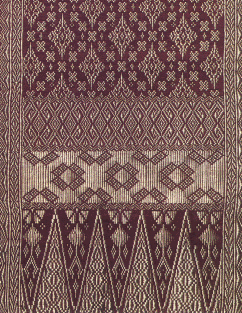
Songket or sungkit is a tenun fabric that belongs to the brocade family of textiles of Brunei, Indonesia, and Malaysia. It is hand-woven in silk or cotton, and intricately patterned with gold or silver threads. The metallic threads stand out against the background cloth to create a shimmering effect. In the weaving process the metallic threads are inserted in between the silk or cotton weft (latitudinal) threads in a technique called supplementary weft weaving technique.
Songket is often associated with the Srivijaya Empire as the origin of the songket tradition, several types of popular Songket can not be separated from locations that were once under Srivijaya rule, one of the dominant locations which is also believed to be the capital of the Srivijaya Empire in the past, namely Palembang, which located in South Sumatra, Indonesia. Besides Palembang, several areas in Sumatra are also the best-in-class Songket producing locations, which include areas in Minangkabau or West Sumatra such as Pandai Sikek, Silungkang, Koto Gadang, and Padang. Outside of Sumatra, songket is also produced by regions such as Bali, Lombok, Sambas, Sumbawa, Makassar, Sulawesi, and other areas in Indonesia.
Due to the historical factors of the Srivijaya Empire, trade, and mixed marriages, Songket has also become popular in the Maritime Southeast Asia region, especially in countries around Indonesia such as Brunei, Malaysia, and Singapore.
Based on the analysis conducted on the statues at the Bumiayu temple, South Sumatra, it can be seen that songket has been worn by the people of South Sumatra since the 8th century CE, when Srivijaya was based in Palembang. This statue was found at the Bumiayu Temple Archaeological Site which is located on the downstream bank of Lematang River which empties into Musi River, precisely in Tanah Abang District, Penukal Abab Lematang Ilir Regency approximately 120 km to the west of Palembang City.
In Malaysia, songket was recognised as intangible national heritage by the Malaysian Ministry of Tourism, Arts, and Culture in 2012. In Indonesia, five songket traditions are recognised as Intangible Cultural Heritage by the Indonesian Ministry of Education and Culture. They are songket traditions of Palembang and Sambas, both appointed in 2013; Pandai Sikek songket of West Sumatra, appointed in 2014; songket tradition of Beratan, Bali appointed in 2018; and Silungkang songket tradition of West Sumatra, appointed in 2019. In 2021, UNESCO (United Nations Educational, Scientific and Cultural Organization) officially recognized Songket as a Masterpiece of the Oral and Intangible Heritage of Humanity from Malaysia.
The term songket derived from the Malay word of sungkit, which means "to hook". It is referred to the method of songket making; to hook and pick a group of threads, and then slip the gold and silver threads in it. Another theory suggested that it was constructed from the combination of two terms, tusuk (prick) and cukit (pick), that combined as sukit, modified further as sukit and finally songket. Some says that the word songket was derived from songka, a Palembang cap in which gold threads was first woven. The earliest confirmable written proof of this clothing in Malay texts always mentioned sungkit instead of songket, for example the Hikayat Aceh of 1620s and Hikayat Banjar of 1660s.
The Malay word menyongket means ‘to embroider with gold or silver threads’. Songket is a luxury product traditionally worn during ceremonial occasions as sarong, shoulder cloths or head ties and tanjak, a headdress songket. Songket were worn at the courts of Kingdoms in Sumatra especially the Srivijaya, as the source and the origin of Malay culture in Southeast Asia. In the early kingdom age, Songkets are also traditionally worn as an apparel by the Malay royal families in Sumatra such as the Deli Sultanate in Medan, Serdang Sultanate, Palembang Sultanate in Palembang and the recently restored royal house in Jambi and sultanates in Malay Peninsula such as Pattani, Kelantan and Terengganu. The fabric is even mandated as part of the ceremonial court dress of Bruneian royalty since the time of Omar Ali Saifuddien III. Traditionally women are the weavers of songket, however in this modern time men also are known to weave it as well.
Songket is known in many names in vernacular Indonesian languages. Other than in Sumatra and Malay peninsula, it is also commonly known as songket in Bali and Java. While it is known as songke in Manggarai, Flores, and Bima in Sumbawa. The Karo Batak of North Sumatra, call it jongkit. People in Ternate, Maluku, call it suje, while the Buginese in South Sulawesi call it subbi’ and arekare’ and the Iban Dayak in West Kalimantan and Sarawak call it pilih or pileh.
Hub AI
Songket AI simulator
(@Songket_simulator)
Songket
Songket or sungkit is a tenun fabric that belongs to the brocade family of textiles of Brunei, Indonesia, and Malaysia. It is hand-woven in silk or cotton, and intricately patterned with gold or silver threads. The metallic threads stand out against the background cloth to create a shimmering effect. In the weaving process the metallic threads are inserted in between the silk or cotton weft (latitudinal) threads in a technique called supplementary weft weaving technique.
Songket is often associated with the Srivijaya Empire as the origin of the songket tradition, several types of popular Songket can not be separated from locations that were once under Srivijaya rule, one of the dominant locations which is also believed to be the capital of the Srivijaya Empire in the past, namely Palembang, which located in South Sumatra, Indonesia. Besides Palembang, several areas in Sumatra are also the best-in-class Songket producing locations, which include areas in Minangkabau or West Sumatra such as Pandai Sikek, Silungkang, Koto Gadang, and Padang. Outside of Sumatra, songket is also produced by regions such as Bali, Lombok, Sambas, Sumbawa, Makassar, Sulawesi, and other areas in Indonesia.
Due to the historical factors of the Srivijaya Empire, trade, and mixed marriages, Songket has also become popular in the Maritime Southeast Asia region, especially in countries around Indonesia such as Brunei, Malaysia, and Singapore.
Based on the analysis conducted on the statues at the Bumiayu temple, South Sumatra, it can be seen that songket has been worn by the people of South Sumatra since the 8th century CE, when Srivijaya was based in Palembang. This statue was found at the Bumiayu Temple Archaeological Site which is located on the downstream bank of Lematang River which empties into Musi River, precisely in Tanah Abang District, Penukal Abab Lematang Ilir Regency approximately 120 km to the west of Palembang City.
In Malaysia, songket was recognised as intangible national heritage by the Malaysian Ministry of Tourism, Arts, and Culture in 2012. In Indonesia, five songket traditions are recognised as Intangible Cultural Heritage by the Indonesian Ministry of Education and Culture. They are songket traditions of Palembang and Sambas, both appointed in 2013; Pandai Sikek songket of West Sumatra, appointed in 2014; songket tradition of Beratan, Bali appointed in 2018; and Silungkang songket tradition of West Sumatra, appointed in 2019. In 2021, UNESCO (United Nations Educational, Scientific and Cultural Organization) officially recognized Songket as a Masterpiece of the Oral and Intangible Heritage of Humanity from Malaysia.
The term songket derived from the Malay word of sungkit, which means "to hook". It is referred to the method of songket making; to hook and pick a group of threads, and then slip the gold and silver threads in it. Another theory suggested that it was constructed from the combination of two terms, tusuk (prick) and cukit (pick), that combined as sukit, modified further as sukit and finally songket. Some says that the word songket was derived from songka, a Palembang cap in which gold threads was first woven. The earliest confirmable written proof of this clothing in Malay texts always mentioned sungkit instead of songket, for example the Hikayat Aceh of 1620s and Hikayat Banjar of 1660s.
The Malay word menyongket means ‘to embroider with gold or silver threads’. Songket is a luxury product traditionally worn during ceremonial occasions as sarong, shoulder cloths or head ties and tanjak, a headdress songket. Songket were worn at the courts of Kingdoms in Sumatra especially the Srivijaya, as the source and the origin of Malay culture in Southeast Asia. In the early kingdom age, Songkets are also traditionally worn as an apparel by the Malay royal families in Sumatra such as the Deli Sultanate in Medan, Serdang Sultanate, Palembang Sultanate in Palembang and the recently restored royal house in Jambi and sultanates in Malay Peninsula such as Pattani, Kelantan and Terengganu. The fabric is even mandated as part of the ceremonial court dress of Bruneian royalty since the time of Omar Ali Saifuddien III. Traditionally women are the weavers of songket, however in this modern time men also are known to weave it as well.
Songket is known in many names in vernacular Indonesian languages. Other than in Sumatra and Malay peninsula, it is also commonly known as songket in Bali and Java. While it is known as songke in Manggarai, Flores, and Bima in Sumbawa. The Karo Batak of North Sumatra, call it jongkit. People in Ternate, Maluku, call it suje, while the Buginese in South Sulawesi call it subbi’ and arekare’ and the Iban Dayak in West Kalimantan and Sarawak call it pilih or pileh.
Recent media