Hubbry Logo
Karo people (Indonesia)Karo people (Indonesia)Main
Open search
Karo people (Indonesia)
Community hub
Karo people (Indonesia)
logo
8 pages, 0 posts
0 subscribers
Be the first to start a discussion here.
Karo people (Indonesia)
from Wikipedia

The Karo (also known as Karo Batak) people are a Bataks sub-ethnic of the Tanah Karo (Karo lands) in North Sumatra, Indonesia. The Karo lands consist of Karo Regency, plus neighboring areas in Southeast Aceh Regency, Langkat Regency, Dairi Regency, Simalungun Regency, and Deli Serdang Regency.[3] In addition, the cities of Binjai and Medan, both bordered by Deli Serdang Regency, contain significant Karo populations, particularly in the Padang Bulan area of Medan. The town of Sibolangit, Deli Serdang Regency in the foothills of the road from Medan to Berastagi is also a significant Karo town.

Key Information

Karoland contains two major volcanoes, Mount Sinabung, which erupted after 400 years of dormancy on 27 August 2010[4] and Mount Sibayak. Karoland consists of the cooler highlands and the upper and lower lowlands.

The Karolands were conquered by the Dutch in 1904. In 1906, roads to the highlands were constructed, ending the isolation of the highland Karo people. The road linked Medan and the lowlands to Kabanjahe and from there to both Kutacane in Aceh and Pematangsiantar in Simalungun. The first Christian evangelism was conducted among the Karo people in 1890 by the Netherlands Missionary Society. Due to the perceived association with the colonialism of the Dutch East Indies, only a minority of the Karo converted initially and it was not until after Indonesian independence in 1945 that Christianity acquired significant support among the Karo people.[5]

In 1911, an agricultural project began at Berastagi, now the major town in Karoland, to grow European vegetables in the cooler temperatures. Berastagi is a prosperous part of Karoland near Medan, while towns further in the interior have lower incomes and limited access to healthcare.[3]

The administrative centre of Karo Regency is Kabanjahe.

Karo identity

[edit]
Traditional longhouses at a Karo village near Lake Toba, circa 1870.
A Karonese woman wears a shawl (Gatip Ampar) over her shoulders and earrings (Padung Perak), while the man is likely wearing a Julu Berjongkit or Ragi Santik as a hip covering. The photo was taken in one of the villages in Karo Regency, around 1914-1919

The Karo people speak the Karo language, a Northern Batak language, but not mutually intelligible with Southern Batak languages, in addition to Indonesian. These Karo people are divided up into clans or merga. The Karo merga are Karo-Karo, Ginting, Sembiring, Perangin-Angin, and Tarigan; these merga are then divided up into sub-clans and finally families.

In the 1200s–1500s, the Karo people established the Aru Kingdom (also spelled Haru), located in modern-day Medan City and Deli Serdang Regency. It was one of the earliest kingdoms in Sumatra.[6] The population of the Aru Kingdom adhered to native animism, Hinduism, and Islam. Islam slowly gained influence in coastal areas since the late 13th century. Despite being among the earliest Sumatran kingdoms that were exposed to Islam, the people of the Aru kingdom remained predominantly pagan, especially those who inhabited the interior regions. The successor state of the Aru Kingdom was the Sultanate of Deli, which demonstrated a mixed influence of Karo, Malay, Tamil, and Aceh.

Today, most of the Karo people are Christian, a religion brought to Sumatra in the 19th century by missionaries. However, an increasing number of people living away from the Karo Highlands have converted to Islam, with the influence of Muslim Malay from the neighboring Deli area in Medan and Javanese immigrants, thus reducing the prevalence of the customs of pig farming and cooking. Some Muslims and Christians, however, still retain their traditional animist beliefs in ghosts, spirits (perbegu), and traditional jungle medicine, despite the fact that it contradicts their other beliefs. The Gereja Batak Karo Protestan or Karo Batak Protestant Church is the largest church among the largely Christian Karo people of North Sumatra, Indonesia. This tribal congregation was established formally in 1941 as a Reformed-Calvinist church. The church has 276,000 members (as of 2006) in 398 congregations with 196 pastors.[7] It is a member of the World Communion of Reformed Churches.[8]

The Karo people traditionally lived in shared longhouses also called "rumah Siwaluh Jabu", but very few now remain (one in Desa Lingga, Karo district), and new construction is exclusively of modern designs.

The ancestors of the Karo are believed to have migrated from Taiwan (Formosa), the urheimat of the Austronesian peoples, thousands of years ago, but it is believed that some of the Karo people may have intermarried with the visiting Tamils following Rajendra Chola's Invasion of Sumatra. This intercourse influenced their religious beliefs, as well as ethnic makeup. The marga Sembiring, meaning 'black one', and many Sembiring sub-marga (Colia, Berahmana, Pandia, Meliala, Depari, Muham, Pelawi, and Tekan) are clearly of South-Indian origin, suggesting that inter-marriage between Karo and Tamil people took place.[9]

The inclusion of Karo people with other Batak subgroups, is controversial due to cultural and linguistic differences. This has led into rejection of the "Batak" label by some Karonese, and the creation of Karo Bukan Batak (KBB, lit. 'the Karonese are not Bataks') movement.[10]

Religion

[edit]
Religion of Karo people in Indonesia[11]
  1. Protestantism (57.5%)
  2. Sunni Islam (21.3%)
  3. Roman Catholic (18.7%)
  4. Buddhism (1.40%)
  5. Pemena (1.10%)
Traditional Karo priest.

Traditional beliefs

[edit]
A Karo people church affiliated with Karo Batak Protestant Church (GBKP). Kabanjahe, Karo Regency, North Sumatra.

Christianity

[edit]

The Karo were harassing Dutch interests in East Sumatra, and Jacob Theodoor Cremer, a Dutch administrator, regarded evangelism as a means to suppress this activity. The Netherlands Missionary Society answered the call, commencing activities in the Karolands in 1890, where they engaged not only in evangelism but also in ethnology and documenting the Karo culture. The missionaries attempted to construct a base in Kabanjahe in the Karo highlands but were repelled by the suspicious locals.

In retaliation, the Dutch administration waged a war to conquer the Karolands, as part of their final consolidation of power in the Indies. The Karo perceived Christianity as the 'Dutch religion', and its followers as 'dark-skinned Dutch'. In this context, the Karo church was initially unsuccessful, and by 1950 the church had only 5,000 members. In the years following Indonesian independence the perception of Christianity among the Karo as an emblem of colonialism faded, with the church itself acquiring independence, and adopting more elements of traditional Karo culture such as music (whereas previously the brass band was promoted). By 1965, the Karo church had grown to 35,000 members.[12]

After the Indonesian mass killings of 1965–66

[edit]
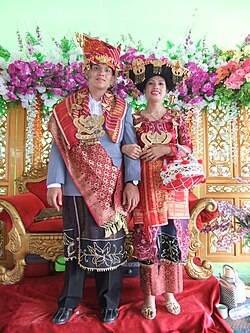
Karo married couple being bound in a sling (traditionally used in Indonesia for carrying babies), wearing traditional costumes including ulos (Karonese: uis) this action signifies this couple is now united as husband and wife.

The Karo continued to follow their traditional religion for several decades after the arrival of the first Christian missionaries in the Karolands.

Following the Indonesian killings of 1965–1966, at which time over 70% of the Karo still followed traditional religions, there was a push for Indonesians to identify with an established religion. Many Karo joined the GBKP (Batak Karo Protestant church) (60,000 were baptised in 1966–1970.[13]), and from 5,000 Muslims (mostly non-Karo) in Karoland in 1950, there were 30,000 in 1970.

At this time, the Balai Pustaka Adat Merga Si Lima (BPAMSL) was established in Berastagi. BPAMSL proclaimed the 'agama Pemena', or the religion (agama) of the founders (Pemena).

The concept of 'religion' was relatively new in the Karoland; historically the neighbouring Muslim people, were known as 'kalak Jawi' or the people of the Jawi lands, and the concept of 'kalak Kristen', or Christian people, was the first time that people were identified by their religion rather than their land. The 'agama Pemena' of BPAMSL was a defense against accusations of atheism, Communism or animism.

BPAMSL conducted a ceremony in the Lau Debuk–Debuk hot spring akin to the one to invest in a new Karo village. This ceremony essentially validated the Dutch-established Berastagi as a 'true' Karo village and was attended by the regent of Karo regency and other political figures.

At that time, BPAMSL became the largest religious organisation in the Karolands, surpassing the GBKP, and absorbing many who had joined it following the anti-Communist purge.

As a response to the Pemena movement, the GBKP after 1969 determined that members could participate in village rituals as a matter of adat (tradition), whereas previously they had been rejected by GBKP as of a religious (unchristian) nature.

After Golkar won the elections in 1972, Djamin Ginting, a leading BPAMSL figure proclaimed BPAMSL as a movement within Golkar, adopting Islam as his religion, while Indonesian National Party supporters rejected this. With BPAMSL no longer a united force for the practice of Pemena, and Pemena itself no longer a uniting force in the Karoland, and with all Indonesians required to follow one of the religions of Islam, Protestantism, Catholicism, Hinduism, Buddhism, or risk writing 'without belief' on their identity card, the board members of BPAMSL met with a wealthy Indian man from Medan and determined that the traditional religion was, in fact, an expression of Indian Hinduism and that it had been founded by a 'Bagavan Bṛgu', from which had been derived the alternate name for the Karo beliefs 'Perbegu' (followers of 'begu' (in Karo, begu is a spirit or ghost)), the existence of Indian-originating Karo marga names and similarities between Karo ritual and Indian Hindu ones all proving this. Thus the Association of Karo Hinduism (PAHK) was proclaimed.

Musical instruments and other items identified as Karo Batak, photograph (circa 1870) by Kristen Feilberg.

The PAHK declared 'Pemena is the same as Hinduism' and received funding from Medan Indians for their cause. PAHK became a movement within Parisada Hindu Dharma Indonesia, and as a culmination of this, in 1985 PAHK became a branch of the PHDI, PHDK. When Parisada Hindu Dharma Karo (PHDK) was established, it claimed 50,000 members and 50,000 more sympathisers. The PHD built a Balinese-style temple in Tanjung, a Karo village to inaugurate the PHDK. In doing so it was stated that PHDI (i.e. Balinese) Hinduism was the only valid form, and the Karo 'Hindu' ritual was invalid, the name change from 'Hindu Karo' to 'Hindu Dharma Karo' and the replacement of Tamil Indians on the PAHK board with Balinese on the PHDK symbolising the assertion of 'Hindu Dharma' as the 'valid' Hindu religion, with little regard paid to re-imagining Karo rituals within an Agama Hindu context.

There was an immediate decline in PAHK/PHDK support, with a small number of people still following the PHDK practices, but others following traditional Karo (Pemena) rituals outside of the formal context of PHDK. This left the Christian GBKP, by then for many years an indigenous Karo-run adat-respecting church a rather more comfortable option for most Karo than the Balinese Hinduism asserted by PHDK. There are today four Balinese-style PHDK temples in the Karoland, but the concept of Karo traditional beliefs as a manifestation of Hinduism is otherwise largely extinct.[14]

Modern Christianity

[edit]

Although the Gereja Batak Karo Protestan (GBKP) is the largest Karo church,[15] There are also Catholic (33,000 members as of 1986) and several Pentecostal denominations.

Merga Silima

[edit]
A Karo woman in traditional attire.

Karo people belong to one of five merga or clans, which are Ginting, Karo-Karo, Perangin-Angin, Sembiring, and Tarigan.[16] Each marga is further divided into sub-marga (83 in total). Except for marga Karo-Karo, most Karo identify themselves by their principal rather than sub-merga.

Karo and other's Batak adat prohibits marriage within a marga (e.g., Ginting with Ginting). Upon marriage, the bride becomes a part of the groom's family, with the kalimbubu (bride's family) joining with anakberu (groom's family).

Karonese marriages are very large affairs, with typically 200 attendees, comprising the family members of both marrying parties. The ritual is called Mbaba belo selambar. It includes the chewing of betel nut (sirih), traditional Karonese dancing (which focuses on hand movements), the payment of a nominal dowry to each of the kalimbubu. Food is cooked by the anakberu, who spends hours cooking to cater to the guests. This social obligation is expected to be reciprocated so that Karo people can attend several weddings each month. Non-Karo people do not attend the wedding ceremony. Where a non-Karo person wishes to marry a Karonese, they would be adopted into a Karo marga.

Traditionally kalimbubu-anakberu relationships would be reinforced by cross-cousin marriages (i.e. to one's mother's brother's child), however, in modern Karo society, this tradition is no longer important.[3]

Merga origin mythology

[edit]
Karo traditional house, 1914.

Karo tradition states that the Merga Silima originate from five villages, each established by a Sibayak, a founding community. The Sibayak Suka whose family name was Ginting Suka established Suka village. The Sibayak Lingga called Karo-karo Sinulingga established Lingga village. The Sibayak Barusjahe whose family name was Karo-karo Barus pioneered Barusjahe village. The Sibayak Sarinembah, called Sembiring Meliala established Sarinembah village. The Sibayak Kutabuluh named Perangin-angin established Kutabuluh village.[17]

Each one of these five villages has its satellite villages inhabited by the extended families of the main village inhabitants. The satellite villages were established for the convenience of the villagers whose fields were relatively far from the main villages. The purpose was to save them time when travelling back and forth from the village to their fields. Today, these satellite villages have developed and matured to be independent of the main villages. In the past, these satellite villages used to ask for help from the main villages to deal with natural disasters, tribal disputes, diseases, and famine.

The leaders of these satellite villages were called URUNGs. The Sibayak Lingga administered five villages i.e., Tiganderket, Tiga Pancur, Naman, Lingga, and Batukarang. The Sibayak Suka administered four villages i.e., Suka, Seberaya, Ajinembah, and Tengging. The Sibayak Sarinembah administered four villages i.e., Sarinembah, Perbesi, Juhar, and Kutabangun. The Sibayak Barusjahe administered two villages i.e., Barusjahe, and Sukanalu. The Sibayak of Kutabuluh administered two villages i.e., Kutabuluh and Marding-ding.

Cuisine

[edit]

Foods

[edit]
Babi Panggang Karo (BPK)
  • Babi Panggang Karo (BPK) (grilled pork with pig blood sauce)[18]
  • Gulai ikan (a fish curry)
  • Rendang cekala (meat rendang cooked with cekala)
  • Lemang-lemang (glutinous rice, coconut milk, and salt, cooked in a hollowed bamboo tube coated with banana leaves to prevent the rice from sticking to the bamboo.)
  • Lomok-lomok (traditional spicy or savoury dish made with pork or dog).
  • Arsik/tangas-tangas (a traditional goldfish/carp dish)
  • Pagit-pagit atau Terites (traditional Karo soup made from partially digested grass from a cow, mixed with other ingredients, herbs and spices)
  • Cimpa (various Karo cakes made of rice flour, coconut and palm sugar. Traditionally consumed during the Kerja Tahun [Yearly Party] festival)[19]
  • Tasak telu (a traditional Karo chicken dish which is cooked three times using different ingredients and cooking methods each time).
  • Rires (more commonly known as "Lemang", a traditional food made of glutinous rice and coconut milk)
  • Cimpa Bohan (various Karo cakes made of purple sweet potato, coconut and palm sugar. Traditionally consumed during the Kerja Tahun [Yearly Party] festival)
  • Cipera (a type of Karo soup made with Corn, chicken and other spices and left to stew in water)

Drinks

[edit]
  • Bandrek (a traditional ginger tea with other spices)

Notes

[edit]

Further reading

[edit]
[edit]
Revisions and contributorsEdit on WikipediaRead on Wikipedia
from Grokipedia
The Karo people, also known as the Karo , are an indigenous ethnic group numbering approximately 1 million, primarily inhabiting the fertile volcanic highlands of , , as one of six distinct Batak subgroups. They speak the Karo , a Northern Batak tongue within the Austronesian family, which serves as their primary means of communication alongside Indonesian. Their society is organized around patrilineal clans, notably the Merga Silima—five founding lineages (Ginting, Karo-Karo, Perangin-Angin, Sembiring, and Tua)—that dictate prohibitions, inheritance, and communal responsibilities, reflecting a emphasis on ties and (customary law). Traditionally reliant on agriculture, the Karo cultivate crops such as , vegetables, and on terraced slopes, supplemented by , in a landscape shaped by Mount Sinabung's volcanic activity. Their pre-colonial religion centered on , venerating ancestors and nature spirits through rituals like offerings and shamanic practices, but mass conversions in the early 20th century—driven by Dutch Protestant missionaries—have made the dominant faith, with minorities following Catholicism, , or syncretic traditionalism known as Pemena. This religious shift preserved core cultural elements, including iconic saddle-roofed houses adorned with buffalo horn motifs symbolizing status and protection, intricate gorga wood carvings, and communal ceremonies marking life events. Historically, the Karo maintained autonomy in their isolated plateau until colonial incursions and influences disrupted traditional practices, including reputed ritual of enemies documented in early European accounts, though such claims likely exaggerated warrior customs for . Today, they navigate modernization while safeguarding heritage through festivals, weaving traditions, and resistance to full assimilation, contributing to Indonesia's ethnic diversity amid pressures from and intermarriage.

History

Origins and Migration

The Karo people, a subgroup of the ethnic complex, are indigenous to the highlands of , , with their traditional homeland centered in what is now Karo Regency around the . Their society is fundamentally organized around five patrilineal clans—Ginting, Karo-Karo, Perangin-Angin, Sembiring, and Tarigan—which oral traditions regard as the primordial ancestors from whom all Karo descend, forming the basis of exogamous marriage rules and (customary law). Linguistic and archaeological evidence links the Karo, like other groups, to early Austronesian-speaking migrants who reached via island-hopping routes from or the , likely between 2500 BCE and 500 BCE, establishing settlements in the interior to avoid lowland and competition. These proto-Batak populations developed wet-rice and megalithic traditions in isolation, with limited external contact until Indian Ocean trade networks introduced Hindu-Buddhist elements by the 7th-14th centuries CE; the Sembiring clan's oral histories specifically claim descent from Tamil traders arriving at ports like , evidenced by retained cremation practices distinct from animist ancestor worship. Pre-colonial migrations within were minimal, confined to expansions into adjacent territories like Simalungun for or , but intensified in the amid Dutch colonial incursions and local power struggles. , including arrests and massacres targeting highland communities during the late colonial era and early period, drove significant internal displacement to coastal lowlands, such as Kuala Lama in Serdang Bedagai Regency, where migrants adapted agricultural practices while preserving clan-based identity. Post-1950s economic pressures and spurred larger-scale out-migration to cities like (approximately 20-30% of the population by the 1980s) and , often for wage labor, education, or commerce, resulting in diaspora communities that maintain ties through remittances and periodic returns.

Pre-Colonial Period

Pre-colonial Karo society in the highlands of was structured around five patrilineal clans, or mers: Ginting, Sembiring, Perangin-angin, Karo-Karo, and Tuan. These clans formed the basis of social organization, with villages (kampung) operating as autonomous units governed by councils of elders and ties rather than centralized authority. emphasized consensus among clan heads, reflecting a system where alliances and conflicts were mediated through adat customary law. The economy relied on , including terraced wet-rice cultivation (sawah) adapted to the volcanic highlands, alongside swidden farming, , and for forest products. with lowland groups exchanged highland goods like resins and spices for salt and metal tools, but the Karo maintained relative isolation, resisting incorporation into coastal sultanates such as or Deli. Housing consisted of clustered jabu dwellings, multi-generational structures built with timber and thatch, designed for extended families within compounds. Religious life revolved around Pemena (or Perbegu), an animistic tradition venerating a supreme deity (Debata Mulajadi Nabulbul) alongside spirits and entities, influenced by ancient Hindu-Buddhist contacts via trade routes. Ritual specialists known as datu conducted ceremonies for agricultural cycles, births, marriages, and funerals, using incantations, sacrifices, and to maintain harmony with the spiritual realm. These practices reinforced solidarity and territorial claims within Taneh Karo, the mythic homeland originating in pre-colonial oral traditions. Conflicts with neighboring ethnic groups occasionally involved , though the society prioritized ritual purity over expansion.

Colonial Encounters

The Dutch East Indies administration's initial encounters with the Karo people in North Sumatra's highlands occurred primarily through Christian missionary activities in the late , as the region remained largely isolated and forested until then. The launched a mission in the Karo field in 1889, focusing on proselytization among the animist Karo , but faced significant cultural and logistical barriers during its first 15 years through 1904. These efforts introduced Karo (customary law) leaders to European influences, though conversions were minimal as locals associated with foreign imposition. Military expeditions marked the escalation of colonial control, culminating in the subjugation of Karo territories in 1904 after campaigns against armed resistance from highland villages. Dutch forces, leveraging superior weaponry, overcame Karo defenses structured around fortified (traditional houses) and clan-based militias, integrating the highlands into the colonial administrative framework. Post-conquest, infrastructure development followed, including road construction to Kabanjahe and other highland centers by 1906, which facilitated troop movements, trade, and further access while eroding Karo isolation. Administrative reforms under Dutch rule from the 1890s to 1942 reshaped Karo social structures by imposing new political offices, such as appointed and demangs, which overlaid and often supplanted traditional merga silima hierarchies with a centralized loyal to Batavia. This restructuring prioritized plantation labor recruitment and tax collection, leading to economic shifts including coffee and tobacco cultivation on cleared lands, though Karo resistance persisted through sporadic revolts and evasion of labor. Missionaries continued operations, documenting Karo customs via and —such as portraits of priests and artifacts collected in the early 1900s—but Christianity's uptake remained low during the colonial era, viewed as a marker of subservience to Dutch authority.

Post-Independence Developments

Following Indonesian independence in 1945, the Karo people experienced significant socio-political upheaval during the East Sumatra , which commenced on March 3, 1946. This movement, driven by indigenous groups including the Karo , sought to dismantle the privileges of Malay sultanates and redistribute land and power to native highlanders previously marginalized under colonial . The revolution targeted the feudal structures that had subordinated Karo communities, resulting in the abolition of traditional aristocracies and the establishment of more egalitarian local , though it also led to violence and instability amid the broader struggle against returning Dutch forces. In the political sphere, Karo involvement in regional movements intensified during the 1950s. North Sumatra's military commander, Maludin Simbolon, a Karo officer, played a key role in the daerah crisis from December 1956, advocating for greater provincial self-rule against perceived centralism. This culminated in the PRRI rebellion launched in February 1958, where Karo areas in the highlands became bases for anti-government forces seeking federalism and economic reforms, though the uprising was quelled by central operations by 1961, reinforcing national unity at the cost of local grievances. Religiously, the post-independence era marked a surge in Christian affiliation among the Karo, with the Gereja Batak Karo Protestan (GBKP) expanding rapidly after local control was achieved. Prior to , conversions were limited, but urban migration and church-led community activities in cities like attracted mass affiliations, particularly as the GBKP served as a social hub for Karo migrants. This trend accelerated after the political upheaval, when mass conversions occurred to align with Indonesia's policy requiring affiliation with one of five recognized religions, enabling access to and while avoiding classification as atheists or communists. By the late , over 80% of Karo identified as Protestant. Economically, Karo society transitioned from subsistence farming to production and technological adoption, enhancing prosperity through , , and later around sites like Lake Lau Kawar. Urbanization drew many to and beyond, fostering adaptability while preserving clan-based social structures. Kabupaten Karo, formalized in the 1950s, saw infrastructure development under national programs, though growth lagged provincial averages until recent tourism booms. These changes reflected pragmatic integration into the Indonesian state, balancing tradition with modernization.

Geography and Demographics

Traditional Territories

The traditional territories of the Karo people, referred to as Taneh Karo or Karolands, are situated in the central highlands of province, , primarily within Karo Regency. These lands extend southward into Dairi Regency, eastward to parts of Deli Serdang Regency, northward into Langkat Regency, and westward toward Southeast Regency. The region spans approximately 5,000 square kilometers of mountainous terrain, characterized by elevations averaging 1,000 meters above and framed by parallel volcanic ranges. This highland plateau includes active volcanoes such as Mount Sinabung (2,460 meters) and Mount Sibayak (2,212 meters), which influence local agriculture through fertile volcanic soils supporting crops like , vegetables, and tobacco. Traditional Karo settlements cluster in villages around key locales like and Kabanjahe, with longhouses adapted to the steep slopes and seismic activity. Historical accounts describe these areas as the core of Karo identity, with clans maintaining territorial claims through () tied to ancestral lands and resource use. The northern extent of the cultural region, Taneh Karo lies about 60 kilometers south of , the provincial capital, facilitating historical trade routes while preserving relative isolation that sustained indigenous practices. Boundaries are not rigidly fixed but culturally defined, encompassing areas where Karo and clans predominate, distinct from neighboring Toba territories around to the south. Population concentrations in rural villages underscore the territories' role as agrarian heartlands, though modern regency divisions reflect administrative overlays on these traditional domains. The Karo population, concentrated primarily in , is estimated at approximately 1.23 million people based on analyses of Indonesian census data incorporating sub-ethnic classifications. This figure reflects self-reported ethnic identification from long-form surveys, where Karo are distinguished as a distinct subgroup within broader categories, though official BPS ethnic breakdowns often aggregate Batak variants, potentially understating subgroup-specific counts due to varying respondent classifications. In core traditional territories like Karo Regency, where Karo constitute about 74% of residents, the overall population grew from 283,713 in 2000 to 404,998 in 2020, representing an average annual growth rate of roughly 1.8%, driven by natural increase and limited net migration. By 2024, the regency's population reached 418,700, continuing a modest upward trajectory amid national fertility declines, with the in the area falling to 2.35 children per woman by 2020. Growth has slowed in recent decades, aligning with 's broader , where annual population increase dropped to 0.79% by 2025. Urban migration has reshaped Karo demographics, with significant outflows to nearby cities like Medan and Binjai for employment in trade, services, and industry, contributing to higher population densities in peri-urban areas and relative stagnation in rural highland villages. This pattern, evident in BPS district-level data, has led to aging populations in traditional settlements and a diaspora comprising up to 20-30% of ethnic Karo outside core regions, though remittances support rural stability without reversing overall growth. Projections indicate continued low but positive growth through 2045, tempered by education-driven fertility reductions, with average schooling length in Karo areas rising to 10.03 years by recent estimates.

Language

Linguistic Characteristics

The Karo language belongs to the Austronesian phylum, within the Malayo-Polynesian branch, and is classified as a member of the North subgroup spoken in the highlands of , . It exhibits typical Austronesian traits such as and affixation for , but shares specific innovations with other Batak varieties, including phonological mergers and lexical retentions from Proto-Malayo-Polynesian. Unlike more conservative Austronesian languages, Karo shows influences from areal contact with non-Austronesian substrates in , evident in certain sound shifts. Phonologically, Karo possesses a moderately small inventory alongside a large quality set of 7 to 14 distinct vowels, resulting in a moderately low consonant-to-vowel ratio that supports complex structures. Consonants include voiceless and voiced stops, fricatives, nasals, and , with restrictions on codas excluding voiced stops and semivowels in certain positions; vowels feature a central schwa (⟨e⟩) and high central unrounded vowel (ɯ ⟨ë⟩), alongside front and back series with mid and low variants. Suprasegmentals include word stress, distinctions, and intonation patterns that influence meaning in questions and emphasis. Morphologically, Karo is agglutinative with productive affixation across prefixes (e.g., nasal /N-/, /per-/, /ter-/ for or derivations), infixes, suffixes, and circumfixes, often combined with of monosyllabic to indicate plurality, intensity, or aspect. Verbal morphology aligns with a Western Malayo-Polynesian voice system akin to , where affixes mark actor, patient, locative, or beneficiary focus, altering valency without true passives; for instance, prefixes like /er-/ derive intransitive or middle voice forms from . Nominal derivation similarly uses affixes for possession or location, with enclitic pronouns attaching to for cross-referencing arguments. This system prioritizes root-invariant forms with affix-driven over stem changes. Syntactically, Karo displays verb-initial typology, predominantly VSO for intransitive and equational clauses, shifting to VOS in transitive constructions especially with patient-focus suffixes, reflecting a pivot system where the focused argument aligns across clauses. rigidly signals grammatical roles in complex predicates, with preverbal particles for tense-aspect-mood and postverbal adjuncts; subordinate clauses may invert to S-Pred order for embedding. Polar questions employ second-position particles, and prefixes verbs without altering basic order. These features facilitate compact clauses but constrain flexibility compared to SVO-dominant Indonesian contact varieties.

Social Organization

Clan Structure

The Karo people organize their around a patrilineal system known as merga, where affiliation is transmitted exclusively through the male line from father to son, determining identity, , and social obligations. This structure emphasizes descent from apical ancestors and fosters extensive networks, with every Karo individual belonging to one of five primary clans, termed Merga Silima: Ginting, Karo-Karo, Perangin-Angin, Sembiring, and Tarigan. Clans function as exogamous units, prohibiting marriage within the same merga to maintain alliance-building through affinal ties, a practice reinforced by and that classifies relatives across clans as brothers, sisters, or in-laws based on maternal (beru) connections to other clans. Each of the five clans includes multiple subclans or lineages (submerga), such as Guru Keyo or Singosongo under Ginting, which trace specific ancestral origins and regulate intra-clan hierarchies, land rights, and ritual leadership roles like the datu or clan elders. This clan framework underpins village (kuta) organization, where founding clans (merga taneh) hold precedence in and resource allocation, while immigrant clans integrate through alliances, ensuring no Karo is entirely unrelated due to the interlocking five-clan matrix. Disputes, such as those over or , are resolved via clan-mediated councils, prioritizing over individual claims, as documented in ethnographic studies of Karo highland communities. The system's resilience is evident in its persistence amid modernization, with clans influencing contemporary migration patterns and urban associations in cities like , where as of 2020, over 700,000 Karo maintained marga-based organizations for mutual aid.

Kinship and Social Norms

The Karo people maintain a patrilineal system structured around five exogamous , or merga, including Ginting, Karo-Karo, Perangin-Angin, Sembiring, and Tarigan, with descent and clan affiliation passed from father to children. Clan membership prohibits endogamous marriages, enforcing to forge inter-clan alliances essential for social cohesion and reciprocity. Marriage practices emphasize preferential unions with matrilateral cross-cousins, known as impal, reflecting an ideal of asymmetrical that strengthens ties between wife-giving (kalimbubu) and wife-taking (anak beru) groups, though such matches remain rare due to demographic and practical constraints. The terminology system classifies relatives based on these roles: a woman's pre-marital kin as kalimbubu to her husband's group, establishing lifelong obligations of respect, support, and exchange, while the husband's sisters' future affines become anak beru. Post-marriage, women integrate into their husband's and often adopt , transferring allegiance from natal to marital kin. Inheritance follows patrilineal principles, with property and land primarily devolving to male heirs to preserve holdings, though daughters may receive movable assets or support in practice; this system reinforces male authority within households and discourages female retention of ancestral resources. Social norms prioritize elder deference, communal decision-making in marriages via family councils, and maintenance of merga purity through avoidance of incestuous relations beyond bounds, fostering stability amid highland agrarian life. Violations of or alliance duties can lead to disputes resolved through () mediation, underscoring the causal link between adherence and community harmony.

Religion

Indigenous Beliefs

The indigenous beliefs of the Karo , known as Perbegu or Pemena, form an animistic system centered on Dibata, a supreme deity described as Dibata Kaci-kaci (Loving ), who exists in three aspects: Dibata Datas (God Above), Dibata Tengah ( Middle), and Dibata Teruh ( Below), unified as Dibata si Telu Sada (Three in One). This framework integrates monotheistic reverence for Dibata as creator with animistic veneration of begu, the spirits of ancestors and the deceased, believed to influence human affairs and require offerings for harmony. Humans possess tendi (soul), which becomes begu after death, necessitating rituals to restore or appease these entities, such as raleng tendi for soul recovery. Shamans, termed guru sibaso (typically female), lead ceremonies invoking Dibata and begu through incantations, music like gendang sarune, and offerings; examples include mesai nini to placate spirits, muncang communal dances for communal , and ndilo wari udan to summon rain for agricultural balance. Priests known as additionally perform , , and sacrificial roles in traditional rites. Key rituals like perumah begu summon ancestral spirits for counsel on disputes or decisions, while erpangir ku lau involves shaman-led cleansing with —such as at Lau Debuk-debuk hot springs—for gratitude to Dibata, illness , disaster prevention, or shaman , scaled from small kin gatherings (pangir selamsam) to grand events (pangir sintua) with animal sacrifices engaging the full sangkep nggeluh network under rakut sitelu principles. These practices historically blended with Hindu elements into a syncretic form but retain core animistic and ancestral foci, reinforcing social structures like merga silima clans. Missionary efforts beginning in 1890 introduced , mapping Dibata to the Christian God and leveraging the triadic concept for Trinitarian alignment, leading to mass conversions; nonetheless, Perbegu elements endure syncretically in customs or among residual practitioners, as Indonesian policy recognizes only major religions, marginalizing traditional faiths.

Christian Missionary Influence

Christian missionary activity among the Karo people began in 1890, initiated by the Dutch Missionary Society (Nederlandsch Zendelinggenootschap, NZG), with financial support from the Dutch Plantation Company. The effort faced significant resistance, as the Karo initially viewed missionaries as agents of Dutch colonialism, leading to slow progress in conversions from indigenous animist beliefs. The first small group of six believers formed in Buluh Awar village in 1893, and the initial church building was constructed there in 1899 under the guidance of missionary Rev. H.C. Kruyt. The Karo Batak Protestant Church (Gereja Batak Karo Protestan, GBKP) was formally established at its first in 1941, marking the institutionalization of Protestant among the Karo, though growth remained modest with only about 5,000 members by the church's 50th anniversary around that time. Conversions were frequently characterized as "by affiliation" rather than individual spiritual transformation, driven by pragmatic considerations such as access to , healthcare, and offered through mission stations, as well as political alliances amid colonial and post-colonial pressures. This approach reinforced Karo ethnic identity by integrating Christian practices with traditional structures and rituals, allowing partial retention of animist elements like within a Christian framework. Missionary influence extended beyond evangelism to social reforms, including the promotion of formal and , which gradually eroded certain traditional practices such as and ritual sacrifices, though full assimilation was incomplete due to Karo resistance to perceived foreign impositions. During the Japanese occupation from to , foreign missionaries were interned, compelling the nascent church to develop indigenous leadership, which accelerated localization and independence efforts culminating in GBKP's self-governance. By the , Christians comprised approximately 67% of the population in Kabupaten Karo, reflecting the long-term demographic impact of these missions despite initial skepticism.

1965-1966 Anti-Communist Response

The 1965-1966 anti-communist purges in , triggered by the aborted coup attempt on September 30, 1965 (G30S), extended to the Karo highlands in , where Protestant Christians formed a majority of the population. Karo communities, organized through church-affiliated youth groups and local militias, participated in identifying, arresting, and executing suspected members and sympathizers of the Indonesian Communist Party (PKI), viewing as an existential threat to their faith due to its atheistic ideology. Mass killings targeted PKI affiliates, including activists and nominal Muslims (), with violence peaking in late 1965 and early 1966; estimates for indicate thousands perished amid army-orchestrated civilian pogroms. This response aligned with broader national efforts under Major General Suharto's emerging New Order regime, which banned the PKI in March 1966 and mandated affiliation with one of Indonesia's five officially recognized monotheistic religions via Presidential Decree No. 1/1965. Among Karo, the purges accelerated conversions from the indigenous animist Pemena faith to , as Pemena practitioners—often syncretic and lacking formal recognition—faced accusations of communist leanings or , prompting pragmatic shifts for survival and social legitimacy. The Karo Protestant Church (GBKP) registered explosive growth, with membership rising 43% from 1964 to 1968 and reaching 94,085 by 1971, fueled by these coerced and opportunistic affiliations rather than solely evangelistic efforts. Fear of reprisals also spurred internal migration, with Karo families relocating to areas like Kuala Lama in Serdang Bedagai district in the late 1960s to evade ongoing purges and land disputes tied to prior PKI-influenced reforms. While the violence consolidated Christian dominance in Karo society—reinforcing ethnic identity through GBKP institutions—it entrenched taboos around leftist politics, stigmatizing survivors and Pemena remnants as potential subversives for decades.

Contemporary Religious Dynamics

The Gereja Batak Karo Protestan (GBKP), the predominant Protestant denomination among the Karo, maintains approximately 260,000 members across 884 congregations, supported by 194 pastors and additional evangelists as of the latest organizational reports. This church, formalized at its first synod in 1941, continues to expand from its origins in Dutch Calvinist missions initiated in the late , serving as the core of Karo religious life in North Sumatra's highlands. Membership figures from record 313,033 adherents organized into 27 classes, underscoring steady growth post-independence. Estimates place Christian affiliation at about 70% among the Karo population, with overwhelmingly favored over Catholicism, which claims a smaller foothold through later activities. A minority, particularly in lowland or migrant communities, adheres to , often resulting from intermarriage or economic integration into Muslim-majority areas, while Pemena—the indigenous faith emphasizing the creator Dibata—persists among a few as a registered alternative or in syncretic forms. Indonesia's constitutional mandate for one of six official religions has reinforced nominal Protestant registration for many, even as traditional animistic elements endure. Contemporary dynamics feature pronounced , where Karo Christians integrate Pemena rituals like gabe-gabe offerings and consultations into lifecycle events such as weddings and funerals, often with approval to preserve ethnic identity. This fusion prompts internal GBKP debates on doctrinal , with some leaders advocating to adapt to Karo cosmology—equating Dibata with the Christian —while others caution against diluting biblical tenets. and have spurred evangelical renewals within the church, aiming to reduce traditionalist influences, yet empirical observations confirm that such practices remain embedded in daily piety, contributing to a resilient hybrid spirituality.

Culture

Arts, Crafts, and Architecture

The traditional architecture of the Karo people centers on the Siwaluh Jabu house, a multi-room structure designed to accommodate up to eight extended families or clan segments, reflecting communal living arrangements. Constructed without nails using interlocking wooden beams, bamboo, and thatched roofs bound with ijuk fibers from palm trees, these houses are elevated on stone piles for elevation above flood-prone terrain and seismic resilience, with palm felt layers absorbing shocks as demonstrated in a 6-Richter-scale earthquake. Roofs feature steep, sloping designs often topped with symbolic buffalo horn motifs, while facades bear gorga carvings or paintings in five colors—red, white, black, yellow, and blue—symbolizing the five Karo sub-tribes and enforcing marriage taboos, such as blue for the Ginting clan. Villages like Peceren and Dokan exemplify clustered layouts of these pile dwellings, built from local hardwoods now scarce due to 20th-century , integrating cosmological motifs that align human spaces with spiritual and natural orders. Auxiliary structures include jambur pavilions for gatherings under extended house roofs, separate rice barns, ancestral bone repositories in areas like Barusjahe, and dormitories for unmarried males over 17, underscoring gendered social divisions. Preservation faces challenges from , skill loss among youth migrating to cities, and replacement with modern single-family homes lacking traditional craftsmanship. In crafts, Karo women produce ikat-woven textiles known as ulos, using alternating colored sections without representational motifs, primarily for ceremonial shrouds, blankets, and status symbols, though production has declined sharply since the mid-20th century due to synthetic alternatives and generational gaps. Carvings adorn house pillars and objects like swords (piso) and baskets, featuring abstract gorga patterns of , geometrics, and protective symbols derived from animist beliefs, executed in wood or buffalo horn with precise minutiae. Other artifacts include containers and books, as seen in ethnographic collections. Performing arts encompass music and integral to rituals and entertainment. The gendang lima sedalanen ensemble, comprising five drums of varying sizes, accompanies ceremonies like erpangir kulau (first rice harvest), invoking ancestral spirits through rhythmic patterns. Guro-guro aron features choral singing with for communal festivities, while piso surit involves warriors mimicking sword fights to gondang percussion, kecapi zithers, and gongs, preserving martial traditions. These forms, rooted in pre-Christian , persist in Christianized contexts but face erosion from modernization.

Culinary Traditions

The culinary traditions of the Karo people of , , center on as the primary staple, paired with locally grown vegetables, , and , reflecting their highland agricultural economy. Dishes emphasize , slow cooking, and the distinctive spice andaliman (), a wild peppercorn harvested from forest edges that provides a citrusy, numbing flavor essential to cuisines including Karo preparations. features prominently in savory mains, enabled by the Karo majority's Protestant faith, which permits its consumption without the prohibitions of restrictions observed by Muslim . Babi Panggang Karo (BPK) exemplifies this tradition: is marinated in , ginger, , and andaliman, then slow-roasted over an open fire to achieve crispy skin and smoky tenderness, accompanied by a of andaliman and bird's eye chilies. This dish, dating to pre-colonial practices, remains a festive staple at weddings and gatherings, symbolizing abundance. Similarly, arsik ikan mas involves stuffing with andaliman, , lemongrass, and torch ginger flower, then simmering the fish in banana stems with minimal water to produce a tangy, aromatic curry-like ; this method preserves nutrients and is reserved for rituals and holidays. Unique among Karo specialties is terites (also pagit-pagit), a derived from —semi-digested contents—boiled with 29 species of wild and cultivated from 17 families, including bitter leaves like and . Documented in a 2018 ethnobiological survey across six Karo villages, terites aids through content and vitamins, embodying ancestral knowledge of resources for medicinal purposes rather than daily fare. Complementary vegetable medleys like tasak telu combine seasonal produce such as long beans, , and in three preparations: broth, sour , and stir-fry, often incorporating grated coconut for creaminess. These foods extend beyond sustenance to reinforce social bonds, as sharing meals during ceremonies fosters and , a core observed in ethnographic accounts of Karo highland life. Preparations like ciplera, a thickened with corn , further highlight corn's role in thickening sauces, drawing from the Karo's cultivation introduced via colonial-era agriculture but integrated into pre-existing rituals. Sweet elements, such as cimpa unung-unung—glutinous rice and steamed in leaves—balance savory profiles and serve as snacks or offerings.

Rituals and Social Customs

Karo marriage rituals commence with the groom's family offering —betel leaves, , and related items—to the bride's family to request permission for the union, symbolizing respect and initial agreement. This step is followed by negotiations over a modest , known as batang unjuken, which the groom provides to the bride's kin, reflecting the in validating alliances rather than economic transaction. Ceremonies often blend rites with indigenous elements, including the singing of pemasu-masun songs that invoke ancestral blessings and the exchange of ulos woven cloths as symbols of unity and fertility. These practices reinforce exogamous ties, prohibiting within the same marga (patrilineal ) to maintain social harmony and . Funerary customs, particularly the cawir metua ceremony for deceased elders with married descendants, prioritize communal commemoration over prolonged grief, involving feasts, speeches, and rituals to honor the deceased's contributions and integrate their spirit into ancestral lineage. Performed days or weeks after burial, it features symbolic offerings like rice and traditional attire, underscoring the Karo's view of death as a transition rather than finality, though Christian influences have reduced shaman-led elements like perumah begu spirit-calling. Community participation in these events exemplifies aron, a custom of mutual aid akin to gotong royong, where kin and neighbors collaborate in preparations to strengthen bonds. Birth-related rituals focus on naming ceremonies, where infants receive names derived from kinship terms, natural events, or desired traits, often decided by elders to invoke protection and continuity. These occur shortly after birth, accompanied by simple gatherings for blessings, integrating Christian baptism while preserving cultural semantics that link the child to clan heritage. Social norms emphasize hierarchical respect for elders and collective labor in rituals, as seen in the merdang mardeng annual work tradition, where communities unite for farming or building under customary guidelines to ensure prosperity. Violations of norms, such as intra-clan unions, traditionally incur fines or ostracism to uphold alliance systems central to Karo identity.

Economy

Agricultural Foundations

The Karo people, inhabiting the highlands of North Sumatra's Karo Regency, have historically centered their economy on agriculture, which provides both subsistence needs and opportunities for cash income. Predominantly smallholder farmers, they cultivate a mix of staple crops and vegetables using traditional methods adapted to the region's steep terrain and volcanic soils, with rice serving as the foundational crop grown in both irrigated wet fields (sawah) along stream-fed valleys and rain-dependent dry fields (ladang) on slopes. Water buffalo are employed for plowing, while manual tools like hoes and sickles predominate, reflecting labor-intensive practices that sustain household food security. Land tenure operates through patrilineal , where fathers divide agricultural holdings equally among sons, fostering family-based production units but also generating resource competition among siblings that shapes farming strategies and household dynamics. labor , embodied in groups such as aron—kin-based work teams—facilitates collective efforts during planting, weeding, and harvesting, ensuring efficient use of limited in this plateau environment. This system underscores agriculture's role not only as an economic pillar but as a social institution reinforcing kinship ties. Key crops beyond include highland vegetables like , tomatoes, chilies, and corn, which support local markets and dietary diversity, with corn processed via traditional techniques such as nuan-nuan to yield foodstuffs integral to rituals and daily meals. , introduced as a during the colonial era, has augmented these foundations by enabling export-oriented production, though it coexists with subsistence priorities; yields vary with altitude, but the crop's integration has diversified income without displacing rice-centric traditions. Rituals honoring spirits, such as those for Beru Dayang, further embed agricultural cycles in cultural practices, linking productivity to spiritual beliefs in bountiful harvests.

Modern Adaptations and Challenges

The Karo economy has undergone adaptations toward commercial agriculture, with a majority of households engaging in cash crop production such as vegetables in the Berastagi highlands, coffee, and cocoa, alongside traditional subsistence farming of rice and maize; this shift integrates local production into broader markets, yielding approximately three-quarters of income from agricultural sales and small-scale trade. Tourism has further diversified economic activities, particularly in Berastagi and surrounding cultural sites like Tahura, where community-based initiatives leverage natural and ethnic heritage to generate revenue, employment, and regional original income through visitor attractions and hospitality. Persistent challenges include land fragmentation from patrilineal practices, where fields are divided equally among sons, leading to smaller holdings, heightened , and reduced productivity in densely populated rural areas. Recurrent volcanic eruptions of Mount Sinabung, beginning in 2010 and intensifying in 2013–2014, have inflicted substantial damage, destroying 1,221.91 hectares of crops (primarily dryland at 62.80% and at 20.58%), comprising 59% of total sectoral losses in affected zones, while causing labor shortages, farm credit disruptions, and income declines with benefit-cost ratios dropping below viability thresholds. Ongoing ashfall continues to impair and product quality, exacerbating market access issues and necessitating socio-economic recovery models focused on rehabilitation and diversification. Youth migration for and urban opportunities has compounded rural labor deficits, straining traditional farming systems amid these pressures.

Ethnic Identity

Core Identity Markers

The Karo people, also referred to as Karo Batak, constitute an indigenous ethnic group primarily inhabiting the highlands of Tanah Karo in , . Their core identity is anchored in the Karo language (Bahasa Karo), an Austronesian tongue that serves not merely as a communication tool but as a vital emblem of and ethnic distinction from neighboring subgroups. This language preserves unique vocabulary and phonetic traits, reinforcing communal bonds through oral traditions, , and rituals. Social organization forms another foundational marker, structured around a patrilineal system known as merga, comprising five primary lineages that dictate , marriage prohibitions, inheritance, and social obligations. across clans is strictly enforced to maintain alliances and prevent , with the merga silima—encompassing groups such as Ginting, Karo-Karo, Perangin-Angin, Sembiring, and Tarigan—serving as the bedrock of and . This system underscores a hierarchical yet interdependent , where individual status derives from clan affiliation and ancestral lineage. Traditionally, Karo spiritual life revolved around animism and ancestor veneration under the syncretic framework of Karo Pemena, which integrated elements of Hinduism with indigenous beliefs in spirits (begu) and life essence (tendi). Priests (dukun or datu) mediated these practices through rituals invoking natural forces and forebears for prosperity and protection. Although colonial-era missions and state policies spurred widespread conversion, with Protestantism now predominant among approximately 80-90% of the population, vestiges of Pemena persist in syncretic customs, highlighting a resilient pre-Christian cosmology that continues to inform ethnic self-perception amid religious pluralism.

Debates on Batak Affiliation

The term "Batak" emerged as an exonym applied by outsiders, including Arab traders and European colonizers in the 19th century, to encompass diverse highland groups in North Sumatra, including the Karo, Toba, Simalungun, Pakpak-Dairi, and Angkola-Mandailing. This categorization facilitated administrative and missionary efforts but overlooked internal distinctions, such as the Karo's emphasis on their territorial identity as inhabitants of Taneh Karo (Karo lands) rather than shared genealogical myths prevalent among Toba Batak. Linguistically, Karo belongs to the North Batak subgroup of Austronesian languages, sharing phonological and lexical features with Toba Batak, yet exhibiting distinct grammar and vocabulary that reflect separate evolutionary paths. Cultural parallels exist in the patrilineal merga () system, with Karo organized into five primary merga silima (Karo-Karo, Perangin-Angin, Ginting, Tarigan, Sembiring), analogous to Toba marga, facilitating exogamous alliances and . However, Karo practices prioritize (impal) and merit-based over the Toba's stricter descent rules, and their pre-colonial centered on unique rituals invoking Debata (supreme deity) without the Toba's extensive pustaha (bark-book) traditions. These differences, compounded by Karo's historical migrations from Pakpak regions and influences like Tamil-derived Sembiring clans from medieval trade hubs such as Kota Cina (11th-14th centuries), underpin arguments for Karo autonomy from the rubric. In contemporary discourse, debates intensify over self-identification, with many Karo viewing "Batak" as Toba-centric and politically dominated by Toba organizations, prompting assertions of distinct to preserve cultural specificity. This sentiment manifests in preferences for "Karo" over "Karo ," particularly amid migrations and , where ties reinforce identity amid assimilation pressures; for instance, the Karo Protestant Church (GBKP), established in 1941, initially adopted "Batak Karo" nomenclature under missionary influence but now symbolizes independent religious expression. Vocal minorities advocate movements rejecting the Batak label outright, citing historical ethnicization as an imposed construct that dilutes Karo uniqueness, though such positions remain contested and often labeled separatist by Batak unity proponents. Empirical data from ethnographic studies affirm shared proto-Batak via archaeological and linguistic evidence, yet causal factors like geographic isolation and adaptive customs sustain Karo claims to differentiation, prioritizing empirical self-perception over external classifications.

Migration Patterns

Internal Relocation

The Karo people, primarily inhabiting the highlands of Karo Regency in , have engaged in internal relocation within driven by conflict, economic opportunities, and natural disasters. Historical migrations from inland highland areas to coastal lowlands, such as Kuala Lama village in Serdang Bedagai Regency, were precipitated by political conflicts including arrests and massacres targeting highland communities during the colonial and early independence eras. These movements, often voluntary but compelled by insecurity, allowed Karo groups to establish settlements while preserving core ethnic practices amid Malay-influenced coastal societies. Economic factors have fueled significant rural-to-urban internal migration, particularly to , the capital of , where Karo populations form a notable portion of the Batak diaspora. By the late 19th and early 20th centuries, Karo and other Batak subgroups began settling in for trade and labor opportunities tied to plantation economies, contributing to the city's ethnic pluralism. Today, Karo communities predominate in sub-districts like Medan Tuntungan and Medan Baru, adapting traditional social structures to urban multiculturalism while facing language shifts from Karo to Indonesian due to bilingualism and economic integration. This urbanization pattern reflects broader trends in , where cultural proximity influences destination choices, with Karo favoring North Sumatran hubs over distant provinces. Natural disasters have prompted government-orchestrated relocations within Karo territories. Recurrent eruptions of Mount Sinabung since 2010 have displaced thousands, leading to phased resettlement programs; for instance, phase III relocation in Mardinding Village, Karo Regency, involved policy administration to move victims from hazard zones to safer sites, addressing immediate shelter and livelihood needs. Following the 2018 eruption, dual evacuation schemes—government-led and community-initiated—facilitated internal shifts, preserving cultural continuity through efforts to maintain (customary law) in new settlements despite challenges in land allocation and infrastructure. These relocations, while stabilizing populations, have strained ethnic identity as highland traditions adapt to altered landscapes.

Diaspora Communities

Karo diaspora communities outside Indonesia remain limited and largely undocumented, with population estimates placing the entire ethnic group at approximately 1,019,000 individuals residing solely within the country. Unlike other Indonesian ethnic groups with established overseas networks, such as Javanese or Minangkabau communities in the Netherlands or Malaysia, Karo migration patterns emphasize internal relocation to urban centers like Medan and Jakarta rather than international emigration. Individual Karo migrants may participate in broader Indonesian labor flows to neighboring countries, including and , where temporary workers from engage in construction, agriculture, and services; however, these do not coalesce into distinct Karo-specific associations or cultural enclaves. Historical colonial ties to the facilitated some Sumatran migration post-independence, but Karo participation appears negligible compared to Toba or other subgroups, with no evidence of formalized groups preserving marga-based structures abroad. In major global cities with Indonesian expatriates, such as those in the United States or , isolated Karo families exist through education or professional opportunities, yet they integrate into general Indonesian or Protestant networks rather than maintaining autonomous ethnic identities. Religious affiliations, predominantly Protestant via the Gereja Batak Karo Protestan, provide loose transnational ties through church activities, but these prioritize spiritual rather than cultural preservation. The absence of prominent Karo organizations akin to Himpunan Masyarakat Karo Indonesia abroad underscores a cultural orientation toward homeland repatriation and endogamous marga alliances.

References

Add your contribution
Related Hubs
User Avatar
No comments yet.