


Community hub
Recent from talks
Contribute something to knowledge base
Content stats: 0 posts, 0 articles, 1 media, 0 notes
Members stats: 0 subscribers, 0 contributors, 0 moderators, 0 supporters
Subscribers
Supporters
Contributors
Moderators
Hub AI
Crown Jewels of the United Kingdom AI simulator
(@Crown Jewels of the United Kingdom_simulator)
Hub AI
Crown Jewels of the United Kingdom AI simulator
(@Crown Jewels of the United Kingdom_simulator)
Crown Jewels of the United Kingdom
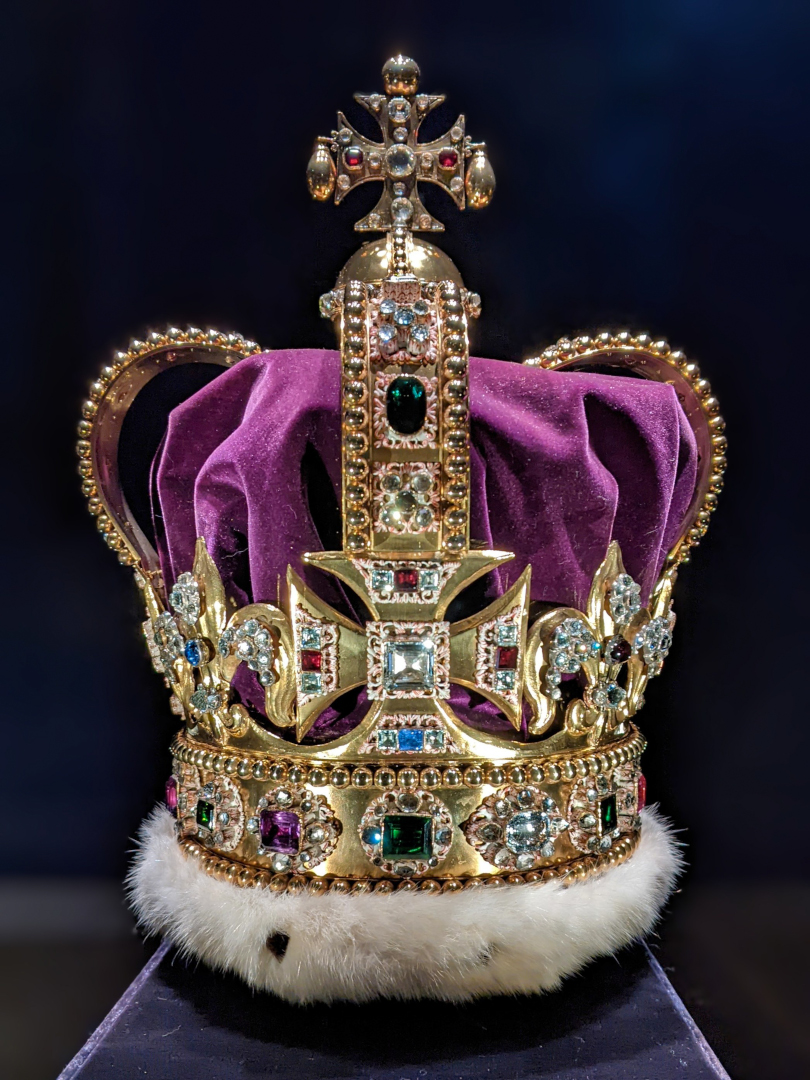
The Crown Jewels of the United Kingdom, originally the Crown Jewels of England, are a collection of royal ceremonial objects kept in the Jewel House at the Tower of London, which include the coronation regalia and vestments worn by British monarchs.
The coronation regalia are the only working set in Europe and the collection is the most historically complete of any royal regalia in the world. Objects used at the coronation ceremony variously denote the monarch's roles as head of state of the United Kingdom, Supreme Governor of the Church of England, and head of the British armed forces. The regalia feature heraldic devices and national emblems of England, Scotland, Wales, Northern Ireland, and other Commonwealth countries.
Use of regalia by monarchs in England can be traced back to when the country was converted to Christianity in the Early Middle Ages. A permanent set of coronation regalia, once belonging to Edward the Confessor, was established after he was made a saint in the 12th century. The sacred holy relics were kept at Westminster Abbey, venue of coronations since 1066, while monarchs wore another set of regalia at religious feasts and State Openings of Parliament. Collectively, these objects came to be known as the Jewels of the Crown. Most of the collection dates from around 1660 when Charles II ascended the throne. The medieval and Tudor regalia had either been sold or melted down after the monarchy was abolished in 1649 during the English Civil War. Only four original items predate the Restoration: a late 12th-century anointing spoon (the oldest object) and three early 17th-century swords. The regalia continued to be used by British monarchs after the kingdoms of England and Scotland united in 1707.
The regalia contain around 23,578 gemstones, among them Cullinan I (530 carats (106 g)), the largest clear cut diamond in the world, set in the Sovereign's Sceptre with Cross. It was cut from the largest gem-quality rough diamond ever found, the eponymous Cullinan, discovered in South Africa in 1905 and presented to Edward VII. In the Imperial State Crown are Cullinan II (317 carats (63 g)), the Stuart Sapphire, St Edward's Sapphire, and the Black Prince's Ruby – a large red spinel. The Koh-i-Noor diamond (105 carats (21 g)) was acquired by Queen Victoria from the Sikh Empire and has featured on three consort crowns. A small number of disused objects at the Tower are either empty or set with glass and crystal replicas.
At a coronation, the monarch is anointed using holy oil poured from an ampulla into the spoon, invested with robes and ornaments, and crowned with St Edward's Crown. Afterwards, it is exchanged for the lighter Imperial State Crown, which is also usually worn at State Openings of Parliament. Wives of kings, known as queens consort, are invested with a plainer set of regalia. Also regarded as crown jewels are state swords, trumpets, ceremonial maces, church plate, historical regalia, banqueting plate, and royal christening fonts. They are part of the Royal Collection and belong to the institution of monarchy, passing from one sovereign to the next. In the Jewel House they are seen by 2.5 million visitors every year.
The earliest known use of a crown in Britain was discovered by archaeologists in 1988 in Deal, Kent, and dates to between 200 and 150 BC. A sword, brooch, ceremonial shield, and decorated bronze crown with a single arch, which sat directly on the head of its wearer, were found inside the tomb of the Deal Warrior. At this point, crowns were symbols of authority worn by religious and military leaders. Priests continued to use crowns following the Roman conquest of Britain in 43 AD. A dig in a field at Hockwold cum Wilton, Norfolk, in the 1950s revealed a bronze crown with two arches and depictions of male faces, as well as two bronze diadems with an adjustable headband and repoussé silver embellishments, dating from the Roman period. One diadem features a plaque in the centre depicting a man holding a sphere and an object similar to a shepherd's crook, analogues of the orb and sceptre that evolved later as royal ornaments.
By the early 5th century, the Romans had withdrawn from Britain, and the Angles and the Saxons settled. A heptarchy of new kingdoms began to emerge. One method used by regional kings to solidify their authority was the use of ceremony and insignia. The tomb of an unknown king – evidence suggests Rædwald of East Anglia (r. circa 599 – 624) – at Sutton Hoo illustrates the regalia of a pre-Christian Anglo-Saxon monarch. Inside the early 7th-century tomb, discovered in 1939, was found the ornate Sutton Hoo helmet, consisting of an iron cap, a neck guard, and a face mask decorated with copper alloy images of animals and warriors set with garnets. He was also buried with a decorated sword; a ceremonial shield; and a heavy whetstone sceptre, on top of which is an iron ring surmounted by the figure of a stag.
In 597 CE, a Benedictine monk was sent by Pope Gregory I to start converting Pagan England to Christianity. The monk, Augustine, became the first archbishop of Canterbury. Within two centuries, the ritual of anointing monarchs with holy oil and crowning them (initially with helmets) in a Christian ceremony had been established, and regalia took on a religious identity. There was still no permanent set of coronation regalia; each monarch generally had a new set made, with which they were buried upon death. In 9th-century Europe, gold crowns in the Byzantine tradition were replacing bronze, and gold soon became the standard material for English royal crowns.
Crown Jewels of the United Kingdom
The Crown Jewels of the United Kingdom, originally the Crown Jewels of England, are a collection of royal ceremonial objects kept in the Jewel House at the Tower of London, which include the coronation regalia and vestments worn by British monarchs.
The coronation regalia are the only working set in Europe and the collection is the most historically complete of any royal regalia in the world. Objects used at the coronation ceremony variously denote the monarch's roles as head of state of the United Kingdom, Supreme Governor of the Church of England, and head of the British armed forces. The regalia feature heraldic devices and national emblems of England, Scotland, Wales, Northern Ireland, and other Commonwealth countries.
Use of regalia by monarchs in England can be traced back to when the country was converted to Christianity in the Early Middle Ages. A permanent set of coronation regalia, once belonging to Edward the Confessor, was established after he was made a saint in the 12th century. The sacred holy relics were kept at Westminster Abbey, venue of coronations since 1066, while monarchs wore another set of regalia at religious feasts and State Openings of Parliament. Collectively, these objects came to be known as the Jewels of the Crown. Most of the collection dates from around 1660 when Charles II ascended the throne. The medieval and Tudor regalia had either been sold or melted down after the monarchy was abolished in 1649 during the English Civil War. Only four original items predate the Restoration: a late 12th-century anointing spoon (the oldest object) and three early 17th-century swords. The regalia continued to be used by British monarchs after the kingdoms of England and Scotland united in 1707.
The regalia contain around 23,578 gemstones, among them Cullinan I (530 carats (106 g)), the largest clear cut diamond in the world, set in the Sovereign's Sceptre with Cross. It was cut from the largest gem-quality rough diamond ever found, the eponymous Cullinan, discovered in South Africa in 1905 and presented to Edward VII. In the Imperial State Crown are Cullinan II (317 carats (63 g)), the Stuart Sapphire, St Edward's Sapphire, and the Black Prince's Ruby – a large red spinel. The Koh-i-Noor diamond (105 carats (21 g)) was acquired by Queen Victoria from the Sikh Empire and has featured on three consort crowns. A small number of disused objects at the Tower are either empty or set with glass and crystal replicas.
At a coronation, the monarch is anointed using holy oil poured from an ampulla into the spoon, invested with robes and ornaments, and crowned with St Edward's Crown. Afterwards, it is exchanged for the lighter Imperial State Crown, which is also usually worn at State Openings of Parliament. Wives of kings, known as queens consort, are invested with a plainer set of regalia. Also regarded as crown jewels are state swords, trumpets, ceremonial maces, church plate, historical regalia, banqueting plate, and royal christening fonts. They are part of the Royal Collection and belong to the institution of monarchy, passing from one sovereign to the next. In the Jewel House they are seen by 2.5 million visitors every year.
The earliest known use of a crown in Britain was discovered by archaeologists in 1988 in Deal, Kent, and dates to between 200 and 150 BC. A sword, brooch, ceremonial shield, and decorated bronze crown with a single arch, which sat directly on the head of its wearer, were found inside the tomb of the Deal Warrior. At this point, crowns were symbols of authority worn by religious and military leaders. Priests continued to use crowns following the Roman conquest of Britain in 43 AD. A dig in a field at Hockwold cum Wilton, Norfolk, in the 1950s revealed a bronze crown with two arches and depictions of male faces, as well as two bronze diadems with an adjustable headband and repoussé silver embellishments, dating from the Roman period. One diadem features a plaque in the centre depicting a man holding a sphere and an object similar to a shepherd's crook, analogues of the orb and sceptre that evolved later as royal ornaments.
By the early 5th century, the Romans had withdrawn from Britain, and the Angles and the Saxons settled. A heptarchy of new kingdoms began to emerge. One method used by regional kings to solidify their authority was the use of ceremony and insignia. The tomb of an unknown king – evidence suggests Rædwald of East Anglia (r. circa 599 – 624) – at Sutton Hoo illustrates the regalia of a pre-Christian Anglo-Saxon monarch. Inside the early 7th-century tomb, discovered in 1939, was found the ornate Sutton Hoo helmet, consisting of an iron cap, a neck guard, and a face mask decorated with copper alloy images of animals and warriors set with garnets. He was also buried with a decorated sword; a ceremonial shield; and a heavy whetstone sceptre, on top of which is an iron ring surmounted by the figure of a stag.
In 597 CE, a Benedictine monk was sent by Pope Gregory I to start converting Pagan England to Christianity. The monk, Augustine, became the first archbishop of Canterbury. Within two centuries, the ritual of anointing monarchs with holy oil and crowning them (initially with helmets) in a Christian ceremony had been established, and regalia took on a religious identity. There was still no permanent set of coronation regalia; each monarch generally had a new set made, with which they were buried upon death. In 9th-century Europe, gold crowns in the Byzantine tradition were replacing bronze, and gold soon became the standard material for English royal crowns.
Recent media
Recent media